The Job Market for Fresh Graduates 2026 is increasingly focused on employability rather than qualifications alone.
A useful way to think about it is:
Degree + practical skills + evidence of ability = stronger entry-level job profile
Employers still need young professionals, but many entry-level roles are evolving.
Companies may expect graduates to use digital tools, work with AI-assisted systems, communicate clearly and solve problems with less training than in the past.
For students searching for Entry Level Jobs for Freshers in India, this means the job search should begin before graduation whenever possible.
Internships, academic projects, certifications, portfolios and real-world practice can help demonstrate what a candidate can actually do.
The rest of this article looks at what is driving the hiring pressure, where opportunities are still emerging, and what fresh graduates can do to become more competitive in the 2026 job market.
The key message is simple: a degree still matters, but employers increasingly want proof that a graduate can apply what they have learned.
What Is Happening to Entry Level Jobs in 2026?
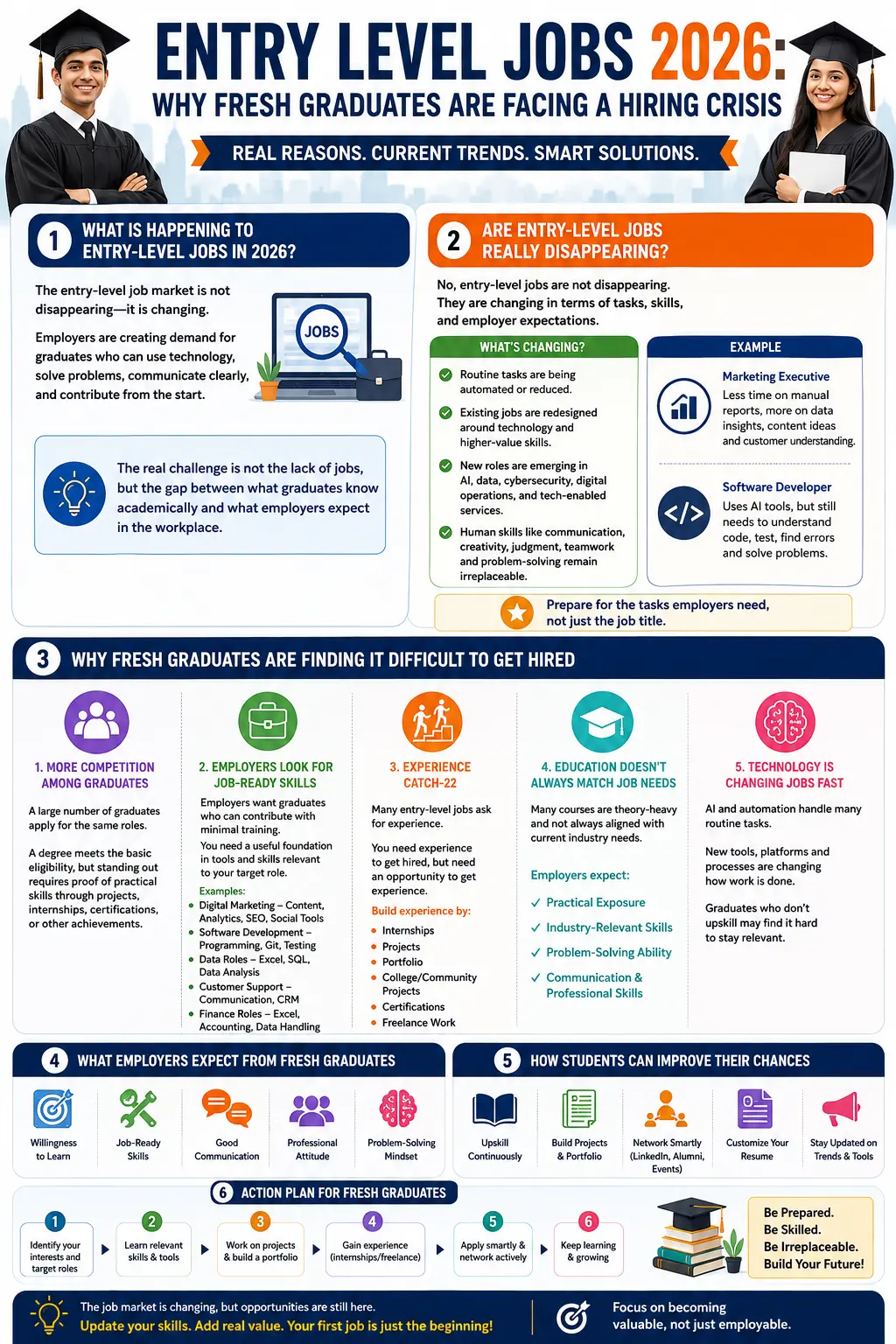
The entry-level job market in 2026 is not simply disappearing—it is changing. Some routine junior roles are being reduced, automated, or redesigned, while employers are creating demand for graduates who can use technology, solve problems, communicate clearly, and contribute from the start.
For students and recent graduates, this means the biggest challenge is often not the complete lack of jobs.
It is the gap between what graduates know academically and what employers expect them to do in a workplace.
Are Entry Level Jobs Really Disappearing?
No, entry-level jobs are not disappearing completely. They are changing in terms of tasks, skills, and employer expectations.
A traditional entry-level position may once have involved repetitive data entry, basic reporting, routine customer support, simple research, or administrative work.
Software and artificial intelligence (AI) can now handle parts of many such tasks faster than before.
That does not necessarily mean the entire occupation disappears. In many cases, the job is redesigned.
For example, a junior marketing employee may spend less time preparing basic reports manually and more time interpreting campaign data, creating content ideas, checking AI-generated material, or working with customers.
Similarly, a junior software professional may use AI coding tools but still need to understand programming, test outputs, identify errors, and solve problems.
This creates two parallel trends:
- Some routine tasks are being automated or reduced.
- Existing jobs are being redesigned around technology and higher-value skills.
- New roles are emerging around AI, data, cybersecurity, digital operations, and technology-enabled services.
- Human skills such as communication, judgment, creativity, teamwork, and problem-solving remain valuable.
- For fresh graduates, the practical lesson is clear: do not prepare only for a job title; prepare for the tasks employers need someone to perform.
A graduate searching for “entry-level jobs” should therefore look beyond traditional job descriptions.
A role that requires basic digital skills, AI-tool familiarity, data interpretation, customer handling, or business communication may offer a stronger starting point than a position based almost entirely on repetitive work.
Why Fresh Graduates Are Finding It Difficult to Get Hired
The difficulty faced by freshers in India is influenced by several factors working together. There is no single explanation for why some graduates struggle to secure their first job.
1. More Competition Among Graduates
Every year, a large number of students complete degrees, diplomas, and professional courses.
This gives employers a wider pool of candidates for many junior positions.
A degree can help a candidate meet the basic eligibility requirement, but it may not be enough to stand out when hundreds of applicants have similar educational qualifications.
For Entry Level Jobs 2026, candidates increasingly need to show what they can actually do through projects, internships, portfolios, certifications, competitions, or other evidence of practical ability.
2. Employers Are Looking for Job-Ready Skills
Many employers want graduates who can become productive with limited training.
This does not mean a fresher must know everything before joining a company. It means candidates should have a useful foundation in the tools and skills relevant to their target role.
For example:
| Target role | Useful job-ready skills |
|---|---|
| Digital marketing | Content creation, analytics, SEO basics, social media tools |
| Software development | Programming fundamentals, Git, testing, project work |
| Data-related roles | Excel, SQL, data analysis, visualization |
| Customer support | Communication, CRM tools, problem-solving |
| Finance roles | Excel, financial basics, accounting software, data handling |
The exact requirements vary by employer, so students should read several current job descriptions for their chosen field before deciding which skills to learn.
3. Experience Requirements Create a Catch-22
One of the most frustrating issues for fresh graduates is seeing “experience required” on jobs advertised as junior or entry-level positions.
Employers may prefer candidates who have already completed internships, projects, apprenticeships, freelance assignments, campus work, or other practical training.
This can create a difficult situation: students need experience to get hired, but they need an opportunity to gain experience.
Students can reduce this gap by building evidence of practical work before graduation.
Examples include:
- Completing an internship
- Building two or three relevant projects
- Creating a portfolio
- Contributing to college or community projects
- Taking part in industry competitions
- Completing practical assignments using real tools
- Gaining relevant certifications where they add value
A project does not replace professional experience, but it can give an employer something concrete to evaluate.
4. AI and Automation Are Changing Junior-Level Work
Artificial intelligence is affecting many workplaces, particularly tasks that are repetitive, predictable, or heavily dependent on processing information.
For fresh graduates, this can be significant because some junior positions traditionally contained a large share of routine tasks.
However, AI does not mean that every job will be replaced.
The more realistic change is that the tasks inside many jobs are being redistributed between people and technology.
Employers may therefore expect graduates to understand how to use AI tools responsibly while also checking their accuracy and applying human judgment.
This makes AI literacy one of the useful additions to a graduate’s skill set in 2026—but it should complement core skills rather than replace them.
5. Economic Uncertainty Can Make Companies More Cautious
Hiring decisions are also influenced by business conditions.
When companies face uncertainty about demand, costs, investment, or future growth, they may take a more cautious approach to recruitment.
Entry-level hiring can be affected because companies may prioritize roles they consider essential or delay expanding teams until they have greater confidence in business conditions.
This can make the Job Market for Fresh Graduates 2026 feel especially competitive even when opportunities continue to exist.
What Does This Mean for Freshers?
The changing market does not mean graduates should panic. It means they should approach their first job search differently.
A stronger strategy is to combine education + practical skills + evidence of work + adaptability.
Instead of asking only, “Which company will hire me?”, a fresher should also ask:
- What entry-level roles match my degree and interests?
- Which skills appear repeatedly in current job descriptions?
- Can I demonstrate those skills through a project or portfolio?
- Which AI tools are relevant to my chosen field?
- Can I explain my practical work clearly during an interview?
The central shift in Entry Level Jobs 2026 is simple: employers are increasingly evaluating not just what a graduate has studied, but what the graduate can actually do.
For students preparing for Freshers Jobs in India 2026, building practical, role-specific skills alongside a degree can make the transition from college to employment much easier.
Why Are Companies Hiring Fewer Fresh Graduates?
Companies are becoming more selective when hiring fresh graduates because they want new employees who can contribute with less training.
A degree still matters, but employers increasingly look for a combination of education, practical skills, problem-solving ability and evidence that a candidate can do real work.
For students searching for Entry Level Jobs 2026, this means the competition is not simply about having a college degree.
Candidates who can show relevant skills through internships, projects, portfolios or practical experience can have an advantage over applicants with similar academic qualifications.
Employers Want Job-Ready Candidates
A job-ready candidate is someone who can understand workplace tasks and start contributing without needing extensive training in basic tools and processes.
Companies value practical skills because training every new employee takes time, money and managerial effort.
When two candidates have similar educational backgrounds, an employer may prefer the person who has already worked on relevant projects or knows the tools used in the role.
For example, a graduate applying for a digital marketing role may have a stronger profile if they can show:
- Experience creating a basic content calendar.
- Knowledge of Google Analytics or similar analytics tools.
- Practical SEO knowledge.
- A sample social media campaign.
- Experience using AI tools responsibly for research or content workflows.
The same principle applies across other careers.
A commerce graduate applying for an accounting position could demonstrate spreadsheet skills and familiarity with accounting software. A computer science graduate could show working projects on GitHub instead of relying only on academic marks.
Degree vs. Degree + Skills + Experience
A college degree provides an educational foundation, but employers often need evidence that a candidate can apply what they have learned.
| Candidate profile | What the employer can see |
|---|---|
| Degree only | Academic qualification |
| Degree + practical skills | Qualification plus ability to use relevant tools |
| Degree + skills + projects | Qualification, skills and proof of application |
| Degree + skills + internship | Qualification, practical work exposure and workplace experience |
This does not mean a degree has become useless. Many professions require specific educational qualifications, and academic knowledge remains important.
The change is that a degree alone may not clearly demonstrate workplace readiness.
Practical takeaway: Fresh graduates should build proof of their skills before applying. One well-made project related to the target job can be more useful than listing ten skills without showing how they were used.
AI Is Changing Entry Level Jobs
Artificial intelligence (AI) is changing the type of work performed by entry-level employees.
It can handle or speed up many repetitive tasks, which means some traditional beginner-level responsibilities are being reduced, redesigned or combined with higher-value work.
Common examples include:
- Basic content: AI can help create first drafts, summaries, headlines and routine variations.
- Data entry: AI-powered systems can extract, classify and organize information from documents.
- Customer support: AI chatbots can answer common questions before complex cases reach human agents.
- Coding assistance: AI coding tools can help generate, explain, test and debug parts of a program.
- Research: AI can help collect, summarize and organize information, although important facts still need human verification.
This does not mean AI is simply eliminating every opportunity for fresh graduates. In many workplaces, the bigger change is task transformation.
A junior employee who once spent several hours preparing a basic report may now use AI to complete the first stage quickly and spend more time checking the information, finding insights and presenting recommendations.
The skills that become valuable in such roles are therefore different.
Employers may look for people who can use AI tools, verify AI-generated information, communicate clearly, solve problems and make decisions rather than simply perform repetitive tasks.
Key idea: AI is changing entry-level jobs by automating some tasks and increasing the value of skills that require judgment, communication, creativity and human responsibility.
For students entering the Job Market for Fresh Graduates 2026, learning AI should therefore not mean learning one specific tool and stopping there.
The stronger approach is to combine AI literacy with a core career skill.
For example:
- AI + Marketing + Analytics can support a digital marketing career.
- AI + Coding + Problem Solving can support software and technology roles.
- AI + Excel + Business Analysis can support business and operations roles.
- AI + Communication + Research can support several knowledge-based entry-level positions.
The goal is not to compete with AI at repetitive tasks. It is to learn how to work effectively with AI while developing abilities that require human judgment.
The Experience Problem for Freshers
One of the biggest challenges in Entry Level Jobs for Freshers in India is the experience requirement attached to jobs described as “entry level.”
A graduate may see a vacancy advertised for beginners but still find requirements such as six months to two years of experience. This creates a difficult cycle:
No job → no experience → no experience → fewer job opportunities.
Employers often use experience requirements because they want candidates who understand workplace expectations.
However, fresh graduates can reduce this gap by gaining experience before their first full-time job.
Internships have become particularly useful for this reason. Even a short, relevant internship can expose a student to workplace communication, deadlines, teamwork, professional tools and real assignments.
Projects can also provide evidence of practical ability.
For example, instead of writing:
“I know digital marketing.”
A fresher could present:
“I created a three-month SEO content plan for a sample website, researched keywords, published sample articles and tracked basic performance metrics.”
The second statement gives an employer something concrete to evaluate.
Fresh graduates can build experience through:
- Internships with companies, startups, agencies or organizations.
- Academic projects that solve a practical problem.
- Personal projects connected to the desired career.
- Freelance assignments where appropriate.
- Open-source contributions for relevant technology roles.
- Volunteer work involving useful professional skills.
- Portfolio projects that demonstrate actual work rather than only certificates.
Certificates can support a profile, but they are stronger when paired with practical evidence.
For instance, completing a course in data analytics becomes more meaningful when the candidate can also show a small dashboard, analysis or project created using the skills learned.
For fresh graduates wondering “Why are freshers struggling to get jobs in 2026?”, the answer is not simply that companies have stopped hiring graduates.
The hiring process is changing, and employers are increasingly looking for evidence that candidates can apply their knowledge.
The most useful approach is to stop thinking of the first job as the only way to gain experience.
Internships, projects and practical work can become the bridge between college and full-time employment.
Which Entry Level Jobs Are Available for Fresh Graduates in 2026?
Yes. Entry Level Jobs 2026 are available across technology, digital marketing, finance, sales, healthcare, education, operations, government, and skilled careers.
However, many employers now expect fresh graduates to show practical skills, basic digital knowledge, and the ability to learn quickly—not just a degree.
For freshers, the best approach is to match a job with your degree, skills, interests, and willingness to learn.
An entry-level role can also be a starting point for building experience rather than a final career choice.
Technology and IT Jobs
Technology remains one of the major areas for Entry Level Jobs for Freshers in India. Graduates from computer science, information technology, engineering, mathematics, and related fields can explore several junior roles.
Common options include:
- Junior Developer: Works on basic coding, testing, debugging, and maintenance under the guidance of experienced developers. Knowledge of languages such as Python, Java, JavaScript, or SQL can help.
- IT Support: Helps users solve hardware, software, network, login, and other technical problems. Basic troubleshooting and communication skills are useful.
- Data-Related Roles: Entry-level positions such as data analyst trainee, reporting executive, or data operations associate may involve spreadsheets, databases, data cleaning, and simple analysis. Excel and SQL are useful starting skills.
- Cybersecurity Support: Junior security roles may involve monitoring alerts, maintaining security records, checking vulnerabilities, or supporting security teams. Basic networking and cybersecurity concepts are valuable.
Practical tip: A degree alone may not be enough for a technology role. Build a small portfolio with projects, GitHub work, dashboards, coding exercises, or certifications that demonstrate what you can actually do.
Digital Marketing and Content Jobs
Digital businesses need people who can create content, manage online channels, understand search, and support marketing campaigns.
This creates several opportunities for graduates from marketing, commerce, management, communications, and other backgrounds.
Popular entry-level roles include:
- SEO Executive: Helps improve website visibility through keyword research, on-page SEO, content optimization, internal linking, and basic performance analysis.
- Social Media Executive: Plans and publishes posts, monitors engagement, responds to audiences, and supports social media campaigns.
- Content Marketing: Creates or assists with blogs, website content, email content, social media posts, and other marketing materials.
- Digital Marketing Trainee: Supports activities such as SEO, social media, email marketing, paid advertising, analytics, and content creation while learning different parts of digital marketing.
For these Freshers Jobs in India 2026, practical work can make a strong difference.
A candidate can demonstrate ability by creating a sample content calendar, writing a few SEO-friendly articles, preparing a social media campaign, or analyzing a small website.
Practical tip: Learn the basics of Google Search, search engine optimization (SEO), analytics, content creation, spreadsheets, and AI-assisted productivity tools. You do not need to master everything before applying.
Finance, Sales and Business Jobs
Finance, banking, sales, and business functions continue to provide entry-level opportunities for graduates in commerce, business administration, economics, finance, and related subjects.
Some common roles are:
- Accounts Executive: Handles routine accounting tasks such as recording transactions, preparing basic reports, maintaining invoices, and supporting reconciliation.
- Knowledge of accounting software and Excel can be useful.
- Banking Operations: Supports customer documentation, account-related processes, transaction operations, data entry, and other back-office activities, depending on the employer.
- Sales Executive: Communicates with potential customers, explains products or services, follows up on leads, and works toward sales targets. Communication and negotiation skills matter.
- Business Development: Identifies potential customers or business opportunities, supports lead generation, and helps build client relationships.
These roles can suit candidates who are comfortable with numbers, communication, customer interaction, or business processes.
Practical tip: Do not apply only for jobs containing the word “finance.” If your goal is a career in this field, related entry-level roles in accounting, banking operations, financial services, customer support, or business development can also provide useful experience.
Other Career Opportunities
The Job Market for Fresh Graduates 2026 is broader than technology and corporate office jobs. Students should also consider sectors that match their education and long-term interests.
- Healthcare: Graduates and trained candidates can explore eligible roles in healthcare administration, medical coding, laboratory services, pharmacy, nursing, allied health, and hospital operations. Specific qualifications and registrations depend on the role.
- Education: Opportunities include teaching support, academic coordination, tutoring, curriculum assistance, education counselling, and learning-support roles. Eligibility varies by position and institution.
- Government Jobs: Graduates can explore recruitment conducted through bodies such as the Union Public Service Commission (UPSC), Staff Selection Commission (SSC), banking recruitment bodies, and state-level public service commissions, depending on eligibility and the specific recruitment notice. Always check the official notification for qualification, age limits, vacancies, and examination dates.
- Operations and Administration: Roles such as operations executive, office administrator, process associate, customer operations executive, and administrative assistant can provide an entry point into many industries.
- Skilled and Vocational Careers: Careers in areas such as electrical work, electronics, automotive services, healthcare support, beauty and wellness, logistics, manufacturing, and other skilled trades can offer alternatives to traditional graduate office jobs. Training through recognised vocational or skill-development programmes can be useful.
A useful rule for fresh graduates: Do not judge a job only by its starting salary or job title. Look at the skills you will gain, the quality of training, career progression, work environment, and whether the role moves you closer to your long-term career goal.
For anyone asking, “Why Are Freshers Struggling to Get Jobs in 2026?”, one practical answer is that employers often look for evidence of job-ready skills alongside educational qualifications. That makes internships, projects, apprenticeships, certifications, portfolios, and relevant practical experience valuable additions to a fresher’s resume.
What Skills Should Fresh Graduates Learn in 2026?
For Entry Level Jobs 2026, a degree alone may not be enough to stand out.
Fresh graduates should build a mix of digital skills, communication skills, and practical job-ready skills.
The right combination depends on the career you want to enter. A software developer, marketing graduate, accountant, designer, and HR professional will not need exactly the same skill set.
A useful approach is to focus on three layers:
- Digital skills to work efficiently with modern tools
- Communication and soft skills to work effectively with people
- Practical industry skills to prove that you can apply what you learned
AI and Digital Skills
AI and digital tools are becoming part of everyday work across many industries. Fresh graduates do not necessarily need to become AI engineers.
They should understand how to use relevant technology responsibly and efficiently in their chosen field.
Generative AI basics
Generative AI refers to tools that can create or transform content such as text, images, code, summaries, and ideas.
Freshers should learn the basics of:
- Writing clear prompts and giving useful context
- Checking AI-generated information before using it
- Using AI for brainstorming, summarising, research support, and drafting
- Understanding basic limitations such as inaccurate or outdated outputs
- Protecting confidential company or customer information when using AI tools
For example, a marketing graduate could use an AI tool to generate initial content ideas, then improve and fact-check the output using their own judgment.
The goal is not to replace your skills with AI. The goal is to learn how to work effectively with AI.
AI-assisted productivity
AI can also help freshers complete routine tasks more efficiently. Depending on the job, useful applications include:
- Creating first drafts of emails and documents
- Summarising lengthy information
- Organising ideas and meeting notes
- Generating spreadsheet formulas
- Creating research outlines
- Preparing presentation structures
- Automating repetitive digital tasks
However, employers still expect people to review the final work. Accuracy, judgment, and responsibility remain human skills.
Excel and data tools
Basic data skills are useful far beyond traditional accounting or finance roles.
Fresh graduates should consider learning:
- Microsoft Excel or Google Sheets
- Formulas and functions
- Sorting and filtering
- Conditional formatting
- Charts and basic dashboards
- Pivot tables
- Basic data cleaning
- Simple data interpretation
For data-focused careers, candidates can go further with tools such as SQL, Power BI, Tableau, or Python, depending on the role.
The best choice is to learn the tools that appear repeatedly in job descriptions for your target career.
Career-specific digital tools
Do not try to learn every popular software platform. Choose tools based on the job you want.
| Career area | Useful digital skills |
|---|---|
| Marketing | Analytics, SEO tools, content tools, social media platforms |
| Finance & Accounting | Excel, accounting software, data analysis |
| Software Development | Programming languages, Git, APIs, development tools |
| Design | Design and prototyping software |
| HR | Recruitment platforms, spreadsheets, HR software |
| Data & Analytics | Excel, SQL, Power BI/Tableau, Python where relevant |
| Sales | CRM software, spreadsheets, presentation tools |
Communication and Soft Skills
Technical knowledge can help you qualify for an interview, but communication and workplace behaviour can influence how effectively you perform after joining.
For fresh graduates entering the Job Market for Fresh Graduates 2026, these skills deserve regular practice.
Written Communication
Learn to communicate clearly through:
- Professional emails
- Reports and documents
- Messages and workplace updates
- Short business proposals
- Resume and cover-letter writing
A simple rule works well: say what is needed, use clear language, and remove unnecessary words.
Verbal Communication
You should be able to explain your ideas without relying on complicated vocabulary.
Practice:
- Introducing yourself confidently
- Explaining your project
- Answering interview questions
- Asking relevant questions
- Giving updates to a manager
- Explaining a problem and suggesting a solution
A fresher does not need perfect English to communicate professionally. Clarity, confidence, listening, and logical thinking matter more than using impressive words.
Presentation
Presentation skills are useful even when your job title does not include the word “presenter.”
Start by learning how to:
- Organise information into a simple structure.
- Create readable slides.
- Explain data using charts or examples.
- Speak within a fixed time.
- Answer questions calmly.
College presentations, project demonstrations, and student competitions can provide useful practice.
Teamwork
Most entry-level roles involve working with other people. Employers may look for evidence that you can:
- Listen to teammates
- Share responsibilities
- Meet deadlines
- Accept feedback
- Give constructive feedback
- Handle disagreements professionally
- Support the team when priorities change
You can demonstrate teamwork through college projects, internships, volunteering, competitions, clubs, or other collaborative work.
Problem-solving
Problem-solving means more than knowing the correct answer from a textbook.
A practical problem-solving process is:
Understand the problem → Find the cause → Identify options → Choose a solution → Test the result → Improve if needed
When preparing for interviews, use real examples from academic projects, internships, part-time work, or other experiences to show how you approached a problem.
Practical and Industry-Specific Skills
One of the strongest ways to demonstrate employability is to show that you can apply knowledge, not simply describe what you studied.
This is particularly useful for Entry Level Jobs for Freshers in India, where employers may compare candidates with similar educational qualifications.
Projects
Build projects that resemble the type of work you want to perform.
Examples:
- A commerce student can create an Excel-based business analysis.
- A computer science student can build a small web or software project.
- A marketing student can create a sample digital marketing campaign.
- A finance student can prepare a financial analysis using publicly available information.
- A design student can develop a small branding or UI/UX portfolio.
- A small completed project is usually more useful than collecting many unfinished courses.
Portfolio
A portfolio gives employers something concrete to review.
Depending on your career, it could include:
- Project summaries
- Screenshots or demonstrations
- Writing samples
- Design work
- Data dashboards
- Code repositories
- Research work
- Presentations
- Campaign examples
For every project, explain the problem, your role, the tools you used, what you created, and what you learned.
Certifications where relevant
Certifications can be useful when they are relevant to your target role and come from credible providers.
But certificates should support your skills rather than replace practical experience.
Before paying for a certification, check:
- Whether employers in your target field value it
- Whether the course teaches practical skills
- Whether the provider is credible
- Whether the certification matches your career goal
- Whether you can demonstrate the skills after completing it
One relevant certification plus a strong project can be more useful than several unrelated certificates.
Real-world application of knowledge
Try to connect classroom learning with actual problems.
You can gain practical exposure through:
- Internships
- College projects
- Freelance assignments
- Student competitions
- Volunteer work
- Open-source contributions
- Case studies
- Personal projects
- Simulated business projects
For example, instead of simply writing “I know Excel” on a resume, a candidate could show a dashboard they created and explain how they used formulas, data cleaning, and charts.
That gives an employer evidence of applied ability.
A simple job-readiness check
Before applying for a role, ask yourself:
- Can I explain the main skills listed in the job description?
- Can I demonstrate at least one relevant project?
- Can I explain how I solved a problem?
- Can I communicate my ideas clearly?
- Can I use the basic digital tools required for the role?
- Can I explain what I learned from my project or internship?
If several answers are “no,” identify the missing skill and work on it before sending dozens of applications.
The Best Skill Strategy for Freshers
Fresh graduates often make one common mistake: trying to learn everything at once.
A better strategy is to build skills around a specific career target.
Use this five-step framework:
Choose a Career → Identify Required Skills → Learn → Build Projects → Apply
1. Choose a Career
Select a specific role or career direction instead of simply deciding that you want “a good job.”
2. Identify Required Skills
Review current entry-level job descriptions and note the technical, digital, and communication skills employers repeatedly mention.
3. Learn
Use reliable courses, books, tutorials, official documentation, and structured practice to build the required foundation.
4. Build Projects
Apply what you learn to practical projects. Your projects should demonstrate the skills you claim to have.
5. Apply
Start applying when you have a reasonable foundation. Do not wait until you feel that you have mastered everything.
Best strategy for freshers: Learn fewer skills deeply, connect them to a specific career, and prove those skills through practical work.
This approach can make Freshers Jobs in India 2026 easier to target because your resume, projects, and interview answers all point toward the same career goal.
How to Get an Entry-Level Job in 2026
Getting an entry-level job in 2026 requires more than submitting applications. Fresh graduates need a clear career target, evidence of practical skills, a relevant resume, and a focused job-search strategy.
A simple approach is: choose a role → build relevant experience → create a targeted resume → apply strategically → prepare for interviews.
1. Choose a Specific Career Path
Don’t search for “any job.” Decide what type of role you want.
A focused job search helps you choose the right skills, projects, internships, and companies. It also makes your resume more relevant to recruiters.
For example, instead of searching for “jobs for freshers,” choose a specific target such as:
- Junior Data Analyst
- Digital Marketing Executive
- Software Developer
- Business Development Executive
- Financial Analyst
- HR Executive
- Graphic Designer
- Content Writer
- Customer Support Executive
Start by answering three questions:
- What am I good at? Consider your subjects, technical skills, communication skills, and interests.
- What type of work do I enjoy? Think about whether you prefer working with people, numbers, technology, writing, design, or business.
- What entry-level roles match these strengths? Check job descriptions on company career pages and reputable job portals to understand common requirements.
Practical tip: Pick one primary career path and one closely related backup path. Avoid applying randomly to ten different types of jobs.
2. Build Practical Experience
For fresh graduates, practical evidence can make a major difference because employers cannot evaluate your work history when you have little or no full-time experience.
Useful ways to gain experience include:
- Internships: Work with a company and learn how the role operates in a real workplace.
- College projects: Turn academic assignments into projects that demonstrate job-related skills.
- Freelancing: Complete small paid or unpaid projects for real clients where appropriate.
- Apprenticeships: Gain structured, workplace-based training and experience.
- Personal projects: Build something independently that demonstrates your ability to use a specific skill.
For example, a student targeting a Data Analyst role could create a project using Excel, SQL, or a data-visualization tool and explain the problem, process, findings, and results.
A student targeting Digital Marketing could create a sample content calendar, SEO audit, social media campaign, or website analysis.
The goal is not to collect certificates. The goal is to show what you can actually do.
3. Create a Strong Fresher Resume
A fresher resume should quickly show why you fit the specific role. You do not need years of experience to create a useful resume.
Follow these principles:
- Keep it relevant: Include skills, projects, internships, coursework, and achievements related to the position.
- Highlight projects and skills: Explain what you did, which tools you used, and what the outcome was.
- Customize it for the job: Adjust your resume to match the genuine skills and requirements mentioned in the job description.
For example, if a job description asks for Excel, data analysis, and reporting, place your relevant skills and project experience where the recruiter can easily see them.
A simple fresher resume structure can include:
- Name and contact details
- Career objective or short professional summary
- Relevant skills
- Projects
- Internship or work experience, if applicable
- Education
- Certifications or achievements relevant to the role
Avoid filling your resume with unrelated information. Also, never add skills or experience you cannot demonstrate in an interview.
Expert tip: Keep a master resume, then create a tailored version for each important job application.
4. Use LinkedIn and Job Portals Strategically
Applying to hundreds of jobs without a strategy can waste time. Use several channels and track where you are applying.
Useful sources for Entry Level Jobs for Freshers in India include:
- LinkedIn: Search for specific job titles, follow companies, and build professional connections.
- Company career pages: Check the official careers section of companies you want to join.
- Job portals: Use reputable employment platforms to find relevant openings.
- Referrals: Connect with alumni, former interns, professionals, and other people in your target field.
- Campus placements: Use your college placement cell and attend eligible recruitment drives.
When searching for Freshers Jobs in India 2026, use specific search terms instead of only typing “fresher jobs.”
For example:
- “Junior Data Analyst fresher”
- “Graduate Software Developer”
- “Digital Marketing Executive entry level”
- “HR Executive fresher”
Before applying, check the job description, location, eligibility, required skills, application deadline, and company information.
Safety tip: Never pay an individual or an unverified recruiter simply to obtain a job. Verify suspicious offers through the employer’s official website and contact channels.
5. Prepare for Interviews
Getting an interview is only one part of the process. Fresh graduates should prepare to explain their education, skills, projects, and career interests clearly.
Focus on four areas:
Common HR questions
Prepare concise answers for questions such as:
- Tell me about yourself.
- Why do you want this role?
- Why should we hire you?
- What are your strengths?
- What are your career goals?
Technical questions
Review the fundamental concepts related to your target role. For example, a software development candidate should revise programming fundamentals, while a finance candidate may need to review accounting and financial concepts.
Project-based questions
Know your projects thoroughly. Be ready to explain:
- What problem did you solve?
- What was your role?
- Which tools or technologies did you use?
- What difficulties did you face?
- What did you learn?
- What would you improve?
Communication practice
Practice answering aloud rather than memorizing scripts. A strong answer should be clear, relevant, and honest.
A useful method is to record yourself answering five common interview questions and then review your clarity, pace, and confidence.
For fresh graduates, the strongest interview preparation is usually a combination of role-specific knowledge + genuine project understanding + clear communication.
Common Mistakes Fresh Graduates Should Avoid
Finding your first job can be challenging, but some mistakes make the process harder than it needs to be. In the Entry Level Jobs 2026 market, fresh graduates should focus not only on getting a degree but also on showing employers what they can actually do.
Depending Only on Your Degree
A college degree proves that you completed formal education in a subject. However, it does not automatically show that you can perform the practical tasks required for a job.
Employers hiring fresh graduates may also look for communication, problem-solving, digital skills, teamwork, and role-specific knowledge. For example, a B.Com graduate applying for an accounting role may benefit from practical knowledge of Excel, accounting software, financial reporting, and basic data analysis.
A better approach: Treat your degree as the foundation, then add practical skills related to the type of job you want.
Before applying, ask yourself:
- What can I actually do with my degree?
- Which practical skills are commonly used in my target role?
- Can I demonstrate those skills through a project, internship, portfolio, or assessment?
- Can I explain my skills clearly during an interview?
The goal is not to make your degree less valuable. It is to make your education more useful in the workplace.
Collecting Certificates Without Building Skills
Certificates can support a job application, but collecting certificates alone does not guarantee employment.
For example, completing five digital marketing courses is less convincing if you cannot explain how you would create a campaign, analyse basic performance data, or write suitable content.
Similarly, an Excel certificate has limited value if you struggle to use spreadsheets for a real business task.
Employers generally need evidence that you can apply what you have learned.
A simple rule is:
Learn → Practise → Build → Demonstrate
After completing a course, create something with the skill. A student learning data analysis could work with a public dataset and create a simple report.
Someone learning web development could build a basic website. A marketing student could create a sample social media campaign.
This gives you something concrete to discuss when applying for Entry Level Jobs for Freshers in India.
Applying for Every Job
Applying to a large number of jobs may feel like the fastest way to get hired, but sending the same generic application everywhere can waste time.
A better strategy is to target positions that match your education, skills, interests, and current level of experience.
For example, a graduate interested in finance could focus on roles such as:
- Junior Accountant
- Finance Executive
- Accounts Assistant
- Financial Operations Associate
- Banking Operations Executive
This does not mean you should apply only to one job title. Instead, identify a small group of related roles and adjust your resume for them.
Before applying, check three things:
- Role fit: Do you have most of the basic skills mentioned in the job description?
- Career fit: Does the role support the direction you want to explore?
- Application fit: Have you adjusted your resume and application to highlight relevant skills?
Quality applications are usually more useful than sending hundreds of identical resumes.
Ignoring AI
Fresh graduates do not need to become artificial intelligence (AI) engineers to remain relevant in the job market.
However, basic AI literacy can be useful across many entry-level careers.
AI tools are increasingly being used for tasks such as drafting, research support, data analysis, customer service, coding assistance, and content creation.
The exact tools and expectations vary by employer and industry.
Students can start with practical knowledge:
- Understand what generative AI is and where it can be useful.
- Learn how to write clear prompts.
- Check AI-generated information instead of accepting it blindly.
- Understand basic privacy and data-safety concerns.
- Use AI as a productivity aid while keeping human judgment in the process.
- Learn how AI is being used in the specific industry you want to enter.
The key is not simply adding “AI” to a resume. Employers can benefit more from a candidate who can explain how they used an AI tool to solve a real problem.
For example, instead of writing “AI skills” on a resume, a graduate could explain that they used an AI assistant to organise research, then verified the information and prepared the final report independently.
Waiting Until Graduation to Start
One of the biggest mistakes a student can make is treating graduation as the starting point of their career preparation.
Students can begin building employability skills well before their final semester. Even small projects can become useful evidence of practical ability.
A simple pre-graduation plan could look like this:
| Stage | What to Focus On |
|---|---|
| First years | Explore career options and build basic digital skills |
| Middle of the course | Learn role-specific skills and complete small projects |
| Before final year | Seek internships, practical experience, and mentorship |
| Final year | Build a strong resume, portfolio, and interview skills |
| Before graduation | Start applying for suitable entry-level positions |
You do not need a perfect portfolio with ten projects. Two or three relevant, well-explained projects can be more useful than a long list of unfinished courses.
For example, a computer science student could build a simple application, a commerce student could create a financial analysis project, and a communications student could develop a sample content portfolio.
Starting early also gives students time to discover what they actually enjoy and where they need improvement.
For fresh graduates entering the Job Market for Fresh Graduates 2026, the practical lesson is simple: do not wait for the degree to finish before starting career preparation. Build evidence of your skills while you are still learning.
What Should Students Do If They Can’t Find a Job After Graduation?
Not finding a job immediately after graduation does not mean your career has stalled.
The practical approach is to gain experience, build proof of your skills, improve your employability, and keep multiple career options open.
For students entering the Entry Level Jobs 2026 market, waiting for the “perfect” job can create a long gap on the resume.
Instead, use the time after graduation to become a stronger candidate.
Consider Internships and Apprenticeships
Internships and apprenticeships can help fresh graduates gain the workplace experience that many employers look for in entry-level hiring.
An internship usually gives you exposure to a specific role or industry. An apprenticeship is more structured and combines practical workplace training with learning.
In India, apprenticeship opportunities can be explored through official government-supported channels such as the National Apprenticeship Promotion Scheme (NAPS) and the Apprenticeship India portal.
Look for opportunities that provide relevant experience rather than choosing an internship only because it has a familiar company name.
For example, a B.Com graduate interested in accounting could look for an internship involving:
- Tally or accounting software
- GST-related work
- Invoice and payment records
- Basic financial reporting
- Excel-based data management
Practical tip: Before accepting an internship, check the role description, learning opportunities, duration, working arrangement and whether the organization is legitimate.
The goal is simple: turn “I am a fresher” into “I have practical experience in this type of work.”
Build a Portfolio While Job Hunting
If you are applying for jobs but getting few interview calls, do not spend all your time sending applications. Build evidence of what you can actually do.
A portfolio gives employers something concrete to evaluate, especially when your professional experience is limited.
The type of portfolio you create should match your target job.
| Target Career | Possible Portfolio Project |
|---|---|
| Digital Marketing | Social media campaign or SEO content plan |
| Graphic Design | Brand identity, posters or social media designs |
| Web Development | Small business website or web application |
| Data Analytics | Excel or Power BI dashboard using a public dataset |
| Content Writing | Well-researched articles or sample website copy |
| Finance/Accounting | Sample financial analysis or spreadsheet project |
| Human Resources | Sample recruitment workflow or interview evaluation template |
You do not need ten impressive projects. Two or three relevant, well-explained projects are often more useful than a large collection of unrelated work.
For each project, explain:
- What problem were you trying to solve?
- What tools or skills did you use?
- What did you create?
- What did you learn?
- What was the outcome?
Keep your portfolio easy to share through a simple website, LinkedIn profile, GitHub repository, Google Drive folder or another suitable platform.
This is especially useful for Entry Level Jobs for Freshers in India because a portfolio can demonstrate practical ability even when your formal work experience is limited.
Upskill With a Clear Career Goal
Upskilling works best when you know which job you are preparing for.
A common mistake among fresh graduates is collecting certificates without building job-ready skills. Completing five unrelated courses does not necessarily make you more employable.
Instead, start with a target role.
For example:
Target job: Junior Data Analyst
Skills to develop: Excel → SQL → Data Visualization → Basic Statistics → Portfolio Projects
Or:
Target job: Digital Marketing Executive
Skills to develop: SEO → Content Marketing → Analytics → Social Media → Campaign Basics
Before enrolling in a course, study several job descriptions for the role you want. Identify the skills that appear repeatedly and create your learning plan around them.
A simple approach is:
- Choose one target job.
- Study current job descriptions.
- Identify the most common skills.
- Learn those skills through reliable resources.
- Build practical projects.
- Add the strongest evidence to your resume and portfolio.
- Apply for suitable entry-level roles while continuing to improve.
The right question is not, “What skill should I learn next?”
It is:
“What skill will make me more capable of doing the job I want?”
This approach can help students respond to the changing Job Market for Fresh Graduates 2026 without wasting months on random courses.
Consider Alternative Career Pathways
A first job does not have to follow the traditional college-to-company route.
If conventional recruitment is taking longer than expected, graduates can explore other legitimate pathways while building long-term career stability.
Freelancing
Freelancing allows you to provide specific services to clients instead of working as a permanent employee.
Possible areas include:
- Content writing
- Graphic design
- Video editing
- Web development
- Social media management
- Translation
- Virtual assistance
- Data-related services
Start with one service you can deliver well. Build sample work before approaching clients, and clearly define your scope, payment terms and deadlines.
Entrepreneurship
Some graduates may prefer building a small business rather than immediately seeking employment.
This could involve a local service business, online business, educational service, digital product or other suitable venture.
Entrepreneurship should not be treated as an escape from unemployment. It requires market research, basic financial planning, customer understanding and consistent execution.
Starting small can reduce unnecessary financial risk.
Vocational Careers
A degree is not the only route to a stable career. Vocational and technical careers can offer practical opportunities in areas such as:
- Electrician and electrical services
- Automotive services
- Healthcare support roles
- Computer hardware and networking
- Skilled manufacturing
- Construction and technical trades
- Beauty and wellness services
- Hospitality and food services
Students can explore relevant courses and training through recognized institutions and government skill-development initiatives.
Always verify course recognition, eligibility, fees and placement claims before enrolling.
Government Examinations
Graduates who are interested in public-sector careers can consider suitable government examinations conducted by organizations such as the Union Public Service Commission (UPSC), Staff Selection Commission (SSC), banking recruitment bodies and state-level public service commissions.
However, government examinations can require significant preparation and competition can be high. Students should check the official recruiting body’s website for current eligibility requirements, examination dates, syllabus and notifications.
Do not stop developing employable skills simply because you are preparing for an examination. A backup career plan can reduce pressure if the examination takes longer than expected.
Further Education
Higher education may make sense when a specific qualification is required for the career you want.
For example, a graduate may consider a master’s degree, professional qualification, specialized diploma or other recognized program when it directly supports a defined career goal.
Before enrolling, compare:
- Course curriculum
- Recognition and accreditation
- Total cost
- Duration
- Entrance requirements
- Internship opportunities
- Career outcomes
- Placement information, where applicable
The key principle is simple: choose further education because it supports your career plan—not simply because you are unable to find a job.
For students asking, “Why are freshers struggling to get jobs in 2026?”, the answer is not always a lack of academic qualifications.
Employers may also look for practical skills, communication, problem-solving ability, relevant experience and evidence that a candidate can perform the role.
A stronger strategy is therefore to keep applying while simultaneously building the skills and experience that make your applications more competitive.
Final Takeaway: The Entry-Level Job Market Is Changing, Not Ending
The Entry Level Jobs 2026 market is competitive, but that does not mean opportunities for fresh graduates are disappearing.
The bigger change is in what employers expect from people entering their first job.
A degree still matters, but a degree alone may not be enough to stand out.
Employers increasingly look for candidates who can apply what they learned, communicate clearly, use modern tools, and adapt to changing workplace needs.
What should fresh graduates focus on in 2026?
Instead of worrying only about how difficult the job market is, focus on becoming job-ready.
A practical career-readiness framework includes:
- Career Clarity: Know which roles match your education, interests, strengths, and long-term goals.
- Relevant Skills: Build skills that are directly connected to the job you want.
- Practical Experience: Work on projects, internships, case studies, portfolios, or other activities that demonstrate what you can actually do.
- AI Literacy: Understand how to use AI tools responsibly for research, productivity, analysis, writing, coding, design, or other tasks relevant to your field.
- Communication: Learn to explain your ideas clearly in interviews, emails, presentations, and workplace conversations.
For example, a B.Com graduate applying for an entry-level finance role can strengthen their profile by learning Excel, understanding basic financial analysis, completing a practical project, and being able to explain that project confidently in an interview.
The same principle applies across Entry Level Jobs for Freshers in India.
The exact skills will differ by industry, but employers generally need evidence that a candidate can contribute beyond what is written on a degree certificate.
Degree-ready vs. job-ready
Being degree-ready means completing your academic qualification.
Being job-ready means being able to use your knowledge in a real work situation.
| Degree-Ready | Job-Ready |
|---|---|
| Has completed a course or degree | Can apply knowledge to practical tasks |
| Knows academic concepts | Can solve basic workplace problems |
| Lists subjects studied on a resume | Shows projects, skills, or practical work |
| Searches for any available job | Targets suitable roles with a clear career direction |
| Has a qualification | Can demonstrate value to an employer |
Should fresh graduates panic about the 2026 job market?
No. Competition can be frustrating, especially when many candidates apply for the same entry-level position.
But a difficult hiring environment is a reason to improve your preparation, not to assume that your career is over.
If you are struggling to get interviews, review your approach instead of simply applying to more jobs.
Ask yourself:
- Am I applying for roles that genuinely match my skills?
- Does my resume show measurable or practical work?
- Do I have projects that I can discuss during an interview?
- Can I explain my skills without relying on textbook definitions?
- Am I comfortable using relevant digital and AI tools?
- Can I communicate clearly and confidently?
The Job Market for Fresh Graduates 2026 may require more preparation than previous generations experienced, but graduates who continuously build relevant skills and practical evidence can improve their chances.
The key mindset for freshers
The most useful shift is simple:
Do not focus only on getting a degree. Focus on becoming capable of doing the job.
Your first job may not be your dream job, and your career path may change as you gain experience. That is normal.
What matters is building a strong foundation that allows you to learn, adapt, and move toward better opportunities.
For students and graduates who are unsure about which direction to choose, Career Blueprint Guides focuses on helping learners understand career options, compare pathways, identify relevant skills, and make more informed career decisions.
The goal is not simply to prepare students to find a job. It is to help them understand what they want to pursue and what they need to become job-ready for that path.
Frequently Asked Questions (FAQs)
1: Why is it so hard to find a new job in 2026?
Because competition is high and employers increasingly prefer candidates with practical skills, experience, and AI literacy.
2: Is the job market bad right now in India in 2026?
The job market remains active, but entry-level hiring is more competitive than in previous years.
3: What are the chances of getting a job in 2026?
Candidates with relevant skills, internships, and project experience have significantly better hiring prospects.
4: What are the most important skills employers will look for in 2026?
Employers value AI literacy, communication, problem-solving, adaptability, and practical job-related skills.
5: How can fresh graduates improve their chances of getting hired in 2026?
Fresh graduates should focus on gaining practical experience, building in-demand skills, and creating a strong professional profile.
6: Why is Gen Z struggling to get jobs?
Many Gen Z candidates face challenges because employer expectations often exceed traditional academic qualifications alone.