
What Is Driving the AI Revolution in 2026?
Artificial Intelligence is growing rapidly in 2026 because businesses, schools, hospitals, and governments are increasingly using AI-powered tools to improve productivity and reduce repetitive work.
From AI chatbots to advanced data analysis systems, technology is helping organizations complete tasks faster and more efficiently.
According to reports from the World Economic Forum and leading technology companies, AI adoption is expected to continue expanding across industries.
As a result, understanding how AI is changing careers has become important for students, parents, and professionals planning for the future.
How AI Is Changing Everyday Work
AI is already transforming many daily workplace activities. Tasks that once required hours can now be completed much faster with AI assistance.
Some common examples include:
- AI writing assistants helping create drafts and reports.
- Chatbots handling basic customer queries.
- AI tools analyzing large amounts of data quickly.
- Virtual assistants managing schedules and reminders.
However, AI mainly automates tasks rather than entire professions. Human skills such as creativity, communication, leadership, and decision-making are still highly valuable.
This is why students should focus on developing both technical knowledge and the Future Skills Students Need in 2026.
Industries Most Affected by AI
AI adoption is not happening equally across all sectors. Some industries are experiencing faster transformation than others.
| Industry | AI Impact |
|---|---|
| Information Technology | Very High |
| Customer Service | High |
| Finance & Banking | High |
| Manufacturing | High |
| Healthcare | Moderate to High |
| Education | Moderate |
While routine tasks are becoming automated, new AI Career Opportunities in 2026 are also emerging in fields such as data science, AI engineering, cybersecurity, digital marketing, and healthcare technology.
For students and parents, the key takeaway is simple: AI is changing the nature of work, but people who continue learning and adapting will remain valuable in the job market.
Will AI Really Replace Human Jobs?
One of the biggest concerns among students, parents, and professionals is whether AI will eventually replace human workers.
The reality is more balanced than many headlines suggest.
While AI can automate certain tasks and improve efficiency, it cannot completely replace the human qualities needed in many professions.
Most experts believe that AI will transform jobs more than it eliminates them.
Some roles may shrink, new roles will emerge, and many existing jobs will evolve to include AI-powered tools.
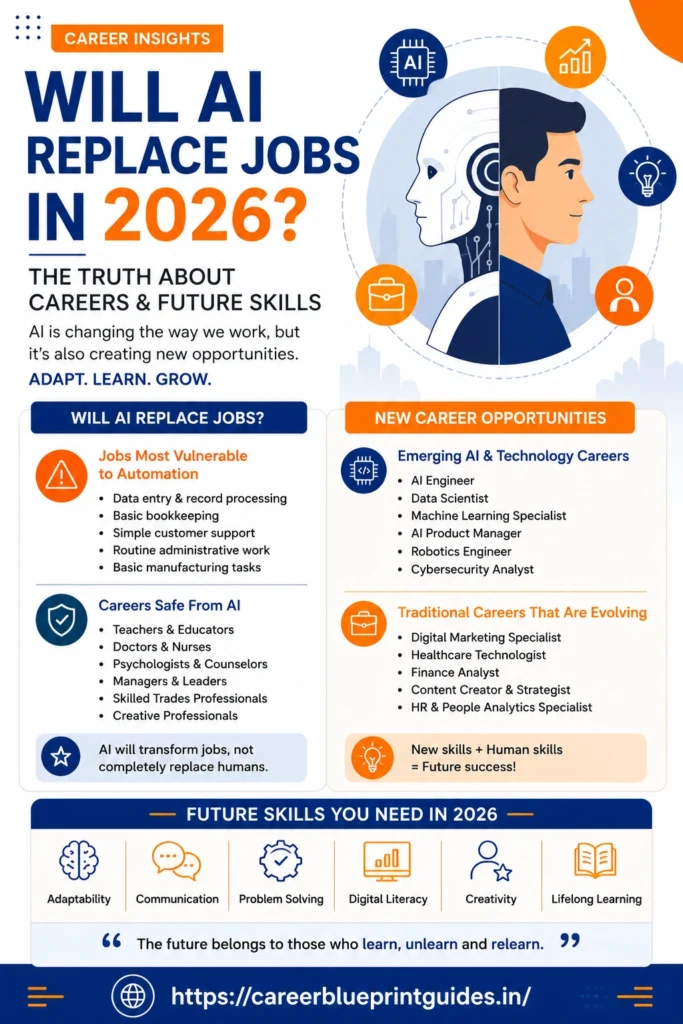
Jobs Most Vulnerable to Automation
Jobs that involve repetitive, predictable, and rule-based tasks are generally more vulnerable to automation.
AI systems can often perform these tasks faster, more accurately, and at a lower cost.
Some examples include:
- Data entry and record processing
- Basic bookkeeping tasks
- Simple customer support queries
- Routine administrative work
- Basic manufacturing and assembly tasks
This does not mean these professions will disappear overnight.
Instead, workers in these fields may need to learn new skills and adapt to changing job requirements.
Why Many Human Roles Will Still Exist
Despite rapid AI advancements, many careers continue to depend on uniquely human abilities.
Skills such as creativity, empathy, critical thinking, leadership, and complex decision-making remain difficult for AI to replicate.
Some of the most common Careers Safe From AI include:
- Teachers and educators
- Doctors and nurses
- Psychologists and counselors
- Managers and leaders
- Skilled trades professionals
- Creative professionals such as designers and writers
These professions require human judgment, emotional understanding, and real-world experience that AI cannot fully provide.
For students planning their future careers, the goal should not be to avoid technology but to develop the Future Skills Students Need in 2026, including adaptability, communication, problem-solving, and digital literacy.
Those who learn to work alongside AI are likely to find the best opportunities in the future job market.
New Career Opportunities Created by AI
While many people worry about jobs being replaced, AI is also creating new career paths across different industries.
Businesses need professionals who can develop, manage, use, and improve AI systems.
At the same time, many traditional careers are evolving and offering new opportunities.
For students, this means the future job market will not only require technology skills but also human skills that work alongside AI.
Understanding these opportunities can help students make better career decisions and prepare for the changing workplace.
Emerging AI and Technology Careers
The rapid growth of AI has created demand for professionals with technology-related skills.
Companies across sectors are actively looking for talent who can build, manage, and support AI-driven solutions.
Some of the fastest-growing AI-related careers include:
- AI Engineer
- Machine Learning Engineer
- Data Scientist
- Cybersecurity Specialist
- AI Product Manager
- Cloud Computing Specialist
- Robotics Engineer
These roles often require knowledge of programming, data analysis, and digital technologies.
Students interested in science, technology, engineering, and mathematics (STEM) fields may find strong career opportunities in these areas over the coming years.
Non-Technical Careers Growing Alongside AI
Not all future careers require coding or advanced technical knowledge.
As AI becomes more common, organizations will continue to need professionals who can provide human judgment, creativity, communication, and emotional understanding.
Some growing non-technical careers include:
- Digital Marketing Specialist
- Content Strategist
- Career Counselor
- Teacher and Educator
- Healthcare Professional
- Human Resource Manager
- UX/UI Designer
- Sales and Business Development Professional
These roles highlight that many Careers Safe From AI depend on skills that machines cannot easily replicate.
Human interaction, leadership, empathy, creativity, and critical thinking remain highly valuable in the modern workplace.
For students planning their future, the best approach is to combine subject expertise with adaptability and continuous learning.
Whether choosing a technical or non-technical path, those who learn to work with AI will be better positioned to benefit from the new opportunities emerging in the job market.
Future Skills Students Need to Succeed
As AI becomes a part of everyday work, students need to prepare for a job market that values both technology skills and human abilities.
Employers are increasingly looking for candidates who can work alongside AI tools rather than compete with them.
Building the right skills today can help students stay relevant and explore better career opportunities in the future.
Technical Skills for the AI Era
Students do not need to become AI engineers to benefit from technology.
However, having basic digital and technical knowledge can provide a significant advantage in almost every career field.
Some important technical skills include:
- AI and digital literacy
- Data analysis and interpretation
- Basic coding and programming
- Cybersecurity awareness
- Digital marketing and content creation
- Using AI productivity tools effectively
The good news is that many of these skills can be learned through online courses, practical projects, and regular practice.
Developing these abilities is becoming one of the most important Future Skills Students Need in 2026.
Human Skills AI Cannot Easily Replace
While AI can process information quickly, it cannot fully replicate human understanding, emotions, and judgment.
This is why many Jobs AI Cannot Replace continue to depend on strong human skills.
Some of the most valuable human skills include:
- Critical thinking and problem-solving
- Communication and presentation skills
- Creativity and innovation
- Leadership and teamwork
- Emotional intelligence and empathy
- Adaptability and lifelong learning
For example, a teacher can use AI tools to create lesson plans, but motivating students and understanding their individual needs still requires human interaction.
Similarly, doctors, managers, counselors, and entrepreneurs rely heavily on skills that AI cannot easily replace.
For students planning their careers, the best strategy is to combine technical knowledge with strong human skills.
This balanced approach will help them remain competitive and explore a wide range of Careers Safe From AI in the years ahead.
Career Planning Tips for Students and Parents
Choosing a career has become more challenging in the age of AI and rapidly changing industries.
Instead of focusing only on today’s popular careers, students and parents should think about long-term opportunities, future industry trends, and individual strengths.
A well-planned career path can help students stay adaptable and confident in an evolving job market.
Choosing the Right Course or Stream
Selecting the right stream or course is one of the most important decisions in a student’s academic journey.
However, the choice should not be based solely on marks, peer pressure, or popular trends.
Students should consider:
- Their interests and strengths.
- Future career opportunities in the field.
- Required skills and qualifications.
- Industry growth potential.
- Long-term career goals.
For example, a student interested in technology can explore fields such as Artificial Intelligence, Data Science, Cybersecurity, or Software Development.
Similarly, students interested in creativity, communication, or business can find growing opportunities in digital marketing, content creation, design, and entrepreneurship.
The best course is one that matches both a student’s interests and future career prospects.
Building a Future-Ready Career Roadmap
A career roadmap helps students move from education to employment with greater clarity and direction.
Rather than planning only for the next exam, students should develop a long-term vision for their future.
A simple career roadmap can include:
- Identifying career interests.
- Selecting the appropriate stream or course.
- Learning relevant technical and soft skills.
- Gaining practical experience through projects, internships, or certifications.
- Staying updated with industry and technology trends.
Parents can support this process by encouraging exploration, skill development, and informed decision-making rather than focusing only on traditional career choices.
As industries continue to evolve, students who combine continuous learning, adaptability, and strong human skills will be better prepared for future career opportunities.
Common Myths About AI and Jobs
As AI becomes more common in workplaces, many students and parents are hearing different opinions about its impact on careers.
Some people believe AI will replace all jobs, while others think it will have little effect.
The truth lies somewhere in between. Understanding the facts can help students make better career decisions and prepare for future opportunities.
Myth vs Reality of AI Job Loss
Many fears about AI are based on misconceptions rather than actual industry trends.
| Myth | Reality |
|---|---|
| AI will replace all jobs. | AI is more likely to automate specific tasks than entire professions. |
| Only technology jobs will survive. | Many careers in healthcare, education, management, and creative fields will continue to grow. |
| Human workers will become unnecessary. | Human skills such as creativity, empathy, leadership, and critical thinking remain essential. |
| AI will create only job losses. | AI is also creating new career opportunities across multiple industries. |
The biggest challenge for workers is not AI itself but keeping skills updated.
Students who continue learning and adapting will have more career options in the future.
What Experts Predict for the Future
Most industry experts believe AI will transform jobs rather than eliminate the workforce.
According to reports from organizations such as the World Economic Forum, some traditional roles may decline, but many new roles are expected to emerge.
Experts predict that future workplaces will increasingly value:
- Digital literacy and AI awareness
- Problem-solving skills
- Communication and teamwork
- Creativity and innovation
- Adaptability and lifelong learning
Many professionals will work alongside AI tools instead of competing against them.
This means the demand for Future Skills Students Need in 2026 will continue to grow.
For students and parents, the key message is simple: focus on learning, adaptability, and practical skills.
Those who combine technology knowledge with strong human abilities are likely to find some of the most promising Careers Safe From AI in the years ahead.
About AI and Careers
Many students and parents are worried about how artificial intelligence will affect future careers.
Here are answers to some of the most common questions about AI and jobs in 2026.
Will AI Replace All Jobs?
No, AI will not replace all jobs.
While AI can automate repetitive and rule-based tasks, many professions still require human skills such as creativity, critical thinking, leadership, emotional intelligence, and decision-making.
In reality, AI is more likely to transform jobs than eliminate them completely.
Most professionals will work alongside AI tools rather than be replaced by them.
The key is learning how to use AI effectively and adapting to changing workplace requirements.
Which Careers Are Safest From AI?
Careers that depend heavily on human interaction, creativity, and complex problem-solving are generally considered the safest from AI.
Some examples include:
- Teachers and Educators
- Doctors and Nurses
- Psychologists and Counselors
- Lawyers and Judges
- Business Leaders and Managers
- Skilled Trades Professionals
- Creative Professionals such as Designers and Writers
These roles require human judgment, empathy, and relationship-building skills that AI cannot fully replicate.
How Can Students Prepare for AI-Powered Workplaces?
Students do not need to become AI experts, but they should understand how AI is used in their chosen field.
Building a combination of technical and human skills will be important for long-term career success.
Some practical steps include:
- Learn basic AI and digital literacy skills.
- Develop communication and problem-solving abilities.
- Improve critical thinking and creativity.
- Stay updated with technology trends.
- Gain hands-on experience through projects and internships.
Students who embrace lifelong learning and adapt to new technologies will be better prepared for future career opportunities in an AI-driven world.
Final Thoughts: Adapt, Learn, and Stay Future-Ready
The question “Will AI Replace Jobs?” does not have a simple yes-or-no answer.
AI is certainly changing how work is done, and some routine tasks may become automated.
However, it is also creating new career paths and increasing the demand for skilled professionals who can work alongside technology.
For students, parents, and career aspirants, the focus should not be on fearing AI but on preparing for a future where technology plays a bigger role in everyday work.
Building strong subject knowledge, digital skills, communication abilities, and problem-solving skills will remain important in almost every profession.
The most successful professionals in the coming years will be those who are willing to learn continuously, adapt to change, and embrace new opportunities.
While AI will continue to evolve, human creativity, critical thinking, emotional intelligence, and leadership will remain highly valuable.
Bottom Line:
AI may replace certain tasks, but it cannot replace the importance of lifelong learning and adaptability.
Students who develop the Future Skills Students Need in 2026 and stay updated with industry trends will be better prepared for the careers of tomorrow.