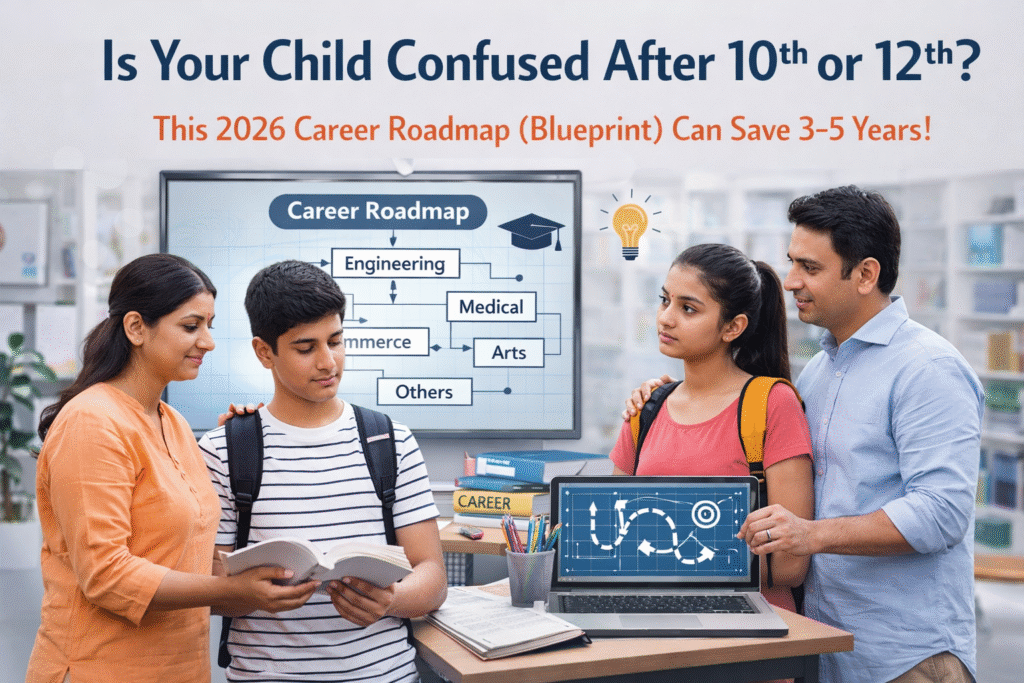
Why Students Get Confused After 10th and 12th
For most students, completing 10th or 12th grade is a major milestone.
However, it is also the stage where one of the most important life decisions must be made—choosing the right academic path and career direction.
Unfortunately, many students and parents feel overwhelmed during this phase.
The education landscape in 2026 offers more opportunities than ever before.
Along with traditional careers like Engineering, Medicine, Commerce, and Government Jobs, students now have access to emerging fields such as Artificial Intelligence, Data Science, Cyber Security, Digital Marketing, UI/UX Design, Content Creation, and many more.
While having more options is beneficial, it also creates confusion. Students often struggle to identify which path matches their interests, strengths, and future goals.
This is where a well-planned Career Roadmap After 10th and 12th becomes essential. Instead of making decisions based on assumptions or social pressure, students need a structured approach that helps them move toward a successful future.
A clear roadmap not only reduces confusion but also saves valuable years that might otherwise be lost due to wrong educational choices.
Too Many Options, Too Little Guidance
One of the biggest reasons students feel confused today is the sheer number of available career choices.
A few years ago, students primarily focused on a limited set of professions.
Today, thousands of courses, certifications, degree programs, and skill-based careers are available both online and offline.
The challenge is that most students are exposed to these options without receiving proper guidance.
Many students face questions such as:
- Should I choose Science, Commerce, or Arts after 10th?
- Which course has the best future scope?
- Is a traditional degree enough in 2026?
- Should I focus on skills, certifications, or college education?
- Which career will remain relevant in the age of AI?
Without clear answers, students often rely on advice from friends, relatives, or social media trends.
While these sources may provide opinions, they may not be suitable for every student.
Every individual has different strengths, interests, learning styles, and career aspirations. What works for one student may not work for another.
This is why a personalized Career Roadmap After 10th and 12th is far more effective than blindly following popular career trends.
Students who receive proper career guidance early can make informed decisions, choose relevant courses, and start building the skills required for future success.
The Hidden Cost of a Wrong Career Choice
A wrong career decision can have consequences that extend far beyond academics.
Many students realize after one or two years that they are pursuing a course they do not enjoy or a career that does not match their interests.
This often leads to:
- Wasted time and academic years
- Additional educational expenses
- Loss of motivation and confidence
- Increased stress and uncertainty
- Delayed career growth
For example, a student who chooses a stream due to parental pressure may later discover a strong interest in a completely different field.
Switching courses or changing career directions can result in losing valuable years that could have been invested in skill development and professional growth.
In today’s competitive world, time is one of the most valuable assets.
A carefully planned Career Roadmap After 10th and 12th helps students avoid costly mistakes by identifying suitable career paths from the beginning.
Rather than focusing only on marks or popular professions, students should evaluate factors such as:
- Personal interests and passions
- Natural strengths and abilities
- Future industry demand
- Required skills and qualifications
- Long-term career opportunities
Making career decisions with clarity and proper planning can save 3 to 5 years of unnecessary detours, helping students move confidently toward a rewarding and future-ready career.
A Simple Career Roadmap for Students
Choosing a career after 10th or 12th can feel overwhelming for both students and parents.
With hundreds of courses, changing industry trends, and constant advice from different people, many students end up confused about the right direction.
The good news is that career planning does not have to be complicated.
A clear and structured approach can help students avoid costly mistakes, save valuable years, and move confidently toward a successful future.
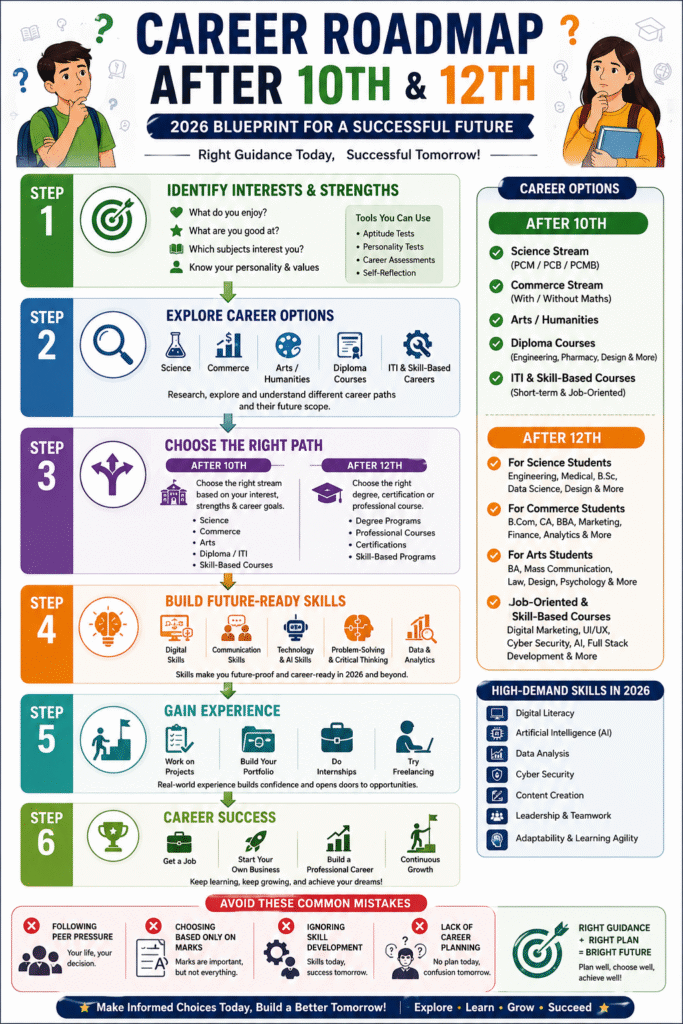
This simple Career Roadmap After 10th and 12th can help students make informed decisions based on their interests, abilities, and future opportunities.
Step 1: Identify Interests and Strengths
The first step in career planning is understanding who you are. Many students choose a stream or course simply because their friends are choosing it or because of family pressure.
This often leads to dissatisfaction later.
Instead, students should focus on discovering:
- Subjects they genuinely enjoy
- Activities they naturally perform well in
- Skills they want to develop further
- Career areas that excite and motivate them
For example, a student who enjoys designing, drawing, and creative thinking may explore Graphic Design or UI/UX Design, while a student who loves problem-solving and technology may consider Computer Science or Data Analytics.
Self-awareness creates the foundation for making better career decisions.
Step 2: Explore Career Opportunities
Once students understand their interests, the next step is exploring available career options.
Today’s job market offers far more opportunities than traditional careers such as Engineering, Medicine, or Government Jobs.
New-age careers are growing rapidly and offer excellent earning potential.
Students should research:
- Career roles and responsibilities
- Required qualifications
- Future demand in the industry
- Salary potential
- Growth opportunities
Some popular career options in 2026 include:
- Artificial Intelligence (AI)
- Data Science
- Digital Marketing
- Cyber Security
- Graphic Design
- Video Editing
- Cloud Computing
- Web Development
- Finance and Investment
- Healthcare and Allied Services
Exploring multiple options helps students make decisions based on facts rather than assumptions.
Step 3: Choose the Right Stream or Path
After understanding career opportunities, students can select the educational path that best aligns with their goals.
For students after 10th, this means choosing the right stream:
- Science
- Commerce
- Arts/Humanities
- Vocational Education
For students after 12th, this means selecting the right degree, diploma, certification, or skill-based program.
It is important to remember that there is no “best” stream. The right choice depends on the student’s interests, abilities, and future career objectives.
A well-planned decision at this stage can prevent students from changing courses repeatedly and losing valuable years.
Step 4: Build Future-Ready Skills
Academic qualifications alone are no longer enough in today’s competitive world.
Employers increasingly look for practical skills that demonstrate real-world capability.
Students should start developing future-ready skills alongside their education.
- Communication Skills
- Digital Literacy
- Problem Solving
- Critical Thinking
- Artificial Intelligence Tools
- Data Analysis
- Graphic Design
- Coding
- Content Creation
- Project Management
Online learning platforms, internships, workshops, and personal projects can help students gain practical experience early.
Students who continuously upgrade their skills often gain a significant advantage in college admissions, internships, and job opportunities.
Step 5: Plan for Long-Term Career Growth
Career planning should not stop after choosing a stream or college course.
Successful professionals regularly review and update their career goals based on changing opportunities.
Students should create a long-term plan that includes:
- Educational milestones
- Skill development goals
- Certifications and training
- Internship opportunities
- Networking and mentorship
- Career advancement targets
Industries evolve rapidly, and new opportunities emerge every year. Students who stay informed and continue learning are more likely to achieve long-term success.
The purpose of a Career Roadmap After 10th and 12th is not just to choose a course but to build a sustainable career that grows with time.
Final Thought
A wrong career decision can cost several years, while a well-planned decision can open doors to rewarding opportunities.
By identifying strengths, exploring careers, choosing the right path, building relevant skills, and planning for future growth, students can create a strong foundation for success.
The earlier students start following a structured career roadmap, the easier it becomes to make confident decisions and build a meaningful future.
Best Career Options After 10th
Choosing the right path after Class 10 is one of the most important decisions in a student’s academic journey.
Many students and parents feel confused because this decision often shapes future education, career opportunities, and skill development.
A well-planned Career Roadmap After 10th and 12th helps students avoid unnecessary course changes and saves valuable time in the long run.
The good news is that students today have multiple career paths available.
Apart from the traditional Science, Commerce, and Arts streams, there are also diploma programs, vocational courses, and skill-based learning options that can lead to successful careers.
Before selecting any stream, students should evaluate:
- Their interests and strengths
- Academic performance
- Long-term career goals
- Industry demand and future opportunities
- Personal learning preferences
The sections below explain the major options available after 10th.
Science Stream Opportunities
Science remains one of the most popular choices after Class 10 because it offers a wide range of career opportunities.
Students who enjoy subjects such as Mathematics, Physics, Chemistry, Biology, or technology-related topics often prefer this stream.
Science can generally be divided into:
- PCM (Physics, Chemistry, Mathematics)
- PCB (Physics, Chemistry, Biology)
- PCMB (Physics, Chemistry, Mathematics, Biology)
Popular career opportunities through the Science stream include:
- Engineering
- Artificial Intelligence
- Data Science
- Computer Science
- Medical Sciences
- Biotechnology
- Pharmacy
- Architecture
- Aviation
- Defence Services
One of the biggest advantages of choosing Science is flexibility. Students can later move into management, business, law, or many other professional fields if their interests change.
Who Should Choose Science?
Science may be a suitable option for students who:
- Enjoy analytical and logical thinking
- Have strong interest in Mathematics or Biology
- Want careers in technology, healthcare, or research
- Like solving complex problems
Students should select Science based on genuine interest rather than peer pressure or societal expectations.
Commerce Stream Opportunities
Commerce is an excellent choice for students interested in business, finance, economics, and entrepreneurship.
With the rapid growth of digital businesses, startups, and financial services, Commerce offers strong career prospects in 2026 and beyond.
Key subjects in Commerce often include:
- Accountancy
- Economics
- Business Studies
- Mathematics
- Entrepreneurship
Popular career options include:
- Chartered Accountant (CA)
- Company Secretary (CS)
- Cost and Management Accountant (CMA)
- Investment Banking
- Financial Analysis
- Digital Marketing
- Business Management
- Banking and Insurance
- Stock Market and Wealth Management
Commerce also provides a solid foundation for students planning to pursue B.Com, BBA, MBA, or professional finance certifications.
Who Should Choose Commerce?
Commerce may be ideal for students who:
- Enjoy working with numbers and financial concepts
- Have an interest in business and entrepreneurship
- Want careers in management, finance, or accounting
- Like understanding how companies and markets operate
Arts & Humanities Opportunities
Arts and Humanities have evolved significantly over the last decade.
Today, this stream offers diverse career opportunities across media, education, design, psychology, public administration, and social sciences.
Common subjects include:
- History
- Political Science
- Geography
- Sociology
- Psychology
- Economics
- English Literature
Career opportunities available through Arts and Humanities include:
- Civil Services
- Journalism and Media
- Content Writing
- Psychology
- Teaching
- Law
- Public Relations
- Social Work
- International Relations
- Graphic Design and Creative Fields
As industries increasingly value creativity, communication, and critical thinking, Humanities graduates are finding opportunities across multiple sectors.
Who Should Choose Arts & Humanities?
This stream may be suitable for students who:
- Have strong communication skills
- Enjoy reading, writing, and research
- Are interested in society, human behavior, or public affairs
- Prefer creative and people-oriented careers
Students should not consider Arts as a fallback option. It can lead to highly respected and rewarding careers when chosen with proper planning.
Diploma, ITI and Skill-Based Paths
Not every student needs to follow the traditional route of Class 11, Class 12, and a university degree.
Many students achieve success through practical, industry-focused education programs that emphasize employable skills.
Popular alternatives after 10th include:
- Polytechnic Diploma Courses
- ITI (Industrial Training Institute) Programs
- Graphic Design Courses
- Web Development Courses
- Digital Marketing Training
- Video Editing and Content Creation
- Animation and Multimedia
- UI/UX Design
- Electrician and Technical Trades
- Mobile Repair and Hardware Courses
These programs often provide hands-on training and can lead to faster employment opportunities compared to traditional academic pathways.
Benefits of Skill-Based Education
Skill-focused programs offer several advantages:
- Earlier entry into the workforce
- Practical industry experience
- Lower education costs
- High-demand technical skills
- Opportunities for freelancing and entrepreneurship
Many successful professionals today have built rewarding careers through vocational training, certifications, and specialized skill development rather than traditional degree programs alone.
Selecting the right path after Class 10 should always be based on a student’s interests, strengths, and long-term goals.
A carefully planned Career Roadmap After 10th and 12th can help students make informed decisions, avoid career confusion, and build a strong foundation for future success.
Best Career Options After 12th
Completing Class 12 is one of the most important milestones in a student’s life.
However, many students and parents face a common challenge—choosing the right career path.
A wrong decision can lead to years of confusion, course changes, and wasted time.
This is where a well-planned Career Roadmap After 10th and 12th becomes valuable.
The best career option is not necessarily the most popular one.
It should match a student’s interests, strengths, aptitude, personality, and future career goals. In 2026, students have more opportunities than ever before, ranging from traditional professional degrees to modern skill-based careers.
Before selecting any course, students should consider:
- Their favorite subjects and natural strengths
- Future job demand and industry growth
- Required skills and qualifications
- Salary potential and career growth
- Personal interests and long-term goals
The ideal career choice is the one that offers both professional growth and personal satisfaction.
Career Paths for Science Students
Science students often have the widest range of career opportunities after Class 12.
Whether they have PCM (Physics, Chemistry, Mathematics) or PCB (Physics, Chemistry, Biology), several promising paths are available.
Some of the most popular career options include:
- Engineering (Computer Science, AI, Mechanical, Civil, Electronics)
- Medical and Healthcare Careers (MBBS, BDS, Nursing, Physiotherapy)
- Data Science and Artificial Intelligence
- Biotechnology and Genetics
- Architecture
- Aviation and Pilot Training
- Environmental Science
- Cyber Security
- Robotics and Automation
- Research and Scientific Studies
Students interested in technology can also explore emerging fields such as Machine Learning, Cloud Computing, and Software Development, which are expected to remain in high demand throughout the coming decade.
The key is to choose a field based on aptitude and interest rather than social pressure or trends.
Career Paths for Commerce Students
Commerce is no longer limited to accounting and banking. Today’s commerce students have access to a wide variety of career opportunities across finance, business, technology, and entrepreneurship.
Popular career paths include:
- Chartered Accountancy (CA)
- Company Secretary (CS)
- Cost and Management Accountancy (CMA)
- Bachelor of Commerce (B.Com)
- Bachelor of Business Administration (BBA)
- Financial Analysis
- Investment Banking
- Stock Market and Wealth Management
- Digital Marketing
- Business Analytics
- E-Commerce Management
- Entrepreneurship
With businesses becoming increasingly data-driven, commerce students who combine financial knowledge with digital skills often gain a significant advantage in the job market.
A strong Career Roadmap After 10th and 12th helps commerce students identify whether they want to pursue professional certifications, corporate careers, or entrepreneurial ventures.
Career Paths for Arts Students
Arts students have access to many rewarding and high-growth career options.
The misconception that Arts offers limited opportunities is outdated. In fact, many modern careers value creativity, communication, critical thinking, and problem-solving skills.
Popular options for Arts students include:
- Psychology
- Law (LLB)
- Journalism and Mass Communication
- Content Writing and Copywriting
- Graphic Design
- Animation and Multimedia
- Interior Design
- Fashion Design
- Hotel Management
- Event Management
- Social Work
- Teaching and Education
- Public Relations
- Civil Services Preparation
Students interested in creative fields can also build careers through freelancing, personal branding, and digital platforms, creating opportunities beyond traditional employment.
The focus should be on identifying strengths and choosing a career that aligns with future industry trends and personal interests.
Job-Oriented and Skill-Based Courses
The modern job market is increasingly focused on skills rather than degrees alone.
Many employers now prioritize practical expertise, certifications, and project experience when hiring candidates.
Students who want faster career entry or additional income opportunities can consider job-oriented and skill-based courses such as:
- Digital Marketing
- Graphic Design
- Video Editing
- Web Development
- Data Analytics
- Artificial Intelligence (AI)
- UI/UX Design
- Cyber Security
- Cloud Computing
- Content Creation
- Social Media Management
- Search Engine Optimization (SEO)
- App Development
- Affiliate Marketing
Many of these skills can be learned through online platforms and can lead to freelancing, remote work, internships, or full-time employment opportunities.
In 2026 and beyond, students who combine academic education with practical skills will have a stronger competitive advantage.
A balanced approach between formal education and industry-relevant skills can significantly improve career growth and employability.
Choosing the right course after Class 12 is not about following the crowd—it’s about building a future-ready career plan.
A structured Career Roadmap After 10th and 12th can help students make informed decisions, avoid costly mistakes, and move confidently toward long-term success.
High-Demand Skills Students Should Learn in 2026
Choosing the right stream, course, or college is important, but skills are what truly shape a student’s future.
In today’s fast-changing world, employers are looking beyond degrees and focusing more on practical abilities that help individuals perform in real-world situations.
A well-planned Career Roadmap After 10th and 12th should always include skill development alongside academic education.
Students who start building future-ready skills early often gain a significant advantage in higher education, internships, and job opportunities.
Below are some of the most valuable skills students should focus on in 2026.
Digital Skills
Digital literacy is no longer optional. Whether a student wants to become an engineer, designer, teacher, entrepreneur, or healthcare professional, digital skills are becoming essential in every industry.
Some useful digital skills include:
- Basic computer proficiency
- Microsoft Office and Google Workspace
- Online research techniques
- Digital marketing fundamentals
- Social media management
- Data handling and spreadsheet skills
- Canva and basic graphic design
Students can learn many of these skills through free or affordable online courses while still studying in school or college.
Communication Skills
Strong communication skills can create opportunities that academic qualifications alone cannot.
Students who can express their thoughts clearly often perform better in interviews, presentations, group discussions, and workplace environments.
Important communication skills include:
- Public speaking
- Professional writing
- Email etiquette
- Presentation skills
- Active listening
- Interpersonal communication
Good communication also helps students build confidence, network effectively, and develop leadership qualities that are valuable throughout their careers.
Technology and AI Skills
Artificial Intelligence is transforming industries across the world.
From healthcare and finance to education and marketing, AI-powered tools are becoming a part of everyday work.
Students should develop a basic understanding of:
- Artificial Intelligence (AI)
- Machine Learning fundamentals
- Prompt engineering
- Coding and programming basics
- Data Analytics
- Cybersecurity awareness
- Cloud computing concepts
Learning these technologies does not mean every student must become a software engineer. Instead, understanding how technology works can help students stay relevant in almost any profession.
For students planning their Career Roadmap After 10th and 12th, gaining exposure to AI and emerging technologies can provide a strong competitive advantage in the coming years.
Problem-Solving and Critical Thinking
One of the most valuable skills employers seek today is the ability to solve problems effectively.
While technical knowledge can be learned, the ability to analyze situations and make informed decisions often sets successful professionals apart.
Students can improve problem-solving and critical thinking by:
- Participating in projects and competitions
- Solving real-world case studies
- Learning through practical experiences
- Engaging in debates and discussions
- Working on team-based activities
These skills help students evaluate options logically, adapt to changing situations, and make better academic and career decisions.
As industries continue to evolve, students who combine technical knowledge with strong critical thinking abilities will be better prepared for future opportunities and challenges.
A successful Career Roadmap After 10th and 12th should therefore focus not only on choosing the right career path but also on developing the skills needed to thrive in it.
Common Career Mistakes That Waste Valuable Years
Many students and parents believe that choosing a stream after 10th or a course after 12th is just another academic decision.
In reality, these choices often shape the next 5–10 years of a student’s life.
A wrong decision can lead to frustration, course changes, loss of confidence, and wasted time.
A well-planned Career Roadmap After 10th and 12th helps students avoid common mistakes and move toward a career that matches their interests, strengths, and future opportunities.
Below are some of the most common career mistakes that can cost students valuable years.
Following Peer Pressure
One of the biggest career mistakes students make is choosing a stream or career simply because their friends are doing the same.
Many students select Science, Commerce, or a particular college because their classmates are choosing it.
While friends can influence decisions, every student has different interests, abilities, and career goals.
A career that works perfectly for one student may not be suitable for another.
Following the crowd often leads to dissatisfaction later when students realize they are studying subjects they do not enjoy.
Before making any career decision, students should focus on:
- Their personal interests
- Natural strengths and abilities
- Long-term career goals
- Future job opportunities
A strong Career Roadmap After 10th and 12th is based on self-understanding, not social pressure.
Choosing Based Only on Marks
Many students assume that high marks automatically mean they should choose Science, while average marks mean Commerce or Arts.
This mindset often leads to poor career decisions.
Marks show academic performance, but they do not reveal:
- Creativity
- Communication skills
- Leadership abilities
- Technical interests
- Entrepreneurial potential
For example, a student with excellent creative skills may thrive in Graphic Design, Animation, Digital Marketing, or UI/UX Design, regardless of their board exam percentage.
Similarly, many successful professionals have built rewarding careers in fields that had little connection with their school marks.
Instead of focusing only on grades, students should evaluate:
- Interests
- Aptitude
- Personality traits
- Industry demand
- Career growth potential
The best career choice combines passion, ability, and opportunity.
Ignoring Skill Development
The job market in 2026 is changing faster than ever. Employers increasingly value practical skills alongside academic qualifications.
Unfortunately, many students spend years collecting certificates and degrees while neglecting real-world skills.
Some of the most valuable skills today include:
- Communication Skills
- Digital Marketing
- Data Analytics
- Coding and Programming
- Graphic Design
- Video Editing
- Artificial Intelligence (AI)
- Problem-Solving Skills
Students who begin developing these skills early often gain a significant advantage over their peers.
A smart Career Roadmap After 10th and 12th should include both academic planning and skill-building.
This combination improves employability, increases earning potential, and opens doors to future opportunities.
Lack of Career Planning
Many students move from one educational stage to another without a clear plan.
They complete 10th, choose a stream randomly, finish 12th, join a college, and only then start thinking about career options. By that time, several important years may already have been lost.
Career planning does not mean deciding your entire future at age 15 or 17.
It means understanding the possible pathways available and making informed decisions at every stage.
Effective career planning helps students:
- Set realistic goals
- Understand future career options
- Select the right courses
- Develop relevant skills
- Avoid unnecessary course changes
- Save time and money
Students who create a clear Career Roadmap After 10th and 12th often make more confident decisions and adapt better to changing career trends.
The earlier career planning begins, the easier it becomes to build a successful and fulfilling professional journey.
How Parents Can Support Their Child
Choosing a career after 10th or 12th has become much more challenging than it was a decade ago.
Students today are exposed to thousands of career options, online courses, influencers, and opinions from relatives, which often creates confusion rather than clarity.
This is where parents play a crucial role.
The most effective support parents can provide is helping their child discover strengths, interests, and long-term goals instead of forcing decisions based on traditional beliefs or social pressure.
A well-planned Career Roadmap After 10th and 12th begins with understanding the student, not with selecting a course.
Parents should encourage open conversations about future aspirations, emerging careers, and skill development.
Listening carefully to a child’s interests can often reveal hidden talents that may lead to successful and fulfilling careers.
Understanding the New Career Landscape
The career world in 2026 looks very different from what previous generations experienced.
Earlier, students mostly chose between Engineering, Medical, Commerce, Government Jobs, or a few professional degrees.
Today, the opportunities are much broader.
Fields such as Artificial Intelligence, Data Science, Cyber Security, Digital Marketing, UI/UX Design, Content Creation, Cloud Computing, Financial Technology, and Renewable Energy are creating thousands of new career opportunities every year.
Many modern careers focus more on skills than on traditional degrees alone.
Employers increasingly look for practical knowledge, certifications, portfolios, and problem-solving abilities.
Because of these rapid changes, students need a flexible and future-focused approach while planning their education.
A structured Career Roadmap After 10th and 12th helps families understand both traditional and emerging career paths before making important decisions.
Supporting Without Creating Pressure
One of the biggest mistakes parents make is comparing their child with friends, cousins, or high-performing classmates. Every student has unique abilities, learning styles, and career interests.
Pressure often creates fear of failure, reduces confidence, and may lead students to choose careers that do not match their strengths. Instead of asking questions like:
- “Why don’t you score like others?”
- “Why don’t you become an engineer or doctor?”
- “What will people say?”
Parents can focus on more constructive questions such as:
- What subjects do you enjoy most?
- Which activities excite you?
- What kind of work would you like to do in the future?
- Which skills would you like to develop?
A supportive environment encourages students to explore possibilities, make informed decisions, and build confidence in their chosen path.
When Career Guidance Becomes Important
Many students remain uncertain even after selecting a stream or course.
This is completely normal because career planning involves understanding personal interests, aptitude, market trends, educational requirements, and future opportunities.
Professional career guidance becomes valuable when:
- A student is confused between multiple career options.
- Parents and children have different expectations.
- The student lacks clarity about stream selection after 10th.
- There is uncertainty about courses after 12th.
- The family wants a long-term educational and career plan.
Career counselors, aptitude assessments, mentorship programs, and career planning resources can provide objective guidance that helps students make informed decisions.
The earlier students gain clarity, the easier it becomes to avoid unnecessary course changes, wasted academic years, and career dissatisfaction.
A carefully planned Career Roadmap After 10th and 12th can help students move forward with confidence and save valuable time, effort, and resources in the long run.
Creating a Career Plan That Actually Works
Many students choose a stream, course, or college without having a clear plan for where it will lead them in the future.
As a result, they often switch courses, prepare for multiple exams without direction, or spend years figuring out what they actually want to do.
A well-planned Career Roadmap After 10th and 12th helps students make informed decisions based on their interests, strengths, future opportunities, and career goals.
Instead of following trends or peer pressure, students can focus on building a path that aligns with their long-term success.
An effective career plan should answer these important questions:
- What subjects or skills do I enjoy most?
- Which careers match my strengths and personality?
- What qualifications will I need?
- hat skills will employers demand in the future?
- What should I do in the next 1, 3, and 5 years?
When students have clarity about these areas, they can avoid unnecessary confusion and save valuable time, money, and effort.
Education + Skills + Career Goals
In today’s competitive world, education alone is no longer enough. Employers and industries increasingly look for candidates who combine academic knowledge with practical skills.
A successful career plan is built on three pillars:
1. Education
Education provides the foundation for future opportunities. Students should select streams, courses, and qualifications that support their chosen career path.
For example:
- Science students may pursue Engineering, Medicine, Data Science, or Research.
- Commerce students may choose CA, CS, Finance, Business Management, or Digital Marketing.
- Arts students may explore Psychology, Design, Journalism, Law, Teaching, or Civil Services.
The key is to understand how today’s educational choices connect with tomorrow’s career opportunities.
2. Skills
Skills are becoming as important as degrees. Students who develop future-ready skills gain a significant advantage in higher education and job markets.
Some valuable skills for 2026 and beyond include:
- Artificial Intelligence (AI)
- Data Analytics
- Digital Marketing
- Graphic Design
- Video Editing
- Communication Skills
- Coding and Programming
- Problem Solving
- Critical Thinking
Even learning one or two high-demand skills alongside academics can open additional career opportunities.
3. Career Goals
Career goals provide direction and motivation. Students should define both short-term and long-term goals.
Examples:
Short-Term Goals
- Select the right stream after 10th.
- Build a strong academic foundation.
- Learn one future-ready skill.
Long-Term Goals
- Get admission into a desired college.
- Build expertise in a chosen field.
- Secure a rewarding career or start a business.
When education, skills, and goals work together, students create a much stronger foundation for long-term success.
Building a Long-Term Roadmap
Career planning should not stop after selecting a stream or course. Students need a roadmap that guides their progress over the coming years.
A practical long-term roadmap may look like this:
After 10th
- Understand interests, strengths, and career options.
- Choose the most suitable stream.
- Start exploring future industries and opportunities.
- Develop basic digital and communication skills.
During 11th and 12th
- Focus on academic performance.
- Participate in projects, competitions, and internships.
- Learn industry-relevant skills.
- Research colleges, entrance exams, and career paths.
During Graduation
- Build practical experience through internships.
- Create a portfolio or professional profile.
- Network with mentors and industry experts.
- Gain certifications in relevant skill areas.
Entering the Professional World
- Apply for jobs aligned with career goals.
- Continue upgrading skills.
- Adapt to changing industry trends.
- Focus on long-term growth rather than short-term gains.
The biggest advantage of following a structured Career Roadmap After 10th and 12th is that it reduces uncertainty.
Students can make confident decisions, avoid costly mistakes, and move steadily toward their desired future.
A career is not built in a single year—it is built through a series of informed choices.
The earlier students start planning, the greater their chances of achieving success while saving 3–5 years that might otherwise be lost to confusion, wrong decisions, or frequent course changes.
Conclusion
Helping Your Child Make Confident Career Decisions
Choosing a career after 10th or 12th is one of the most important decisions in a student’s life.
However, many students feel confused because they are exposed to too many opinions, career options, and changing industry trends.
As a parent, your role is not to choose a career for your child but to guide them toward making an informed and confident decision.
A well-planned Career Roadmap After 10th and 12th can help students avoid common mistakes such as selecting the wrong stream, pursuing a course without understanding its future scope, or changing careers multiple times later.
When students understand their strengths, interests, skills, and long-term goals, they can move forward with greater clarity and confidence.
The good news is that today’s students have more opportunities than ever before.
Along with traditional careers like Engineering, Medicine, Commerce, and Government Services, they can also explore emerging fields such as Artificial Intelligence, Data Science, Digital Marketing, Cyber Security, Graphic Design, Content Creation, and many other high-growth industries.
Parents should encourage students to:
- Explore different career options before making a decision.
- Identify their natural strengths and interests.
- Research future job opportunities and industry demand.
- Learn practical and digital skills alongside academics.
- Seek guidance from career counselors, mentors, and industry experts.
Remember, a successful career is not built by following the crowd. It is built by choosing a path that matches a student’s abilities, interests, and future aspirations.
If your child is currently unsure about what to do after 10th or 12th, start by creating a structured plan, exploring available opportunities, and focusing on skill development.
The right guidance today can save years of confusion, course changes, and career setbacks in the future.
A clear Career Roadmap After 10th and 12th can become the foundation for a rewarding, successful, and fulfilling professional journey.
The earlier students gain clarity, the better prepared they will be to achieve their academic and career goals in 2026 and beyond.