
Why High Income Skills Matter in 2026
The world of work is changing faster than ever before. New technologies, artificial intelligence, automation, and digital transformation are reshaping industries across the globe.
As a result, employers are no longer looking only for degrees and certificates.
They are actively searching for individuals who possess practical, job-ready skills that can solve real-world problems.
This shift has made High Income Skills one of the most important factors for career growth in 2026.
Whether you are a school student, college student, working professional, or someone planning a career change, learning the right skills can significantly improve your earning potential and open doors to new opportunities.
Unlike traditional qualifications that may take years to show results, skill-based learning allows individuals to build expertise that is directly applicable in the workplace.
From Digital Marketing and Data Analytics to Artificial Intelligence and Cyber Security, professionals with in-demand skills are finding better job opportunities, higher salaries, and greater career flexibility.
Understanding why these skills matter today can help students and parents make smarter decisions about education, career planning, and future growth.
How the Job Market is Changing
The modern job market is very different from what it was a decade ago. Businesses are rapidly adopting digital tools, cloud technologies, automation systems, and artificial intelligence to improve efficiency and productivity.
As companies evolve, their hiring requirements are also changing.
Many organizations now prioritize practical abilities and problem-solving skills over traditional qualifications alone.
Employers want candidates who can contribute immediately and adapt to changing industry demands.
Several major trends are shaping today’s job market:
- Increased use of Artificial Intelligence and Automation
- Growth of remote and hybrid work opportunities
- Expansion of digital businesses and e-commerce
- Rising demand for technology-driven careers
- Greater focus on skill-based hiring
According to various industry reports, many future jobs will require a combination of technical knowledge and practical skills.
Students who start developing relevant skills early can gain a significant advantage when entering the workforce.
This is why understanding and learning High Income Skills has become essential for long-term career success.
Why Skills Matter More Than Degrees
A degree can provide a strong educational foundation, but employers increasingly value what a person can actually do rather than what qualification they hold.
In many industries, Practical skills have become the deciding factor during recruitment.
Companies often assess candidates based on their ability to solve problems, complete projects, use industry tools, and deliver measurable results.
For example:
- A Digital Marketer can help businesses generate leads and sales.
- A Web Developer can build websites and applications.
- A Data Analyst can turn raw data into valuable business insights.
- A Cyber Security professional can protect organizations from digital threats.
These abilities create direct value for employers, which is why skilled professionals are often rewarded with better salaries and faster career growth.
This does not mean degrees have lost their importance. Instead, the most successful professionals combine formal education with practical skills.
Students who focus on both academic learning and skill development are often better prepared for future career opportunities.
In today’s competitive environment, having a degree alone may not be enough.
Developing relevant High Income Skills can help bridge the gap between education and employment.
Benefits of Learning Future-Ready Skills
Learning future-ready skills offers advantages that go far beyond earning a higher salary.
These skills help individuals stay relevant in a rapidly changing world and prepare them for long-term career success.
Some key benefits include:
Better Career Opportunities
Professionals with in-demand skills often have access to a wider range of job opportunities across different industries.
They are more likely to qualify for specialized roles that offer strong career growth.
Higher Earning Potential
Many skill-based careers offer competitive salaries because employers are willing to pay more for expertise that delivers results.
Fields such as Artificial Intelligence, Data Science, Cloud Computing, and Cyber Security are examples of high-paying career paths.
Freelancing and Remote Work Options
Many modern skills can be used independently, allowing professionals to work as freelancers, consultants, or remote employees.
This creates additional income opportunities and greater flexibility.
Career Security in a Changing Economy
As industries continue to evolve, individuals with adaptable and future-focused skills are often better positioned to handle changes in the job market.
Continuous learning helps professionals remain valuable and employable.
Opportunities for Entrepreneurship
Skills such as Digital Marketing, Web Development, Content Creation, and Data Analytics can also help individuals start their own businesses or offer services directly to clients.
Ultimately, investing time in learning relevant High Income Skills is one of the smartest decisions students and professionals can make in 2026.
The earlier these skills are developed, the greater the opportunities for growth, financial stability, and career success in the future.
What Are High Income Skills?
In today’s rapidly evolving job market, having a degree alone is often not enough to secure a high-paying and future-ready career.
Employers increasingly value practical abilities that help solve real business problems, improve efficiency, and generate results. This is where High Income Skills become important.
Unlike traditional qualifications that focus mainly on academic knowledge, High Income Skills are specialized abilities that can help individuals earn higher incomes through jobs, freelancing, consulting, remote work, or even entrepreneurship.
These skills are highly valued because they directly contribute to business growth and productivity.
From Digital Marketing and Data Analytics to Artificial Intelligence and Cybersecurity, many modern careers are built around skills rather than just educational credentials.
As industries continue to adopt new technologies, the demand for skilled professionals is expected to grow significantly in the coming years.
For students, college graduates, and working professionals, understanding High Income Skills can be the first step toward building a successful and financially rewarding career.
Definition of High Income Skills
High Income Skills are specialized, market-driven abilities that enable individuals to earn above-average income because of the value they provide to employers, clients, or businesses.
These skills are typically linked to industries experiencing strong growth and talent shortages. They focus on practical application rather than theoretical knowledge, making them highly relevant in today’s competitive economy.
Some common examples of High Income Skills include:
- Digital Marketing
- Data Analytics
- Artificial Intelligence (AI)
- Web Development
- Cyber Security
- Cloud Computing
- Data Science
- UI/UX Design
- Video Editing and Content Creation
What makes these skills valuable is their ability to solve real-world problems.
For example, a Digital Marketing specialist helps businesses generate leads and sales, while a Data Analyst helps organizations make informed decisions based on data.
The earning potential of these skills often depends on expertise, experience, and the ability to deliver measurable results.
This is why professionals with strong practical skills can sometimes earn more than individuals with advanced degrees but limited industry-relevant expertise.
As the global economy becomes more technology-driven, learning High Income Skills can provide students and professionals with better career opportunities, greater flexibility, and long-term financial growth.
Characteristics of High-Paying Skills
Not every skill qualifies as a High Income Skill. Certain characteristics make these skills valuable in the modern job market and contribute to their strong earning potential.
High Market Demand
The most profitable skills are usually connected to industries that are growing rapidly. Fields such as technology, digital marketing, artificial intelligence, cloud computing, and cybersecurity consistently require skilled professionals to meet increasing business demands.
Ability to Solve Real Problems
Businesses are willing to pay more for professionals who can solve challenges, improve processes, increase revenue, or reduce costs. Skills that create measurable impact generally command higher salaries.
Scalability of Income
Many High Income Skills allow professionals to earn income through multiple channels. In addition to traditional employment, individuals can work as freelancers, consultants, trainers, or business owners.
Global Career Opportunities
Several modern skills are not limited by geography. Professionals with expertise in areas like software development, digital marketing, and data analytics can work with companies and clients across the world.
Continuous Industry Relevance
The best High Income Skills remain valuable because they evolve with market trends.
Professionals who continuously upgrade their knowledge can stay competitive and increase their earning potential over time.
Strong Career Flexibility
Many high-paying skills can be applied across different industries. For example, Digital Marketing is used in education, healthcare, e-commerce, finance, and countless other sectors, giving professionals more career options.
These characteristics make High Income Skills attractive for students who want long-term career stability as well as professionals looking to increase their income and career growth.
Why Companies Prefer Skilled Professionals
Over the last decade, hiring trends have changed significantly. Employers are increasingly focusing on practical abilities rather than relying solely on academic qualifications.
The primary reason is simple: businesses need people who can contribute from day one.
Immediate Business Impact
Skilled professionals often require less training because they already possess the knowledge needed to perform specific tasks.
This helps companies save time, reduce costs, and achieve faster results.
Better Problem-Solving Abilities
Organizations face challenges every day, from attracting customers to managing data and protecting digital assets.
Professionals with specialized skills can identify solutions and help businesses operate more efficiently.
Adaptability in a Changing Market
Technology and consumer behavior continue to evolve rapidly. Companies prefer individuals who can learn new tools, adapt to industry changes, and stay updated with emerging trends.
Increased Productivity
Employees with practical expertise often work more efficiently and contribute directly to organizational goals.
This increased productivity creates greater value for businesses and leads to better career opportunities for the employee.
Support for Digital Transformation
Many industries are undergoing digital transformation. Whether it is automation, cloud computing, artificial intelligence, or online marketing, companies require skilled professionals who can help them remain competitive in a technology-driven environment.
Long-Term Business Growth
Businesses view skilled professionals as investments rather than expenses.
Employees who possess valuable High Income Skills often play a critical role in driving innovation, improving performance, and supporting long-term growth.
As a result, students and professionals who focus on developing practical, industry-relevant skills are more likely to secure rewarding careers and remain competitive in the future job market.
High Income Skills vs Traditional Career Paths
The career landscape has changed significantly over the last decade. Earlier, most people followed a traditional path—complete their education, secure a job, and gradually climb the corporate ladder.
While this approach still works in many industries, today’s job market increasingly rewards practical expertise and problem-solving abilities.
This is where High Income Skills stand out.
These skills enable individuals to create value for businesses, solve real-world challenges, and earn income based on their capabilities rather than solely on their qualifications.
Whether you are a student planning your future or a professional looking to upgrade your career, understanding the difference between traditional career paths and skill-based careers is essential.
Income Growth Potential
One of the biggest differences between traditional careers and High Income Skills is the speed at which income can grow.
In traditional jobs, salary growth often depends on factors such as years of experience, promotions, organizational hierarchy, and educational qualifications.
While steady growth is possible, it can take several years to reach higher income levels.
In contrast, professionals who develop High Income Skills are often rewarded based on the value they provide.
For example, a skilled digital marketer who helps a company generate more sales or a data analyst who improves business decisions can command higher compensation much earlier in their career.
Some of the most sought-after skills in today’s market include:
- Digital Marketing
- Data Analytics
- Artificial Intelligence (AI)
- Cyber Security
- Web Development
- Cloud Computing
As expertise increases, professionals can expand their income through consulting, freelancing, specialized projects, and leadership roles.
This creates multiple income streams that are often unavailable in traditional career structures.
For students, learning a valuable skill early can provide a significant advantage and shorten the time required to achieve financial stability.
Job Security and Future Demand
Job security is no longer determined solely by having a degree. Employers increasingly seek individuals who can adapt to changing technologies and contribute practical solutions.
Traditional roles in some industries are becoming vulnerable to automation and digital transformation.
Tasks that were once performed manually are now being handled by software, artificial intelligence, and automated systems.
However, professionals with High Income Skills remain in demand because they possess abilities that businesses actively need.
Skills such as AI, Cyber Security, Data Science, and Digital Marketing continue to experience strong growth due to increasing reliance on technology and digital platforms.
Several factors contribute to the future demand for these skills:
- Rapid technological advancement
- Growth of online businesses
- Increased use of artificial intelligence
- Expansion of remote work
- Rising importance of data-driven decision-making
Students and parents should understand that future career security depends not only on choosing the right degree but also on continuously developing relevant skills that align with industry needs.
Freelancing and Remote Work Opportunities
Traditional careers usually involve working for a single employer in a fixed location and following a structured schedule.
While this arrangement provides stability, it may limit flexibility and income opportunities.
High Income Skills open doors to freelancing and remote work, which have become increasingly popular worldwide.
Professionals with expertise in areas such as:
- Graphic Design
- Content Creation
- Video Editing
- Web Development
- Digital Marketing
- UI/UX Design
can work with clients from different cities or even different countries without relocating.
Remote work offers several advantages:
- Greater flexibility in work schedules
- Access to global job opportunities
- Ability to work from home
- Opportunity to earn from multiple clients
- Improved work-life balance
For students entering the workforce, these opportunities can provide valuable experience while also helping them build a professional portfolio and income source at an early stage.
As businesses continue to embrace digital operations, remote work is expected to remain an important part of the future employment landscape.
Entrepreneurship Possibilities
Another major advantage of developing High Income Skills is the potential to start and grow a business.
Traditional careers generally focus on working within an organization’s structure. Entrepreneurship, on the other hand, requires the ability to solve problems, attract customers, and deliver value independently.
Many successful entrepreneurs began by mastering a specific skill before launching their own ventures. For example:
- Digital marketers start marketing agencies.
- Web developers launch software companies.
- Graphic designers build creative studios.
- Data professionals create consulting businesses.
- Content creators develop personal brands and media channels.
High Income Skills provide a strong foundation for entrepreneurship because they reduce dependence on external resources and increase self-sufficiency.
Students who develop these skills not only improve their employability but also gain the ability to create opportunities for themselves and others in the future.
In today’s competitive economy, the combination of practical expertise, adaptability, and entrepreneurial thinking can significantly increase long-term career success.
This is why High Income Skills are becoming an important part of modern career planning for both students and professionals.
Top 10 High Income Skills to Learn in 2026
The job market is changing faster than ever before. Companies today are not just looking for degrees; they are looking for people who can solve problems, create value, and adapt to new technologies. This is where High Income Skills come into the picture.
High income skills are specialized abilities that can help individuals earn significantly more than traditional entry-level jobs.
These skills are in demand across industries, offer strong career growth, and often provide opportunities for freelancing, remote work, and entrepreneurship.
Whether you are a school student, college student, job seeker, or working professional, learning the right skill can improve your earning potential and future career opportunities.
One of the most valuable and accessible high income skills in 2026 is Digital Marketing.
1. Digital Marketing
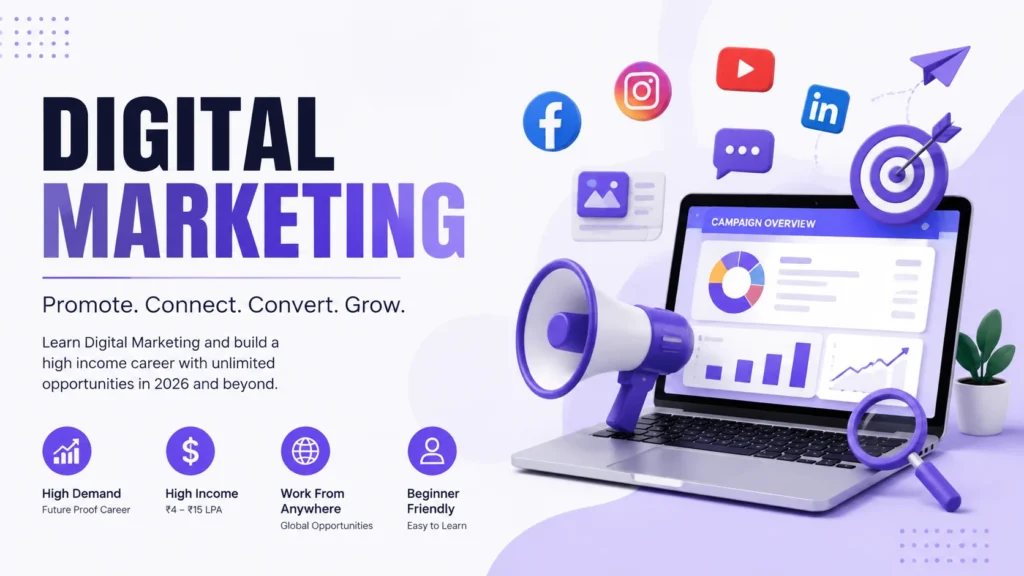
Digital Marketing has become one of the fastest-growing career fields in the world.
As businesses increasingly move online, they need professionals who can help them attract customers, generate leads, and grow their brand presence across digital platforms.
From small startups to multinational companies, almost every business relies on digital marketing to reach its target audience.
This growing demand makes Digital Marketing one of the most practical high income skills to learn in 2026.
What is Digital Marketing?
Digital Marketing refers to the promotion of products, services, or brands using digital channels such as search engines, social media platforms, websites, email, and online advertising.
Unlike traditional marketing, digital marketing allows businesses to reach specific audiences, track results in real time, and optimize campaigns for better performance.
Some common areas of digital marketing include:
- Search Engine Optimization (SEO)
- Social Media Marketing (SMM)
- Content Marketing
- Email Marketing
- Pay-Per-Click (PPC) Advertising
- Affiliate Marketing
- Video Marketing
- Marketing Analytics
Today, businesses of all sizes use these strategies to increase visibility, generate sales, and build long-term customer relationships.
Key Skills Required
To succeed in digital marketing, students and professionals should focus on developing a combination of technical and creative skills.
Some of the most important skills include:
Search Engine Optimization (SEO)
SEO helps websites rank higher on Google and other search engines. Professionals who understand SEO can help businesses attract organic traffic without spending heavily on advertising.
Content Creation
Creating useful and engaging content is at the heart of digital marketing. This includes blog writing, video content, social media posts, and email campaigns.
Social Media Management
Businesses need experts who can manage their presence on platforms like Instagram, Facebook, LinkedIn, YouTube, and X (formerly Twitter).
Paid Advertising
Knowledge of platforms such as Google Ads and Meta Ads allows marketers to run targeted campaigns and generate leads or sales efficiently.
Data Analysis
Modern digital marketers must understand website analytics, campaign performance metrics, and consumer behavior data to make informed decisions.
Communication Skills
Strong communication skills help marketers create compelling messages that connect with customers and encourage action.
Career Opportunities
Digital Marketing offers diverse career opportunities, making it suitable for students from almost any educational background.
Some popular career roles include:
- Digital Marketing Executive
- SEO Specialist
- Content Marketing Specialist
- Social Media Manager
- Google Ads Specialist
- Email Marketing Manager
- Marketing Automation Expert
- Digital Marketing Consultant
- E-commerce Marketing Manager
- Growth Marketing Specialist
With experience, professionals can move into senior positions such as:
- Digital Marketing Manager
- Performance Marketing Manager
- Head of Marketing
- Chief Marketing Officer (CMO)
Additionally, many digital marketers choose freelancing, consulting, or running their own marketing agencies.
Average Salary in India
Digital Marketing offers attractive salary packages, especially for individuals who continuously upgrade their skills and stay updated with industry trends.
Approximate salary ranges in India are:
| Experience Level | Average Annual Salary |
|---|---|
| Beginner (0–2 Years) | ₹3 LPA – ₹6 LPA |
| Mid-Level (3–5 Years) | ₹6 LPA – ₹12 LPA |
| Experienced (5–10 Years) | ₹12 LPA – ₹25 LPA |
| Specialist/Consultant | ₹15 LPA – ₹40 LPA+ |
Freelancers and agency owners often have the potential to earn significantly more depending on their expertise and client base.
Who Should Learn It?
Digital Marketing is one of the most flexible high income skills because it does not require a specific degree or educational background.
It is an excellent option for:
- Class 10th and 12th students exploring future careers
- College students looking for practical skills
- Graduates seeking job-ready expertise
- Working professionals planning a career switch
- Small business owners wanting to grow online
- Freelancers looking for additional income opportunities
- Content creators and influencers building personal brands
Students who enjoy creativity, communication, technology, social media, and business growth are likely to find Digital Marketing particularly rewarding.
As businesses continue investing in their online presence, the demand for skilled digital marketers is expected to remain strong, making it one of the most future-ready high income skills to learn in 2026.
2. Data Analytics
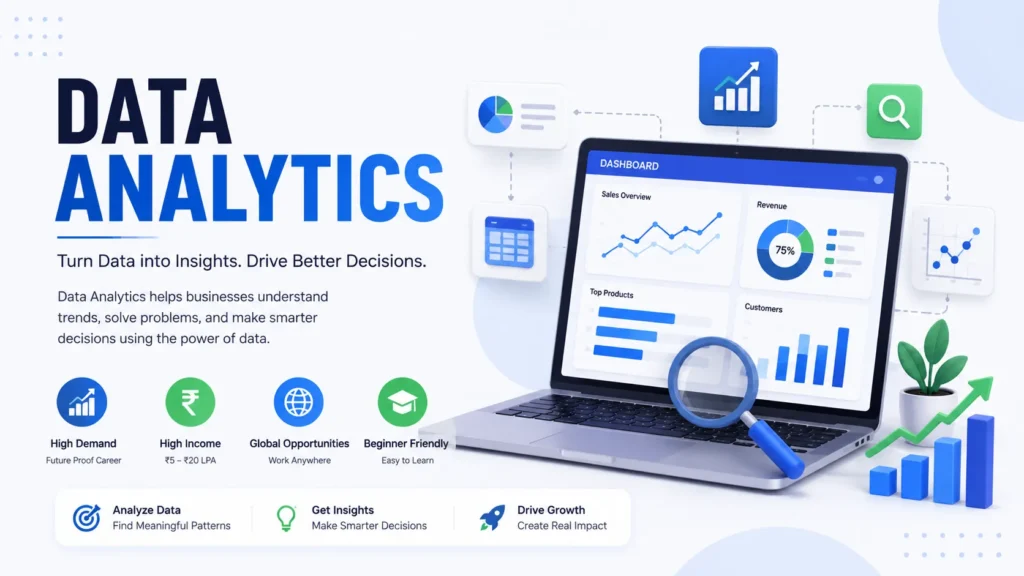
Data Analytics is one of the most in-demand skills in today’s digital economy.
Every business, whether it is a small startup or a multinational company, generates large amounts of data every day.
However, data alone has little value unless it can be understood and used to make better decisions.
This is where Data Analytics becomes important. Professionals in this field collect, organize, analyze, and interpret data to identify trends, solve business problems, and improve performance.
As organizations continue to rely on data-driven decision-making, the demand for skilled data analysts is growing rapidly across industries.
For students looking to build a future-ready career, Data Analytics is considered one of the most valuable high income skills because it combines technology, business understanding, and problem-solving abilities.
What is Data Analytics?
Data Analytics is the process of examining raw data to discover useful information, patterns, and insights that can help organizations make informed decisions.
For example, an e-commerce company may analyze customer purchase data to understand which products sell the most, while a hospital may use patient data to improve healthcare services.
A Data Analyst transforms complex information into easy-to-understand reports and visualizations that help managers and business owners make smarter decisions.
The field of Data Analytics is widely used in:
- Finance and Banking
- Healthcare
- E-commerce
- Marketing
- Education
- Manufacturing
- Government Organizations
As businesses continue to become more data-driven, Data Analytics remains one of the fastest-growing high income skills in the job market.
Tools Used by Data Analysts
Data Analysts use various tools and technologies to collect, clean, analyze, and present data.
Some of the most commonly used tools include:
Microsoft Excel
Excel remains one of the most widely used tools for data analysis, reporting, and dashboard creation.
SQL (Structured Query Language)
SQL helps analysts retrieve and manage data stored in databases.
Power BI
Power BI is a business intelligence tool used for creating interactive dashboards and visual reports.
Tableau
Tableau allows analysts to create advanced data visualizations that help businesses understand complex information quickly.
Python
Python is a programming language widely used for data cleaning, statistical analysis, automation, and machine learning.
Google Analytics
Used primarily in digital marketing, Google Analytics helps businesses understand website traffic and user behavior.
Learning these tools can significantly improve a student’s employability and prepare them for real-world industry requirements.
Career Scope
The career opportunities in Data Analytics are expanding rapidly because almost every industry depends on data for growth and decision-making.
Some popular career roles include:
- Data Analyst
- Business Analyst
- Reporting Analyst
- Financial Analyst
- Marketing Analyst
- Operations Analyst
- Data Visualization Specialist
- Junior Data Scientist
Professionals with Data Analytics skills can work in sectors such as:
- IT and Technology
- Banking and Finance
- Healthcare
- Retail
- Digital Marketing
- Logistics
- Consulting
Many companies also offer remote work opportunities for data professionals, allowing them to work with global organizations from anywhere.
As artificial intelligence and automation continue to grow, businesses will require even more professionals who can interpret and manage data effectively.
Salary Range
One of the biggest reasons why Data Analytics is considered among the top high income skills is its strong earning potential.
Approximate salary ranges in India are:
| Experience Level | Average Annual Salary |
|---|---|
| Fresher | ₹4 LPA – ₹7 LPA |
| 2–5 Years Experience | ₹7 LPA – ₹15 LPA |
| Senior Data Analyst | ₹15 LPA – ₹25 LPA |
| Analytics Manager | ₹20 LPA – ₹40 LPA+ |
Salary can vary depending on:
- Skills and certifications
- Industry
- Location
- Company size
- Technical expertise
Professionals who combine Data Analytics with skills like Artificial Intelligence, Data Science, or Machine Learning often command even higher salaries.
Suitable Students
Data Analytics is an excellent career option for students who enjoy working with information, solving problems, and identifying patterns.
This field may be particularly suitable for:
- Students who enjoy Mathematics and Statistics
- Individuals who like logical thinking
- Problem solvers who enjoy finding answers through data
- Commerce students interested in business insights
- Science students interested in technology and analytics
- Graduates looking for future-oriented career opportunities
The good news is that students do not necessarily need an advanced technical background to begin learning Data Analytics.
With consistent practice and the right learning approach, beginners can gradually build the skills required for this field.
For students seeking a career that offers strong growth potential, industry demand, and long-term stability, Data Analytics remains one of the most promising high income skills to learn in 2026 and beyond.
3. Artificial Intelligence (AI)
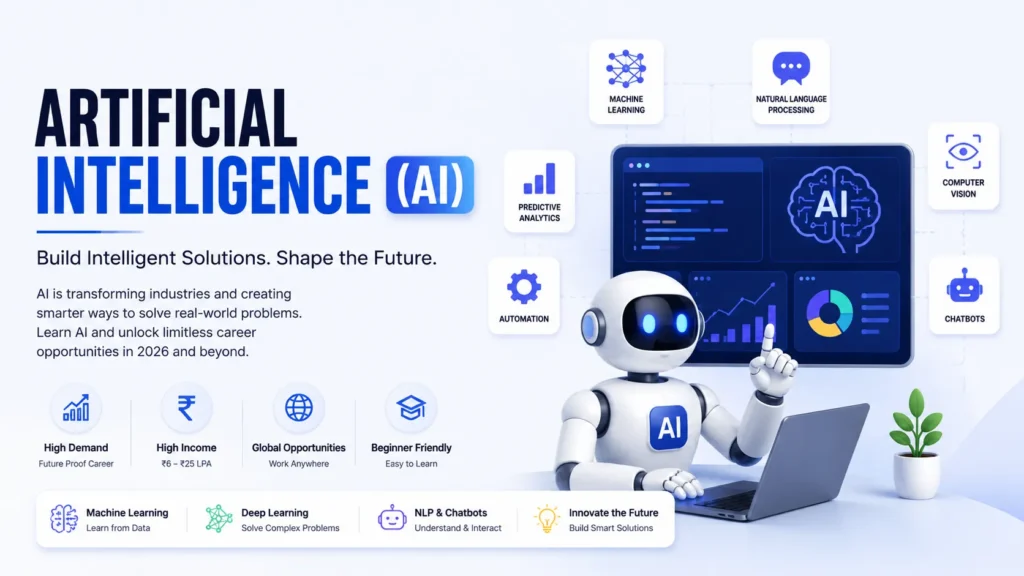
Artificial Intelligence (AI) is one of the fastest-growing technologies in the world and is transforming the way businesses operate.
From personalized recommendations on streaming platforms to virtual assistants and self-driving vehicles, AI is becoming a part of our daily lives.
As organizations continue to automate processes and use data-driven decision-making, the demand for AI professionals is increasing rapidly.
For students and professionals looking to build future-ready careers, Artificial Intelligence is among the most promising High Income Skills to learn in 2026.
The field offers excellent career opportunities, global demand, and attractive salary packages across various industries.
What is Artificial Intelligence?
Artificial Intelligence refers to the ability of machines and computer systems to perform tasks that normally require human intelligence.
These tasks include learning from data, recognizing patterns, understanding language, solving problems, and making decisions.
AI systems are designed to improve their performance over time by analyzing large amounts of information.
Today, AI is widely used in sectors such as healthcare, finance, education, e-commerce, manufacturing, and entertainment.
Some common examples of AI include:
- Chatbots and virtual assistants
- Voice recognition systems
- Recommendation engines
- Facial recognition technology
- Fraud detection systems
- Self-driving vehicles
As technology continues to evolve, Artificial Intelligence is expected to become even more important in both personal and professional environments.
Important AI Skills
To build a successful career in Artificial Intelligence, students should focus on developing a combination of technical and analytical skills.
Some of the most important AI skills include:
- Python Programming
- Machine Learning
- Deep Learning
- Natural Language Processing (NLP)
- Data Analysis
- Statistics and Mathematics
- Neural Networks
- AI Model Development
- Prompt Engineering
- AI Tools and Automation
Beginners can start with Python and basic Machine Learning concepts before progressing to advanced AI applications.
Developing these skills can open doors to some of the most rewarding and future-focused career opportunities available today.
Future Scope
The future of Artificial Intelligence looks extremely promising.
Governments, startups, and multinational companies are investing heavily in AI technologies to improve productivity, reduce costs, and create innovative solutions.
According to industry experts, AI-related job opportunities are expected to grow significantly over the next decade.
Businesses are increasingly looking for professionals who can build, manage, and optimize intelligent systems.
Some industries where AI is creating strong demand include:
- Healthcare
- Banking and Finance
- Education Technology
- Cyber Security
- E-commerce
- Manufacturing
- Digital Marketing
- Automotive Industry
As AI adoption continues to increase worldwide, professionals with AI expertise will remain highly valuable in the job market.
Salary Potential
Artificial Intelligence is considered one of the highest-paying career fields in the technology sector.
The salary depends on factors such as experience, technical expertise, certifications, project portfolio, and location.
Average Salary in India:
| Experience Level | Average Annual Salary |
|---|---|
| Entry Level | ₹6 LPA – ₹12 LPA |
| Mid-Level | ₹12 LPA – ₹25 LPA |
| Experienced Professionals | ₹25 LPA – ₹50 LPA+ |
Professionals specializing in Machine Learning, Generative AI, and AI Research often earn even higher salaries due to the growing demand and limited talent pool.
For students aiming to build a long-term career with strong earning potential, AI remains one of the most valuable High Income Skills available today.
Best Career Paths
Artificial Intelligence offers a wide range of career options depending on a person’s interests and strengths.
Some of the most popular AI career paths include:
- AI Engineer
- Machine Learning Engineer
- Data Scientist
- AI Research Scientist
- NLP Engineer
- Robotics Engineer
- Computer Vision Engineer
- AI Product Manager
- Business Intelligence Analyst
- AI Consultant
Students who enjoy technology, problem-solving, mathematics, and innovation may find Artificial Intelligence to be an excellent career choice.
With continuous learning, practical projects, and hands-on experience, AI professionals can build successful careers that remain relevant for many years to come.
As businesses increasingly rely on intelligent technologies, Artificial Intelligence is expected to stay among the most in-demand and rewarding High Income Skills in 2026 and beyond.
4. Web Development
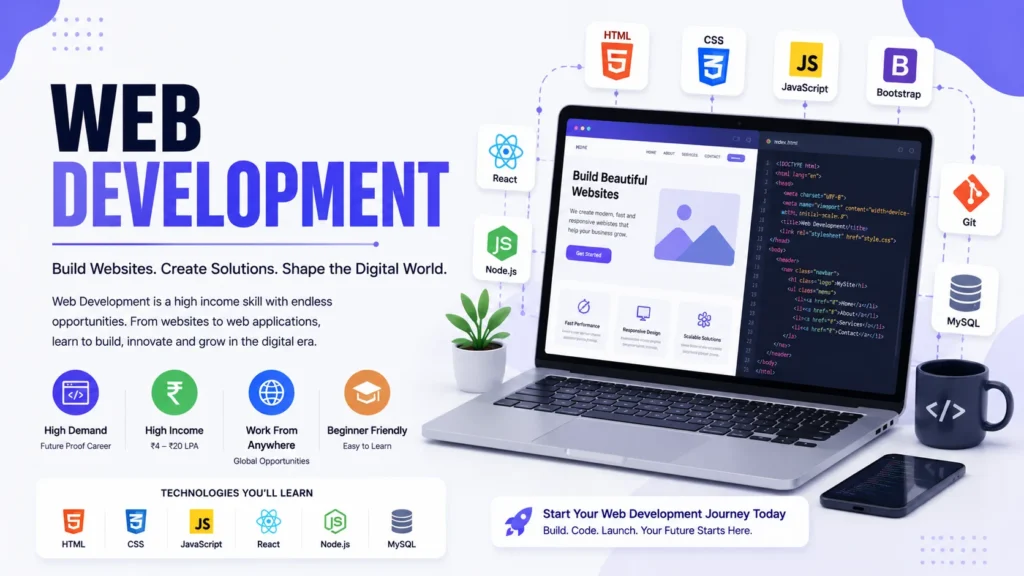
Web Development is one of the most valuable and future-focused skills in today’s digital world.
Every business, from small local shops to multinational companies, needs a website or web application to connect with customers, showcase services, and generate revenue.
As more businesses shift online, the demand for skilled web developers continues to grow.
For students and professionals looking to build a strong career in technology, web development offers excellent opportunities, competitive salaries, and the flexibility to work remotely or as a freelancer.
It is also one of the few skills that allows individuals to create their own websites, applications, and online businesses.
Whether you are interested in designing beautiful websites or building powerful web applications, web development can open the door to a rewarding and high-growth career.
Front-End vs Back-End Development
Before starting a career in web development, it is important to understand the two main areas of this field: Front-End Development and Back-End Development.
Front-End Development focuses on everything users see and interact with on a website.
Front-end developers create visually appealing layouts, navigation menus, buttons, forms, and responsive designs that work across different devices.
Examples of front-end tasks include:
- Designing website layouts
- Creating responsive mobile-friendly pages
- Improving user experience
- Building interactive website elements
Back-End Development, on the other hand, handles the behind-the-scenes functionality of a website.
It manages databases, servers, user authentication, and application logic that make websites work smoothly.
Examples of back-end tasks include:
- Managing website databases
- Processing user data
- Handling login and registration systems
- Creating APIs and server-side applications
Many professionals eventually become Full-Stack Developers, which means they have knowledge of both front-end and back-end development.
Essential Technologies
To become a successful web developer, students should learn the fundamental technologies used in modern website development.
Some of the most important technologies include:
HTML (HyperText Markup Language)
HTML forms the basic structure of every website. It defines headings, paragraphs, images, links, and other webpage elements.
CSS (Cascading Style Sheets)
CSS controls the appearance of a website, including colors, layouts, fonts, animations, and responsiveness.
JavaScript
JavaScript adds interactivity to websites, such as dynamic content, sliders, forms, and user interactions.
React.js
React is one of the most popular front-end libraries used for building modern web applications efficiently.
Node.js
Node.js allows developers to run JavaScript on the server side and build scalable web applications.
Databases
Technologies such as MySQL, PostgreSQL, and MongoDB help store and manage website data.
Git and GitHub
These tools help developers manage code, track changes, and collaborate with teams effectively.
Learning these technologies provides a strong foundation for building professional websites and web applications.
Career Opportunities
The growing digital economy has created numerous career opportunities for web developers across industries.
Some popular career options include:
- Front-End Developer
- Back-End Developer
- Full-Stack Developer
- Web Application Developer
- WordPress Developer
- E-commerce Website Developer
- UI Developer
- Software Engineer
- Freelance Web Developer
Web developers can find opportunities in:
- IT companies
- Startups
- E-commerce businesses
- Educational platforms
- Healthcare organizations
- Digital marketing agencies
- Government projects
One of the biggest advantages of web development is that professionals can work as freelancers and serve clients globally, creating multiple income streams.
With experience and specialization, developers can also move into leadership positions such as Technical Lead, Solution Architect, or Product Developer.
Salary Range
Web Development is considered one of the most rewarding high income skills because of its strong demand and career growth potential.
The average salary can vary based on experience, location, and technical expertise.
| Experience Level | Average Salary (India) |
|---|---|
| Beginner (0–2 Years) | ₹3 LPA – ₹6 LPA |
| Mid-Level (3–5 Years) | ₹6 LPA – ₹12 LPA |
| Experienced (5+ Years) | ₹12 LPA – ₹25 LPA+ |
| Freelancers | Variable based on projects |
Developers who specialize in advanced technologies such as React, Next.js, Node.js, Cloud Integration, or Full-Stack Development often command higher salaries and better job opportunities.
As businesses continue investing in digital transformation, web development is expected to remain one of the most in-demand high income skills for years to come, making it an excellent career choice for students and professionals seeking long-term growth.
5. Cyber Security
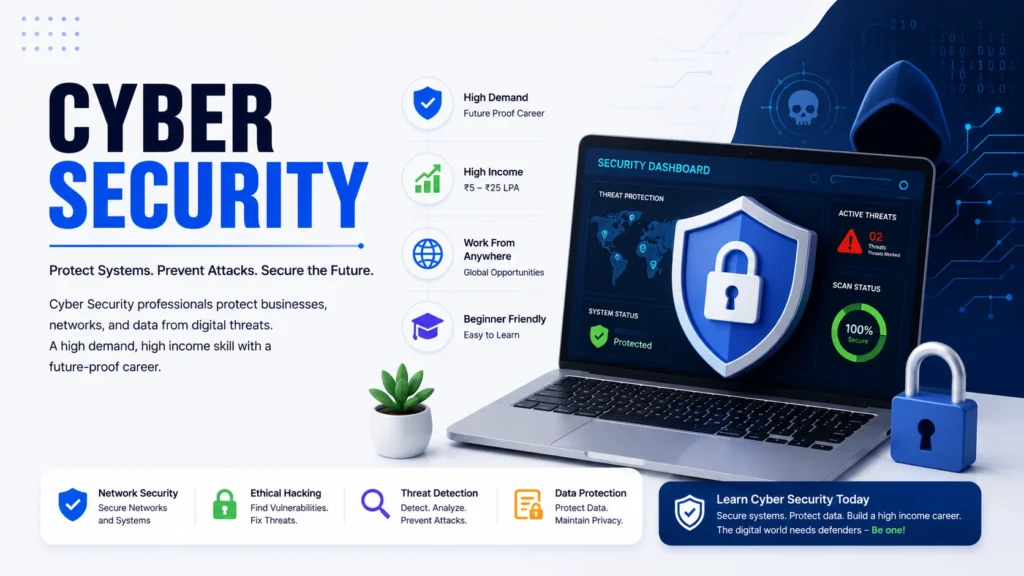
Cyber Security is one of the fastest-growing and most valuable skills in today’s digital world. As businesses, governments, banks, and individuals increasingly rely on technology, the need to protect sensitive information has become more important than ever.
From online banking and e-commerce websites to social media platforms and cloud storage systems, almost every digital service faces the risk of cyber threats.
Cyber Security professionals help organizations protect their data, networks, and systems from hackers, malware, ransomware attacks, and other security risks.
With the rapid growth of digital transformation, Cyber Security has emerged as one of the most in-demand high income skills globally. Organizations are actively searching for skilled professionals who can secure their digital infrastructure and minimize cyber risks.
For students looking for a future-proof career with strong growth potential, Cyber Security offers excellent opportunities across multiple industries.
Why Cyber Security is Important
In today’s interconnected world, cyber attacks are becoming more frequent and sophisticated.
A single security breach can result in financial losses, operational disruptions, and damage to a company’s reputation.
Cyber Security plays a critical role in protecting:
- Personal information and digital identities
- Banking and financial transactions
- Business data and customer records
- Government systems and national infrastructure
- Cloud-based applications and services
As organizations continue to digitize their operations, the demand for Cyber Security professionals is expected to grow significantly over the coming years.
Another major reason behind the popularity of Cyber Security is the increasing number of regulations related to data privacy and information security.
Companies must comply with these regulations, creating additional demand for qualified security experts.
For students and professionals seeking stable and future-oriented careers, Cyber Security remains one of the most promising high income skills to learn in 2026 and beyond.
Skills Required
Building a successful career in Cyber Security requires a combination of technical knowledge, analytical thinking, and problem-solving abilities.
Some of the most important skills include:
Network Security
Understanding how computer networks function and learning how to protect them from unauthorized access.
Ethical Hacking
Learning how hackers identify vulnerabilities so that organizations can fix security weaknesses before they are exploited.
Security Analysis
Monitoring systems, detecting threats, and responding to potential security incidents.
Risk Assessment
Evaluating security risks and implementing preventive measures to reduce vulnerabilities.
Cloud Security
Protecting data and applications hosted on cloud platforms such as AWS, Microsoft Azure, and Google Cloud.
Incident Response
Managing and investigating cyber attacks to minimize damage and restore normal operations.
In addition to technical expertise, Cyber Security professionals must stay updated with evolving threats and emerging technologies because the cybersecurity landscape changes constantly.
Career Opportunities
One of the biggest advantages of learning Cyber Security is the wide range of career opportunities available across industries.
Organizations in sectors such as banking, healthcare, technology, e-commerce, education, telecommunications, and government all require Cyber Security experts.
Popular career roles include:
- Cyber Security Analyst
- Information Security Specialist
- Ethical Hacker
- Penetration Tester
- Security Consultant
- Security Operations Center (SOC) Analyst
- Network Security Engineer
- Cloud Security Engineer
- Digital Forensics Expert
- Chief Information Security Officer (CISO)
Many Cyber Security professionals also work as independent consultants, helping businesses identify vulnerabilities and improve their security systems.
As remote work continues to grow, international job opportunities and remote positions are becoming increasingly common in this field.
This makes Cyber Security one of the most versatile high income skills for students who want long-term career flexibility.
Salary Expectations
Cyber Security professionals are among the highest-paid technology specialists due to the growing shortage of skilled talent worldwide.
Average salary ranges in India are:
| Experience Level | Average Annual Salary |
|---|---|
| Entry-Level | ₹5 LPA – ₹8 LPA |
| Mid-Level | ₹8 LPA – ₹15 LPA |
| Experienced Professional | ₹15 LPA – ₹30 LPA+ |
| Security Consultants & Specialists | ₹20 LPA – ₹40 LPA+ |
Salaries may vary depending on factors such as certifications, technical expertise, industry, and geographic location.
Professionals who specialize in advanced areas like Cloud Security, Ethical Hacking, Threat Intelligence, and Security Architecture often command significantly higher compensation packages.
With cyber threats continuing to rise globally, Cyber Security is expected to remain one of the most rewarding and future-proof high income skills for students and professionals seeking strong career growth in 2026 and beyond.
6. Graphic Design
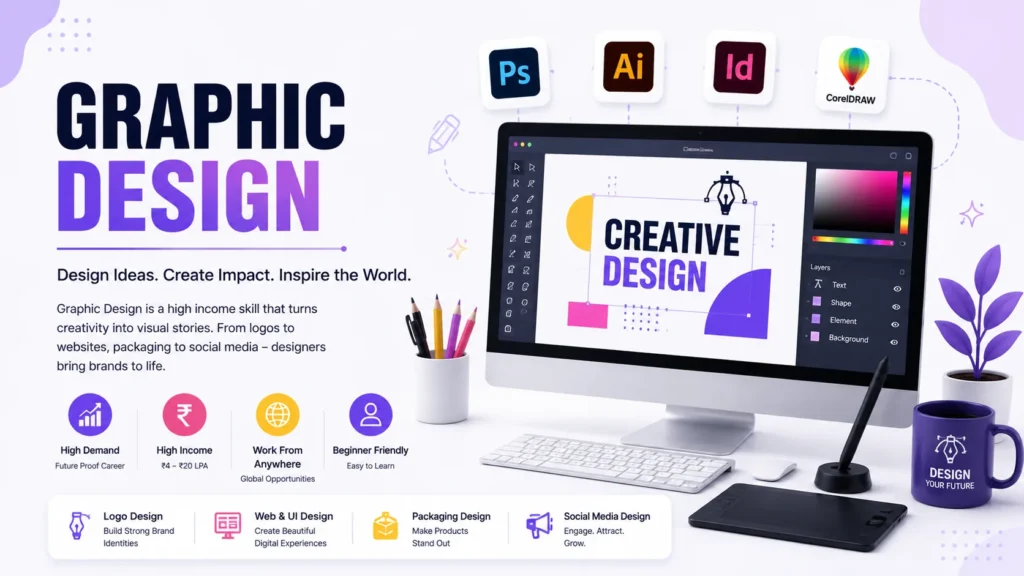
Graphic Design is one of the most popular creative skills in today’s digital world. Every business, brand, website, social media page, and marketing campaign requires visually appealing content to attract customers and communicate effectively.
As companies continue to invest in digital marketing and online branding, the demand for skilled graphic designers is growing rapidly. For students and professionals looking for a creative career path, graphic design is one of the most practical high income skills that can be learned without requiring an expensive degree.
Whether it is designing social media posts, advertisements, logos, brochures, websites, or product packaging, graphic designers play a crucial role in shaping a brand’s visual identity.
What Graphic Designers Do
Graphic designers create visual content that helps businesses communicate their message clearly and effectively.
Their work combines creativity, design principles, and technology to produce engaging graphics for both digital and print platforms.
Some common responsibilities of graphic designers include:
- Creating logos and brand identity materials
- Designing social media graphics
- Developing marketing and advertising creatives
- Creating brochures, posters, and banners
- Designing website and app visuals
- Producing infographics and presentation designs
- Developing packaging designs for products
A graphic designer’s goal is not just to make something look attractive but also to ensure that the design effectively communicates information and encourages user engagement.
With businesses increasingly focusing on online marketing, graphic design has become one of the most valuable high income skills for creative individuals.
Tools Used
Modern graphic designers use a variety of professional design tools to create high-quality visual content.
Learning these tools can significantly improve job opportunities and freelancing potential.
Some of the most commonly used graphic design tools include:
Adobe Photoshop – Image editing and creative design
Adobe Illustrator – Vector graphics and logo design
Canva – Beginner-friendly design platform
Figma – Collaborative design and UI creation
Adobe InDesign – Print and publication design
CorelDRAW – Professional vector graphic design
Beginners often start with Canva due to its ease of use and then gradually move to professional software such as Photoshop and Illustrator as their skills improve.
Understanding design tools along with design principles can help students build a strong portfolio and increase their earning potential.
Career Scope
The career opportunities in graphic design continue to expand as businesses increasingly rely on digital communication and branding.
Graphic designers can work in multiple industries, including:
- Digital marketing agencies
- Advertising companies
- Media and publishing houses
- E-commerce businesses
- Educational institutions
- Startups and technology companies
- Corporate branding departments
Professionals with graphic design expertise can pursue various roles such as:
- Graphic Designer
- Visual Designer
- Brand Designer
- Creative Designer
- Marketing Designer
- Social Media Designer
- Motion Graphics Designer
Many graphic designers also choose freelancing, allowing them to work with clients worldwide and build an independent income source.
Because of this flexibility, graphic design remains one of the most practical high income skills for students seeking creative career opportunities.
Salary Potential
The earning potential in graphic design depends on skills, experience, portfolio quality, and specialization.
Typical salary ranges in India are:
| Experience Level | Average Annual Salary |
|---|---|
| Beginner (0–2 Years) | ₹3 LPA – ₹5 LPA |
| Mid-Level (3–5 Years) | ₹5 LPA – ₹8 LPA |
| Experienced Professional | ₹8 LPA – ₹15 LPA+ |
| Freelancers & Specialists | Variable Based on Projects |
Designers who specialize in areas such as branding, UI/UX design, motion graphics, and advertising often command higher salaries and premium project fees.
As businesses continue to invest heavily in digital marketing and brand development, graphic design is expected to remain one of the most relevant and rewarding high income skills in 2026 and beyond.
Who Should Consider Graphic Design?
Graphic design is an excellent career option for students who:
- Enjoy creativity and visual storytelling
- Have an interest in branding and marketing
- Like working with digital tools
- Want freelancing opportunities
- Prefer project-based work over traditional desk jobs
For students looking to combine creativity with strong earning potential, graphic design can provide a stable and future-ready career path.
7. Video Editing and Content Creation
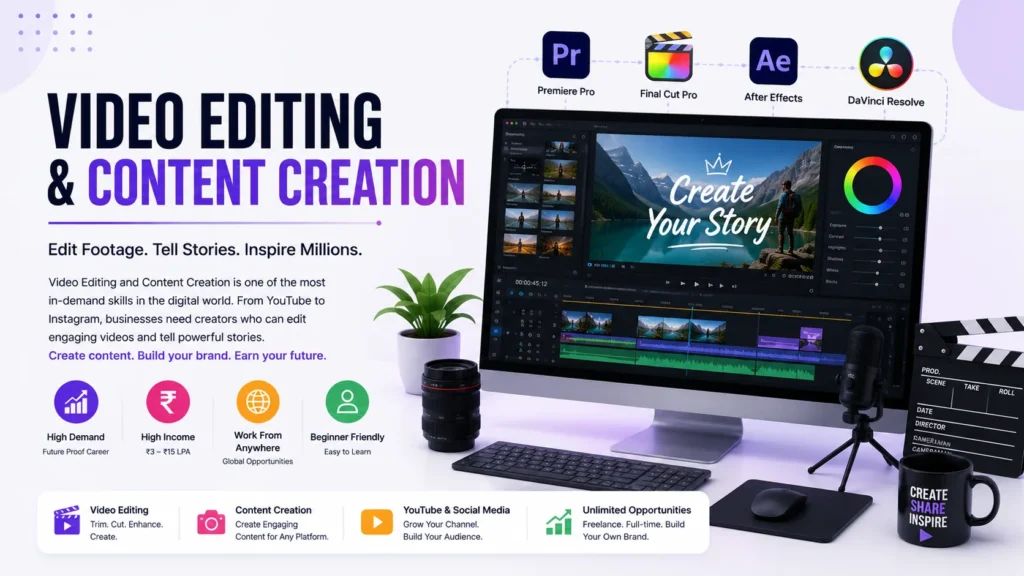
Video Editing and Content Creation have become some of the most valuable career skills in today’s digital world.
With the rapid growth of platforms like YouTube, Instagram, Facebook, LinkedIn, and OTT services, businesses and creators constantly need professionals who can create engaging visual content.
Whether it is a short Instagram Reel, a YouTube video, an online advertisement, or an educational course, video content is now one of the most effective ways to communicate with an audience.
As a result, video editing has emerged as one of the most practical high income skills for students and professionals looking to build a career in the digital economy.
Unlike many traditional career paths, video editing offers multiple opportunities including freelancing, remote work, content creation, and full-time employment.
Students can start learning this skill with basic tools and gradually build expertise through practice and real-world projects.
Growing Demand in Digital Media
The demand for video content has increased dramatically over the last few years.
Businesses, educational institutions, influencers, startups, and large corporations are investing heavily in video marketing because it attracts more attention and engagement than text-based content.
Some major factors driving this demand include:
- Growth of YouTube and short-form video platforms
- Increasing popularity of online learning and webinars
- Rising use of video advertisements by businesses
- Expansion of digital marketing across industries
- Growing demand for personal branding and influencer content
According to industry trends, video content is expected to dominate online communication for the foreseeable future.
This makes Video Editing and Content Creation one of the most future-ready high income skills to learn in 2026.
For students who enjoy creativity, storytelling, and technology, this field offers excellent long-term career opportunities.
Required Skills
To become a successful video editor or content creator, students should develop both technical and creative abilities.
Some important skills include:
- Video Editing Fundamentals
- Storytelling Techniques
- Audio Editing
- Motion Graphics Basics
- Thumbnail Design
- Content Planning
- Social Media Understanding
- Visual Communication
Popular tools used by professionals include:
- Adobe Premiere Pro
- Final Cut Pro
- DaVinci Resolve
- CapCut
- Canva
- Adobe After Effects
Apart from learning software, students should focus on understanding audience psychology and content trends.
A well-edited video is not just visually appealing—it also keeps viewers engaged and delivers a clear message.
Consistent practice and portfolio building play a significant role in mastering this high income skill.
Career Opportunities
One of the biggest advantages of Video Editing and Content Creation is the variety of career paths available.
Professionals in this field can work as:
- Video Editor
- YouTube Editor
- Social Media Content Creator
- Motion Graphics Designer
- Video Marketing Specialist
- Content Strategist
- Multimedia Producer
- Freelance Video Editor
Industries hiring video editing professionals include:
- Digital Marketing Agencies
- Media and Entertainment
- Education and E-Learning
- Corporate Businesses
- Advertising Agencies
- News and Broadcasting
- Personal Branding and Influencer Management
Students can begin by working on small freelance projects and gradually move toward larger assignments as they gain experience and build a strong portfolio.
Earnings Potential
Video Editing and Content Creation offer strong income potential, especially for professionals who continuously improve their skills and stay updated with industry trends.
Typical earning ranges in India are:
| Experience Level | Average Annual Income |
|---|---|
| Beginner | ₹3 LPA – ₹5 LPA |
| Intermediate | ₹5 LPA – ₹10 LPA |
| Experienced Professional | ₹10 LPA – ₹20 LPA+ |
| Freelancers | Project-based earnings vary significantly |
Many skilled editors earn additional income through:
- Freelancing platforms
- YouTube monetization
- Content creation services
- Digital marketing projects
- Personal brand development
As video consumption continues to grow worldwide, Video Editing and Content Creation are expected to remain among the most rewarding high income skills for students seeking flexible and future-focused career opportunities.
Pro Tip for Students: Focus on building a portfolio rather than collecting certificates.
Employers and clients often prefer to see your actual work samples, editing style, and creativity before hiring you. A strong portfolio can open more opportunities than multiple certifications alone.
8. Cloud Computing
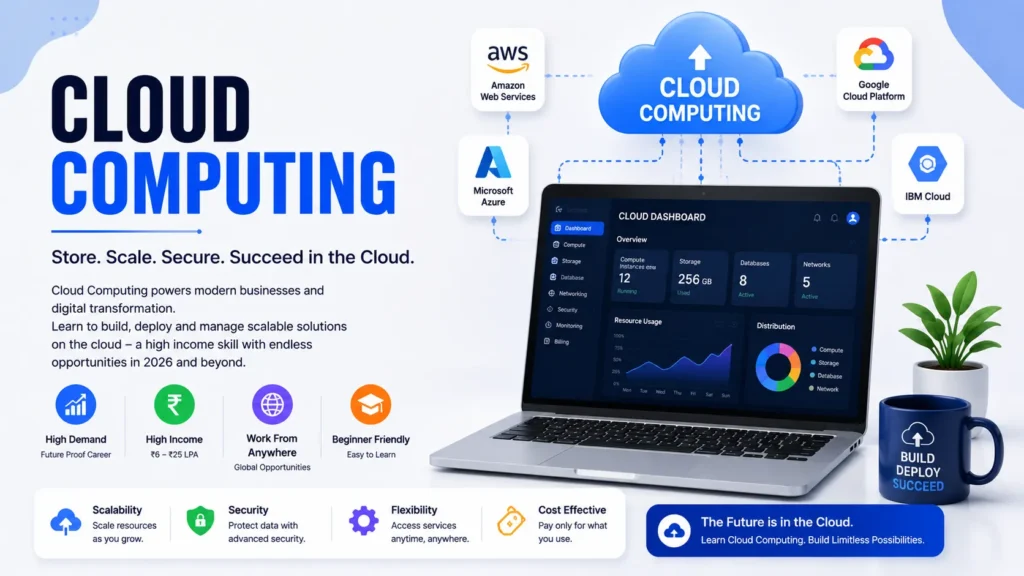
Cloud Computing has become one of the most valuable and future-focused skills in today’s technology-driven world.
As businesses increasingly move their operations online, the demand for professionals who can manage, secure, and optimize cloud infrastructure continues to grow rapidly.
From startups to multinational corporations, organizations rely on cloud services to store data, run applications, improve scalability, and reduce operational costs.
This growing adoption makes Cloud Computing one of the most promising high income skills to learn in 2026.
Whether you are a student exploring career options after 12th or a professional looking to upgrade your skills, Cloud Computing offers excellent career opportunities across multiple industries.
What is Cloud Computing?
Cloud Computing refers to the delivery of computing services such as servers, storage, databases, networking, software, and analytics over the internet instead of relying on physical hardware located on-site.
In simple terms, cloud technology allows businesses and individuals to access computing resources whenever needed without purchasing and maintaining expensive infrastructure.
For example:
- Storing files on Google Drive
- Watching movies on Netflix
- Hosting websites online
- Using online business software
All these services operate using cloud technology.
Cloud Computing provides several advantages:
- Reduced infrastructure costs
- Better data security
- Easy scalability
- Faster deployment of applications
- Improved business continuity
As digital transformation accelerates globally, companies are investing heavily in cloud solutions, making Cloud Computing one of the most sought-after high income skills in the modern job market.
Popular Cloud Platforms
Cloud professionals typically work with industry-leading cloud service providers. Learning one or more of these platforms can significantly improve career prospects.
Amazon Web Services (AWS)
AWS is the world’s largest cloud platform and offers hundreds of services including computing, storage, networking, machine learning, and security solutions.
Popular AWS services include:
- EC2 (Virtual Servers)
- S3 (Cloud Storage)
- Lambda (Serverless Computing)
- RDS (Database Management)
Microsoft Azure
Microsoft Azure is widely used by enterprises and government organizations.
Key Azure services include:
- Virtual Machines
- Azure Active Directory
- Azure SQL Database
- Azure DevOps
Google Cloud Platform (GCP)
Google Cloud is known for its strong capabilities in:
- Artificial Intelligence
- Data Analytics
- Machine Learning
- Big Data Processing
Many organizations prefer Google Cloud for data-intensive projects and AI-based applications.
Other Cloud Platforms
Additional cloud providers include:
- Oracle Cloud
- IBM Cloud
- Alibaba Cloud
- DigitalOcean
While beginners can start with any platform, AWS, Azure, and Google Cloud currently dominate the global cloud computing market.
Career Scope
Cloud Computing offers a wide range of career opportunities because almost every industry now depends on cloud-based infrastructure.
Some of the most popular job roles include:
Cloud Engineer
Cloud Engineers design, implement, and maintain cloud infrastructure for organizations.
Cloud Architect
Cloud Architects create cloud strategies and design secure, scalable systems that support business operations.
Cloud Security Specialist
These professionals focus on protecting cloud environments from cyber threats and ensuring compliance with security standards.
DevOps Engineer
DevOps Engineers use cloud technologies to automate software deployment, testing, and system management.
Site Reliability Engineer (SRE)
SREs ensure cloud applications remain available, reliable, and high-performing.
Cloud Consultant
Cloud Consultants help businesses migrate from traditional systems to cloud-based environments.
Industries hiring cloud professionals include:
- Information Technology
- Banking and Finance
- Healthcare
- E-Commerce
- Education
- Telecommunications
- Government Organizations
With digital transformation becoming a priority across sectors, Cloud Computing remains one of the most future-proof high income skills available today.
Salary Potential
One of the biggest reasons students and professionals are attracted to Cloud Computing is its strong earning potential.
The salary depends on factors such as:
- Technical expertise
- Certifications
- Experience level
- Cloud platform specialization
- Company size
Average Salary in India
| Experience Level | Average Annual Salary |
|---|---|
| Beginner (0–2 Years) | ₹5 LPA – ₹10 LPA |
| Mid-Level (3–6 Years) | ₹10 LPA – ₹20 LPA |
| Experienced Professional | ₹20 LPA – ₹35 LPA+ |
| Cloud Architect | ₹30 LPA – ₹50 LPA+ |
Global Opportunities
Cloud professionals also have access to:
- Remote jobs
- International projects
- Freelancing opportunities
- Consulting assignments
As organizations continue investing in cloud infrastructure, salary growth in this field is expected to remain strong throughout 2026 and beyond.
For students looking to build a future-ready career, Cloud Computing offers an excellent combination of high demand, job stability, global opportunities, and long-term income potential.
It is undoubtedly one of the most valuable high income skills for the coming decade.
9. UI/UX Design
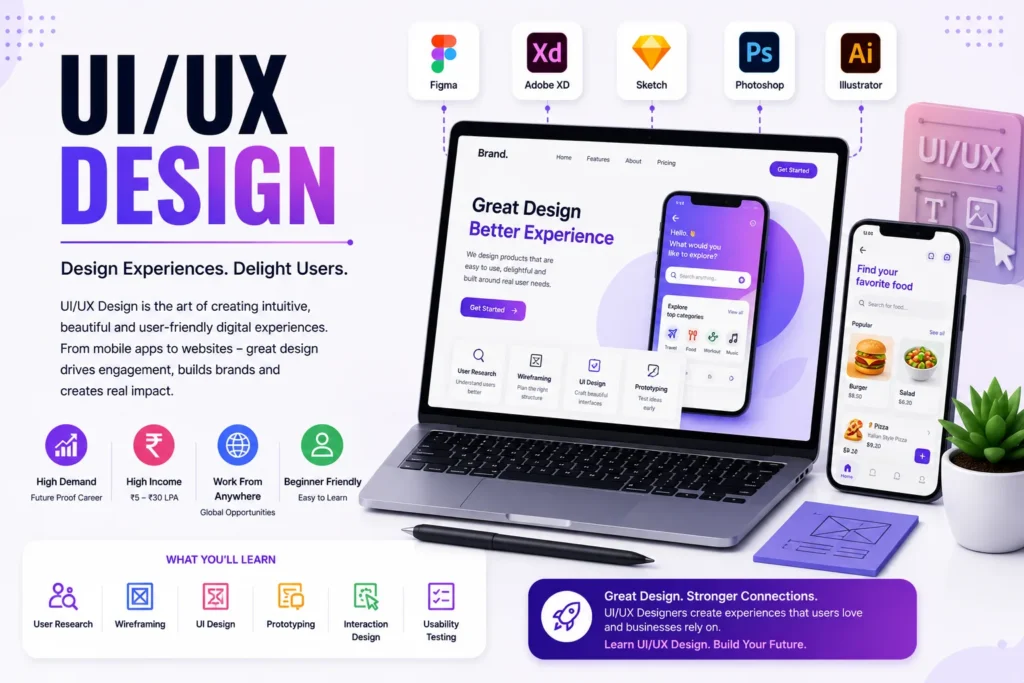
UI/UX Design is one of the fastest-growing career fields in today’s digital world. As businesses increasingly focus on websites, mobile apps, and digital products, the demand for professionals who can create user-friendly experiences continues to rise.
Among the various High Income Skills available in 2026, UI/UX Design stands out because it combines creativity, problem-solving, psychology, and technology.
Companies understand that a well-designed product not only attracts users but also improves customer satisfaction and business growth.
Whether it’s an e-commerce website, a banking application, an educational platform, or a healthcare app, every digital product needs a smooth and engaging user experience.
This is why UI/UX Designers are becoming essential members of modern product development teams.
Understanding User Experience
Before learning UI/UX Design, it is important to understand the difference between UI and UX.
UI (User Interface) refers to the visual elements that users interact with, such as buttons, menus, layouts, icons, and colors.
UX (User Experience) focuses on how users feel while using a product. It aims to make the product simple, intuitive, efficient, and enjoyable.
For example, imagine two online shopping websites:
- One website is confusing and difficult to navigate.
- The other is simple, fast, and easy to use.
Most customers will naturally prefer the second website because it provides a better user experience.
A UI/UX Designer studies user behavior and designs products that solve problems while keeping users engaged.
This ability to improve customer satisfaction makes UI/UX Design one of the most valuable High Income Skills in the digital economy.
Skills and Tools
To become a successful UI/UX Designer, students need to develop both technical and creative skills.
Essential Skills
- User Research
- Wireframing
- Prototyping
- Information Architecture
- Visual Design
- Interaction Design
- Problem Solving
- Communication Skills
- Design Thinking
Popular UI/UX Design Tools
- Figma
- Adobe XD
- Sketch
- InVision
- Miro
- Photoshop
- Illustrator
Students should begin with understanding design principles and user behavior before moving on to advanced tools and software.
Building practical projects and case studies is equally important because employers often evaluate a designer’s portfolio more than academic qualifications.
Career Opportunities
The demand for UI/UX professionals is growing across multiple industries because nearly every business today relies on digital products.
Popular career options include:
- UI Designer
- UX Designer
- Product Designer
- Interaction Designer
- UX Researcher
- Information Architect
- Design Consultant
- Mobile App Designer
- Web Experience Designer
Industries hiring UI/UX professionals include:
- Information Technology (IT)
- E-commerce
- FinTech
- Healthcare
- Education Technology (EdTech)
- Gaming
- Media and Entertainment
- SaaS Companies
- Startups
One major advantage of UI/UX Design is flexibility. Professionals can work as:
- Full-time employees
- Freelancers
- Remote designers
- Independent consultants
- Agency professionals
This flexibility makes UI/UX Design one of the most practical High Income Skills for students who want multiple career opportunities.
Salary Range
UI/UX Design offers attractive earning potential, especially for professionals who continuously improve their skills and build strong portfolios.
| Experience Level | Expected Salary |
|---|---|
| Beginner (0–2 Years) | ₹4 LPA – ₹8 LPA |
| Mid-Level (3–5 Years) | ₹8 LPA – ₹15 LPA |
| Experienced (5+ Years) | ₹15 LPA – ₹30 LPA+ |
Freelancing Income Potential
Freelance UI/UX Designers can earn:
- ₹10,000–₹50,000 per project for beginners
- ₹50,000–₹2,00,000+ per project for experienced designers
International clients often pay significantly higher rates, making UI/UX Design a strong choice for remote work and freelancing.
As digital transformation continues across industries, UI/UX Design is expected to remain one of the most sought-after High Income Skills in 2026 and beyond.
Students who enjoy creativity, technology, and problem-solving can build a rewarding and future-ready career in this field.
10. Data Science
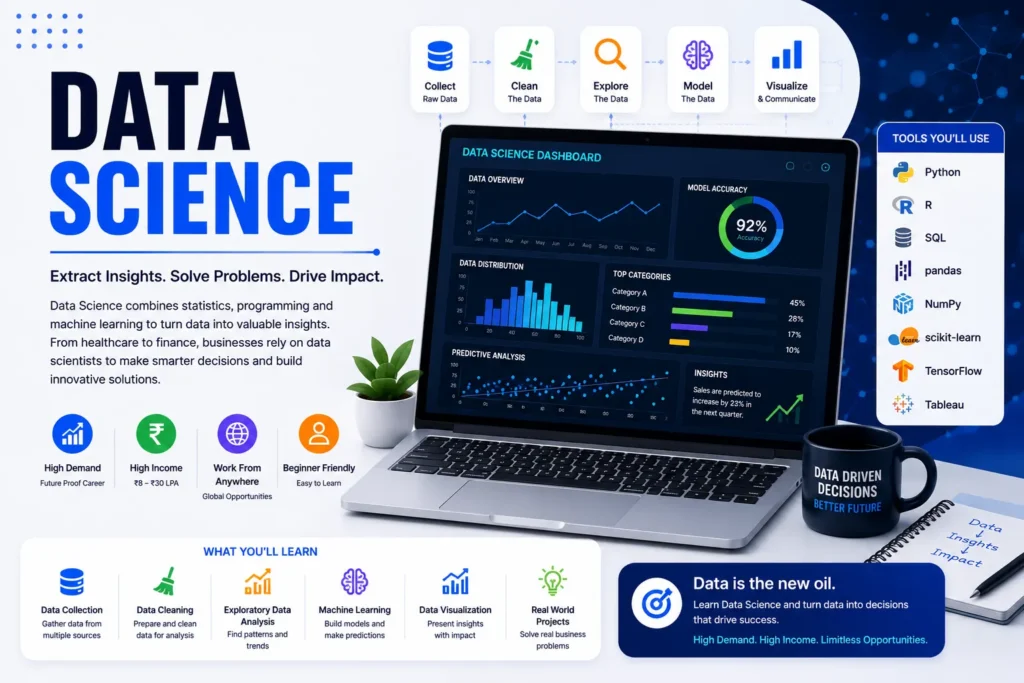
Data Science is one of the most sought-after career fields in today’s digital economy.
As businesses generate massive amounts of data every day, there is a growing need for professionals who can analyze this information and convert it into meaningful insights.
From helping companies understand customer behavior to predicting future trends, data science plays a crucial role in decision-making across industries.
For students and professionals looking to build a future-ready career, Data Science offers excellent opportunities, strong job demand, and attractive salary packages.
It combines technology, statistics, and business understanding to solve real-world problems using data.
What Does a Data Scientist Do?
A Data Scientist is responsible for collecting, analyzing, and interpreting large volumes of data to help organizations make informed decisions.
Their work typically involves:
- Gathering data from different sources
- Cleaning and organizing raw data
- Identifying patterns and trends
- Building predictive models
- Creating reports and visualizations
- Supporting business strategy with data-driven insights
For example, an e-commerce company may use data scientists to predict which products customers are most likely to buy, while healthcare organizations use data science to improve patient care and treatment planning.
Because almost every industry relies on data today, the demand for skilled data scientists continues to grow worldwide.
Required Skills
To build a successful career in Data Science, students should focus on developing both technical and analytical skills.
Some of the most important skills include:
- Python Programming
- SQL and Database Management
- Statistics and Probability
- Machine Learning
- Data Visualization
- Data Cleaning and Processing
- Critical Thinking
- Problem-Solving Skills
Popular tools used by Data Scientists include:
- Python
- R Programming
- Tableau
- Power BI
- Excel
- TensorFlow
- Scikit-Learn
Beginners do not need to learn everything at once. Starting with Python, statistics, and basic data analysis can provide a strong foundation for future growth.
Career Growth
Data Science offers one of the strongest career growth paths among all modern High Income Skills.
A typical career progression may look like this:
Data Analyst → Junior Data Scientist → Data Scientist → Senior Data Scientist → Lead Data Scientist → Data Science Manager → Chief Data Officer
As professionals gain experience and develop expertise in areas such as Artificial Intelligence, Machine Learning, and Big Data Analytics, they can move into leadership positions and highly specialized roles.
Industries actively hiring Data Science professionals include:
- Information Technology
- Banking and Finance
- Healthcare
- E-commerce
- Telecommunications
- Manufacturing
- Consulting
- Education Technology
With the rapid adoption of Artificial Intelligence and automation, Data Science is expected to remain one of the most valuable High Income Skills for many years to come.
Salary Potential
One of the biggest reasons students are attracted to Data Science is its excellent earning potential.
The average salary range in India is:
| Experience Level | Average Annual Salary |
|---|---|
| Entry Level | ₹6 LPA – ₹10 LPA |
| Mid-Level | ₹12 LPA – ₹20 LPA |
| Experienced Professional | ₹20 LPA – ₹35 LPA |
| Senior Data Scientist | ₹35 LPA+ |
Professionals working with advanced technologies such as Artificial Intelligence, Machine Learning, and Big Data often earn significantly higher salaries.
In addition to full-time jobs, Data Scientists can also work as consultants, freelancers, or remote professionals for international companies, creating multiple income opportunities.
For students seeking a future-proof career with strong demand, continuous learning opportunities, and excellent income potential, Data Science remains one of the best High Income Skills to learn in 2026.
Comparison Table of the Top 10 High Income Skills
Choosing the right skill is often confusing because students tend to focus only on salary figures. However, a smart career decision should also consider factors such as learning difficulty, time required to gain proficiency, future demand, and personal interest.
The table below provides a quick comparison of the most popular High Income Skills in 2026. It can help students, graduates, and working professionals understand which skill aligns best with their career goals and learning capacity.
Whether you are planning to start a freelancing career, secure a high-paying job, or build your own business, understanding these differences can make your decision much easier.
Salary Comparison
One of the biggest reasons students explore High Income Skills is the potential to earn significantly more than traditional entry-level jobs.
However, salary depends on several factors including experience, expertise, location, portfolio strength, and industry demand.
The following table provides estimated salary ranges for beginners to experienced professionals in India.
| Skill | Average Annual Salary (India) |
|---|---|
| Digital Marketing | ₹4 LPA – ₹12 LPA |
| Data Analytics | ₹6 LPA – ₹15 LPA |
| Artificial Intelligence (AI) | ₹8 LPA – ₹25 LPA |
| Web Development | ₹5 LPA – ₹15 LPA |
| Cyber Security | ₹7 LPA – ₹20 LPA |
| Graphic Design | ₹3 LPA – ₹10 LPA |
| Video Editing & Content Creation | ₹3 LPA – ₹12 LPA |
| Cloud Computing | ₹8 LPA – ₹25 LPA |
| UI/UX Design | ₹6 LPA – ₹18 LPA |
| Data Science | ₹10 LPA – ₹30 LPA |
Important Note: Salary should never be the only factor when choosing a skill.
A person who enjoys and masters a particular skill often earns much more than someone who chooses a field solely based on income potential.
Learning Difficulty Comparison
Not all High Income Skills require the same level of effort or technical knowledge.
Some skills can be learned relatively quickly, while others demand strong analytical thinking, coding abilities, or advanced problem-solving skills.
Understanding the learning difficulty can help students choose a realistic starting point based on their current knowledge and interests.
| Skill | Learning Difficulty |
|---|---|
| Digital Marketing | Easy to Medium |
| Data Analytics | Medium |
| Artificial Intelligence (AI) | Hard |
| Web Development | Medium |
| Cyber Security | Medium to Hard |
| Graphic Design | Easy to Medium |
| Video Editing & Content Creation | Easy to Medium |
| Cloud Computing | Hard |
| UI/UX Design | Medium |
| Data Science | Hard |
Easy to Medium Skills
These skills are generally beginner-friendly and suitable for students who are just starting their career journey:
- Digital Marketing
- Graphic Design
- Video Editing
- Basic UI Design
These fields often focus more on creativity, communication, and practical execution than advanced technical knowledge.
Medium Difficulty Skills
Students willing to invest more time in learning and practice can explore:
- Data Analytics
- Web Development
- UI/UX Design
- Cyber Security
These careers require structured learning but offer excellent growth opportunities.
High Difficulty Skills
The following skills usually require long-term dedication and continuous learning:
- Artificial Intelligence
- Data Science
- Cloud Computing
Although challenging, these fields are among the fastest-growing and highest-paying career options worldwide.
Time Required to Learn
One of the most common questions students ask is, “How long will it take to learn a skill and start earning from it?”
The answer depends on your learning speed, consistency, and practical exposure. However, the table below provides a general estimate for developing job-ready skills.
| Skill | Estimated Learning Time |
|---|---|
| Digital Marketing | 4–6 Months |
| Data Analytics | 6–12 Months |
| Artificial Intelligence (AI) | 1–2 Years |
| Web Development | 6–12 Months |
| Cyber Security | 6–12 Months |
| Graphic Design | 3–6 Months |
| Video Editing & Content Creation | 3–6 Months |
| Cloud Computing | 1–2 Years |
| UI/UX Design | 6–10 Months |
| Data Science | 1–2 Years |
Skills You Can Learn Within 6 Months
If your goal is to start freelancing, internships, or part-time work quickly, consider:
- Graphic Design
- Video Editing
- Digital Marketing
These skills offer relatively faster entry into the job market.
Skills That Require 6–12 Months
Students seeking a balance between learning time and earning potential may choose:
- Data Analytics
- Web Development
- Cyber Security
- UI/UX Design
These fields provide strong career opportunities while requiring a moderate learning commitment.
Long-Term Skills for Maximum Career Growth
For students interested in advanced technology careers, the following skills can provide exceptional future opportunities:
- Artificial Intelligence
- Data Science
- Cloud Computing
Although they require more time and effort, they are expected to remain among the most valuable High Income Skills for many years to come.
Choosing among these High Income Skills becomes easier when you compare salary potential, learning difficulty, and time investment together.
Instead of following trends blindly, focus on selecting a skill that matches your interests, strengths, and long-term career goals.
A well-chosen skill can create opportunities for jobs, freelancing, remote work, and even entrepreneurship in the future.
How Students Can Choose the Right Skill
Choosing the right skill is one of the most important decisions students can make in today’s competitive world.
While many students focus only on courses, degrees, or trending careers, long-term success often depends on developing the right skills that match both personal interests and market demand.
The growing importance of High Income Skills has created countless opportunities for students to build rewarding careers. However, not every skill is suitable for everyone.
A skill that works well for one person may not be the best choice for another.
Before investing time, effort, and money into learning a new skill, students should carefully evaluate their interests, strengths, future opportunities, and career goals.
The following factors can help students make a smarter and more informed decision.
Understand Your Interests
The first step in choosing the right skill is understanding what genuinely interests you.
Many students make the mistake of selecting a skill simply because it is popular, highly paid, or recommended by friends.
While market demand is important, learning becomes much easier and more enjoyable when you are interested in the subject.
For example:
- Students who enjoy creativity may prefer Graphic Design, UI/UX Design, or Content Creation.
- Students who enjoy technology may find Web Development or Cyber Security more exciting.
- Students who like analyzing information may perform well in Data Analytics or Data Science.
When you are interested in a skill, you are more likely to stay consistent during the learning process.
This consistency often leads to better results and long-term career growth.
Ask yourself questions such as:
- What subjects do I enjoy learning?
- What activities keep me engaged for hours?
- Which tasks feel exciting rather than stressful?
The answers can provide valuable clues about which High Income Skills may be the right fit for you.
Evaluate Your Strengths
Interests are important, but they should be supported by your natural strengths and abilities.
Every student has unique talents. Some excel at communication, while others are better at logical thinking, creativity, problem-solving, or technical work.
Understanding your strengths can help you choose a skill where you can perform better and achieve success more quickly.
For example:
| Strength | Suitable Skills |
|---|---|
| Communication | Digital Marketing, Sales, Content Writing |
| Creativity | Graphic Design, UI/UX Design, Video Editing |
| Analytical Thinking | Data Analytics, Data Science |
| Technical Problem Solving | Cyber Security, Web Development |
| Research Skills | Artificial Intelligence, Data Science |
A simple self-assessment can help identify areas where you naturally perform well. Parents and teachers can also provide valuable feedback regarding a student’s strengths.
Choosing skills that align with your abilities can significantly improve learning speed and career satisfaction.
Consider Future Demand
While passion and strengths are important, students should also evaluate the future demand of a skill.
Technology, automation, and digital transformation are changing the job market rapidly.
Some traditional roles are declining, while new opportunities are emerging every year.
Before selecting a skill, ask:
- Will this skill be relevant five years from now?
- Are companies actively hiring professionals with this skill?
- Is the industry growing or shrinking?
Some of the most in-demand High Income Skills expected to remain valuable in the coming years include:
- Artificial Intelligence (AI)
- Data Analytics
- Data Science
- Cyber Security
- Cloud Computing
- Digital Marketing
- Web Development
- UI/UX Design
Skills that solve real business problems tend to remain valuable even as industries evolve.
Students who focus on future-ready skills often gain better career opportunities, higher salaries, and greater job security.
Assess Learning Time and Costs
Every skill requires an investment of time and effort.
Some skills can be learned relatively quickly, while others may require months or even years of dedicated practice.
Understanding the learning commitment beforehand helps students set realistic expectations.
For example:
| Skill | Estimated Learning Time |
|---|---|
| Graphic Design | 3–6 Months |
| Video Editing | 3–6 Months |
| Digital Marketing | 4–8 Months |
| Web Development | 6–12 Months |
| Data Analytics | 6–12 Months |
| Cyber Security | 6–12 Months |
| Artificial Intelligence | 1–2 Years |
| Data Science | 1–2 Years |
In addition to time, students should also consider:
- Course fees
- Certification costs
- Software requirements
- Internet and device availability
- Project and portfolio development expenses
Fortunately, many learning resources are now available online at affordable prices, making skill development more accessible than ever before.
Choosing a skill that fits your available time and resources can prevent frustration and increase your chances of success.
Match Skills With Career Goals
The final step is connecting the skill with your long-term career objectives.
Every student has different goals. Some want a high-paying corporate job, while others dream of freelancing, remote work, entrepreneurship, or building their own business.
The skill you choose should support the career path you want to pursue.
For example:
- If your goal is freelancing, Digital Marketing, Graphic Design, Web Development, and Video Editing can be excellent options.
- If you want a technology-focused corporate career, Data Science, Artificial Intelligence, and Cyber Security may be more suitable.
- If you aim to start an online business, Digital Marketing and Content Creation can provide valuable advantages.
- If you prefer creative careers, UI/UX Design and Graphic Design offer strong growth opportunities.
Students should think beyond immediate income and focus on where they want to be five or ten years from now.
The best High Income Skills are those that align with your interests, strengths, market demand, and future ambitions.
When all these factors come together, choosing the right skill becomes much easier and more effective.
By taking a thoughtful approach instead of following trends blindly, students can build a strong foundation for a successful and future-ready career.
How to Start Learning High Income Skills
Learning High Income Skills has become easier than ever before.
Thanks to the internet, students and working professionals can now access quality learning resources from anywhere in the world.
However, simply consuming content is not enough. The real success comes from following a structured learning path, practicing regularly, and applying your knowledge in real-world situations.
Whether you are a Class 12 student, a college graduate, or someone looking to switch careers, the right approach can help you develop valuable skills that create better career opportunities and long-term earning potential.
Free Learning Resources
One of the biggest advantages of the digital age is that many valuable skills can be learned without spending a large amount of money.
Before investing in paid courses or certifications, beginners should start by exploring free educational resources.
These platforms provide foundational knowledge and help students understand whether a particular skill matches their interests.
Some popular free learning resources include:
- YouTube educational channels
- Google Digital Garage
- Coursera free courses
- edX free learning programs
- Khan Academy
- HubSpot Academy
- Microsoft Learn
- FreeCodeCamp
For example:
- Students interested in Digital Marketing can learn SEO, content marketing, and social media marketing through free tutorials.
- Those interested in Web Development can begin with HTML, CSS, and JavaScript using free coding platforms.
- Students exploring Data Analytics can start learning Excel, SQL, and data visualization through beginner-friendly resources.
The goal at this stage is not to master everything but to build a strong foundation and understand how the skill works in real-world scenarios.
Tips for Using Free Resources Effectively
- Focus on one skill at a time.
- Create a weekly learning schedule.
- Take notes while learning.
- Apply concepts immediately through small exercises.
- Avoid jumping between multiple courses.
Consistency is more important than learning speed when developing high income skills.
Practical Projects and Portfolios
Learning theory alone will not help you stand out in today’s competitive job market. Employers and clients want proof that you can apply your knowledge to solve real problems.
This is where practical projects become important.
Working on projects helps you:
- Improve problem-solving abilities
- Gain hands-on experience
- Build confidence
- Understand industry requirements
- Showcase your skills to employers
For example:
Digital Marketing Students
- Create a blog website
- Optimize content for search engines
- Run sample social media campaigns
Web Development Students
- Build personal websites
- Create portfolio websites
- Develop small web applications
Graphic Design Students
- Design logos
- Create social media creatives
- Build branding projects
Data Analytics Students
- Analyze publicly available datasets
- Create dashboards
- Build reports using Excel or Power BI
A portfolio acts as a visual proof of your capabilities.
Even if you are a beginner with no work experience, a strong portfolio can significantly improve your chances of getting internships and job opportunities.
What Should a Good Portfolio Include?
- Personal introduction
- Skills and tools you know
- Completed projects
- Project descriptions
- Screenshots or demonstrations
- Contact information
A portfolio often speaks louder than a certificate because it demonstrates practical ability rather than theoretical knowledge.
Internships and Real-World Experience
After gaining basic knowledge and completing a few projects, the next step is to gain practical industry exposure.
Internships provide an opportunity to understand how professionals work in real business environments.
They help bridge the gap between learning and employment.
Benefits of internships include:
- Industry exposure
- Professional networking
- Better understanding of work processes
- Improved communication skills
- Real-world problem-solving experience
Many companies today offer:
- Virtual internships
- Part-time internships
- Remote internships
- Freelance project opportunities
Students should not focus only on salary during their first internship.
The primary objective should be gaining experience and learning industry practices.
Even short internships can provide valuable insights that help students make better career decisions.
Ways to Gain Experience Without a Formal Internship
If internships are not immediately available, students can still gain practical exposure through:
- Freelance projects
- Volunteer work
- Student clubs
- College projects
- Personal business experiments
- Open-source contributions
Every real-world experience helps build credibility and professional confidence.
Building a Strong Resume
A resume is often the first impression employers have of a candidate. A well-structured resume can significantly increase the chances of receiving interview calls.
Many students make the mistake of creating resumes that focus only on educational qualifications. In today’s skill-driven economy, employers also want to see practical experience and demonstrated abilities.
A strong resume should highlight:
- Relevant skills
- Certifications
- Practical projects
- Internship experience
- Achievements
- Technical competencies
Essential Sections of a Resume
1. Professional Summary
A brief introduction describing your skills, career goals, and strengths.
2. Educational Background
Include relevant academic qualifications and achievements.
3. Skills Section
List the technical and professional skills you have developed.
4. Projects
Mention important projects with measurable outcomes.
5. Internship Experience
Highlight responsibilities and accomplishments.
6. Certifications
Include industry-recognized certifications relevant to your chosen field.
7. Achievements and Extracurricular Activities
Showcase leadership, teamwork, and problem-solving abilities.
Resume Tips for Students
- Keep the resume concise and professional.
- Use simple and clear formatting.
- Customize the resume for each job role.
- Focus on achievements rather than responsibilities.
- Include project links or portfolio links whenever possible.
A strong resume combined with practical experience and a well-developed portfolio can significantly improve career opportunities in today’s competitive job market.
By following a structured approach—learning through free resources, working on practical projects, gaining real-world experience, and building a professional resume—students can gradually develop High Income Skills that remain valuable and in demand for years to come.
These skills not only increase employability but also open doors to freelancing, entrepreneurship, and long-term career growth.
Common Mistakes Students Make While Choosing Skills
Choosing the right skill can significantly influence a student’s future career and earning potential.
With so many career options and online learning opportunities available today, students often feel overwhelmed and end up making decisions that may not align with their long-term goals.
While learning High Income Skills can open doors to excellent career opportunities, selecting the wrong skill or following the wrong approach can lead to frustration, wasted time, and slow career growth.
Understanding these common mistakes can help students make smarter decisions and build a stronger foundation for future success.
Following Trends Blindly
One of the biggest mistakes students make is choosing a skill simply because it is currently trending on social media or because everyone around them is learning it.
For example, a student may decide to learn Artificial Intelligence, Data Science, or Digital Marketing only because these fields are popular.
However, popularity alone does not guarantee success. Every skill requires genuine interest, dedication, and continuous learning.
Before investing time and effort into any skill, students should ask themselves:
- Does this field genuinely interest me?
- Can I see myself working in this area for the next few years?
- Does this skill match my strengths and personality?
A skill may offer high salaries and strong demand, but if a student has no interest in it, staying motivated becomes difficult. Instead of following trends blindly, students should focus on finding a balance between market demand and personal interest.
The most successful professionals are often those who choose a path that combines passion, aptitude, and future opportunities.
Ignoring Personal Interests
Many students choose a skill based solely on salary potential or family expectations while completely ignoring their natural interests and strengths.
This often leads to dissatisfaction and poor performance in the long run.
A student who enjoys creativity may struggle in highly analytical fields, while someone who loves problem-solving and technology may not enjoy creative design work.
When selecting among various High Income Skills, students should first identify:
- Subjects they enjoy learning
- Activities they naturally excel at
- Tasks they can perform without losing motivation
For example:
- Creative students may enjoy Graphic Design, UI/UX Design, or Content Creation.
- Analytical students may be better suited for Data Analytics, Artificial Intelligence, or Cyber Security.
- Communication-oriented students may excel in Digital Marketing or Sales.
Choosing a skill that aligns with personal interests increases the chances of long-term success, continuous learning, and career satisfaction.
Expecting Quick Success
Many students begin learning a new skill with unrealistic expectations.
They often believe that completing a short course will immediately result in a high-paying job or a successful freelancing career.
In reality, mastering any valuable skill takes time, patience, and practical experience.
Whether it is Web Development, Cloud Computing, Data Science, or Digital Marketing, every skill requires:
- Consistent learning
- Hands-on practice
- Real-world projects
- Continuous improvement
High-paying careers are built gradually through knowledge, experience, and problem-solving abilities.
Students should understand that learning High Income Skills is not a shortcut to instant wealth.
Instead, it is a long-term investment that can provide significant rewards when pursued with dedication and discipline.
Those who remain consistent and focus on improving their expertise often achieve far better results than those looking for quick success.
Not Practicing Consistently
Another common mistake is spending too much time consuming information and very little time applying it.
Many students watch tutorials, attend webinars, and complete online courses but never practice what they learn.
As a result, they gain theoretical knowledge without developing practical skills.
Employers and clients usually value proven abilities more than certificates.
For example:
- A Digital Marketing student should create and manage real campaigns.
- A Web Development student should build websites and applications.
- A Graphic Design student should develop a professional portfolio.
- A Data Analytics student should work on real datasets and case studies.
Consistent practice helps students:
- Build confidence
- Improve problem-solving abilities
- Develop a professional portfolio
- Become job-ready faster
Learning and implementation should always go hand in hand.
Students who regularly practice their skills gain valuable experience and stand out in a competitive job market.
By avoiding these common mistakes, students can choose the right direction, stay motivated throughout their learning journey, and maximize the benefits of developing High Income Skills that remain valuable for years to come.
Career Opportunities After Learning High Income Skills
Learning High Income Skills is not only about increasing your earning potential; it is also about creating multiple career opportunities for yourself.
In today’s rapidly changing job market, companies are looking for people who can solve real-world problems, adapt to new technologies, and deliver measurable results.
One of the biggest advantages of developing High Income Skills is that they provide flexibility.
Unlike traditional career paths that often depend on a single employer, these skills can open doors to full-time jobs, freelancing opportunities, remote work, and even entrepreneurship.
Whether you are a student planning your future, a graduate looking for career direction, or a working professional wanting to upgrade your income, High Income Skills can help you build a more secure and rewarding career.
Full-Time Jobs
For many students and professionals, securing a stable full-time job remains a top career goal.
Companies across industries are actively hiring candidates who possess practical, job-ready skills rather than relying solely on academic qualifications.
Skills such as Digital Marketing, Data Analytics, Artificial Intelligence, Cyber Security, Cloud Computing, and Web Development are in high demand because businesses need experts who can contribute from day one.
Some popular full-time career opportunities include:
- Digital Marketing Executive
- Data Analyst
- AI Engineer
- Software Developer
- Cyber Security Analyst
- Cloud Engineer
- UI/UX Designer
- Data Scientist
One major benefit of full-time employment is job stability, structured career growth, and employee benefits such as health insurance, paid leave, and retirement plans.
Professionals with strong High Income Skills often experience faster promotions and higher salary growth compared to those with only general qualifications.
Freelancing
Freelancing has become one of the most attractive career options for skilled professionals.
Instead of working for a single employer, freelancers offer their services to multiple clients and get paid based on projects or contracts.
The demand for freelance professionals has increased significantly as businesses seek specialized expertise without hiring permanent employees.
Some of the most popular freelance skills include:
- Content Writing
- Digital Marketing
- Graphic Design
- Video Editing
- Web Development
- Search Engine Optimization (SEO)
- Social Media Management
- UI/UX Design
Freelancing offers several advantages:
- Flexible working hours
- Freedom to choose clients
- Opportunity to work on diverse projects
- Potential for higher earnings
- Ability to build a personal brand
Students can even start freelancing while studying, helping them gain practical experience and earn income before entering the job market.
Remote Work
The rise of digital technology has transformed how businesses operate.
Today, many companies hire professionals who work entirely from home or from any location with a stable internet connection.
Remote work has become especially common in fields that rely heavily on High Income Skills, including technology, marketing, design, consulting, and data analysis.
Popular remote career roles include:
- Remote Software Developer
- Digital Marketing Specialist
- Virtual Assistant
- Data Analyst
- Graphic Designer
- Content Strategist
- Cyber Security Consultant
- Online Business Consultant
Remote work offers several benefits:
- Better work-life balance
- Reduced commuting time and expenses
- Access to global job opportunities
- Increased productivity for many professionals
- Freedom to work from different locations
As companies continue to adopt hybrid and remote work models, professionals with relevant High Income Skills will have greater access to international employment opportunities.
Starting a Business
One of the most powerful advantages of learning High Income Skills is the ability to build your own business.
Many successful entrepreneurs started by mastering a valuable skill and then converting that expertise into a business model.
For example:
- A Digital Marketer can start a marketing agency.
- A Web Developer can launch a website development company.
- A Graphic Designer can create a design studio.
- A Data Analyst can offer business consulting services.
- A Video Editor can build a content production business.
Starting a business allows individuals to:
- Create multiple income streams
- Build long-term wealth
- Work independently
- Scale their earnings beyond a fixed salary
- Create employment opportunities for others
While entrepreneurship involves risks and challenges, possessing strong High Income Skills provides a solid foundation for business success.
These skills help entrepreneurs solve real market problems, attract clients, and build sustainable ventures.
By combining knowledge, practical experience, and continuous learning, students and professionals can use High Income Skills not only to secure jobs but also to create their own opportunities in an increasingly competitive world.
Future of High Income Skills Beyond 2026
The world of work is changing faster than ever before. New technologies, digital transformation, and changing business needs are reshaping the job market across industries.
While traditional qualifications will continue to have value, employers are increasingly looking for professionals who possess practical, adaptable, and future-ready skills.
The demand for high income skills is expected to grow significantly beyond 2026 as companies focus on innovation, automation, data-driven decision-making, and digital expansion.
Students who start developing relevant skills today can position themselves for better career opportunities, higher earning potential, and long-term professional growth.
Understanding future industry trends can help students, parents, and young professionals make informed career decisions and invest their time in skills that are likely to remain valuable for years to come.
AI and Automation Trends
Artificial Intelligence (AI) and automation are expected to become major driving forces behind global economic growth in the coming years.
Businesses across sectors such as healthcare, finance, education, manufacturing, retail, and logistics are increasingly adopting AI-powered solutions to improve efficiency and reduce operational costs.
Many routine and repetitive tasks are already being automated. However, rather than eliminating all jobs, AI is creating new opportunities for individuals who can work alongside technology and leverage it effectively.
Some of the fastest-growing areas influenced by AI and automation include:
- Machine Learning
- Generative AI
- Data Analytics
- Robotics
- Intelligent Process Automation
- AI-Powered Marketing
- Predictive Business Intelligence
Professionals who understand how to use AI tools, interpret data, and solve business problems will remain highly valuable in the job market.
This is one reason why AI-related expertise is often considered one of the most promising high income skills for the future.
Students should view AI not as a threat but as a powerful tool that can enhance productivity and create new career opportunities across multiple industries.
Emerging Industries
Several emerging industries are expected to experience rapid growth beyond 2026, creating demand for skilled professionals with specialized knowledge and practical expertise.
As technology continues to evolve, businesses are investing heavily in innovative sectors that offer long-term growth potential.
Students who align their learning with these industries may benefit from increased job opportunities and competitive salaries.
Some emerging industries to watch include:
Artificial Intelligence and Machine Learning
AI is transforming how businesses operate, making it one of the fastest-growing sectors globally. From virtual assistants to intelligent business systems, AI applications are expanding rapidly.
Renewable Energy and Sustainability
With increasing focus on environmental responsibility, industries related to solar energy, electric vehicles, green technology, and sustainable development are expected to create thousands of new jobs.
Cybersecurity
As cyber threats become more sophisticated, organizations are investing heavily in protecting their digital infrastructure.
Skilled cybersecurity professionals will continue to be in high demand.
Healthcare Technology
Digital healthcare solutions, telemedicine platforms, wearable health devices, and health data analytics are opening new career pathways for technology and healthcare professionals.
Cloud Computing and Digital Infrastructure
Businesses are increasingly moving their operations to cloud platforms, creating opportunities for cloud architects, cloud engineers, and infrastructure specialists.
These emerging industries demonstrate why continuous learning and skill development are becoming essential for long-term career success.
Skills Expected to Stay Relevant
While specific technologies may change over time, certain skills are expected to remain valuable regardless of industry trends.
These skills provide a strong foundation for career growth and adaptability in an evolving job market.
Students should focus not only on technical expertise but also on developing transferable skills that can be applied across different professions.
Some of the most future-proof high income skills include:
Data Analysis and Data Interpretation
Organizations rely heavily on data to make business decisions. Professionals who can collect, analyze, and interpret data will continue to play a critical role across industries.
Digital Marketing
As businesses compete for online visibility and customer attention, digital marketing skills such as SEO, content marketing, social media marketing, and paid advertising will remain highly relevant.
Software and Web Development
The demand for websites, mobile applications, and digital platforms continues to grow, making development skills valuable for the foreseeable future.
Cybersecurity and Risk Management
Protecting digital assets and sensitive information will remain a top priority for businesses worldwide.
Communication and Problem-Solving
Technical knowledge alone is not enough. Employers consistently value professionals who can communicate effectively, collaborate with teams, and solve complex problems.
Adaptability and Continuous Learning
The most successful professionals are often those who can quickly learn new technologies and adapt to changing market demands.
Lifelong learning is becoming one of the most important career skills of the modern era.
As industries continue to evolve, students who combine technical expertise with strong analytical, communication, and problem-solving abilities will be well-positioned for long-term success.
Investing in the right high income skills today can create opportunities that extend far beyond 2026 and help build a resilient, future-ready career.
What is the Highest-Paying Skill in 2026?
Among all the high income skills available today, Artificial Intelligence (AI), Data Science, Cloud Computing, and Cyber Security are expected to remain among the highest-paying skills in 2026.
These skills are in high demand because businesses across the world are rapidly adopting automation, data-driven decision-making, and digital infrastructure.
As a result, companies are willing to offer attractive salary packages to professionals who possess specialized expertise in these fields.
However, students should understand that the highest-paying skill is not necessarily the best skill for everyone.
A student who enjoys creativity may perform better in Digital Marketing or UI/UX Design, while someone who enjoys technology and problem-solving may find greater success in AI or Data Science.
Instead of chasing salary alone, focus on choosing a skill that matches your interests, strengths, and long-term career goals.
In the long run, expertise and consistency often lead to higher earnings than simply following trends.
Which Skill is Easiest to Learn?
The easiest skill to learn depends on a student’s background, interests, and learning style. However, some skills generally have a lower learning curve and can be started with little or no technical knowledge.
Examples include:
- Digital Marketing
- Graphic Design
- Video Editing
- Content Creation
- Social Media Management
These skills can often be learned through practical projects and online resources within a few months.
Students do not need advanced mathematics or coding knowledge to get started.
For example, Digital Marketing can be learned by creating a blog, managing social media pages, or understanding basic SEO concepts. Similarly, Graphic Design can be practiced using beginner-friendly tools such as Canva and Figma.
While these skills may be easier to learn initially, mastering them still requires dedication, continuous practice, and real-world experience.
Can Students Start Learning These Skills After 10th?
Yes, students can start learning many high income skills immediately after completing Class 10th.
In fact, beginning early gives students a significant advantage because they get more time to explore their interests, build practical experience, and develop professional-level skills before entering college or the workforce.
Some beginner-friendly skills for students after 10th include:
- Digital Marketing
- Graphic Design
- Video Editing
- Web Development
- UI/UX Design
- Basic Coding
- Content Writing
Starting early does not mean students should ignore academics. Instead, skill development should complement formal education and help students prepare for future career opportunities.
By the time these students complete Class 12th or graduation, they may already possess practical experience that many job applicants lack.
Which Skill is Best for Freelancing?
Several high income skills offer excellent freelancing opportunities, but Digital Marketing, Web Development, Graphic Design, Video Editing, and Content Writing are among the most popular options.
Freelancing allows individuals to work independently with clients from different industries and even different countries.
Many businesses prefer hiring freelancers for specific projects rather than maintaining large in-house teams.
Some of the best freelancing skills include:
| Skill | Freelancing Demand |
|---|---|
| Digital Marketing | Very High |
| Web Development | Very High |
| Graphic Design | High |
| Video Editing | High |
| UI/UX Design | High |
| Content Writing | High |
Students interested in freelancing should focus on building a strong portfolio and gaining practical experience through personal projects.
Clients usually evaluate skills and results rather than academic qualifications.
The more expertise and experience you develop, the greater your potential to earn through freelance work.
Which Skill Has the Best Future Scope?
Artificial Intelligence (AI), Data Science, Cyber Security, Cloud Computing, and Data Analytics are expected to have some of the strongest future demand over the next decade.
Businesses are increasingly relying on technology, automation, and data to improve efficiency and remain competitive.
This trend is creating a growing need for professionals who can work with advanced digital systems and emerging technologies.
Skills with strong future scope include:
- Artificial Intelligence (AI)
- Machine Learning
- Data Science
- Cyber Security
- Cloud Computing
- Data Analytics
- Digital Marketing
While technology-based careers offer tremendous opportunities, students should remember that future success depends not only on industry demand but also on continuous learning and adaptability.
Industries change rapidly, and professionals who regularly upgrade their knowledge will remain valuable regardless of market trends.
How Long Does It Take to Learn a High Income Skill?
The time required to learn a high income skill varies depending on the complexity of the skill, the amount of time invested, and the learner’s commitment.
Below is a general estimate:
| Skill | Approximate Learning Time |
|---|---|
| Graphic Design | 3–6 Months |
| Video Editing | 3–6 Months |
| Digital Marketing | 4–6 Months |
| Web Development | 6–12 Months |
| UI/UX Design | 6–10 Months |
| Data Analytics | 6–12 Months |
| Cyber Security | 6–12 Months |
| Cloud Computing | 1–2 Years |
| Artificial Intelligence | 1–2 Years |
| Data Science | 1–2 Years |
It is important to understand that learning a skill and becoming job-ready are two different things.
Most employers and clients look for practical experience, project work, and problem-solving ability.
Students who consistently practice, build projects, and apply their knowledge in real-world situations can become employable much faster than those who focus only on theoretical learning.
The key is not how quickly you learn a skill, but how effectively you develop expertise and create value using that skill.
Final Thoughts
In today’s fast-changing world, learning the right skills can have a greater impact on your career than simply collecting degrees or certificates.
While academic education provides a strong foundation, employers increasingly look for people who can solve problems, use technology effectively, communicate well, and deliver results.
The demand for High Income Skills continues to grow across industries such as technology, digital marketing, data analytics, artificial intelligence, design, and cybersecurity.
These skills not only improve your earning potential but also create opportunities for freelancing, remote work, entrepreneurship, and long-term career growth.
Whether you are a school student, college student, job seeker, or working professional, the best time to start investing in your skills is now.
The future belongs to people who continuously learn, adapt, and stay relevant in an evolving job market.
Success does not come from learning dozens of skills at once. It comes from choosing the right skill, practicing it consistently, gaining real-world experience, and improving over time.
Even small daily efforts can create significant career opportunities in the future.
By focusing on practical knowledge and continuous improvement, you can build a career that offers both financial stability and personal satisfaction.
Focus on Skill Building, Not Just Degrees
For many years, students were taught that earning a degree was the only path to a successful career.
While degrees still hold value, the modern job market has shifted significantly.
Companies now prefer candidates who can demonstrate practical abilities and contribute from day one.
This is why High Income Skills have become increasingly important.
Skills such as Digital Marketing, Data Analytics, Artificial Intelligence, Web Development, Cloud Computing, and UI/UX Design allow individuals to create measurable value for organizations.
Instead of asking only, “Which degree should I pursue?” students should also ask:
- Which skills are in demand?
- What problems can I solve?
- Which industries are growing rapidly?
- How can I make myself more employable?
Employers often evaluate portfolios, projects, internships, certifications, and practical experience alongside academic qualifications.
A student with strong practical skills can often stand out in a competitive job market, regardless of their educational background.
Parents should also encourage children to develop future-ready skills alongside their formal education.
This balanced approach can help students become more confident, adaptable, and prepared for real-world career challenges.
Ultimately, degrees can open doors, but skills help you build a successful career once those doors are open.
Start Early and Stay Consistent
One of the biggest advantages students have today is access to unlimited learning resources.
From online courses and educational videos to industry blogs and practical projects, learning a valuable skill has never been more accessible.
However, success is not determined by how many courses you enroll in. It depends on how consistently you learn and apply what you study.
Students who begin developing High Income Skills early often gain a significant advantage because they have more time to:
- Build practical experience
- Create a strong portfolio
- Explore different career options
- Develop confidence in their abilities
- Understand industry requirements
Even dedicating 30 to 60 minutes daily to learning a skill can produce remarkable results over time.
Consistency creates expertise, and expertise creates opportunities.
Remember that every expert was once a beginner.
The key is to start with one skill, focus on steady improvement, and avoid comparing your progress with others.
Career growth is a long-term journey, and small efforts made consistently often lead to the biggest achievements.
As industries continue to evolve and new technologies emerge, lifelong learning will become one of the most valuable habits for career success.
Those who stay curious, keep learning, and adapt to change will be in the best position to take advantage of future opportunities.
The most important step is not waiting for the perfect moment—it is starting today and staying committed to your learning journey.