Career Options After 10th WITHOUT Maths
Choosing the right path after Class 10 is one of the first major decisions in a student’s academic journey.
While some students are comfortable with Mathematics, many find the subject challenging, stressful, or simply not aligned with their interests.
As a result, they often start looking for Career Options After 10th WITHOUT Maths that can help them build a successful future without forcing themselves into a subject they do not enjoy.
The good news is that today’s career landscape offers far more opportunities than ever before.
Success is no longer limited to traditional careers that require advanced Mathematics.
Fields such as business, digital marketing, design, law, psychology, media, hospitality, and government services provide excellent growth opportunities for students who prefer other strengths over calculations and formulas.
In this guide, you will discover the best pathways available after 10th without Maths, understand their future scope, and learn how to choose a career that matches your interests, abilities, and long-term goals.
Why Many Students Search for Career Options After 10th Without Maths
Every student has unique talents and learning preferences.
While some enjoy solving mathematical problems, others excel in communication, creativity, practical skills, or social sciences.
This is one of the main reasons why many students begin searching for Career Options After 10th WITHOUT Maths.
There are several common reasons behind this search:
- Difficulty understanding mathematical concepts
- Fear of exams and low confidence in the subject
- Greater interest in creative or theoretical subjects
- Preference for practical learning instead of calculations
- Desire to pursue careers that do not heavily depend on Mathematics
It is important to understand that avoiding Maths does not mean limiting your future.
Many successful professionals, entrepreneurs, designers, writers, lawyers, marketers, and government officers have built rewarding careers by focusing on their strengths rather than forcing themselves into subjects they disliked.
The modern job market values skills, problem-solving abilities, communication, creativity, and adaptability just as much as academic knowledge.
Therefore, students should focus on identifying their interests and choosing a path that supports their natural abilities.
Can You Build a Successful Career Without Maths?
One of the biggest misconceptions among students and parents is that Mathematics is the only gateway to success.
In reality, career success depends more on your skills, dedication, continuous learning, and ability to adapt to changing industry demands.
Many high-growth fields today offer excellent opportunities without requiring advanced Mathematics. For example:
- Digital Marketing
- Content Creation
- Graphic Designing
- Journalism and Mass Communication
- Psychology
- Hotel Management
- Law
- Fashion Designing
- Government Services
- Entrepreneurship
These fields focus on communication, creativity, management, leadership, and practical skills rather than complex calculations.
Another important factor is the rise of the digital economy.
Companies increasingly look for individuals who can create content, manage brands, understand customer behavior, solve real-world problems, and work effectively with technology.
These skills can often be developed without having a strong background in Mathematics.
Instead of asking, “Can I succeed without Maths?” students should ask, “Which career matches my interests and strengths?”
When your career choice aligns with your abilities and passion, you are more likely to stay motivated, perform better, and achieve long-term success.
The right direction, combined with consistent effort, is far more important than any single subject studied in school.
Is Choosing a Career Without Maths a Good Decision?
Many students feel worried when they realize that Mathematics is not their strongest subject.
After Class 10, this often leads to an important question: Can I still build a successful career if I don’t choose Maths?
The simple answer is yes.
In today’s world, career success is no longer limited to students who excel in Mathematics.
Industries are evolving rapidly, and employers are looking for a combination of knowledge, practical skills, creativity, communication abilities, and problem-solving capabilities.
As a result, students have access to a wide range of career paths that do not require advanced mathematical skills.
Whether you choose Commerce without Maths, Arts and Humanities, Diploma programs, or vocational courses, there are numerous opportunities available to build a rewarding future.
The key is not to focus on what subject you are avoiding, but rather on what strengths and interests you want to develop.
Before selecting a stream or course, it is important to understand some common misconceptions about Maths and career success.
Common Myths About Maths and Career Success
Many students and parents believe that choosing a path without Maths automatically limits future opportunities.
However, this belief is often based on outdated assumptions rather than current career realities.
Myth 1: Only Maths Students Get High-Paying Jobs
One of the most common misconceptions is that students who study Maths always earn more than others. In reality, income depends on factors such as expertise, experience, skills, and industry demand.
For example, professionals in fields like digital marketing, content creation, law, psychology, media, design, and hospitality can build highly successful careers without requiring advanced Mathematics.
Myth 2: Science Is the Only Stream With Good Career Scope
While Science offers many excellent opportunities, it is not the only path to success.
Commerce, Arts, Diploma programs, and skill-based education have expanded significantly over the past decade.
Today, businesses, media companies, government organizations, startups, and digital industries actively recruit professionals from diverse educational backgrounds.
Myth 3: Students Without Maths Have Limited Career Choices
Many students believe that avoiding Maths means having fewer options.
The reality is quite the opposite. Students can explore careers in management, law, psychology, journalism, hotel management, fashion design, public administration, digital marketing, and many other fields.
The number of available career paths continues to grow as industries become more specialized and skill-focused.
Myth 4: Maths Determines Future Success
Success is rarely determined by a single subject.
Some of the most successful professionals excel because of their communication skills, leadership qualities, creativity, discipline, or technical expertise.
Academic subjects are important, but long-term success usually depends on continuous learning and practical application of skills.
Industries Where Maths Is Not a Major Requirement
There are many industries where advanced mathematical knowledge is not a primary requirement.
These sectors focus more on communication, creativity, management, human interaction, or practical skills.
Media and Communication
Fields such as journalism, content writing, public relations, advertising, and broadcasting rely heavily on communication skills.
Students who enjoy writing, speaking, researching, or storytelling can find excellent opportunities in this industry.
Law and Public Administration
Legal professions require analytical thinking, research abilities, and strong communication rather than advanced calculations.
Students interested in justice, governance, and policy-making often pursue careers in law and civil services.
Hospitality and Tourism
The hospitality industry includes hotels, travel management, event planning, and customer service roles.
Success in this sector depends on interpersonal skills, professionalism, and customer satisfaction.
Design and Creative Industries
Graphic design, animation, fashion design, interior design, and multimedia production are ideal for students with creative interests.
These professions value imagination, innovation, and practical design skills.
Psychology and Counselling
As awareness about mental health continues to increase, psychology and counselling are becoming popular career choices.
Professionals in this field focus on understanding human behaviour and helping individuals overcome personal challenges.
Digital and Online Careers
The digital economy has created new opportunities in social media management, content creation, digital marketing, video editing, and online business management.
Many of these careers prioritize creativity and strategic thinking over mathematical expertise.
What Actually Matters More Than Maths
When choosing among various Career Options After 10th WITHOUT Maths, students should focus on qualities that contribute to long-term career growth.
Interest and Passion
Students who genuinely enjoy what they study are often more motivated to learn and improve.
Choosing a field based on personal interest can lead to better academic performance and career satisfaction.
Practical Skills
Modern employers increasingly value practical skills alongside educational qualifications.
Skills such as communication, digital literacy, teamwork, creativity, and problem-solving can significantly improve career prospects.
Adaptability and Continuous Learning
Industries are constantly changing due to technology and innovation. Students who remain open to learning new skills and adapting to changes are more likely to succeed in the future job market.
Career Planning
A clear career plan helps students make informed decisions.
Understanding educational requirements, future opportunities, and industry trends can prevent confusion and reduce the chances of making a poor career choice.
Consistency and Effort
Regardless of the stream chosen, success requires dedication and continuous improvement.
Students who consistently work toward their goals often outperform those who rely solely on academic subjects or marks.
Ultimately, choosing a career path without Maths is not a disadvantage.
What matters most is selecting a direction that aligns with your interests, strengths, and future aspirations.
With the right planning and skill development, students can build successful careers across a wide range of industries, even without pursuing Mathematics after Class 10.
Best Streams After 10th Without Maths
Choosing the right stream after Class 10 is one of the most important decisions in a student’s academic journey.
Many students believe that avoiding Maths will limit their future opportunities, but that is not true.
Today, there are several career paths available that focus on creativity, communication, management, practical skills, and professional expertise.
If you are searching for Career Options After 10th WITHOUT Maths, understanding the available streams is the first step toward making an informed decision.
Let’s explore the most popular options and the opportunities they can offer in 2026 and beyond.
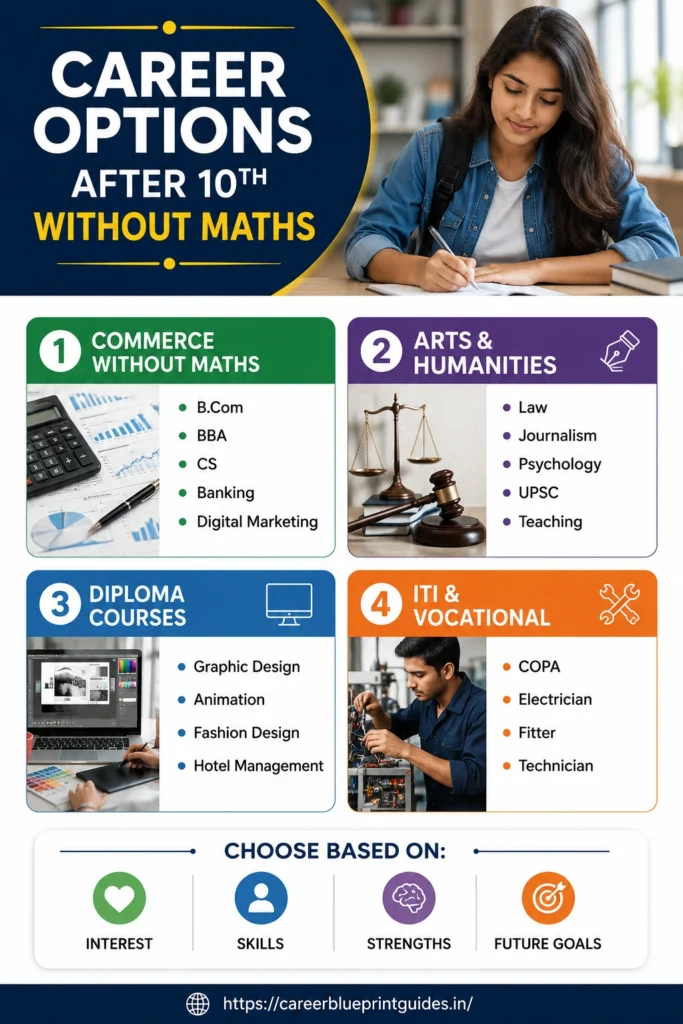
Commerce Without Maths
Commerce is a popular stream for students who are interested in business, finance, management, and entrepreneurship but do not wish to study advanced Mathematics.
Many schools offer Commerce without Maths, allowing students to focus on business-related subjects while keeping a wide range of career opportunities open.
Subjects You Will Study
In Commerce without Maths, students generally study subjects such as:
- Accountancy
- Business Studies
- Economics
- English
- Entrepreneurship
- Informatics Practices (in some schools)
These subjects help students understand how businesses operate, how financial transactions are managed, and how economic systems influence the market.
Career Opportunities
Students who choose Commerce without Maths can pursue various professional and degree courses after Class 12, including:
- Bachelor of Commerce (B.Com)
- Bachelor of Business Administration (BBA)
- Company Secretary (CS)
- Digital Marketing
- Banking and Finance
- Human Resource Management
- Entrepreneurship
With India’s growing startup ecosystem and expanding digital economy, commerce-related careers continue to offer promising growth and employment opportunities.
Arts and Humanities
Arts and Humanities is one of the most flexible streams available after Class 10.
It is suitable for students who enjoy subjects related to society, history, communication, human behavior, and creativity.
Contrary to common misconceptions, Arts is not a limited stream. In fact, it opens doors to many respected and high-growth professions.
Subjects You Will Study
Depending on the school and board, students may study:
- History
- Political Science
- Geography
- Psychology
- Sociology
- Economics
- English Literature
These subjects help students develop analytical thinking, communication skills, research abilities, and a deeper understanding of society.
Career Opportunities
Arts students can pursue a wide variety of careers, including:
- Journalism and Media
- Law
- Psychology
- Civil Services
- Teaching
- Content Writing
- Public Relations
- Social Work
- International Relations
Students preparing for government examinations such as UPSC, SSC, and State Public Service Commissions often find Arts subjects particularly helpful.
For students who enjoy reading, writing, communication, or understanding people and society, Arts can be an excellent choice.
Diploma Courses
Diploma programs are ideal for students who prefer practical learning and wish to develop industry-specific skills at an early stage.
These courses are generally shorter than traditional degree programs and focus on hands-on training that can help students become job-ready.
Popular Diploma Options
Some of the most popular diploma courses after 10th include:
- Diploma in Graphic Design
- Diploma in Animation and Multimedia
- Diploma in Fashion Design
- Diploma in Hotel Management
- Diploma in Interior Design
- Diploma in Photography
- Diploma in Event Management
The duration of these programs usually ranges from one to three years depending on the institution and specialization.
Career Opportunities
After completing a diploma course, students may find opportunities in industries such as:
- Advertising
- Hospitality
- Media and Entertainment
- Fashion Industry
- Design Studios
- Event Management Companies
- Digital Agencies
Many diploma holders also choose to continue their education through advanced diploma or degree programs to enhance their qualifications and career prospects.
For students who enjoy practical work and creative projects, diploma courses can be a valuable alternative to traditional academic streams.
ITI and Vocational Courses
Industrial Training Institutes (ITI) and vocational courses focus on skill development and practical training.
These programs are designed to prepare students for employment in specific trades and industries.
They are particularly suitable for students who prefer hands-on learning and want to enter the workforce with job-ready skills.
Best ITI Trades
Some popular ITI trades and vocational programs include:
- Computer Operator and Programming Assistant (COPA)
- Electrician
- Fitter
- Welder
- Plumber
- Stenography
- Sewing Technology
- Mechanic Trades
These courses provide technical knowledge and practical experience that can be directly applied in the workplace.
Career Opportunities
After completing ITI or vocational training, students may work as:
- Technicians
- Machine Operators
- Computer Operators
- Skilled Tradespersons
- Maintenance Professionals
- Service Technicians
Many students also choose self-employment by starting their own service-based businesses after gaining experience.
As industries increasingly require skilled workers, vocational education continues to play an important role in creating employment opportunities across various sectors.
Conclusion
When exploring Career Options After 10th WITHOUT Maths, it is important to remember that success is not determined by a single subject.
Your interests, strengths, skills, and long-term goals matter far more than whether you choose Maths or not.
Whether you select Commerce, Arts, a Diploma program, or an ITI course, each path offers unique opportunities for learning, growth, and career development.
The best choice is the one that aligns with your abilities and future aspirations, allowing you to build a career that is both successful and personally fulfilling.
Top Career Options After 10th Without Maths in 2026
Students often believe that avoiding Maths after Class 10 limits their future opportunities.
However, the reality is very different. In 2026, several industries are growing rapidly and offer excellent career prospects to students who choose paths that do not require advanced mathematical skills.
The right career is not determined by a subject alone. It depends on your interests, strengths, willingness to learn, and long-term goals.
Whether you prefer creativity, communication, business, helping others, or practical skills, there are many rewarding options available.
Let’s explore some of the most promising career paths for students looking for career options after 10th without Maths.
Digital Marketing
Digital Marketing has become one of the fastest-growing career fields in recent years.
As businesses continue to move online, the demand for professionals who can promote products and services through digital platforms is increasing rapidly.
This field focuses on activities such as social media marketing, content creation, search engine optimization (SEO), email marketing, and online advertising.
Most of these skills can be learned through short-term courses, certifications, and practical experience.
Why choose Digital Marketing?
- High demand across industries
- Opportunity to work remotely
- Freelancing and self-employment options
- Continuous growth and learning opportunities
Career Opportunities:
- Social Media Manager
- SEO Specialist
- Content Marketer
- Digital Marketing Executive
- Freelance Digital Marketer
Students who enjoy creativity, communication, and technology often find Digital Marketing to be an exciting and future-ready career path.
Graphic Designing
Graphic Designing is an excellent choice for students who have a creative mindset and enjoy visual communication.
Designers create logos, social media posts, advertisements, websites, packaging designs, and other visual content that helps brands connect with their audience.
With businesses, startups, and content creators constantly requiring visual content, skilled graphic designers are in demand across multiple industries.
Why choose Graphic Designing?
- Ideal for creative students
- Opportunity to build a freelance career
- Flexible work options
- Growing demand in digital businesses
Career Opportunities:
- Graphic Designer
- Brand Designer
- UI Designer
- Social Media Creative Designer
- Freelance Visual Artist
Students can start learning design software and creative principles through diploma programs, certification courses, or online training platforms.
Hotel Management
Hotel Management is a popular option for students who enjoy interacting with people and working in service-oriented environments.
The hospitality industry includes hotels, resorts, restaurants, event management companies, cruise lines, and tourism organizations.
This field focuses on customer service, operations management, hospitality standards, and business administration.
Why choose Hotel Management?
- Diverse career opportunities
- Opportunities in India and abroad
- Dynamic and people-focused work environment
- Strong growth in tourism and hospitality sectors
Career Opportunities:
- Hotel Executive
- Front Office Manager
- Event Coordinator
- Restaurant Manager
- Hospitality Consultant
Students who possess good communication skills, confidence, and a professional attitude often perform well in this industry.
Journalism and Mass Communication
Journalism and Mass Communication is an excellent field for students who are curious about current events, storytelling, and media.
This career path allows individuals to inform, educate, and engage audiences through various platforms.
The media industry has expanded significantly beyond traditional newspapers and television.
Today, digital media, podcasts, YouTube channels, and online news platforms create numerous opportunities for aspiring professionals.
Why choose Journalism and Mass Communication?
- Opportunity to influence society
- Diverse career options
- Creative and dynamic work environment
- Growing digital media industry
Career Opportunities:
- Journalist
- News Reporter
- Content Writer
- Public Relations Executive
- Media Producer
Students who enjoy writing, speaking, researching, and communicating ideas can build successful careers in this field.
Fashion Designing
Fashion Designing combines creativity, innovation, and business understanding.
It is a suitable career for students who have an interest in clothing, styling, trends, and artistic expression.
Fashion professionals work on creating apparel, accessories, and fashion collections while understanding consumer preferences and market trends.
Why choose Fashion Designing?
- Creative and rewarding profession
- Opportunities for entrepreneurship
- Exposure to global fashion trends
- Growing demand for unique designs
Career Opportunities:
- Fashion Designer
- Apparel Designer
- Fashion Stylist
- Fashion Consultant
- Boutique Owner
Students can pursue diploma courses, design certifications, or specialized fashion programs after completing their schooling.
Psychology
Psychology is becoming one of the most respected and sought-after career fields. It focuses on understanding human behavior, emotions, learning patterns, and mental well-being.
As awareness about mental health continues to grow, professionals with knowledge of psychology are increasingly needed in schools, hospitals, organizations, and counseling centers.
Why choose Psychology?
- Opportunity to help people
- Increasing demand for mental health professionals
- Wide range of specialization options
- Meaningful and impactful career
Career Opportunities:
- Psychologist
- School Counselor
- Career Counselor
- Behavioral Specialist
- Human Resource Professional
Students who are empathetic, patient, and interested in understanding people often find Psychology to be a fulfilling career path.
Government Services
Government jobs remain a preferred career option for many students because they offer stability, structured growth, and long-term benefits.
Students from Arts and other non-Maths backgrounds can prepare for various government examinations after completing higher studies.
Government careers exist across multiple departments, including administration, education, public services, defense, railways, and law enforcement.
Why choose Government Services?
- Job security
- Attractive benefits and allowances
- Respect in society
- Clear career progression
Career Opportunities:
- Civil Services Officer
- Teacher
- Police Officer
- Government Clerk
- Administrative Officer
Students interested in public service and long-term career stability can consider this path while focusing on strong academic preparation.
Entrepreneurship
Entrepreneurship is no longer limited to experienced professionals.
Today, many young individuals start businesses, online ventures, and personal brands at an early age.
Entrepreneurs identify problems, create solutions, and build businesses around those solutions.
This path requires creativity, leadership, decision-making ability, and continuous learning rather than advanced mathematical expertise.
Why choose Entrepreneurship?
- Freedom to build your own career
- Unlimited growth potential
- Opportunity to turn passion into income
- Development of leadership and business skills
Career Opportunities:
- Business Owner
- Startup Founder
- E-commerce Entrepreneur
- Digital Product Creator
- Agency Owner
Students can begin by learning business fundamentals, digital skills, marketing, and customer understanding.
Even small projects during school years can provide valuable entrepreneurial experience.
Final Thoughts
There are numerous career options after 10th without Maths that can lead to professional success and personal satisfaction.
Whether you are interested in creativity, communication, hospitality, psychology, government services, or business, the key is to choose a path that aligns with your interests and strengths.
Instead of focusing on what subject you are avoiding, focus on the skills you can develop and the opportunities you can create.
A well-informed decision today can help build a rewarding career in the years ahead.
Skills Students Should Learn Alongside Their Studies
Choosing from the various Career Options After 10th WITHOUT Maths is only the first step.
In today’s competitive world, academic qualifications alone are not enough to build a successful career.
Employers and colleges are increasingly looking for students who possess practical skills in addition to their studies.
Whether you choose Commerce, Arts, Diploma courses, or vocational training, developing the right skills can improve your career opportunities and help you stand out from others.
The good news is that many of these skills can be learned alongside your regular studies.
Let’s explore some of the most valuable skills students should focus on in 2026 and beyond.
Communication Skills
Communication is one of the most important life skills for students.
No matter which career path you choose, the ability to express your ideas clearly can create better opportunities in education, jobs, and personal growth.
Good communication includes:
- Speaking confidently
- Listening actively
- Writing clearly
- Presenting ideas effectively
- Participating in discussions and interviews
Students with strong communication skills often perform better in interviews, group discussions, presentations, and workplace interactions.
These skills are especially valuable in careers such as journalism, teaching, marketing, law, customer service, and business management.
You can improve communication skills by:
- Reading books and newspapers regularly
- Participating in debates and public speaking activities
- Practicing English and your native language writing
- Watching educational content and learning new vocabulary
Remember, your knowledge becomes more valuable when you can communicate it effectively.
Computer and Digital Skills
Technology has become a part of almost every profession. Regardless of which stream you choose after Class 10, having basic computer and digital skills can significantly improve your career prospects.
Some useful digital skills include:
- Microsoft Word, Excel, and PowerPoint
- Internet research
- Email communication
- Online collaboration tools
- Basic graphic design
- Social media management
Students interested in digital careers can also explore:
- Digital Marketing
- Content Creation
- Graphic Designing
- Video Editing
- Website Management
Many of these skills can be learned through affordable online courses and practical projects.
Developing digital literacy at an early stage can help students prepare for future job markets where technology plays a major role.
Creativity and Problem Solving
Creativity is not limited to artists or designers.
Every profession requires the ability to think differently, find solutions, and adapt to new situations.
Problem-solving skills help students:
- Make better decisions
- Handle challenges confidently
- Work effectively in teams
- Find innovative solutions to real-world problems
Creativity is especially valuable in fields such as:
- Graphic Designing
- Fashion Designing
- Advertising
- Content Creation
- Entrepreneurship
- Media and Communication
Students can develop creativity by:
- Working on projects and assignments
- Learning new hobbies
- Participating in competitions
- Reading about different industries and trends
- Exploring practical solutions to everyday challenges
In today’s fast-changing world, employers value individuals who can think independently and solve problems effectively.
AI and Technology Awareness
Artificial Intelligence (AI) is transforming industries across the world. From education and healthcare to business and marketing, AI is becoming an important part of modern workplaces.
Students do not need to become programmers to benefit from AI.
However, understanding basic AI concepts can provide a significant advantage in the future.
Areas students should become familiar with include:
- AI-powered tools
- Automation technologies
- Digital productivity platforms
- Online learning tools
- Emerging technology trends
Learning about technology helps students:
- Stay updated with future career requirements
- Improve productivity and efficiency
- Adapt to changing job markets
- Identify new career opportunities
Many companies now expect employees to be comfortable working with digital tools and technology.
Developing technology awareness early can help students remain competitive and future-ready.
As industries continue to evolve, students who combine academic knowledge with practical skills will have a clear advantage.
Whether you are exploring Career Options After 10th WITHOUT Maths or planning your long-term future, investing time in communication, digital skills, creativity, and technology awareness can open doors to exciting opportunities in the years ahead.
How to Choose the Right Career After 10th Without Maths
Choosing a career after Class 10 is one of the first major decisions in a student’s academic journey. For students who are not interested in Mathematics, the decision can feel even more challenging.
However, the reality is that there are numerous career paths available today that do not require advanced Maths skills.
The key is not to focus on what subject you want to avoid, but rather on what kind of future you want to build.
The best career choice is one that aligns with your interests, strengths, and long-term goals.
Before selecting a stream, course, or skill program, take some time to understand yourself and explore the opportunities available.
The following steps can help you make a confident and informed decision.
Identify Your Interests
Your interests play a significant role in determining which career path will keep you motivated and engaged in the future.
Students often perform better in subjects and careers that genuinely interest them.
Ask yourself a few simple questions:
- Which subjects do you enjoy studying the most?
- Do you prefer creative activities or analytical tasks?
- Are you interested in business, communication, design, teaching, or helping people?
- Do you enjoy practical work more than classroom learning?
For example:
- Students who enjoy creativity may explore fields like graphic design, fashion design, content creation, or media.
- Those interested in business and management can consider Commerce without Maths.
- Students who enjoy social sciences may find Arts and Humanities a suitable option.
- Practical learners may benefit from diploma or vocational courses.
Choosing a path based on your interests increases the chances of enjoying your studies and building a fulfilling career.
Understand Your Strengths
While interests are important, understanding your strengths is equally essential. Sometimes students like a particular field but may naturally excel in another area.
Think about the skills and abilities that come naturally to you:
- Are you good at communication and public speaking?
- Do you enjoy writing and expressing ideas?
- Are you creative and imaginative?
- Do you prefer hands-on practical work?
- Are you organized and good at managing tasks?
For instance:
- Strong communication skills can be useful in journalism, teaching, public relations, and marketing.
- Creative thinking can open opportunities in design, advertising, animation, and digital content creation.
- Practical skills can lead to successful careers through ITI courses, vocational training, or technical diploma programs.
Understanding your strengths helps you choose a career path where you can perform confidently and continue improving over time.
Consider Future Opportunities
While passion and strengths matter, it is also important to evaluate the future scope of a career.
The job market continues to evolve, and students should be aware of industries that are expected to grow in the coming years.
Before choosing a stream or course, research:
- Employment opportunities in the field
- Scope for higher education
- Industry growth trends
- Skill requirements
- Career advancement possibilities
Some growing career areas in 2026 include:
- Digital Marketing
- Graphic Designing
- Content Creation
- Hospitality Management
- Psychology and Counselling
- Banking and Financial Services
- Government Services
- Media and Communication
Instead of focusing only on starting salaries, look at the long-term potential of a career.
A field with continuous learning and growth opportunities can provide better career satisfaction and stability in the future.
Discuss with Parents and Mentors
Many students make career decisions without seeking guidance, while others rely completely on the opinions of friends. Neither approach is ideal.
Parents, teachers, career counsellors, and mentors can provide valuable perspectives based on their experience and knowledge.
They may help you understand career options, educational requirements, and future opportunities that you might not have considered.
When discussing your future:
- Share your interests openly.
- Explain your strengths and goals.
- Ask questions about different career paths.
Listen to suggestions but make an informed decision based on your own aspirations.
A healthy discussion can reduce confusion and help you gain clarity before making an important academic choice.
Ultimately, selecting a career after Class 10 is not about choosing the most popular stream or following what others are doing.
It is about finding a path that matches your interests, strengths, and future ambitions.
With proper research, self-awareness, and guidance, students can confidently move toward a rewarding future—even without choosing Mathematics.
Common Mistakes Students Should Avoid
Choosing a career after Class 10 is one of the first important decisions in a student’s academic journey.
While exploring various Career Options After 10th WITHOUT Maths, many students make choices based on emotions, assumptions, or external influence rather than proper planning.
These mistakes can lead to confusion, loss of interest, and even a change of direction later.
The good news is that most of these mistakes can be avoided if students take time to understand their interests, strengths, and long-term goals.
Let’s look at some of the most common career-planning mistakes and how to avoid them.
Following Friends Blindly
One of the biggest mistakes students make after 10th is choosing a stream simply because their friends are choosing it.
It may feel comfortable to stay in the same class or follow the same path as close friends, but career decisions should never be based on someone else’s choices.
Every student has different interests, abilities, learning styles, and career aspirations.
A stream that is perfect for your friend may not be the right fit for you. For example, a friend may choose Commerce because they enjoy business-related subjects, while you may be more interested in creative fields, communication, or practical skill-based careers.
Before selecting a stream, ask yourself:
- What subjects do I enjoy studying?
- What type of work excites me?
- What are my strengths and natural abilities?
- Which career path matches my future goals?
Remember, your career is a long-term journey. Making decisions based on your own interests and capabilities will help you stay motivated and confident in the future.
Choosing a Stream Due to Pressure
Many students face pressure from family members, relatives, teachers, or society when selecting a stream after 10th. Sometimes students are encouraged to choose a particular path because it is considered “safe,” “popular,” or “prestigious.”
While guidance from parents and mentors is valuable, the final decision should also consider the student’s interests and career goals.
Choosing a stream only to satisfy others can lead to frustration and lack of motivation later.
For example, a student interested in design, media, or psychology may struggle if forced into a stream that does not align with their interests.
On the other hand, students who choose a path they genuinely enjoy are more likely to perform well and build successful careers.
When exploring Career Options After 10th WITHOUT Maths, focus on finding a path that balances your interests, strengths, and future opportunities rather than making a decision based solely on external expectations.
Ignoring Skill Development
Many students believe that good marks alone guarantee career success. While academic performance is important, today’s employers and industries also value practical skills.
In fact, many high-growth careers now require skills that go beyond classroom learning.
Communication, creativity, digital literacy, teamwork, and problem-solving abilities can significantly improve career opportunities.
Some useful skills students can start developing after 10th include:
- Communication and presentation skills
- Basic computer and digital skills
- Graphic design and content creation
- Digital marketing fundamentals
- Time management and organization
- Critical thinking and problem-solving
Whether you choose Commerce, Arts, a Diploma program, or vocational training, learning relevant skills alongside your studies can increase your confidence and employability.
The combination of education and practical skills often creates better opportunities than academic qualifications alone.
Focusing Only on Salary
Salary is an important factor when choosing a career, but it should not be the only factor.
Many students search for the highest-paying career without considering whether they will enjoy the work or have the skills required to succeed in that field.
A career chosen only for money can become stressful if it does not match your interests or strengths.
Long-term success usually comes when students enjoy what they do, continuously improve their skills, and remain committed to their goals.
Instead of asking only, “Which career pays the most?” consider asking:
- Will I enjoy working in this field?
- Does this career match my abilities?
- What are the future growth opportunities?
- Can I continue learning and improving in this profession?
Many successful professionals started with moderate salaries but achieved excellent growth because they were passionate about their work and consistently upgraded their skills.
Key Takeaway
Exploring Career Options After 10th WITHOUT Maths can open many exciting opportunities, but making informed decisions is essential.
Avoid following friends blindly, choosing a stream under pressure, ignoring skill development, or focusing only on salary.
The best career choice is one that matches your interests, strengths, and future goals.
When you combine the right education with practical skills and thoughtful planning, you create a strong foundation for long-term success.
Quick Comparison Table
| Path | Typical Duration | Further Studies Options | Job Opportunities | Best For | Growth Potential |
|---|---|---|---|---|---|
| Commerce (Without Maths) | 2 Years (11th & 12th) + Graduation | B.Com, BBA, CA, CS, MBA, Banking Courses | Accountant, Banking Executive, Business Manager, Digital Marketer | Students interested in business, finance, management, or entrepreneurship | High |
| Arts / Humanities | 2 Years (11th & 12th) + Graduation | BA, LLB, Journalism, Psychology, UPSC Preparation, Teaching Courses | Teacher, Journalist, Lawyer, Psychologist, Government Officer | Students with interests in communication, social sciences, creativity, and public service | High |
| Diploma Courses | 1–3 Years | Advanced Diploma, Degree Programs, Specialized Certifications | Graphic Designer, Animator, Hotel Executive, Interior Designer, Fashion Designer | Students seeking practical learning and early career opportunities | High |
| ITI Courses | 1–2 Years | Advanced ITI, Polytechnic, Apprenticeships, Skill Certifications | Technician, Electrician, Fitter, Welder, Computer Operator | Students who prefer hands-on training and job-oriented skills | Medium to High |
Final Thoughts
Choose a Career Based on Interest, Skills, and Future Goals
After exploring the various Career Options After 10th WITHOUT Maths, one thing becomes clear: success is not determined by a single subject.
While Maths is important for some career paths, it is not a requirement for every successful profession.
Today, students have access to a wide range of opportunities in Commerce, Arts, Diploma programs, ITI courses, digital careers, creative industries, and skill-based professions.
The key is not to focus on what you are avoiding, but on what you are passionate about and willing to learn.
Before making a decision, take time to understand your interests, strengths, and long-term goals.
A student who enjoys creativity may thrive in fields such as design, media, or content creation.
Someone interested in business and management may find Commerce without Maths to be a suitable choice. Students who prefer practical learning can benefit from diploma or vocational courses that provide job-ready skills.
It is also important to think beyond academics. In today’s rapidly changing world, employers value communication skills, digital literacy, problem-solving abilities, adaptability, and continuous learning. Developing these skills alongside your studies can significantly improve your career prospects, regardless of the stream you choose.
Remember that career planning is a journey, not a one-time decision.
Your first choice after Class 10 should provide a strong foundation, but it does not lock you into a single path forever.
Many successful professionals have changed directions, learned new skills, and created opportunities for themselves over time.
Instead of comparing yourself with friends or following trends, focus on choosing a path that aligns with your personality and aspirations.
Research your options carefully, seek guidance from parents, teachers, and career experts, and make an informed decision based on facts rather than pressure or assumptions.
The best Career Options After 10th WITHOUT Maths are those that match your interests, help you develop valuable skills, and support your future goals.
When you choose a path that suits you, learning becomes more enjoyable, growth becomes easier, and success becomes more achievable.
Your career is not defined by whether you choose Maths or not—it is defined by your dedication, skills, willingness to learn, and the actions you take every day toward your goals.