
Why Choosing the Right Career After 10th Matters
Choosing the right direction after Class 10 can make the next few years of education more focused and purposeful.
It does not mean a student has to decide their entire life at the age of 15 or 16.
Instead, the goal is to understand available choices and select an educational path that matches the student’s interests, abilities, and future goals.
The decision may involve choosing an academic stream, exploring Courses After 10th, or considering a diploma or skill-based route.
A thoughtful decision can help students avoid unnecessary changes later and make better use of their time, effort, and education.
For students in India, there is no single best career option after 10th for everyone.
A good choice depends on individual strengths, academic interests, financial circumstances, and the type of career a student wants to explore.
Why Career Planning Should Start After Class 10
Class 10 is an important stage because students begin making choices that can influence their higher-secondary education and future study options.
For many students, this is when they select Science, Commerce, Arts/Humanities, or explore vocational and technical pathways.
Starting career planning for students and parents at this stage does not mean forcing a child to choose a profession immediately.
It means creating enough awareness before making an educational decision.
A practical approach is to consider these four questions:
- What subjects does the student genuinely enjoy?
- What are the student’s strengths and learning preferences?
- Which careers or fields match those interests and abilities?
- What education or skills are required to enter those fields?
For example, a student who enjoys mathematics, problem-solving, and technology may want to explore engineering, computer-related fields, data, or other technical careers.
A student interested in business, accounts, economics, or entrepreneurship may find Commerce worth exploring.
Someone interested in languages, society, history, psychology, design, or communication may consider Arts and Humanities.
Students should also understand that career planning is not a one-time decision.
Interests can change as they learn more about different fields.
The purpose of starting early is to make informed choices rather than making decisions based only on marks, friends, social pressure, or assumptions about salary.
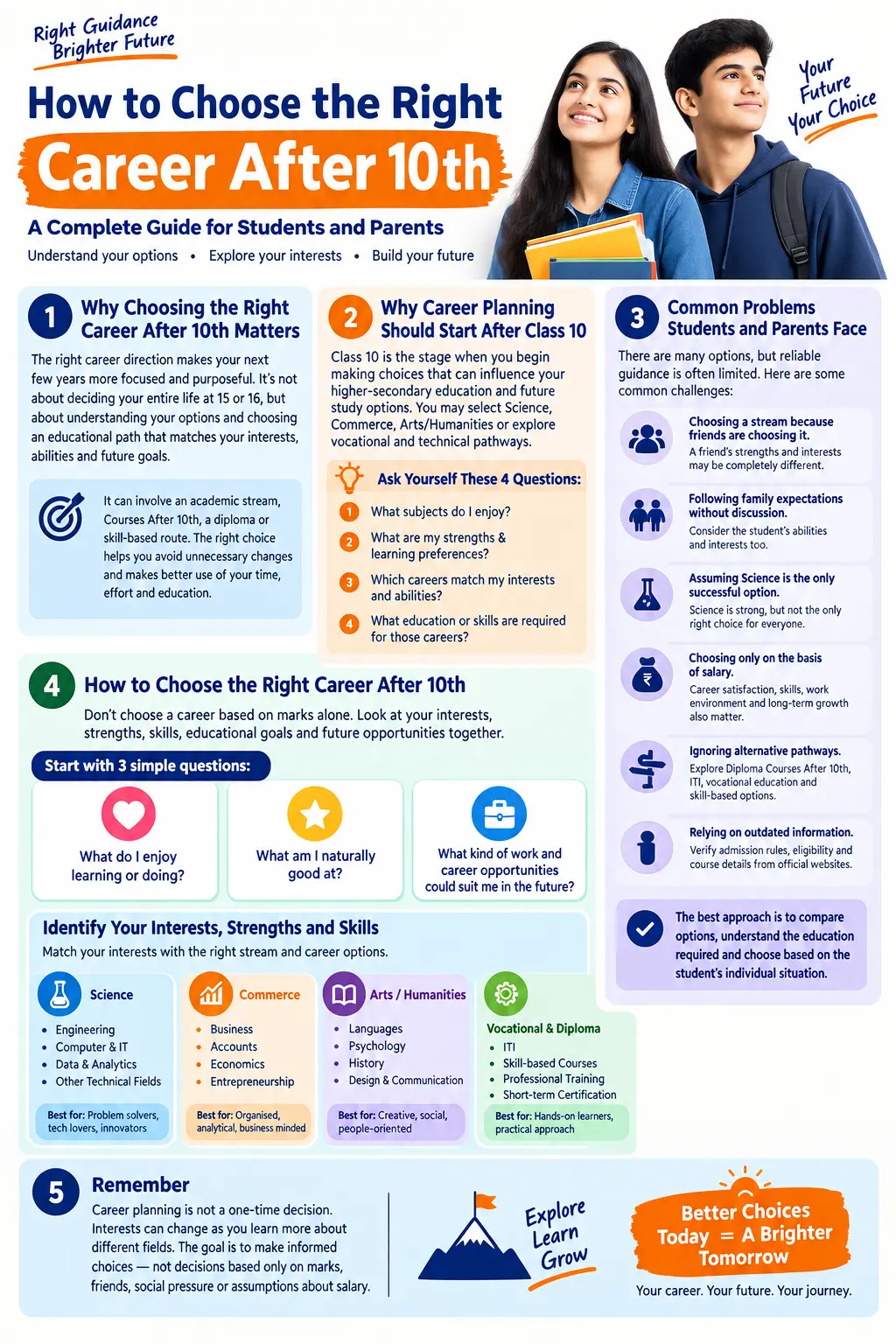
Common Problems Students and Parents Face
Students and parents often find How To Choose The Right Career After 10th a difficult question because there are many options but limited reliable guidance.
Some common problems include:
- Choosing a stream because friends are choosing it: A friend’s strengths and interests may be completely different from yours.
- Following family expectations without discussion: Parents usually want the best for their children, but a career choice should also consider the student’s abilities and interests.
- Assuming Science is the only successful option: Science can lead to many strong careers, but it is not automatically the right choice for every student.
- Choosing only on the basis of salary: Income matters, but career satisfaction, skills, education requirements, work environment, and long-term growth also deserve consideration.
- Ignoring alternative pathways: Academic streams are not the only routes. Students can also investigate Diploma Courses After 10th, ITI, vocational education, and other skill-based options.
- Relying on outdated information: Career opportunities and course requirements can change. Students should verify admission rules, eligibility, and course details through the relevant official institution or examination website.
- The best approach is to compare options calmly, understand the education required for each path, and then make a decision based on the student’s individual situation. Good Career Guidance After 10th in India should expand a student’s choices—not pressure them into one particular career.
How to Choose the Right Career After 10th
Choosing a career after Class 10 should not be based on marks alone. A better approach is to look at interests, strengths, skills, educational goals, and future opportunities together.
There is no single “best career” for every student. The right choice is one that matches the student’s abilities and interests while also offering a realistic path for further education and employment.
A simple way to begin career planning for students and parents is to ask three questions:
- What do I enjoy learning or doing?
- What am I naturally good at?
- What kind of work and career opportunities could suit me in the future?
Identify Your Interests, Strengths and Skills
Before deciding what to do after 10th, students should first understand themselves. Marks can provide useful information, but they do not tell the complete story.
For example, a student who scores well in Mathematics may enjoy problem-solving, technology, finance, or engineering.
Another student with good language and communication skills may be interested in law, teaching, media, management, or other communication-focused fields.
Consider these areas:
- Interests: Which subjects or activities do you genuinely enjoy?
- Strengths: Which subjects or tasks come more naturally to you?
- Skills: Are you good at communication, writing, calculations, technology, creativity, organising, or practical work?
- Work preferences: Do you prefer working with people, numbers, machines, computers, ideas, or creative projects?
- Learning style: Do you prefer academic study, practical training, or a combination of both?
A useful exercise is to make a simple three-column list:
- What I Enjoy What I Do Well Skills I Want to Develop
- Mathematics Problem-solving Coding
- Drawing Creativity Graphic design
- Helping people Communication Public speaking
- This exercise can help students identify patterns before selecting a stream or course.
Practical tip: Do not choose a stream simply because friends are choosing it. A stream that suits one student may not suit another, even if both have similar marks.
Consider Career Scope and Future Opportunities
Once you understand your interests and strengths, the next step is to research the career scope and future opportunities connected with different educational paths.
Students should look beyond statements such as “this career has a high salary.” Salary is only one factor. Also consider the education required, skills involved, competition, working conditions, career growth, and whether the field genuinely interests you.
When researching a career, ask:
- What qualifications are required?
- Which subjects or skills are useful for this field?
- What courses or degrees usually lead to this career?
- What entrance examinations may be required?
- What types of jobs are available?
- How is the field changing because of technology?
- Will I be comfortable with the type of work involved?
For example, a student interested in technology can explore areas such as software, data, cybersecurity, electronics, or artificial intelligence. However, choosing a technology-related field only because it is considered a “future career” may not be suitable if the student has no interest in the underlying subjects or skills.
Similarly, students considering diploma courses after 10th or skill-based courses after 10th should check the course curriculum, eligibility, recognition, further-study options, and actual career pathways before enrolling.
For Indian students, reliable information should come from official sources whenever possible. Depending on the career, this may include education boards, universities, examination authorities, government departments, or official course portals.
Expert tip: Separate a career’s popularity from its suitability. A popular career is not automatically the right career for every student.
Talk to Parents, Teachers and Career Counsellors
Students do not have to make this decision alone. Parents, teachers, and qualified career counsellors can provide different perspectives and help identify options that a student may have overlooked.
Parents can share their understanding of the child’s personality, habits, and interests.
Teachers can provide useful feedback about academic performance and learning abilities.
A qualified career counsellor can help students explore career choices using structured discussions and, where appropriate, aptitude or interest assessments.
However, guidance should support the student’s decision rather than replace it.
A healthy discussion can include questions such as:
- Which subjects do you enjoy most?
- Which subjects do you find difficult, and why?
- What kind of work would you like to explore?
- Are you comfortable with a longer academic path?
- Would you prefer practical or classroom-based learning?
- That careers have you researched so far?
Parents should also avoid comparing their child with relatives, classmates, or neighbours. Two students can have completely different strengths and still build successful careers.
A good career decision is usually a shared process: the student brings self-awareness, the family provides support, teachers provide academic insight, and career professionals can provide structured guidance.
Main Streams and Career Options After 10th
After Class 10, students generally choose an academic stream based on their interests, strengths, and future education plans.
The three major streams are Science, Commerce, and Arts/Humanities. There is no single “best stream” for every student.
The right choice depends on questions such as: What subjects do you enjoy?
What are you good at? What type of work interests you?
What kind of education do you want to pursue after Class 12?
Students can also explore alternatives such as diploma, ITI, and skill-based programs, depending on their goals and eligibility.
Science Stream
Science is commonly chosen by students who enjoy subjects such as Physics, Chemistry, Mathematics, Biology, or Computer Science. It can lead to careers in engineering, medicine, technology, research, healthcare, and several other fields.
However, students should not choose Science simply because it is considered a “high-status” stream. The subjects require regular study, problem-solving, and a willingness to understand concepts rather than only memorize them.
The Science stream can broadly offer different combinations, depending on the school or education board:
- Physics, Chemistry, Mathematics (PCM) – often suitable for students interested in engineering, technology, architecture, and mathematics-related fields.
- Physics, Chemistry, Biology (PCB) – commonly chosen by students interested in medicine, healthcare, life sciences, and related areas.
- PCMB – combines Mathematics and Biology and may keep more academic options open, but it also creates a heavier subject load.
- Science with Computer Science or other subjects – available in some schools and useful for students interested in computing and technology.
Popular Career Options
Some popular career options after choosing Science include:
- Engineering and technology
- Medicine and healthcare
- Pharmacy
- Biotechnology and life sciences
- Computer science and software
- Data and technology-related fields
- Architecture
- Research and scientific careers
- Environmental and applied sciences
Students interested in JEE, NEET, CUET, architecture, or other professional pathways should check the current eligibility and subject requirements of the relevant official examination or institution before selecting subjects.
Practical tip: If you enjoy Science but are unsure about a specific career, do not choose a stream based only on one profession. First check whether you genuinely enjoy the subjects you will study for the next two years.
Commerce Stream
Commerce is a strong option for students who are interested in business, finance, accounting, economics, markets, or entrepreneurship. It is not limited to becoming a chartered accountant or working in a bank.
Depending on the school, Commerce may include subjects such as Accountancy, Business Studies, Economics, Mathematics, and Informatics Practices or related subjects.
Students who prefer working with numbers, business concepts, financial information, or real-world economic issues may find Commerce a suitable choice.
Commerce can also be a good foundation for students who later want to study management, finance, economics, law, or entrepreneurship.
Popular Career Options
Popular career paths associated with Commerce include:
- Chartered Accountancy (CA)
- Company Secretary (CS)
- Cost and Management Accountancy (CMA)
- Banking and financial services
- Accounting and taxation
- Business and management
- Economics
- Finance and investment-related careers
- Entrepreneurship
- Marketing and sales
- Business analytics
Students interested in professional qualifications should always check the latest eligibility rules of the relevant professional body because admission requirements can change.
Practical tip: Do not avoid Commerce because you think it is only for students who are “weak in Science.”
Commerce has its own academic demands and can lead to a wide range of professional careers.
Arts and Humanities Stream
Arts, also called Humanities, is suitable for students interested in subjects such as history, geography, political science, sociology, psychology, languages, economics, literature, and other social sciences.
This stream can be especially useful for students who enjoy reading, writing, communication, society, culture, human behaviour, public affairs, or creative subjects.
Humanities is sometimes misunderstood as having fewer career opportunities. In reality, students from this stream can enter many professional and academic fields, depending on their higher education and skills.
Popular Career Options
Career paths commonly associated with Arts and Humanities include:
- Law
- Civil services and public administration
- Journalism and mass communication
- Psychology
- Teaching and education
- Social work
- Public policy
- International relations
- Literature and languages
- Design and creative fields
- Advertising and communication
- Media and content-related careers
Students considering careers such as law, civil services, teaching, journalism, psychology, or public policy should research the education and eligibility requirements for the specific career rather than choosing Humanities only because they believe it will be easier.
Practical tip: A student who enjoys writing, communication, social sciences, and understanding people may perform much better in Humanities than in a stream chosen under pressure.
The best stream is the one that matches the student’s abilities and long-term direction.
Diploma, ITI and Skill-Based Courses After 10th
Students do not have to follow only the traditional Class 11–12 route after Class 10. Diploma courses, ITI programs, vocational education, and other skill-based courses after 10th can provide practical learning and, depending on the course, opportunities for further education or employment.
The right choice depends on a student’s interests, academic goals, preferred learning style, and long-term career plan. Before taking admission, check the course eligibility, duration, recognition, fees, practical training, and progression options from the official institution or education authority.
Polytechnic and Diploma Courses
Polytechnic diploma courses are generally designed to provide technical and practical education in areas such as engineering and technology.
Many diploma programs can be pursued after Class 10, subject to the eligibility requirements of the particular institution and state.
Common diploma areas include:
- Civil Engineering
- Mechanical Engineering
- Electrical Engineering
- Computer Engineering
- Electronics and Communication
- Automobile Engineering
- Information Technology
A diploma can be useful for students who prefer practical and technical learning instead of spending several years in a purely academic pathway.
For example, a student interested in machines and how things work may explore a Mechanical Engineering diploma. Someone interested in computers may consider Computer Engineering or Information Technology.
Before choosing a diploma, compare:
- Course curriculum – Does it teach the skills you want?
- Institution recognition – Is the institution and program properly recognized?
- Practical training – Does the course include laboratories, projects, or industry exposure?
- Further study options – Can you continue to higher education after completing the diploma?
- Total cost – Consider tuition, accommodation, travel, equipment, and other expenses.
Admission rules vary by state and institution. Students should therefore verify current eligibility, entrance requirements, and admission dates through the official website of the relevant state technical education authority or institution.
ITI and Vocational Courses
Industrial Training Institutes (ITIs) offer trade-based training focused on practical and occupational skills. ITI can be a suitable option for students who want to develop a specific technical skill and enter the workforce or continue their education.
Depending on the institute and trade, students may find options such as:
- Electrician
- Fitter
- Welder
- Plumber
- Mechanic-related trades
- Computer and information technology-related trades
- Electronics-related trades
The exact trades, eligibility criteria, duration, and admission process can differ between programs and institutions.
ITI is not simply a “backup option” for students who do not want traditional schooling. For the right learner, hands-on vocational education can be a deliberate career choice.
When comparing ITI courses, look at the trade syllabus, workshop facilities, practical training, apprenticeship opportunities, placement support, and progression routes.
The official Directorate General of Training (DGT) and relevant state authorities are useful sources for checking information about vocational training and trades.
NSQF and Other Skill-Based Options
The National Skills Qualifications Framework (NSQF) provides a structured framework for competency-based qualifications in India. Skill-based education can help students develop practical abilities alongside formal education.
Depending on availability and eligibility, students may explore areas such as:
- Information Technology
- Retail
- Healthcare support
- Beauty and wellness
- Tourism and hospitality
- Automotive services
- Agriculture and allied activities
- Banking and financial services
- Media and creative skills
Skill-based courses can be particularly useful when a student already knows the type of work they want to explore. For example, a student interested in computers might look for an entry-level IT skill program, while someone interested in hospitality could explore tourism or hotel-related training.
However, students should not choose a course only because it is short or promises quick employment.
Check whether the qualification is recognized, what skills are actually taught, whether practical training is included, and what opportunities are available after completion.
Quick Comparison
- Option Main Focus Suitable For
- Polytechnic Diploma Technical and engineering education Students interested in technical careers
- ITI Trade and practical skills Students who prefer hands-on training
- Vocational Courses Job-related occupational skills Students interested in specific industries
- NSQF-aligned Programs Competency-based skill development Students looking for structured skill qualifications
Expert tip: When deciding what to do after 10th, don’t compare courses only by their duration or starting salary. Compare the skills you will gain, recognition of the qualification, practical exposure, future education options, and actual career pathway.
A well-chosen skill-based course can be a strong part of a student’s career plan when it matches their interests and goals.
Popular Career Options After 10th in 2026
After Class 10, students have more career choices than simply selecting Science, Commerce, or Arts.
The right option depends on a student’s interests, academic strengths, skills, financial situation, and long-term goals.
Some students may prefer traditional degree-based careers, while others may want to start with diploma, vocational, or skill-based education.
In 2026, technology and digital skills are also creating new career paths alongside established professions.
The following are some of the major Career Options After 10th that students in India can explore.
Engineering and Technology
Engineering and technology remain popular choices for students who enjoy Mathematics, Science, computers, problem-solving, and technical subjects.
Students interested in engineering generally continue their education through the Science stream, particularly with subjects such as Physics, Chemistry, and Mathematics.
Another route is to pursue a relevant diploma or polytechnic program after Class 10 and later explore higher technical education.
Some technology-related career areas include:
- Computer Science and Software Development
- Information Technology
- Electronics and Communication
- Mechanical Engineering
- Civil Engineering
- Electrical Engineering
- Robotics and Automation
- Artificial Intelligence and Data-related fields
Students should remember that choosing Science after 10th does not automatically mean becoming an engineer.
The stream should match the student’s genuine interest and ability to handle the subjects involved.
Practical tip: If a student enjoys understanding how machines, computers, systems, or technology work, exploring engineering and technical education can be a sensible starting point.
Healthcare and Medical Fields
Healthcare is another broad career area for students who are interested in Biology, human health, medicine, and helping people.
Students who want to pursue medical and many allied-health professions usually take the Science stream with Biology.
Specific professional courses have their own eligibility requirements and admission processes, so students should check the relevant official authority before applying.
Healthcare-related career areas include:
- Medicine
- Nursing
- Pharmacy
- Physiotherapy
- Medical Laboratory Technology
- Radiology and Imaging
- Occupational Therapy
- Nutrition and Dietetics
- Other allied healthcare professions
Students should not choose Biology or a medical pathway only because it is considered a prestigious option. Healthcare education can involve several years of study, practical training, and professional requirements.
Practical tip: Students should first identify whether they genuinely enjoy Biology and healthcare-related subjects before committing to this pathway.
Business, Finance and Management
Students who enjoy business, numbers, economics, communication, or entrepreneurship can explore careers in commerce, finance, and management.
Commerce is a common route after Class 10 for students interested in areas such as accounting, banking, business, and financial services.
Depending on their interests, students can later pursue undergraduate and professional qualifications in these fields.
Possible career areas include:
- Accounting
- Banking and Financial Services
- Business Management
- Marketing
- Human Resources
- Entrepreneurship
- Economics
- Investment and Financial Analysis
Students interested in professional qualifications should always check the current eligibility and examination rules on the official website of the relevant professional body.
Practical tip: Commerce does not mean that a student has to become an accountant. It can lead to many different careers across business, finance, management, and entrepreneurship.
Government and Public Sector Careers
Government careers are another area that attracts many students and parents in India. However, students should understand that eligibility differs from one recruitment examination or government position to another.
Some government recruitment opportunities may require Class 10 as a minimum educational qualification, while many others require Class 12, a diploma, or a graduation degree.
Depending on the recruitment rules, students can later explore areas such as:
- Central and State Government services
- Defence-related opportunities
- Railways
- Staff Selection Commission (SSC) examinations
- Police and uniformed services
- Public-sector organizations
- Technical government positions
The exact age limit, educational qualification, selection process, and number of vacancies vary by recruitment notification.
Therefore, students should not select a school stream only because they want a government job.
A better approach is to build a strong educational foundation and check official recruitment notifications when they become eligible.
Important: Government recruitment rules can change. Always verify eligibility, age limits, vacancies, and examination requirements on the official website of the recruiting organization.
Digital, AI and Creative Careers
The growth of digital technology has expanded the range of career possibilities available to students. However, most specialised digital and AI careers require education and skill development beyond Class 10.
Students can begin exploring areas such as:
- Artificial Intelligence and Machine Learning
- Data Analytics
- Cybersecurity
- Web Development
- Graphic Design
- UI/UX Design
- Digital Marketing
- Video Production and Editing
- Content Creation
- Animation and Multimedia
For example, a student interested in computers could begin with basic programming and digital literacy, while someone interested in creativity could explore graphic design, video editing, animation, or communication skills.
AI is also changing how many professionals work. Therefore, students should focus not only on learning a particular software tool but also on developing problem-solving, communication, creativity, digital literacy, and adaptability.
A useful approach is to treat these as skills to build alongside formal education rather than looking for a quick shortcut to a high-paying career.
How to Choose a Career Based on Your Interests
Choosing from the many career options after 10th becomes easier when you start with your interests rather than with a particular job title.
A student who enjoys solving problems may prefer a different path from someone who enjoys writing, managing people, or working with technology.
A useful approach is to ask three questions:
- What subjects or activities do I genuinely enjoy?
- What skills come naturally to me, and which skills am I willing to develop?
- What kind of work would I be comfortable doing for several years?
Interests alone should not decide your career. Try to consider your academic performance, aptitude, preferred work style, education requirements, and long-term career opportunities together.
If You Like Science and Technology
Students who enjoy mathematics, science, computers, experiments, or understanding how things work can explore several technology and science-related career paths.
Your interests may point toward areas such as:
- Engineering and technology
- Computer science and software development
- Artificial intelligence and data-related fields
- Cybersecurity
- Electronics and electrical technology
- Biotechnology and life sciences
- Healthcare and allied health fields
- Research and scientific careers
For example, a student who enjoys mathematics and coding may eventually explore computer science or software-related education.
Someone interested in biology and human health may prefer healthcare or life-science pathways.
However, liking Science does not automatically mean that engineering or medicine is the right choice.
The better approach is to understand the subjects involved, the required education, and the nature of the actual work before choosing a path.
Practical tip: Make a list of the three science or technology subjects you enjoy most and identify the careers connected with them. Then compare the education required, skills needed, and type of work involved.
If You Like Business and Numbers
If you enjoy mathematics, money management, business ideas, markets, accounting, or organising information, Commerce can be one pathway worth exploring after Class 10.
Commerce-related career areas include:
- Accounting and finance
- Banking and financial services
- Business management
- Economics
- Investment and financial analysis
- Entrepreneurship
- Marketing and sales
- Business analytics
Students interested in this area should not assume that Commerce is limited to becoming an accountant.
The field connects with finance, management, economics, entrepreneurship, digital business, and several other professional areas.
For example, a student who enjoys numbers and problem-solving may be interested in finance or analytics, while someone who enjoys business ideas and communication may prefer management or marketing.
Practical tip: If you are considering Commerce, pay attention to whether you enjoy working with numbers, analysing information, understanding how businesses operate, or making decisions based on facts. These interests can help you identify suitable career directions.
If You Like Creativity and Communication
Students who enjoy writing, drawing, public speaking, storytelling, design, social interaction, or understanding people can explore career paths that use creativity and communication.
Possible areas include:
- Graphic and communication design
- Writing and publishing
- Journalism and media
- Advertising and marketing
- Public relations
- Animation and visual communication
- Law
- Psychology and social sciences
- Teaching and education
- Content and digital media
These careers require more than creativity alone.
Strong communication, research, digital skills, and the ability to understand an audience are increasingly useful across many creative professions.
For example, a student who enjoys writing and explaining ideas might explore content, journalism, teaching, or communication-related fields.
Someone interested in visual creativity could investigate design, animation, or related digital fields.
Practical tip: Start building a small portfolio while you are still studying. This could include writing samples, designs, presentations, photographs, or other work related to your interests. A portfolio can help you understand whether you genuinely enjoy the work.
If You Are Interested in Government Careers
Students interested in public service, administration, law enforcement, defence, teaching, or other public-sector roles can start planning early.
However, the eligibility requirements for government jobs vary significantly by post.
Some government career pathways require:
- Class 10 qualification
- Class 12 qualification
- A diploma or technical qualification
- A bachelor’s degree
- Specific age or other eligibility conditions
Therefore, students should not choose a school stream only because they want a government job. The appropriate educational path depends on the specific examination or post they eventually want to pursue.
For example, some recruitment opportunities may accept candidates with Class 10 or Class 12 qualifications, while major competitive examinations such as the Union Public Service Commission (UPSC) Civil Services Examination require a bachelor’s degree.
When planning for a government career, always check the latest eligibility criteria on the relevant official government recruitment or examination website. Recruitment rules can change, and eligibility should never be assumed from old information.
Practical tip: First identify the type of government career that interests you.
Then work backwards: check the required qualification, subjects, examination pattern, and skills before deciding your educational path.
Common Mistakes to Avoid After 10th
Choosing what to do after 10th is a personal decision, but students often make mistakes because of pressure, comparison, or incomplete information.
A good career decision should consider interests, abilities, academic strengths, and long-term goals rather than following what others are doing.
Here are some common mistakes students and parents should avoid while exploring career options after 10th.
Choosing a Stream Because of Friends
Choosing Science, Commerce, or Arts simply because your friends are choosing it can create problems later. Your friend’s interests, strengths, and career goals may be completely different from yours.
For example, a student who enjoys accounting and business may choose Science because most friends are taking it. Similarly, a student interested in biology may choose Commerce just to remain with a particular friend group.
Before selecting a stream, ask yourself:
- Which subjects do I genuinely enjoy?
- Which subjects am I reasonably good at?
- What type of work or career interests me?
- Does this stream support my future education plans?
Expert tip: Friends can influence your decision, but they should not make the decision for you.
A good stream is one that matches your own abilities and goals.
Following Social or Family Pressure
Parents naturally want the best for their children, but sometimes career decisions are influenced by family expectations or social comparisons.
A student may hear statements such as, “Science is better,” “Government jobs are safer,” or “You should become an engineer or doctor.”
These opinions may come from good intentions, but they do not automatically make one career suitable for every student.
Instead of asking, “Which career has the highest status?”, students and parents should ask:
“Which career path matches the student’s interests, abilities, and realistic goals?”
Career planning for students and parents works best when both sides discuss options openly. Parents can share their experience and concerns while allowing the student to understand and evaluate different choices.
Choosing Only Based on Salary
Salary is a valid factor when comparing career options, but it should not be the only factor.
A career can offer attractive earning potential but still be a poor fit if the student dislikes the type of work involved. Students should also consider:
- Required education and qualifications
- Skills needed for the career
- Work responsibilities
- Career growth
- Employment opportunities
- Personal interest and aptitude
- Time and cost involved in education
For example, two careers may have similar earning potential but require very different skills and work environments.
Understanding these differences can help students make a more realistic decision.
Remember: A career should provide a reasonable balance between interest, ability, opportunity, and income.
Ignoring Your Own Interests and Abilities
One of the biggest mistakes is choosing a course or career without understanding yourself first.
Interests alone are not enough, and marks alone do not define a student’s future.
A better decision considers both what you enjoy and what you can develop into a useful skill.
Before choosing among the many career options after 10th, make a simple list:
Ask Yourself Why It Matters
- Which subjects do I enjoy? Shows areas that naturally interest you
- What am I good at? Helps identify existing strengths
- What skills do I want to develop? Connects education with future work
- What type of work interests me? Helps explore suitable career fields
- What are my long-term goals? Helps create a realistic education plan
Students do not need to have their entire career figured out immediately after Class 10.
The goal is to make a well-informed next step, keep learning, and remain open to refining the plan as interests and opportunities become clearer.
How Parents Can Help Students Choose the Right Career
Parents have an important role in Career Planning for Students and Parents, but the best support is not choosing a career on the child’s behalf.
A better approach is to help students understand their interests, strengths, educational options, and long-term goals.
After Class 10, students may hear different opinions from friends, relatives, teachers, and social media.
Parents can provide stability by helping them compare options calmly and make decisions based on their individual abilities rather than outside pressure.
Encourage Exploration Instead of Pressure
Students do not always know what career they want at the age of 15 or 16.
Some may have a clear interest, while others may need time to explore different subjects and career paths.
Parents should treat this uncertainty as a normal part of career planning.
Instead of saying, “You should choose Science” or “Commerce has better career options,” start with questions such as:
- Which subjects do you enjoy studying?
- What activities do you naturally enjoy?
- Which subjects are difficult, and why?
- Do you prefer practical work, creative work, numbers, technology, people, or communication?
- What kind of work would you like to explore in the future?
Parents can also encourage students to learn about different Career Options After 10th before making a decision.
For example, a student interested in computers does not necessarily have to follow only one traditional career path.
Technology-related opportunities can include programming, cybersecurity, data-related fields, design, digital services, and other areas.
A useful approach is to create a simple career exploration list together:
- List three to five areas the student finds interesting.
- Research the education required for each option.
- Compare the subjects, skills, costs, and study duration involved.
- Identify possible career paths after completing the required education.
- Discuss which options match the student’s interests and strengths.
This allows students to participate actively in the decision instead of simply following a decision made by someone else.
Parents should also avoid comparing their child with relatives, neighbours, or classmates.
A career that works well for one student may not suit another. The goal is not to find the most popular option, but to find a suitable and realistic path for that particular student.
Focus on Skills, Interests and Long-Term Goals
When considering What To Do After 10th, parents should look beyond marks alone.
Academic performance matters, but it is only one part of a student’s overall profile.
A better decision considers three areas:
- Area Questions to Consider
- Interests What subjects and activities does the student genuinely enjoy?
- Skills What does the student do well or show potential in?
- Goals What type of education, work, or lifestyle does the student want in the future?
For example, a student who enjoys mathematics, business concepts, and working with numbers may explore Commerce and related fields.
Another student who enjoys biology and wants to work in healthcare may explore relevant Science pathways.
A student interested in writing, history, psychology, languages, or creative subjects may find suitable options within Arts and Humanities.
Parents should also discuss long-term goals without treating them as fixed decisions. Students can change their interests as they learn more.
Career planning should therefore be viewed as a process rather than a single decision made immediately after Class 10.
It is also useful to discuss practical factors such as:
- Education and training requirements
- Course duration
- Approximate education costs
- Location and availability of institutions
- Skills required for the career
- Further study opportunities
- Possible career growth
For Diploma Courses After 10th, ITI programs, vocational education, or other skill-based pathways, parents should check the course details and recognition status from the relevant official institution or authority before enrolling.
Most importantly, parents should create an environment where students can ask questions without fear of criticism.
A student who feels comfortable discussing confusion, mistakes, or changing interests is more likely to make a thoughtful career decision.
The best parental guidance does not decide a student’s future; it helps the student understand the choices well enough to make an informed decision.
Frequently Asked Questions About Career Options After 10th
What are the best career options after 10th?
There is no single best career option after 10th for every student. The right choice depends on your interests, academic strengths, skills, financial situation, and long-term goals.
Students can explore several broad pathways, including:
- Science and technology
- Commerce, business and finance
- Arts and humanities
- Engineering and technical fields
- Healthcare and allied fields
- Design and creative careers
- Diploma and vocational education
- ITI and skill-based courses
Instead of choosing a career only because it is popular or has a high salary, students should first ask:
“Does this field match my interests and abilities?”
A good career decision should balance interest, ability, education requirements, career opportunities and future growth.
Which stream is best after 10th?
There is no universally best stream after 10th. Science, Commerce and Arts/Humanities can all lead to successful careers, but each suits different interests and goals.
- Stream Suitable for students interested in Examples of career directions
- Science Mathematics, science, technology, research Engineering, medicine, IT, research
- Commerce Business, accounting, economics, numbers Finance, accounting, banking, management
- Arts/Humanities Society, languages, history, creativity Law, civil services, media, design, social sciences
- Students should not choose Science simply because it is considered more prestigious, or reject Arts because of outdated assumptions.
- The best stream after 10th is the one that matches a student’s abilities, interests and future education plans.
What should I do after 10th if I am confused?
If you are confused about what to do after 10th, do not make a quick decision just because your friends have already chosen their streams.
Start with these steps:
- List your favourite subjects and identify why you enjoy them.
- Review your academic performance to understand your stronger areas.
- Identify your interests, such as technology, business, creativity, healthcare or public service.
- Research different career paths and check their education requirements.
- Talk to parents, teachers or a qualified career counsellor.
- Compare courses and streams before making a final decision.
You do not need to have your entire career figured out immediately after Class 10.
The goal at this stage is to make a well-informed next step, not to predict your entire working life.
Are diploma courses a good option after 10th?
Yes. Diploma courses after 10th can be a good option for students who prefer practical and technical learning or want to enter a specialized field earlier.
Depending on the course and institution, students may explore areas such as:
- Engineering and technology
- Computer applications and IT
- Design
- Hotel management
- Healthcare-related fields
- Other technical and vocational areas
A polytechnic diploma can also provide a technical education pathway and, subject to the rules of the relevant institution or state, may offer opportunities for further study.
Before enrolling, check the official institution or state education authority for eligibility, course duration, recognition, fees, curriculum and progression options.
The right question is not whether a diploma is “better” than Class 11–12. It is whether the course matches the student’s interests and long-term education or career plan.
Can I prepare for government jobs after 10th?
Yes, some government recruitment opportunities have Class 10 as the minimum educational qualification, but eligibility varies by recruitment, post, age, category and other conditions.
Students should not assume that passing Class 10 automatically makes them eligible for every government job. Recruitment rules are different for different posts and organizations.
For example, some opportunities may require:
- Class 10 qualification
- Specific technical or vocational qualifications
- A particular age range
- Physical or medical standards
- Additional selection requirements
For current vacancies and eligibility, always check the official recruitment notification and the official website of the recruiting organization.
Requirements can change from one recruitment cycle to another.
Students who are interested in government careers should also think beyond immediate recruitment and plan their education, skills and qualifications according to the type of government role they want to pursue.
Which careers will have good opportunities in the future?
Future career opportunities are likely to remain strong in fields where technology, human expertise, problem-solving and changing social needs create continued demand.
However, no career can be guaranteed to remain high-paying or “future-proof.”
Students can explore areas such as:
- Artificial intelligence and data-related fields
- Cybersecurity and information technology
- Healthcare and allied health services
- Engineering and advanced technology
- Digital business and marketing
- Renewable energy and sustainability
- Design, communication and creative work
- Skilled technical and vocational occupations
The World Economic Forum’s Future of Jobs research also highlights the growing importance of technology-related skills along with human skills such as analytical thinking, creativity, resilience and collaboration.
For students, the practical lesson is simple: choose a field that interests you and keep developing relevant skills as the field changes.
A strong foundation in communication, digital literacy, problem-solving and adaptability can remain useful across many career paths.
Final Thoughts
There is no single best career option after 10th that works for every student.
The right choice depends on a student’s interests, strengths, learning style, educational goals, and long-term plans.
Before deciding, take time to understand the available career options after 10th rather than choosing a stream simply because friends are choosing it or because someone says it has better salary prospects.
A practical approach is to:
Identify subjects and activities you genuinely enjoy.
Understand your strengths and areas that need improvement.
Compare different streams, courses, and career pathways.
Consider the education and skills required for your preferred career.
Discuss your choices openly with parents, teachers, or a qualified career counsellor.
Keep future opportunities in mind without assuming that one career will guarantee success.
For students in India, career planning after Class 10 should be viewed as a process, not a one-time decision.
Your first choice can guide your next step, but learning, gaining skills, and adapting to new opportunities remain important throughout your education and career.
The best career decision is not necessarily the one with the highest salary or popularity.
It is the one that offers a realistic match between your interests, abilities, educational goals, and future opportunities.