
Why Students Get Confused After 10th
Completing Class 10 is an important milestone in a student’s academic journey.
It is also the stage where students face one of the biggest decisions of their lives—choosing the right path for their future.
With multiple career options available today, many students and parents find it difficult to decide what comes next.
Whether it is choosing Science, Commerce, Arts, Diploma, or ITI, the number of choices can sometimes create more confusion than clarity.
As a result, students often spend weeks or even months trying to understand which path will lead to a successful and satisfying career.
Before exploring the best career options after 10th, it is important to understand why this confusion exists and how students can overcome it.
Common Reasons Behind Career Confusion
One of the biggest reasons students feel confused after 10th is the overwhelming number of choices available today.
Unlike earlier times when career paths were limited, students now have access to traditional academic streams as well as technical, vocational, and skill-based programs.
Some of the most common reasons behind career confusion include:
- Lack of proper career guidance and counseling
- Limited awareness about different career opportunities
- Pressure from parents, relatives, or society
- Influence of friends’ career choices
- Fear of making the wrong decision
- Uncertainty about future job opportunities
Many students believe that only Science, Commerce, and Arts are available after Class 10.
However, there are several other career options after 10th, including diploma courses, polytechnic programs, ITI trades, and skill-development certifications.
Another common mistake is focusing only on marks. Students often assume that higher marks automatically mean they should choose a particular stream.
In reality, marks are only one factor. Personal interests, strengths, abilities, and long-term goals are equally important when selecting a career path.
The good news is that confusion is normal. Almost every student faces it at some level.
What matters is taking the time to explore all available options before making a decision.
Why Choosing the Right Path Matters
The decision you make after 10th can influence your educational journey, career opportunities, and personal satisfaction in the years ahead.
While no choice is permanent, selecting a path that aligns with your interests and goals can save valuable time and effort.
Choosing the right career path helps students:
- Stay motivated and interested in their studies
- Build skills relevant to their future profession
- Make better academic and career decisions
- Reduce stress and uncertainty about the future
- Create a strong foundation for long-term success
On the other hand, choosing a stream without proper understanding may lead to dissatisfaction, loss of interest, or even a change in direction later.
This is why students should avoid making decisions based solely on trends, popularity, or external pressure.
Instead, they should focus on understanding their strengths, interests, and future aspirations.
The best career options after 10th are not the same for everyone. What works for one student may not be the right fit for another.
A well-informed decision today can open doors to exciting opportunities tomorrow.
That is why taking the time to evaluate different career options after 10th is one of the smartest investments a student can make in their future.
Top Career Options After 10th
After completing Class 10, students are introduced to several career paths that can shape their future education and professional journey.
While many students automatically choose a stream based on marks or family suggestions, it is important to understand all available career options before making a decision.
The good news is that students today have more opportunities than ever before.
Whether your interest lies in academics, technical education, practical skills, or early employment, there is a suitable path available for you.
Let us explore the most popular career options after 10th and understand who they are best suited for.
Science Stream
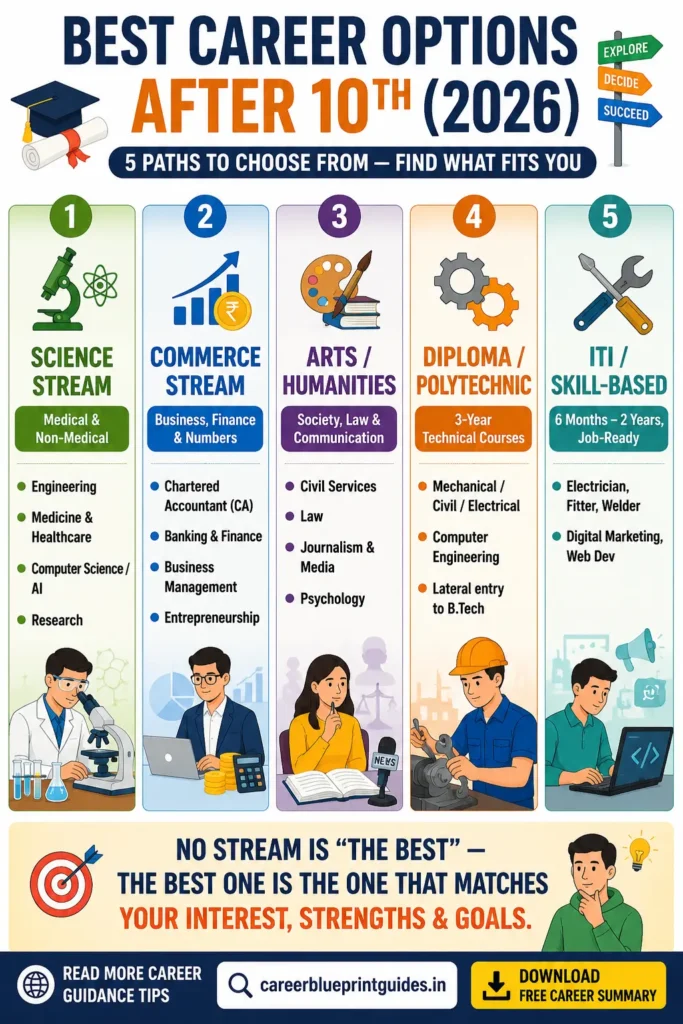
Science is one of the most preferred options for students who enjoy subjects like Mathematics, Physics, Chemistry, and Biology.
It is often chosen by students who wish to keep multiple career opportunities open for the future.
The Science stream provides a strong foundation for professional courses and higher education.
Students can choose between Medical and Non-Medical combinations depending on their interests.
Some popular career paths after choosing Science include:
- Engineering
- Medicine and Healthcare
- Pharmacy
- Biotechnology
- Computer Science
- Artificial Intelligence and Data Science
- Research and Development
Science is a suitable choice for students who enjoy analytical thinking, problem-solving, and technical subjects.
However, it should be selected based on genuine interest rather than societal pressure or marks alone.
Commerce Stream
Commerce is an excellent option for students interested in business, finance, economics, and management.
Over the years, Commerce has become one of the fastest-growing streams because of the increasing demand for financial and business professionals.
Students in Commerce learn subjects such as Accountancy, Business Studies, Economics, and Mathematics, which help build a strong understanding of the business world.
Popular career opportunities in Commerce include:
- Chartered Accountant (CA)
- Company Secretary (CS)
- Banking and Finance
- Business Management
- Investment and Financial Planning
- Entrepreneurship
- Digital Business and E-Commerce
Commerce is ideal for students who have an interest in numbers, business operations, financial planning, and management-related careers.
Arts and Humanities Stream
Arts and Humanities is a versatile stream that offers a wide range of career opportunities.
Contrary to common misconceptions, Arts is not a limited-scope stream. In fact, many prestigious careers emerge from Humanities education.
Students in this stream study subjects such as History, Political Science, Geography, Sociology, Psychology, and Languages.
Career opportunities available through Arts and Humanities include:
- Civil Services
- Law
- Journalism and Mass Communication
- Psychology
- Teaching and Education
- Social Work
- Public Administration
- Content Writing and Media Careers
This stream is particularly suitable for students who enjoy understanding society, human behavior, communication, creativity, and public service.
Diploma and Polytechnic Courses
Diploma and Polytechnic programs are among the most practical career options after 10th for students interested in technical education.
Most diploma programs are completed in three years and often allow students to enter the workforce earlier than traditional academic routes.
Popular diploma fields include:
- Mechanical Engineering
- Civil Engineering
- Electrical Engineering
- Computer Engineering
- Electronics Engineering
- Automobile Engineering
One of the biggest advantages of diploma education is that students can either pursue employment after completion or continue their studies through lateral entry into engineering degree programs.
For students who prefer practical learning over purely theoretical studies, diploma courses can be an excellent choice.
ITI and Skill-Based Courses
Industrial Training Institutes (ITI) and skill-based programs focus on developing job-ready skills that are highly valued in various industries.
These courses are designed for students who want practical training and quicker entry into the workforce.
ITI programs generally range from six months to two years, depending on the trade selected.
- Electrician
- Fitter
- Mechanic
- Welder
- Plumber
- Computer Operator
- Refrigeration and Air Conditioning Technician
Apart from ITI, students can also explore modern skill-based fields such as:
- Digital Marketing
- Graphic Designing
- Web Development
- Video Editing
- Artificial Intelligence Tools
- Computer Applications
With industries increasingly focusing on practical expertise, skill-based careers are becoming an attractive option for students who want employment-oriented education and real-world experience.
The best career option after 10th is not the same for every student.
The right choice depends on individual interests, strengths, learning preferences, and long-term career goals.
Understanding these options carefully is the first step toward making a confident and informed career decision.
Which Option Is Best After 10th?
One of the most common questions students ask after completing Class 10 is:
“Which option is best after 10th?”
The answer is simple—there is no single option that is best for every student. The right choice depends on your interests, abilities, learning style, and future goals.
Some students enjoy science and technology, while others are interested in business, creativity, or practical skills.
That is why understanding the different career options after 10th is more important than blindly following a popular stream.
Instead of looking for the “best” option, focus on finding the option that is best for you.
Best Option for Higher Studies
If your goal is to pursue professional courses and higher education in the future, continuing with Class 11 and 12 is usually the most suitable path.
After 10th, students can choose from:
- Science Stream
- Commerce Stream
- Arts/Humanities Stream
Each stream opens the door to different career opportunities.
For example:
- Science can lead to careers in Engineering, Medicine, Research, and Technology.
- Commerce can lead to careers in Accounting, Finance, Banking, and Business Management.
- Arts can lead to careers in Civil Services, Law, Psychology, Journalism, and Social Sciences.
Students who plan to complete graduation, pursue competitive exams, or build a long-term professional career often prefer this route because it provides a strong academic foundation.
Before selecting a stream, consider your interests and strengths rather than choosing solely based on marks or external pressure.
Best Option for Technical Careers
Students who enjoy practical learning, machines, technology, and hands-on work may find technical education more suitable than traditional academic studies.
In such cases, Diploma and Polytechnic courses are among the best career options after 10th.
Popular diploma fields include:
- Mechanical Engineering
- Civil Engineering
- Electrical Engineering
- Computer Engineering
- Automobile Engineering
A diploma program typically lasts three years and focuses on practical knowledge along with technical skills.
One major advantage is that students can either:
- Start working after completing the diploma, or
- Continue higher education through lateral entry into engineering degree programs.
For students who already know they want a technical career, diploma courses often provide a more direct path toward industry-specific skills and employment opportunities.
Best Option for Early Job Opportunities
Some students prefer entering the workforce as early as possible or learning a skill that can generate income quickly.
For such students, ITI and skill-based courses can be excellent choices after 10th.
Industrial Training Institutes (ITIs) offer training in various trades such as:
- Electrician
- Fitter
- Welder
- Mechanic
- Plumber
- Technician Trades
These programs focus on practical skills that are directly relevant to industry requirements.
Apart from ITI, students can also explore modern skill-based fields such as:
- Digital Marketing
- Graphic Designing
- Web Development
- Computer Applications
- AI and Technology Fundamentals
These career paths are becoming increasingly popular because employers today value skills as much as formal qualifications.
Students who are willing to continuously learn and improve their abilities can build rewarding careers through skill-based education and vocational training.
Final Takeaway
The best career option after 10th is not the same for everyone.
- Choose Science, Commerce, or Arts if you want to continue higher studies.
- Choose a Diploma if you are interested in technical careers and practical learning.
- Choose ITI or skill-based courses if your priority is job-ready skills and early employment.
The smartest decision is the one that matches your interests, strengths, and future goals.
When your career path aligns with your abilities, success becomes much easier to achieve.
How to Choose the Right Career After 10th
Choosing among the many career options after 10th can feel overwhelming.
With so many streams, courses, and career paths available, students often struggle to decide what is best for their future.
The good news is that you do not need to make a perfect decision overnight. Instead, focus on understanding yourself, your goals, and the opportunities available.
A well-informed choice can help you build a strong academic and professional foundation for the years ahead.
Before selecting a stream or course, consider the following three factors that play a major role in making the right career decision.
Know Your Interests and Strengths
The first step in choosing the right path is understanding what you genuinely enjoy and where your strengths lie.
Many students make the mistake of selecting a stream based on marks, peer pressure, or popular trends.
However, long-term success often comes from pursuing a field that matches your interests and abilities.
Ask yourself a few simple questions:
- Which subjects do I enjoy studying the most?
- Do I prefer practical learning or theoretical concepts?
- Am I interested in technology, business, creativity, or skilled trades?
- What activities make me feel motivated and engaged?
For example, students who enjoy Mathematics and Science may find Science or technical diploma courses suitable.
Those interested in business and finance may prefer Commerce, while creative and socially aware students may feel more comfortable in Arts and Humanities.
When your education aligns with your interests, learning becomes more enjoyable, and career growth becomes easier.
Consider Future Career Goals
Your future goals should also influence your decision after Class 10.
Different career options after 10th lead to different educational and professional pathways.
Therefore, it is important to think about where you want to be in the coming years.
Consider questions such as:
- Do I want to pursue higher education?
- Am I aiming for a professional career like engineering, medicine, law, or finance?
- Do I want to start working and earning at an earlier stage?
- Am I interested in technical or vocational training?
For example, students planning for engineering or medical careers generally choose the Science stream.
Those interested in accounting, management, or entrepreneurship often select Commerce.
Students seeking practical and job-oriented education may find Diploma or ITI courses more suitable.
Having a clear goal does not mean every detail of your future must be planned. It simply helps you choose a direction that supports your aspirations.
Check Career Scope and Opportunities
While interest is important, it is equally important to understand the future scope of a career.
The job market continues to evolve, and many new opportunities are emerging in technology, healthcare, digital services, and skilled trades.
Before making a decision, research the career prospects associated with your chosen stream or course.
Look for information about:
- Future job demand
- Growth opportunities
- Required skills and qualifications
- Salary potential
- Industry trends
For instance, fields such as Artificial Intelligence, Data Science, Digital Marketing, Healthcare, and Technical Services are expected to offer strong career opportunities in the coming years.
At the same time, traditional careers in education, law, banking, government services, and business continue to remain relevant and rewarding.
The best approach is to choose a path that combines your interests with realistic career opportunities. This balance can help you stay motivated while also improving your chances of long-term success.
By understanding your strengths, setting clear goals, and exploring future opportunities, you can confidently select the right career path after Class 10 and move toward a successful future.
Common Mistakes Students Should Avoid
Choosing a career path after Class 10 is one of the first major decisions in a student’s life.
While there are many excellent career options after 10th available today, students often make decisions based on incomplete information or outside influence.
These mistakes can lead to confusion, loss of interest, and even a change of career direction later.
Understanding these common mistakes can help students make smarter and more confident career choices.
Following Friends or Trends
One of the biggest mistakes students make after 10th is choosing a stream simply because their friends are choosing it or because it is currently popular.
For example, many students select Science because most of their classmates are taking it, while others choose Commerce or a Diploma course because they hear it offers good career opportunities.
However, what works for one student may not be the right choice for another.
Every student has different interests, strengths, learning styles, and career goals.
A stream that suits your friend may not match your abilities or aspirations.
Before making a decision, ask yourself:
- What subjects do I genuinely enjoy?
- What type of career interests me?
- Does this path align with my future goals?
Instead of following trends, focus on choosing a path that matches your own potential and ambitions.
Choosing Based Only on Marks
Many students believe that their board exam marks should completely determine their future stream.
While marks can indicate academic performance, they should not be the only factor in career planning.
A student who scores high marks is often encouraged to choose Science, even if they are more interested in business, design, law, or other fields.
Similarly, students with average marks may underestimate their abilities and limit their career choices unnecessarily.
The reality is that success depends on a combination of interest, dedication, skills, and consistent effort—not just marks.
When exploring career options after 10th, consider:
- Your interests and passions
- Your strengths and natural abilities
- Future career opportunities
- Long-term goals
Marks can guide your decision, but they should never become the sole reason for choosing a career path.
Ignoring Skills and Interests
Another common mistake is focusing only on streams and courses while ignoring personal skills and interests.
Today’s job market values practical abilities, creativity, communication skills, problem-solving, and technical expertise.
Students who understand their strengths early are often better positioned to build successful careers.
For instance:
- A student who enjoys technology may thrive in Science, Computer Applications, or technical Diploma programs.
- A student interested in business and finance may find Commerce more suitable.
- A creative student may excel in Arts, Design, Media, or related fields.
When selecting from various career options after 10th, take time to identify what excites you and where your natural talents lie.
Choosing a path that aligns with your interests makes learning more enjoyable and increases the chances of long-term career satisfaction.
The best career decisions are made when students balance academic performance, personal interests, skills, and future opportunities.
By avoiding these common mistakes, you can choose a direction that supports both your growth and career success.
Final Thoughts
Choosing among the many career options after 10th can feel overwhelming at first.
With so many streams, courses, and career paths available, it is natural for students and parents to feel confused about the next step.
However, the good news is that there are more opportunities today than ever before.
Whether you choose Science, Commerce, Arts, Diploma, or ITI, every path can lead to a successful and rewarding career when it aligns with your interests, abilities, and long-term goals.
Instead of focusing only on what others are choosing, take time to understand yourself.
Explore different options, learn about future opportunities, and make a decision based on proper research rather than assumptions.
A well-informed choice today can save years of confusion and help build a stronger foundation for your future.
Remember, career planning is not about finding the most popular option—it is about finding the right option for you.
There Is No One-Size-Fits-All Career Option
One of the biggest misconceptions among students is that there is a single “best” career option after 10th. In reality, the right choice is different for every student.
A student who enjoys Mathematics and technology may find Science to be the ideal path.
Someone interested in business and finance may perform better in Commerce.
A creative student may thrive in Arts and Humanities, while a practical learner may benefit from Diploma or ITI courses that focus on skills and hands-on training.
This is why comparing your journey with others can often lead to the wrong decision.
Every student has unique strengths, interests, learning styles, and career aspirations.
What works perfectly for one person may not be the best choice for another.
Before making a final decision, ask yourself a few important questions:
- Which subjects do I genuinely enjoy?
- What type of work interests me?
- Do I prefer practical learning or academic studies?
- What are my long-term career goals?
- Which path matches my strengths and future aspirations?
The answers to these questions can provide far more clarity than simply following trends, marks, or peer pressure.
At the end of the day, the best career option after 10th is the one that matches your interests, supports your goals, and helps you move confidently toward a successful future.
When you choose a path that is right for you, learning becomes more enjoyable, growth becomes easier, and career success becomes much more achievable.