

Why Choosing the Right Path After 10th Matters in 2026
Completing Class 10 is one of the first major turning points in a student’s academic journey.
The decision made at this stage can influence future education, career opportunities, skill development, and even long-term earning potential.
In 2026, students have more career options than ever before.
Along with traditional academic streams, there are technical, vocational, and skill-based pathways that can lead to successful careers.
This abundance of choices is a positive development, but it can also create confusion.
Many students and parents find themselves comparing options such as Diploma, ITI, and 11th Class, wondering which path offers better opportunities.
The truth is that there is no universal answer. The best option after 10th depends on a student’s interests, strengths, learning style, and future goals.
Before comparing Diploma, ITI, and 11th Class, it is important to understand why this decision matters and what factors should influence your choice.
How Career Choices Have Changed in Recent Years
A decade ago, most students followed a simple route after Class 10.
They chose Science, Commerce, or Arts and continued their education through the traditional academic system.
Today, the situation is very different.
Technology, automation, digital transformation, and changing industry demands have created new career opportunities across various sectors.
Companies are increasingly looking for skilled professionals who can solve practical problems rather than relying only on academic qualifications.
As a result, students now have multiple pathways available after Class 10, including:
- Diploma courses in engineering and technology
- ITI and vocational training programs
- Skill-based certification courses
- Traditional 11th and 12th education
- Hybrid learning and online skill development programs
For example, a student interested in software development can pursue a Diploma in Computer Engineering, while another student may choose ITI training to enter a technical trade and start earning sooner.
At the same time, many students continue with 11th Class to prepare for professional careers through higher education.
This shift has made career planning more flexible than ever before.
Students are no longer limited to one route, which is why understanding all available options has become essential.
Why Students Get Confused After Class 10
Confusion after Class 10 is completely normal, Most students are making their first major career-related decision at an age when they are still discovering their interests and strengths.
At the same time, they receive advice from multiple sources, often leading to mixed opinions.
Some of the most common reasons behind this confusion include:
Too Many Career Options
Students today have access to countless educational and career paths. While having choices is beneficial, it can also make decision-making difficult.
Lack of Career Awareness
Many students know about Science, Commerce, and Arts but have limited knowledge about Diploma courses, ITI programs, vocational education, and emerging career fields.
Family and Social Pressure
Parents and relatives often suggest career paths based on their own experiences or societal expectations.
While their intentions are good, their advice may not always align with the student’s interests.
Fear of Making the Wrong Decision
Students frequently worry that choosing the wrong stream or course could negatively affect their future. This fear often leads to uncertainty and hesitation.
Influence of Friends
Many students choose a path simply because their friends are taking it. However, a career decision should always be based on personal goals rather than peer influence.
The good news is that confusion can be reduced significantly when students gather accurate information and evaluate their options carefully.
Common Myths About Diploma, ITI, and 11th Class
One of the biggest reasons students struggle to choose the best option after 10th is the presence of misconceptions and outdated beliefs.
Let’s clear up some common myths.
Myth 1 – Diploma Is Only for Weak Students
This is completely false.
Diploma programs are designed for students who want technical knowledge and practical skills.
Many successful engineers begin their journey through Diploma courses and later pursue higher education.
Myth 2 – ITI Has Limited Career Scope
While ITI focuses on vocational skills, skilled technicians and trade professionals remain in high demand across industries such as manufacturing, construction, electrical services, automotive, and renewable energy.
With experience and additional certifications, ITI graduates can build rewarding careers.
Myth 3 – Only Science Stream Leads to Success
Success is not limited to one stream.
Students from Commerce, Arts, Diploma, and vocational backgrounds have built successful careers in business, technology, government services, design, healthcare, digital marketing, entrepreneurship, and many other fields.
Myth 4 – Higher Studies Are the Only Path to a Good Career
While higher education offers many opportunities, skill-based education can also lead to stable and well-paying careers.
The right choice depends on an individual’s goals and preferred learning style.
Myth 5 – One Option Is Best for Everyone
Perhaps the biggest myth is that there is a single best option after 10th for all students.
Every student is different. A student interested in engineering may benefit from a Diploma.
Someone who wants practical skills and quicker employment may prefer ITI. Another student aiming for professional degrees and competitive exams may choose 11th Class.
The right path is the one that matches your interests, abilities, and future aspirations.
As you continue reading, you’ll discover the strengths, limitations, and career opportunities associated with Diploma, ITI, and 11th Class, helping you make a more informed decision for your future.
Best Option After 10th: Understanding the Three Major Choices
Completing Class 10 is an important milestone in every student’s academic journey. It is also the stage where one of the first major career decisions needs to be made.
Many students and parents find themselves confused about whether to choose a Diploma course, enroll in an ITI program, or continue with 11th Class in a traditional school setting.
The truth is that there is no single path that is perfect for everyone.
The Best Option After 10th depends on factors such as your interests, learning style, career goals, and future aspirations.
While some students prefer technical education and practical training, others may wish to pursue higher studies through the conventional academic route.
Before making a decision, it is important to understand what each option offers, how it differs from the others, and what opportunities it can create in the future.
What is a Diploma Course After 10th?
A Diploma course is a technical education program that students can join immediately after completing Class 10.
These courses are designed to provide industry-specific knowledge and practical skills in various engineering and technology-related fields.
Diploma programs generally last for three years and focus on a balanced combination of theoretical concepts and practical training.
Unlike traditional schooling, Diploma courses are more career-oriented and prepare students for technical roles in industries.
Some of the most popular Diploma courses after 10th include:
- Diploma in Mechanical Engineering
- Diploma in Civil Engineering
- Diploma in Computer Science Engineering
- Diploma in Electrical Engineering
- Diploma in Electronics and Communication Engineering
One of the biggest advantages of choosing a Diploma is that students can enter the workforce earlier than those following the traditional 11th and 12th route.
Additionally, Diploma holders can pursue higher education through lateral entry into the second year of a B.Tech or Engineering degree program.
Who Should Choose a Diploma Course?
A Diploma can be a suitable option for students who:
- Have an interest in engineering or technology.
- Enjoy practical learning along with classroom education.
- Want to build a technical career.
- Prefer gaining industry-relevant skills early.
- Plan to pursue B.Tech or higher technical education later.
For students who are clear about their interest in technical fields, a Diploma can be a strong pathway toward long-term career growth.
What is ITI After 10th?
ITI stands for Industrial Training Institute. It is a vocational education program that focuses on skill development and practical training.
ITI courses are designed to prepare students for specific trades and job roles that are in demand across various industries.
Unlike Diploma courses, ITI programs emphasize hands-on learning rather than extensive theoretical study.
The duration of ITI courses generally ranges from six months to two years, depending on the trade selected.
Some popular ITI trades include:
- Electrician
- Fitter
- Welder
- Mechanic Diesel
- COPA (Computer Operator and Programming Assistant)
- Plumber
- Turner
The primary goal of ITI education is to equip students with job-ready skills so that they can enter the workforce quickly.
Many ITI graduates also pursue apprenticeships, which provide valuable industry experience and improve employment prospects.
Who Should Choose ITI?
ITI may be the right choice for students who:
- Prefer practical and hands-on learning.
- Want to acquire job-oriented skills quickly.
- Are interested in technical trades and industrial work.
- Wish to start earning at an early age.
- Do not want to spend many years in academic education.
For students seeking skill-based training and faster entry into the job market, ITI can be an excellent career pathway.
What is 11th Class (Science, Commerce, Arts)?
Choosing 11th Class means continuing with the traditional academic route after completing Class 10.
Students select a stream based on their interests and future career plans. The three main streams available are Science, Commerce, and Arts (Humanities).
This pathway involves completing both 11th and 12th Class, after which students can pursue graduation, professional courses, or competitive examinations.
Science Stream
The Science stream is often chosen by students interested in careers such as:
- Engineering
- Medicine
- Research
- Information Technology
- Data Science
- Artificial Intelligence
Students study subjects such as Physics, Chemistry, Mathematics, and Biology, depending on their chosen combination.
Commerce Stream
Commerce is suitable for students interested in business, finance, and management-related careers. Common subjects include:
- Accountancy
- Business Studies
- Economics
- Mathematics
- Entrepreneurship
Commerce students can later pursue careers in fields such as Chartered Accountancy, Banking, Finance, Business Management, and Entrepreneurship.
Arts (Humanities) Stream
The Arts stream offers a wide range of career opportunities and is ideal for students interested in social sciences, creativity, and public service.
Popular subjects include:
- History
- Political Science
- Geography
- Psychology
- Sociology
- English
Students from the Arts stream can build careers in teaching, law, journalism, civil services, content creation, design, and many other fields.
Who Should Choose 11th Class?
Continuing with 11th Class is generally suitable for students who:
- Want to pursue higher education after 12th.
- Are preparing for professional careers.
- Prefer academic learning over vocational training.
- Want flexibility in choosing future career options.
- Plan to appear for competitive examinations.
For students who are not yet ready to specialize in a technical trade or vocational skill, 11th Class provides a broader foundation and keeps multiple career options open for the future.
Understanding these three major pathways is the first step toward making an informed career decision. Instead of following trends or copying others, students should evaluate their interests, strengths, and long-term goals before deciding on the Best Option After 10th for their future.
Diploma vs ITI vs 11th Class: Quick Comparison Table
Choosing the right path after Class 10 is one of the most important decisions for a student’s future.
While some students prefer the traditional route of 11th and 12th, others look toward Diploma or ITI courses to gain technical skills and enter the workforce earlier.
Before deciding on the best option after 10th, it is important to understand how these three pathways differ in terms of duration, cost, learning style, career opportunities, and future growth.
The comparison below will help students and parents make a more informed decision based on their goals and interests.
| Criteria | Diploma | ITI | 11th Class (Science, Commerce, Arts) |
|---|---|---|---|
| Duration | 3 Years | 6 Months to 2 Years | 2 Years |
| Eligibility | Pass in Class 10 | Pass in Class 8 or 10 (Trade Dependent) | Pass in Class 10 |
| Cost | Moderate | Low to Moderate | Low to Moderate |
| Learning Style | Technical + Practical + Theory | Mostly Practical | Academic + Theory-Based |
| Job Opportunities | Technical Roles, Junior Engineer Positions | Skilled Trade Jobs | Usually After Graduation |
| Higher Education Options | Polytechnic to B.Tech (Lateral Entry) | Apprenticeship, Diploma, Advanced Certifications | Graduation, Professional Courses |
| Salary Potential | Good | Moderate Initially | High Long-Term Potential |
| Career Growth | Strong with Experience and Further Studies | Good with Skills and Experience | Wide Career Flexibility |
Duration
The duration of a course often influences a student’s decision. Diploma programs generally take three years to complete and provide in-depth technical education.
ITI courses are shorter, ranging from six months to two years depending on the trade selected. On the other hand, the 11th and 12th academic route requires two years of study before students can move on to higher education.
Students who want to enter the workforce quickly often prefer ITI, while those looking for a balance between technical learning and future education opportunities may find Diploma more suitable.
Eligibility
All three options are available to students after passing Class 10.
However, some ITI trades may also accept students after Class 8. Diploma and 11th Class generally require successful completion of Class 10 from a recognized board.
Since eligibility is not usually a major barrier, students should focus more on their interests, strengths, and career aspirations while choosing the best option after 10th.
Cost
The cost of education varies significantly depending on the institution. Government ITIs are often the most affordable option, making them attractive for students seeking low-cost skill development.
Diploma courses usually cost more because they involve technical infrastructure, laboratories, and practical training.
The cost of 11th and 12th depends on whether the student studies in a government or private school.
Students should evaluate both the investment required and the long-term returns before making a decision.
Learning Style
One of the biggest differences among these options is the way students learn.
Diploma courses combine classroom theory with practical training, helping students build technical knowledge and hands-on skills.
ITI focuses primarily on practical learning. Students spend most of their time developing industry-specific skills that can be applied directly in the workplace.
In contrast, 11th Class follows a more academic approach with greater emphasis on theoretical concepts, examinations, and preparation for higher education.
Students should choose a learning style that matches their strengths and preferences.
Job Opportunities
Job prospects vary depending on the path chosen.
Diploma holders can find opportunities in technical industries as technicians, supervisors, junior engineers, and field professionals.
Many companies actively recruit diploma graduates for technical roles.
ITI graduates can secure jobs in skilled trades such as electrician, fitter, welder, mechanic, technician, and machine operator.
These roles often allow students to start earning earlier.
Students pursuing 11th and 12th generally continue their education before entering the job market, which means employment opportunities typically come later but may offer broader career choices.
Higher Education Options
Further education opportunities are an important factor when deciding the best option after 10th.
Diploma students can continue their studies through lateral entry into B.Tech or pursue advanced technical certifications.
ITI graduates can enroll in apprenticeship programs, advanced vocational training, or even diploma courses to enhance their qualifications.
Students completing 11th and 12th enjoy the widest range of higher education opportunities, including undergraduate degrees, professional courses, and competitive examinations.
Salary Potential
Salary growth depends on skills, experience, industry demand, and educational qualifications.
Diploma holders often start with competitive salaries in technical industries and can achieve significant growth through experience and further studies.
ITI graduates may start earning earlier, but salary growth generally depends heavily on practical expertise and specialization.
Students following the 11th and 12th route may take longer to enter the workforce, but higher education can lead to professions with strong long-term earning potential.
Career Growth
Career growth should be evaluated from a long-term perspective rather than focusing only on the first job.
Diploma holders often benefit from structured technical career progression and opportunities to upgrade their qualifications.
ITI graduates can build successful careers by developing specialized skills, gaining experience, and obtaining additional certifications.
Students who continue through 11th, 12th, and higher education usually enjoy the greatest flexibility in choosing careers across multiple industries and professions.
Ultimately, there is no single answer to the question of the best option after 10th.
The right choice depends on a student’s interests, learning preferences, financial situation, and long-term career goals.
Understanding these differences can help students select a path that aligns with their future aspirations rather than simply following popular trends.
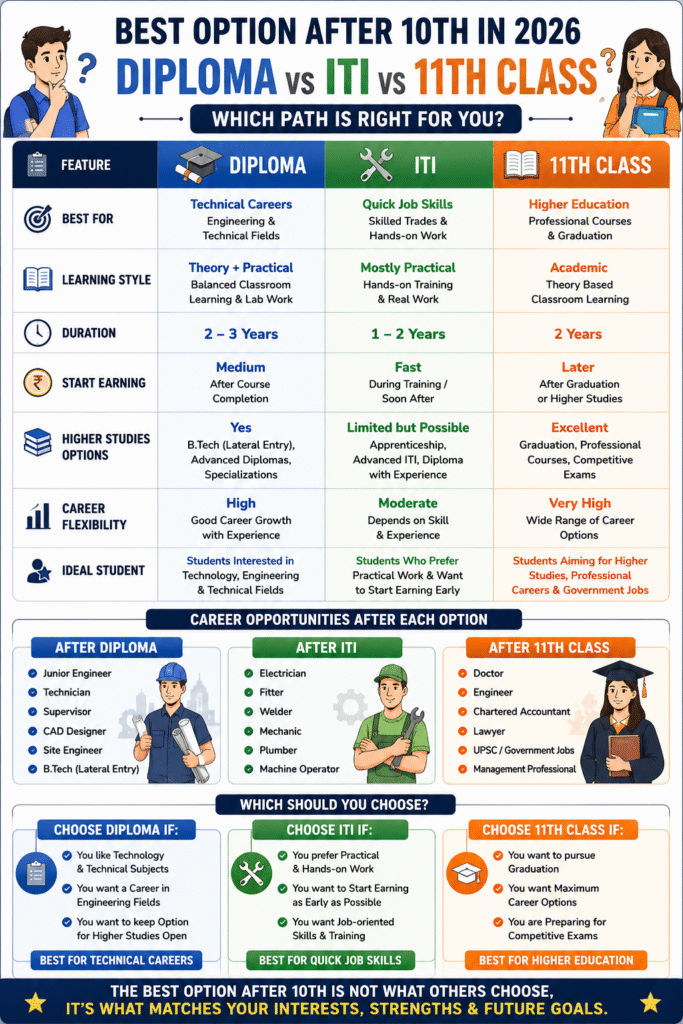
Diploma After 10th: Advantages, Disadvantages and Career Scope
For students who are interested in technical education and practical learning, a diploma course can be a valuable option after completing Class 10.
Unlike the traditional 11th and 12th route, diploma programs focus on industry-oriented skills and technical knowledge that prepare students for specific career fields.
In 2026, the demand for skilled professionals in engineering, technology, manufacturing, automation, and computer-related industries continues to grow.
This has made diploma courses an attractive choice for students who want to develop job-ready skills while keeping higher education opportunities open.
However, before making a decision, it is important to understand both the advantages and limitations of pursuing a diploma after 10th.
This will help students and parents identify whether it is the best option after 10th based on individual interests, career goals, and learning preferences.
Top Diploma Courses in 2026
Today, diploma programs are available in a wide range of technical and professional fields. Students can choose a course based on their interests and future career aspirations.
Some of the most popular diploma courses in 2026 include:
Engineering and Technology Diplomas
- Diploma in Mechanical Engineering
- Diploma in Civil Engineering
- Diploma in Electrical Engineering
- Diploma in Electronics and Communication Engineering
- Diploma in Automobile Engineering
Computer and IT Diplomas
- Diploma in Computer Science Engineering
- Diploma in Information Technology
- Diploma in Artificial Intelligence
- Diploma in Data Science
- Diploma in Cyber Security
Design and Creative Diplomas
- Diploma in Graphic Design
- Diploma in Animation and Multimedia
- Diploma in UI/UX Design
- Diploma in Interior Design
Emerging Industry Diplomas
- Diploma in Robotics
- Diploma in Cloud Computing
- Diploma in Renewable Energy Technology
- Diploma in Digital Marketing
Before selecting any diploma course, students should evaluate industry demand, personal interests, and future career opportunities rather than simply following popular trends.
Benefits of Choosing Diploma
A diploma course offers several advantages for students who prefer technical education and practical learning.
Early Exposure to Technical Skills
Diploma programs introduce students to industry-relevant concepts and practical applications from an early stage.
This helps them develop specialized skills before many of their peers enter college.
Practical Learning Approach
Unlike traditional academic programs that focus heavily on theory, diploma courses combine classroom learning with laboratory work, workshops, projects, and hands-on training.
Faster Entry into Technical Careers
Students who complete a diploma can enter the workforce earlier than those who follow the traditional graduation route.
This can provide valuable work experience at a younger age.
Pathway to Higher Education
One of the biggest advantages of a diploma is that it does not limit future education opportunities.
Many diploma holders can pursue B.Tech or BE through lateral entry programs, allowing them to directly enter the second year of engineering studies.
Industry-Relevant Curriculum
Most diploma courses are designed to meet current industry requirements.
This helps students acquire skills that employers actively seek in sectors such as manufacturing, construction, information technology, and automation.
Limitations Students Should Know
While diploma courses offer many benefits, students should also understand their limitations before making a final decision.
Early Specialization
A diploma requires students to choose a specific field at an early stage.
If a student is unsure about their interests, selecting the wrong specialization may lead to dissatisfaction later.
Limited Career Flexibility
Compared to the 11th and 12th route, a diploma is more career-focused.
Students who later wish to switch to completely different fields may face additional challenges.
Competitive Growth in Some Industries
Although diploma holders can secure technical jobs, higher-level positions in certain industries may require a bachelor’s degree or additional qualifications.
Less Exposure to Diverse Academic Subjects
Students pursuing a diploma generally focus on technical subjects. As a result, they may not receive the broader academic exposure that students in Science, Commerce, or Arts streams receive.
Understanding these limitations helps students make a more informed and realistic career decision.
Career Opportunities After Diploma
A diploma can open doors to various technical and professional careers depending on the chosen specialization.
Technical Job Roles
Diploma graduates may work as:
- Junior Engineer
- CAD Designer
- Site Supervisor
- Electrical Technician
- Maintenance Engineer
- Quality Control Technician
- Production Supervisor
- Computer Hardware Technician
- Network Support Executive
Government Sector Opportunities
Many government departments and public sector organizations recruit diploma holders for technical and engineering-related positions through competitive examinations and direct recruitment.
Private Sector Opportunities
Industries such as manufacturing, construction, automotive, information technology, telecommunications, and energy regularly hire diploma graduates for technical roles.
Entrepreneurship Opportunities
Students with strong technical skills may also start their own businesses, service centers, repair workshops, design studios, or technology-based ventures.
Higher Education Options
Diploma holders can continue their education through:
- B.Tech (Lateral Entry)
- BE Programs
- Advanced Certification Courses
- Professional Skill Development Programs
- Specialized Technical Training
This flexibility makes a diploma a strong option for students who want both employment opportunities and future educational growth.
Who Should Choose a Diploma?
A diploma can be the best option after 10th for students who meet the following criteria:
- They have a strong interest in technical or engineering fields.
- They enjoy practical learning and hands-on activities.
- They want to develop job-ready skills at an early stage.
- They prefer industry-focused education rather than purely academic studies.
- They are considering engineering or technical careers in the future.
- They want the option to pursue higher education through lateral entry programs.
However, students who are still exploring their interests or planning careers that require extensive higher education may also consider the 11th and 12th route before making a final decision.
The right choice ultimately depends on personal interests, career goals, learning style, and long-term aspirations.
A diploma can be a rewarding pathway for students who are clear about entering technical and skill-based professions while keeping future opportunities open.
ITI After 10th: Advantages, Disadvantages and Career Scope
For students who want practical training and early employment opportunities, ITI (Industrial Training Institute) is one of the most popular options after Class 10.
Unlike traditional academic education, ITI focuses on developing industry-specific skills that prepare students for real-world jobs.
In 2026, the demand for skilled professionals continues to grow across sectors such as manufacturing, construction, electrical services, automobile repair, renewable energy, and industrial maintenance.
This makes ITI a valuable pathway for students who prefer hands-on learning over classroom-based theoretical studies.
However, before deciding whether ITI is the best option after 10th for you, it is important to understand its career scope, advantages, limitations, and future opportunities.
Popular ITI Trades in 2026
ITI offers a wide range of trades designed to meet the needs of different industries.
Students can choose a trade based on their interests, abilities, and career goals.
Some of the most popular ITI trades in 2026 include:
- Electrician
- Fitter
- Welder
- Diesel Mechanic
- Motor Vehicle Mechanic
- Plumber
- Electronics Mechanic
- Refrigeration and Air Conditioning Technician
- Computer Operator and Programming Assistant (COPA)
- Solar Technician
- Wireman
- Draughtsman Civil
- Draughtsman Mechanical
Many of these trades are aligned with current industry demands, making them attractive for students seeking practical skills and faster entry into the workforce.
Benefits of ITI Courses
One of the biggest reasons students choose ITI after 10th is its strong focus on skill development and employability.
Some key benefits of ITI courses include:
Faster Entry into the Job Market
Most ITI courses can be completed within six months to two years. This allows students to start working much earlier than those following longer academic routes.
Practical Learning Approach
ITI training emphasizes workshops, tools, machines, and real-life applications. Students spend more time learning practical skills than theoretical concepts.
Affordable Education
Compared to many diploma and degree programs, ITI courses are generally more affordable, making them accessible to students from different financial backgrounds.
Industry-Relevant Skills
The curriculum is designed to meet industry requirements, helping students develop skills that employers actively look for.
Opportunities for Apprenticeships
Many ITI students can participate in apprenticeship programs where they gain practical experience while earning a stipend.
Support for Government Job Aspirants
Several government departments, railways, public sector undertakings, and state agencies regularly recruit ITI-qualified candidates for technical positions.
Limitations of ITI
While ITI provides several advantages, students should also understand its limitations before making a decision.
Limited Academic Exposure
ITI focuses mainly on practical training and technical skills. Students who later wish to pursue advanced academic qualifications may need additional educational pathways.
Trade-Specific Career Path
Most ITI trades lead to specialized careers. Changing fields later may require extra training or certifications.
Slower Salary Growth Initially
Although students can start earning early, salary growth may be slower compared to professionals who pursue higher education and advanced qualifications.
Career Progression Depends on Skill Development
Success after ITI often depends on continuous learning, certifications, work experience, and keeping up with changing technologies.
Understanding these limitations helps students make a balanced and informed career decision.
Job Opportunities After ITI
One of the biggest strengths of ITI education is the availability of job opportunities across multiple industries.
After completing ITI, students may find employment in:
- Manufacturing industries
- Automobile companies
- Electrical maintenance services
- Construction projects
- Railways
- Public sector undertakings (PSUs)
- Renewable energy companies
- Telecommunications sector
- Private workshops and service centers
Common job roles include:
- Electrician
- Technician
- Fitter
- Welder
- Machine Operator
- Maintenance Technician
- Field Service Engineer
- HVAC Technician
- Workshop Assistant
Students can also choose self-employment opportunities by starting their own service-based businesses in areas such as electrical work, plumbing, welding, air-conditioning repair, or automobile servicing.
With additional experience and certifications, ITI graduates can significantly improve their career prospects and earning potential.
Who Should Choose ITI?
ITI is a suitable choice for students who:
- Prefer practical learning over theoretical studies.
- Want to develop job-ready skills quickly.
- Are interested in technical and hands-on work.
- Wish to enter the workforce at an early stage.
- Want affordable vocational education.
- Are interested in apprenticeship and skill-based career opportunities.
- Plan to build expertise in a specific trade or technical field.
However, students aiming for careers that require extensive higher education, such as doctors, engineers through traditional routes, lawyers, or researchers, may find other educational pathways more aligned with their goals.
Ultimately, the best option after 10th depends on your interests, strengths, and future aspirations.
For students who enjoy practical work and want industry-relevant skills with quicker employment opportunities, ITI can be a strong and rewarding career choice in 2026.
11th Class After 10th: Advantages, Disadvantages and Future Opportunities
Choosing 11th class after 10th is the most traditional and widely preferred path among students in India. It provides a strong academic foundation and opens the door to higher education, competitive exams, and professional careers.
While Diploma and ITI focus on specific technical or skill-based careers, 11th class offers broader career flexibility and allows students to explore multiple opportunities before making a final career decision.
For students who are still exploring their interests and future goals, continuing with regular schooling can be a practical choice.
However, it is important to understand the opportunities, benefits, and challenges associated with this path before deciding whether it is the best option after 10th for you.
Science Stream Career Options
Science is often chosen by students who are interested in subjects such as Mathematics, Physics, Chemistry, Biology, and Computer Science. It is considered one of the most versatile streams because it provides access to a wide range of professional careers.
Some popular career options available through the Science stream include:
- Engineering (Computer, Mechanical, Civil, Electrical, AI, etc.)
- Medical careers (Doctor, Dentist, Pharmacist, Physiotherapist)
- Data Science and Artificial Intelligence
- Architecture
- Aviation and Aerospace
- Research and Scientific Fields
- Defence Services
- Environmental Science
One of the biggest advantages of choosing Science is flexibility.
Students can later move into technical, medical, management, or even some commerce-related fields after completing their education.
However, Science also requires strong dedication, regular study habits, and a genuine interest in analytical subjects.
Commerce Stream Career Options
Commerce is an excellent choice for students who are interested in business, finance, economics, and management. Over the last few years, Commerce has become increasingly popular because of the growing demand for professionals in finance, taxation, digital business, and entrepreneurship.
Popular career options in Commerce include:
- Chartered Accountant (CA)
- Company Secretary (CS)
- Cost and Management Accountant (CMA)
- Banking and Finance
- Business Management
- Investment and Stock Market Analysis
- Digital Marketing
- Entrepreneurship
- E-commerce and Online Business
Commerce is suitable for students who enjoy working with numbers, business concepts, and financial planning.
It also offers a good balance between academic learning and practical business knowledge.
For students aiming for long-term professional growth in the corporate sector, Commerce can be a strong contender for the best option after 10th.
Arts/Humanities Career Options
Arts or Humanities is often misunderstood as a stream with limited opportunities. In reality, it offers diverse and rewarding career paths for students interested in social sciences, languages, creativity, and public service.
Popular career options in Arts and Humanities include:
- Civil Services (UPSC)
- Law
- Journalism and Mass Communication
- Psychology
- Teaching and Education
- Political Science
- Social Work
- Graphic Design and Creative Fields
- Content Writing and Media
- International Relations
The Arts stream helps students develop communication skills, critical thinking abilities, creativity, and a deeper understanding of society and human behavior.
Students with strong interests in writing, public speaking, social issues, or creative professions may find Arts to be the right educational path after 10th.
Benefits of Continuing Regular Schooling
Choosing 11th and 12th class offers several long-term advantages that can benefit students throughout their academic and professional journey.
Some major benefits include:
Wider Career Flexibility
Unlike specialized courses, regular schooling keeps multiple career paths open.
Students can decide on their professional direction after gaining more clarity during classes 11th and 12th.
Eligibility for Higher Education
Most undergraduate degree programs require students to complete 12th class.
Continuing regular schooling ensures eligibility for a wide variety of colleges, universities, and professional courses.
Preparation for Competitive Exams
Students preparing for exams such as JEE, NEET, CUET, NDA, CLAT, and various government entrance examinations often benefit from the academic foundation provided by 11th and 12th class studies.
Better Long-Term Career Growth
While skill-based courses may provide quicker entry into the workforce, higher education often creates opportunities for better salary growth, leadership roles, and professional advancement over time.
Personality Development
School education helps students improve communication skills, teamwork, problem-solving abilities, and overall personality development, which are valuable in every profession.
Who Should Choose 11th Class?
11th class can be a suitable choice for students who:
- Want to pursue higher education after 12th.
- Are preparing for professional careers such as engineering, medicine, law, management, or civil services.
- Need more time to explore their interests before specializing in a particular field.
- Prefer academic learning and theoretical concepts.
- Want maximum career flexibility in the future.
- Are planning to appear for competitive entrance examinations.
On the other hand, students who are primarily interested in gaining job-ready skills quickly or entering technical trades may find Diploma or ITI more aligned with their goals.
Ultimately, there is no single best option after 10th for every student.
The right choice depends on your interests, strengths, learning style, and long-term career aspirations.
For students seeking broader opportunities and higher education pathways, continuing with 11th class remains one of the most reliable and flexible options available in 2026.
Which Option Offers Better Job Opportunities?
One of the biggest concerns for students and parents after Class 10 is future job opportunities.
Many students want to know whether a Diploma, ITI, or the traditional 11th and 12th route will provide better career prospects.
The truth is that all three paths can lead to successful careers, but the opportunities, earning potential, and growth timeline are different.
Understanding these differences can help you choose the best option after 10th based on your career goals rather than assumptions.
Jobs After Diploma
A Diploma course is designed for students who are interested in technical and engineering-related fields.
It combines theoretical concepts with practical training, making students industry-ready for various technical roles.
After completing a Diploma, students can either start working or continue their education through lateral entry into engineering degree programs.
Some popular job roles after a Diploma include:
- Junior Engineer
- CAD Designer
- Mechanical Technician
- Civil Site Supervisor
- Electrical Technician
- Computer Hardware Technician
- Quality Control Assistant
- Production Supervisor
Diploma holders often find opportunities in:
- Manufacturing industries
- Construction companies
- IT support services
- Automobile sector
- Government departments
- Public Sector Undertakings (PSUs)
One major advantage of a Diploma is that students can continue their education and significantly increase their earning potential over time.
This makes Diploma a suitable choice for students seeking a balance between job opportunities and higher education.
Jobs After ITI
ITI (Industrial Training Institute) courses focus primarily on practical skills and vocational training.
These programs are designed to prepare students for specific trades and help them enter the workforce quickly.
Students who prefer hands-on work and want to gain employment at an early stage often choose ITI courses.
Popular job opportunities after ITI include:
- Electrician
- Fitter
- Welder
- Mechanic
- Plumber
- Turner
- Machine Operator
- Technician Assistant
ITI graduates can find employment in:
- Industrial plants
- Factories
- Railways
- Construction projects
- Automobile workshops
- Electrical maintenance companies
- Government apprenticeship programs
Many ITI students also benefit from apprenticeship opportunities where they earn while learning practical industry skills.
For students whose primary goal is to start earning quickly, ITI can be a practical option after Class 10.
Jobs After 12th and Graduation
Choosing 11th and 12th class keeps the door open for a wide range of higher education and professional career opportunities.
After completing Class 12, students can pursue graduation in fields such as:
- Engineering
- Medicine
- Commerce
- Law
- Management
- Design
- Computer Applications
- Humanities
This path generally requires more years of study before entering the workforce, but it can lead to highly specialized careers and broader opportunities.
Some popular career options after graduation include:
- Engineer
- Doctor
- Chartered Accountant
- Lawyer
- Software Developer
- Data Analyst
- Teacher
- Business Manager
- Government Officer
Students who choose the academic route often have access to a larger variety of career options compared to those who directly enter vocational or technical training.
If your goal is long-term professional growth and higher education, continuing with 11th and 12th can be a strong choice.
Short-Term vs Long-Term Career Growth
When comparing these three paths, it is important to understand the difference between short-term and long-term career growth.
Short-Term Career Growth
Students who want to enter the workforce quickly usually benefit from:
- ITI courses
- Certain Diploma programs
These options allow students to develop job-ready skills and start earning sooner than traditional academic pathways.
Long-Term Career Growth
Students who are willing to invest more time in education often benefit from:
- 11th and 12th education
- Graduation and professional degrees
- Diploma followed by higher education
These pathways may require additional years of study, but they often provide:
- Greater career flexibility
- Higher earning potential
- Better leadership opportunities
- Access to professional careers
Final Comparison
In simple terms:
- ITI is ideal for students seeking early employment and practical skills.
- Diploma offers technical expertise along with opportunities for higher studies.
- 11th Class and Graduation provide the widest range of career options and long-term growth potential.
There is no single answer to which path offers the best job opportunities.
The best option after 10th depends on your interests, learning style, financial situation, and future career goals.
Choosing a path that aligns with your strengths will always lead to better outcomes than simply following what others are doing.
Which Option Has Better Salary Potential in the Future?
When students and parents compare Diploma, ITI, and 11th Class after Class 10, one of the most common questions is:
“Which option will provide better earning opportunities in the future?”
While salary is an important factor, it should never be the only factor when choosing the Best Option After 10th. Career growth, job stability, skill development, and future learning opportunities also play a major role in long-term success.
The truth is that all three paths can lead to good earnings if they align with a student’s interests, abilities, and career goals. However, the salary journey is different for each option.
Let’s understand how income growth works in each path.
Salary Growth After Diploma
A Diploma course is often chosen by students who are interested in technical fields such as Mechanical Engineering, Civil Engineering, Computer Science, Electrical Engineering, and Electronics.
After completing a Diploma, students can either start working or continue their education through lateral entry into B.Tech or other degree programs.
In the beginning, diploma holders generally earn a moderate salary as junior technicians, supervisors, or technical assistants. However, their earning potential increases significantly with experience, certifications, and higher education.
Some factors that influence salary growth after a Diploma include:
- The engineering branch chosen
- Technical skills and practical knowledge
- Industry demand
- Work experience
- Additional qualifications
Students who continuously upgrade their skills often move into higher-paying technical and managerial positions over time.
Key Insight: Diploma students may not receive the highest starting salary, but they usually have strong long-term earning potential, especially when combined with further studies and industry experience.
Salary Growth After ITI
ITI courses are designed to provide practical, job-oriented training in specific trades such as Electrician, Fitter, Welder, Mechanic, Turner, and Technician roles.
One of the biggest advantages of ITI is that students can enter the workforce relatively quickly.
Since the training period is shorter, many students start earning earlier than those pursuing longer academic programs.
Initially, salaries may be modest, especially for freshers. However, skilled workers who gain hands-on experience can significantly increase their earnings over time.
Salary growth after ITI depends on:
- The trade selected
- Practical expertise
- Industry demand
- Apprenticeship experience
- Government or private sector opportunities
Many ITI graduates also pursue advanced certifications, apprenticeships, or specialized training programs to improve their career prospects.
Key Insight: ITI is often suitable for students who want to gain practical skills and start earning sooner.
While salary growth may be gradual, skilled professionals remain in demand across various industries.
Salary Growth Through Higher Education
Students who choose 11th Class continue with the traditional academic pathway through Science, Commerce, or Arts streams.
This route usually requires more time because students complete Class 12 and then pursue graduation or professional courses.
As a result, they may start earning later compared to Diploma or ITI students.
However, higher education can open doors to a wider range of careers, including:
- Engineering
- Medicine
- Chartered Accountancy
- Management
- Law
- Government Services
- Research
- Information Technology
The earning potential in these professions can be substantial, especially after acquiring specialized qualifications and experience.
The growth in income through higher education generally depends on:
- The course selected after 12th
- The college or institution attended
- Industry demand
- Professional skills
- Work experience
While the journey may take longer, higher education often provides broader career flexibility and opportunities for long-term advancement.
Key Insight: Students willing to invest more years in education may benefit from greater career options and potentially higher earning opportunities in the future.
Realistic Expectations for Students
Many students search for the Best Option After 10th based only on expected salary. However, focusing only on income can lead to poor career decisions.
A successful career is built through:
- Consistent skill development
- Practical experience
- Continuous learning
- Career planning
- Personal interest in the chosen field
A student who enjoys technical work may perform exceptionally well in a Diploma program.
Another student may thrive in an ITI trade and build a successful career through expertise and experience. Similarly, a student interested in higher studies may achieve excellent results through the academic route.
Instead of asking, “Which option pays the most?”, students should ask:
“Which option matches my interests, strengths, and long-term goals?”
That approach leads to better career satisfaction, stronger growth opportunities, and a more successful future.
Final Takeaway
There is no single path that guarantees the highest salary for every student.
- Diploma offers strong technical career growth and good long-term earning potential.
- ITI helps students gain practical skills and start earning earlier.
- 11th Class and Higher Education provide wider career opportunities and long-term professional growth.
The Best Option After 10th is not the one that promises the highest salary today—it is the one that helps you build a successful and sustainable career tomorrow.
Best Option After 10th Based on Your Career Goals
Many students search for the best option after 10th, hoping to find one perfect answer. However, the reality is that the right choice depends on your career goals, interests, learning style, and future plans.
A path that works well for one student may not be the right fit for another.
Therefore, before choosing between Diploma, ITI, or 11th Class, it is important to understand where you want to see yourself in the coming years.
The following guide will help you identify which option may be most suitable based on your career aspirations.
If You Want an Engineering Career
If your dream is to become an engineer, work with technology, design machines, develop software, or build infrastructure projects, then a Diploma after 10th can be an excellent choice.
Diploma programs are designed to provide technical knowledge along with practical training.
Students can choose fields such as Mechanical Engineering, Civil Engineering, Computer Science, Electrical Engineering, Electronics, and more.
One major advantage of a Diploma is that after completing it, students can often take lateral entry into the second year of a B.Tech or engineering degree program, depending on the institution and eligibility criteria.
A Diploma may be a suitable option if:
- You enjoy Mathematics and Science.
- You are interested in technical subjects.
- You prefer practical learning along with theory.
- You want to enter engineering-related industries at an early stage.
- You may pursue higher technical education later.
For students with a clear interest in engineering and technology, a Diploma can provide a focused pathway toward their career goals.
If You Want a Government Job
Many students aim for government jobs because of job security, career stability, and long-term benefits.
In this case, there is no single route that guarantees success. Different government positions have different educational requirements.
For example:
- Some technical government positions prefer Diploma holders.
- Certain skilled trade positions recruit ITI graduates.
- Many competitive examinations require completion of 12th class or graduation.
If government service is your primary goal, you should first identify the type of government job you want to pursue and then choose the educational path accordingly.
Generally:
- ITI can be beneficial for technical trade-related government vacancies.
- Diploma can help in technical departments and junior engineering roles.
- 11th and 12th followed by graduation can open the door to a wider range of government examinations.
The best option after 10th for government job aspirants depends largely on the specific career path they plan to follow.
If You Want to Start Earning Early
Some students prefer to enter the workforce as soon as possible due to personal goals, financial responsibilities, or a strong interest in practical skills.
For such students, ITI (Industrial Training Institute) is often a practical choice.
ITI courses focus on industry-relevant skills and hands-on training rather than extensive theoretical study.
Many trades can be completed within one to two years, allowing students to enter apprenticeships, technical roles, and entry-level jobs relatively quickly.
Popular ITI trades include:
- Electrician
- Fitter
- Welder
- Mechanic
- COPA (Computer Operator and Programming Assistant)
- Refrigeration and Air Conditioning Technician
ITI may be suitable if:
- You enjoy practical work.
- You want job-oriented training.
- You wish to start earning sooner.
- You prefer learning by doing rather than classroom-based theory.
For students seeking quicker entry into employment, ITI can be a valuable and skill-focused pathway.
If You Want Higher Studies
If your long-term goal is to pursue professional courses, university education, or competitive examinations, then continuing with 11th and 12th Class is usually the most flexible option.
After choosing a stream—Science, Commerce, or Arts—you can explore a wide variety of career opportunities in the future.
Some examples include:
- Engineering
- Medicine
- Law
- Chartered Accountancy
- Management
- Teaching
- Design
- Civil Services
- Research and many more
Choosing 11th Class can be beneficial because it keeps multiple career options open while providing a strong academic foundation.
This path may be suitable if:
- You plan to complete graduation.
- You want maximum career flexibility.
- You are preparing for competitive exams.
- You enjoy academic learning and theoretical subjects.
Students who are still exploring different career possibilities often benefit from the wider opportunities available after completing 12th and higher education.
If You Are Still Unsure About Your Career
It is completely normal to feel confused after completing Class 10. In fact, many successful professionals were uncertain about their career direction at this stage.
Instead of rushing into a decision, focus on understanding:
- Your interests
- Your strengths
- Your favorite subjects
- Your learning style
- Your future aspirations
Ask yourself questions such as:
- Do I enjoy practical work or theoretical study?
- Am I interested in technology, business, arts, healthcare, or skilled trades?
- Do I want to start working soon or continue studying?
Speaking with teachers, career counselors, industry professionals, and parents can also provide valuable guidance.
Remember, choosing the best option after 10th is not about following friends or trends. It is about selecting a path that aligns with your abilities, interests, and long-term goals.
A thoughtful decision today can help create a stronger and more satisfying career journey tomorrow.
7 Mistakes Students Make While Choosing After 10th
Choosing the right path after Class 10 is one of the first major decisions in a student’s academic journey.
Whether you are considering a Diploma, ITI, or 11th Class, the decision can influence your future education, career opportunities, and personal growth.
Unfortunately, many students make choices based on incomplete information, social pressure, or short-term thinking.
As a result, they often realize later that the selected path does not align with their interests or career goals.
If you are trying to find the best option after 10th, avoiding these common mistakes can help you make a smarter and more confident decision.
Following Friends Blindly
One of the most common mistakes students make after 10th is choosing a course simply because their friends are choosing it.
Many students think that studying together will make things easier.
While friendship is important, career decisions should never be based solely on what others are doing. Every student has different interests, strengths, learning abilities, and future goals.
For example, your friend may be interested in engineering and choose a Diploma course, while you may have a stronger interest in commerce, design, or government services.
Following someone else’s path without understanding your own goals can lead to dissatisfaction and confusion later.
Before making a decision, focus on what is right for you rather than what is popular among your friends.
Choosing Based Only on Marks
Many students believe that their board exam marks should completely determine their future path.
While marks can indicate academic performance, they should not be the only factor in choosing a career direction.
For instance, scoring high marks in Science does not automatically mean you must choose Science in 11th.
Similarly, average marks do not mean you cannot succeed in technical or vocational fields.
Your interests, skills, learning style, and career aspirations are equally important.
Some students excel in practical learning environments like ITI, while others thrive in academic or technical education through 11th Class or Diploma programs.
The best option after 10th is not always the one suggested by your marksheet; it is the one that matches your overall potential.
Ignoring Personal Interests
Interest plays a crucial role in long-term success and satisfaction. Yet many students overlook their genuine interests while making career decisions.
Some students choose a course because it is considered prestigious, while others do so to meet family expectations.
However, studying a subject that does not interest you can make learning difficult and stressful.
Ask yourself simple questions:
- Which subjects do I enjoy studying?
- What kind of work excites me?
- Do I prefer practical learning or theoretical learning?
- What careers attract me the most?
Understanding your interests can help you select a path that keeps you motivated and engaged throughout your educational journey.
Not Researching Career Scope
Another major mistake is choosing a course without understanding the opportunities it can provide in the future.
Students often hear about a particular course from relatives or social media and enroll without researching important factors such as:
- Future job opportunities
- Higher education options
- Industry demand
- Salary potential
- Career growth prospects
For example, Diploma, ITI, and 11th Class all offer different career pathways.
Understanding where each option can lead helps you make a more informed decision.
Before finalizing any path, spend time exploring its long-term scope rather than focusing only on the present.
Taking Advice from Too Many People
Seeking guidance is important, but listening to too many opinions can create even more confusion.
Parents, relatives, teachers, friends, and social media influencers may all have different suggestions.
While most advice comes with good intentions, not all recommendations will be suitable for your situation.
Instead of trying to satisfy everyone’s expectations, focus on gathering information from reliable sources and evaluating it based on your interests and goals.
A well-informed decision made after careful consideration is far better than a decision made to please others.
Choosing a Course Just for Quick Money
Many students are attracted to courses that promise fast jobs or immediate income.
While earning early can be beneficial, making a decision solely for short-term financial gain can limit future opportunities.
A course should not only help you earn money today but also support your long-term career growth.
For example, some students choose a field because they hear it offers quick employment, without considering whether they will enjoy the work or want to continue in that profession for years.
A balanced approach is important. Consider both present opportunities and future career potential before making your choice.
Not Planning for the Next 5 Years
Many students focus only on what they will study immediately after 10th without thinking about where that choice may lead in the future.
A good career decision should answer questions such as:
- What will I do after completing this course?
- Can I pursue higher studies if needed?
- What career opportunities will be available after five years?
- Will this path help me achieve my long-term goals?
Thinking ahead allows you to choose a path that aligns with your future aspirations rather than making a short-term decision that may create challenges later.
Whether you choose Diploma, ITI, or 11th Class, having a clear vision for the next few years can help you stay focused and make better educational choices.
Final Thoughts
There is no single best option after 10th that works for every student.
The right choice depends on your interests, strengths, career goals, and learning preferences.
By avoiding these common mistakes and taking the time to understand your options carefully, you can make a decision that supports both your education and future career growth.
Remember, a thoughtful decision today can save years of confusion tomorrow.
How to Decide the Best Option After 10th: A Simple 5-Step Framework
Choosing between Diploma, ITI, and 11th Class can feel overwhelming for many students and parents.
Every option has its own advantages, career opportunities, and future pathways.
That is why instead of asking, “Which is the best option after 10th?” it is more useful to ask, “Which option is best for my interests, abilities, and goals?”
A well-planned decision today can save years of confusion later.
The following five-step framework can help students make a confident and informed choice after Class 10.
Identify Your Interests
The first step in choosing the right path is understanding what genuinely interests you.
Many students select a stream or course based on marks, family expectations, or what their friends are doing.
However, long-term success often comes when your education aligns with your interests.
Ask yourself questions such as:
- Which subjects do I enjoy studying the most?
- Do I prefer practical work or theoretical learning?
- Am I interested in technology, business, arts, design, healthcare, or skilled trades?
What type of work excites me?
For example, a student who enjoys working with machines and technology may find a Diploma course more suitable.
Someone who enjoys hands-on practical work may prefer ITI. Students interested in professional careers that require higher education may choose the 11th Class route.
When your interests match your chosen path, learning becomes easier and more enjoyable.
Assess Your Strengths
Interest is important, but understanding your strengths is equally essential.
Every student has unique abilities. Some excel in academic subjects, while others perform better in practical environments. Identifying your strengths can help you choose an education path where you are more likely to succeed.
Consider the following:
- Are you strong in Mathematics and Science?
- Do you learn better through practical activities?
- Are you comfortable with classroom-based theoretical studies?
- Do you enjoy solving technical problems?
Students with strong analytical and technical abilities may find Diploma programs beneficial.
Those who prefer skill-based learning and practical training may perform better in ITI courses. Students with strong academic foundations and ambitions for higher studies may find 11th Class to be the right choice.
Knowing your strengths helps you make a decision based on reality rather than assumptions.
Explore Career Opportunities
Before choosing any path, it is important to understand where that path can lead in the future.
Many students focus only on the next two or three years without considering long-term career opportunities.
A better approach is to explore the jobs, industries, and higher education options connected to each choice.
For example:
- Diploma courses can lead to technical careers in engineering, manufacturing, information technology, and infrastructure sectors.
- ITI programs can open opportunities in skilled trades, apprenticeships, technical services, and industrial jobs.
- The 11th and 12th route can lead to graduation, professional courses, competitive examinations, and a wide range of career options.
Researching career opportunities helps students understand both immediate and long-term possibilities.
This makes it easier to select a path that aligns with future goals.
Compare Education Paths
After understanding your interests, strengths, and career goals, compare the available education paths objectively.
Each option serves a different purpose:
Diploma focuses on technical education and provides a balance between theoretical concepts and practical learning.
ITI emphasizes skill development and job-oriented training, helping students become industry-ready in a shorter period.
11th Class provides an academic foundation and keeps the maximum number of career options open for higher education.
While comparing these paths, consider factors such as:
- Duration of study
- Learning style
- Course fees
- Future education opportunities
- Job prospects
- Career flexibility
There is no universally correct choice. The best option after 10th depends on how well a particular path matches your individual aspirations.
Take an Informed Decision
The final step is making a thoughtful and informed decision.
Avoid rushing into a choice simply because others are recommending it.
Gather information, discuss options with parents and teachers, and evaluate each path carefully.
Before finalizing your decision, ask yourself:
- Does this option match my interests?
- Does it align with my strengths?
- Can it help me achieve my long-term career goals?
- Am I choosing this path for myself rather than for others?
Remember that a successful career is built through consistent effort and smart planning, not by choosing the most popular option.
The best option after 10th is the one that provides clarity, matches your abilities, and supports your future ambitions.
By following this simple five-step framework, students can make career decisions with greater confidence and avoid many of the common mistakes made after Class 10.
Diploma vs ITI vs 11th Class: Final Verdict
After comparing Diploma, ITI, and 11th Class, one thing becomes clear—there is no single path that is perfect for every student.
The best option after 10th depends on your interests, learning style, career goals, and future plans.
Many students make the mistake of choosing a course simply because their friends selected it or because someone told them it offers good scope.
However, a career decision should be based on what suits you, not what works for someone else.
Before making a final choice, understand what each option is designed for and how it aligns with your long-term goals.
When Diploma Is the Best Option
A Diploma is a suitable choice for students who are interested in technical fields and want to build a career in engineering, technology, or industrial sectors.
You should consider a Diploma after 10th if:
- You enjoy subjects like Mathematics, Science, and Computers.
- You want practical learning along with theoretical knowledge.
- You are interested in technical careers such as Mechanical, Civil, Electrical, or Computer Engineering.
- You plan to pursue higher education later through lateral entry into B.Tech or similar programs.
- You prefer a career path that combines technical skills with long-term growth opportunities.
A Diploma can provide a strong foundation for students who want to enter the engineering field without waiting until after 12th grade.
When ITI Is the Best Option
ITI is ideal for students who prefer practical work and want to gain job-ready skills in a shorter period.
You should consider ITI after 10th if:
- You want to start earning at an early stage.
- You prefer hands-on training over classroom-based learning.
- You are interested in trades such as Electrician, Fitter, Welder, Mechanic, or Technician roles.
- You want industry-relevant skills that can help you secure employment quickly.
- You are looking for a cost-effective and skill-focused education path.
ITI courses are designed to make students employment-ready and can be a great option for those who want to enter the workforce sooner.
When 11th Class Is the Best Option
Continuing with 11th and 12th is often the right choice for students who wish to keep their future career options open and pursue higher education.
You should choose 11th Class if:
- You plan to complete graduation and higher studies.
- You want to prepare for competitive examinations.
- You are interested in professional careers such as Doctor, Engineer, Lawyer, Chartered Accountant, Teacher, Designer, or Civil Servant.
- You want maximum flexibility when choosing future courses and career paths.
- You are comfortable with academic and theory-based learning.
The 11th and 12th route offers a broader educational foundation and opens the door to a wide range of undergraduate programs and professional careers.
Key Takeaway for Students and Parents
The search for the best option after 10th should not focus on finding the most popular course. Instead, it should focus on finding the right course for the student.
A simple way to decide is:
- Choose Diploma if you are interested in technical and engineering-related careers.
- Choose ITI if you want practical skills and early job opportunities.
- Choose 11th Class if you plan to pursue higher education and professional careers.
Parents should also remember that every child has different strengths, interests, and aspirations.
A path that works well for one student may not be suitable for another.
The smartest decision is the one that matches a student’s abilities, interests, and long-term goals.
When the right choice is made with proper understanding and planning, it becomes much easier to build a successful and satisfying career journey.