
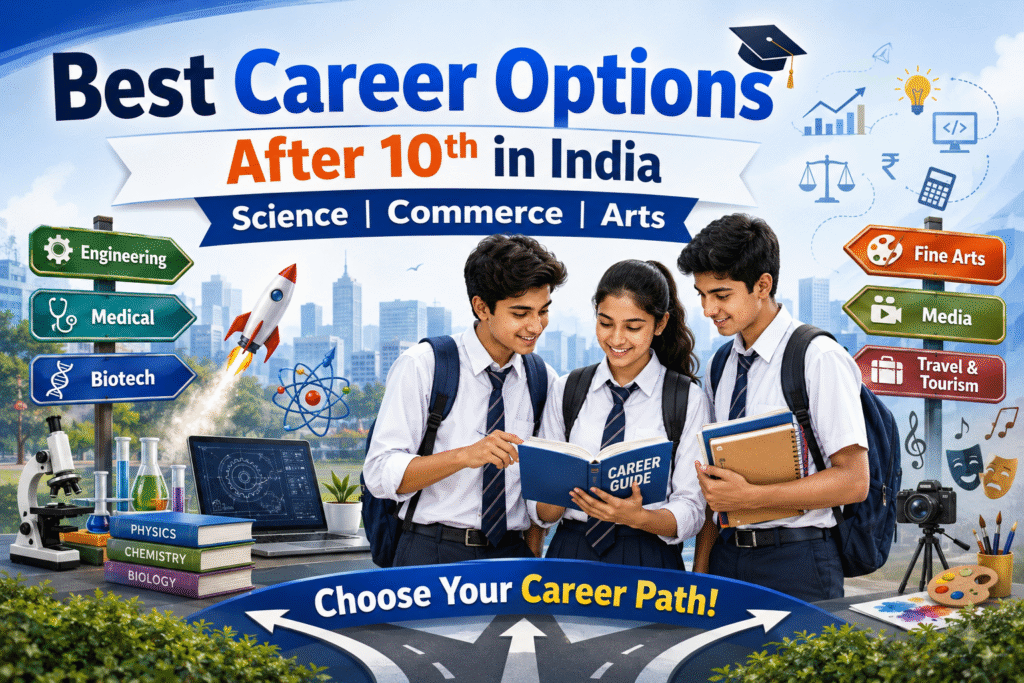
Why Choosing the Right Career After 10th Matters
Completing Class 10 is one of the first major milestones in a student’s academic journey.
At this stage, students are required to make important decisions regarding their future education and career direction.
While many students feel pressure to choose a stream quickly, taking the time to make an informed decision can significantly impact future opportunities.
The choices made after Class 10 often influence the subjects students study in higher secondary education, the courses they become eligible for, and the career paths available to them later.
This is why understanding the best career options after 10th is not just about selecting a stream—it’s about building a strong foundation for long-term success.
Rather than following friends, family expectations, or popular trends, students should focus on their interests, strengths, and future goals.
A well-planned decision today can help avoid confusion, unnecessary course changes, and career dissatisfaction in the future.
How Class 10 Influences Your Future Career Path
The decisions made after Class 10 play a crucial role in shaping a student’s educational and professional journey. Once students choose a stream—Science, Commerce, or Arts—they begin developing knowledge and skills related to specific fields.
For example:
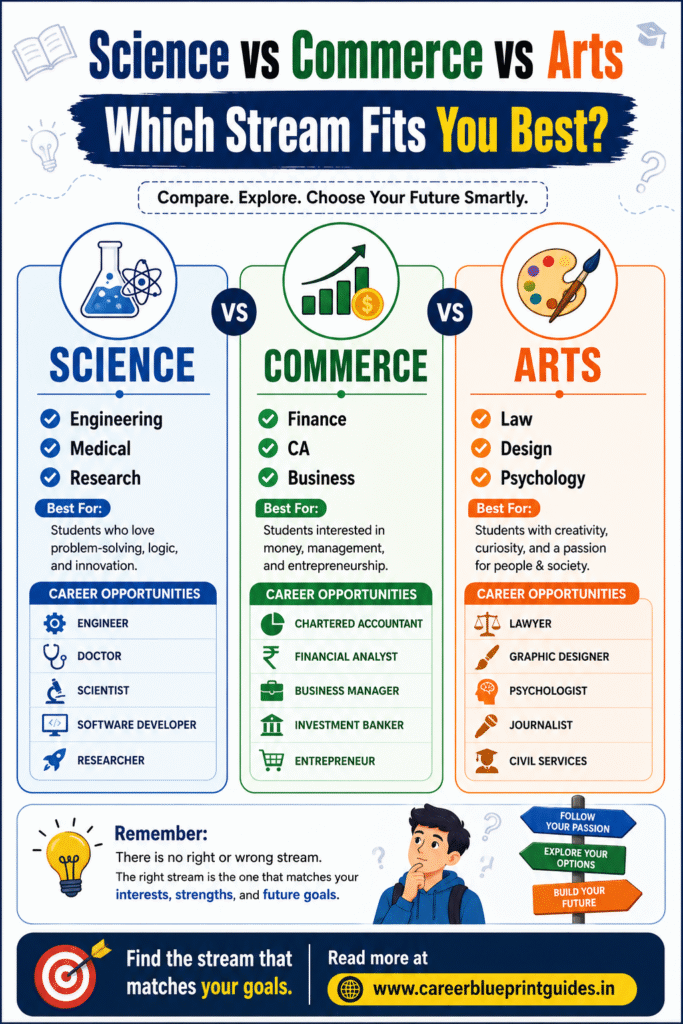
- Students choosing Science may pursue careers in engineering, medicine, research, technology, or data science.
- Students opting for Commerce can explore accounting, finance, banking, business management, and entrepreneurship.
- Arts students can build careers in law, journalism, psychology, public administration, design, and many other fields.
Although stream selection does not permanently lock students into a single career path, it does create a foundation that can make certain opportunities more accessible. Therefore, understanding future possibilities before selecting a stream is essential.
Class 10 also helps students identify their academic strengths and interests. Subjects that students enjoy and perform well in can often provide valuable clues about suitable career directions.
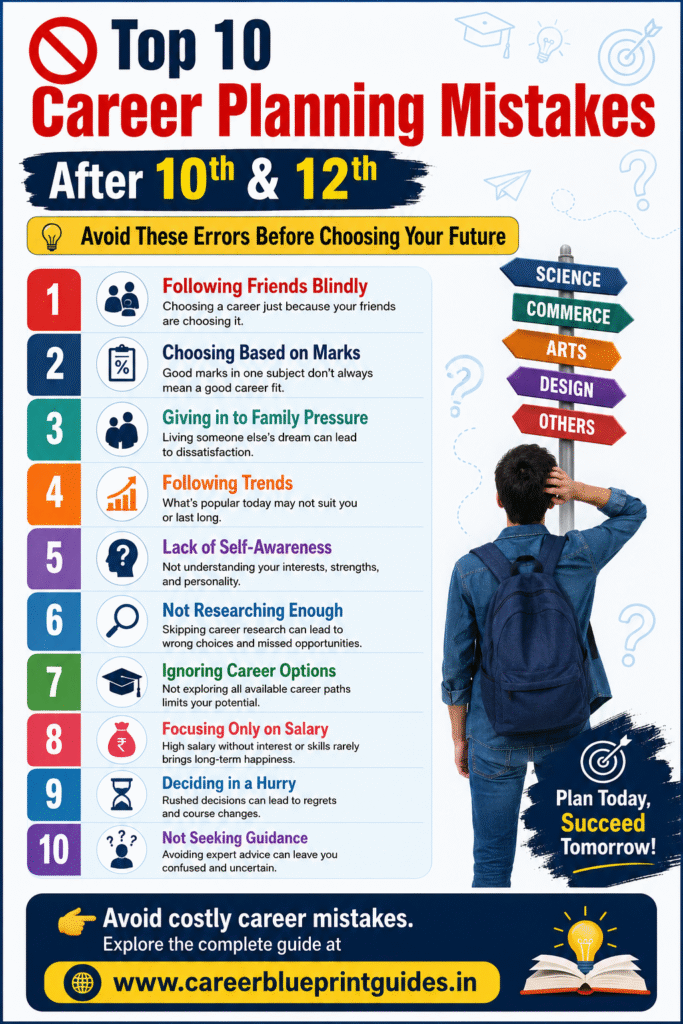
Common Mistakes Students Make After 10th
Many students make career decisions without proper research or self-assessment. As a result, they may later feel dissatisfied with their chosen stream or career path.
Some of the most common mistakes include:
Choosing a Stream Based on Peer Pressure
Many students select the same stream as their friends because they do not want to be separated. However, career decisions should always be based on personal interests and goals rather than social influences.
Following Popular Trends Without Understanding Them
Certain career fields become popular due to social media, market demand, or public perception. Choosing a stream simply because it appears trendy can lead to disappointment if it does not match a student’s interests or abilities.
Ignoring Personal Strengths and Interests
Every student has unique talents and preferences. Ignoring these factors while selecting a stream often results in a lack of motivation and poor academic performance.
Focusing Only on Salary Potential
While income is an important consideration, choosing a career solely based on earning potential may not lead to long-term satisfaction.
A successful career typically combines interest, skills, growth opportunities, and financial rewards.
Not Exploring Available Career Options
Many students are unaware of the wide range of career opportunities available today.
Emerging fields such as artificial intelligence, cybersecurity, digital marketing, animation, and data analytics offer exciting prospects that students should explore before making decisions.
Avoiding these common mistakes can help students make more confident and informed choices after Class 10.
Factors to Consider Before Choosing a Career Option
Selecting the right path requires careful evaluation of several important factors. Instead of making a rushed decision, students should take time to understand themselves and the opportunities available.
Interests and Passion
Students should identify subjects and activities they genuinely enjoy. A career aligned with personal interests often leads to greater motivation, learning, and professional satisfaction.
Academic Strengths
Understanding academic strengths can help students choose a stream where they are more likely to perform well.
For example, students who enjoy mathematics and science may find technical fields more suitable, while those interested in communication and creativity may thrive in Arts-related careers.
Skills and Natural Abilities
Apart from academic performance, students should evaluate their natural talents.
Problem-solving, leadership, creativity, analytical thinking, communication, and teamwork are all valuable skills that can influence career success.
Future Career Opportunities
Before selecting a stream, students should research future job prospects, industry growth, and emerging career trends.
Understanding where opportunities are expanding can help in making a future-ready decision.
Educational Requirements
Different careers require different educational pathways.
Students should understand the qualifications, entrance exams, and training required for careers they are interested in pursuing.
Long-Term Career Goals
Thinking about future aspirations can provide clarity when choosing a stream. While students may not have a complete career plan at this stage, having a general direction can make decision-making easier.
By carefully considering these factors, students can make informed choices that align with their abilities, interests, and future ambitions.
Taking a thoughtful approach now can help create a smoother academic journey and open doors to rewarding career opportunities in the years ahead.
Best Career Options After 10th – Overview
Completing Class 10 is one of the first major milestones in a student’s academic journey. It is also the stage where students begin thinking seriously about their future education and career goals.
While many students feel pressure to select the “perfect” path, the reality is that there are multiple career opportunities available across different streams and skill-based fields.
The best career options after 10th depend on several factors, including your interests, strengths, aptitude, learning style, and long-term goals.
Some students are naturally inclined toward science and technology, while others excel in business, creativity, communication, or practical skills.
Choosing the right stream after 10th does not mean deciding your entire future in one day.
Instead, it means selecting a direction that aligns with your abilities and gives you opportunities to grow further through higher education, professional training, or vocational programs.
Today, students can explore careers not only through traditional streams such as Science, Commerce, and Arts but also through diploma courses, vocational training, and industry-specific certifications that lead directly to employment opportunities.
The following sections provide an overview of the major career pathways available after Class 10 and the opportunities associated with each one.
Career Opportunities Through Science Stream
The Science stream is often chosen by students who enjoy subjects such as Mathematics, Physics, Chemistry, Biology, and Computer Science.
It is considered one of the most versatile streams because it opens doors to a wide range of professional careers and higher education options.
Students who choose Science after 10th can later pursue careers in:
- Engineering and Technology
- Medicine and Healthcare
- Computer Science and Information Technology
- Artificial Intelligence and Data Science
- Biotechnology
- Research and Development
- Aviation and Aerospace
- Architecture
- Environmental Science
One of the biggest advantages of the Science stream is flexibility. Students can often move into Commerce or Arts-related fields later if their interests change.
This broad scope makes Science a popular choice among students seeking diverse career opportunities.
However, students should select this stream based on genuine interest and aptitude rather than external pressure.
Success in Science requires curiosity, analytical thinking, and a willingness to engage with technical subjects.
Career Opportunities Through Commerce Stream
The Commerce stream is ideal for students interested in business, finance, economics, management, and entrepreneurship.
With the rapid growth of the global economy and digital business environment, Commerce offers numerous career opportunities across various industries.
Some popular career paths available through Commerce include:
- Chartered Accountancy (CA)
- Company Secretary (CS)
- Cost and Management Accounting (CMA)
- Banking and Financial Services
- Business Management
- Investment and Financial Planning
- E-Commerce
- Digital Marketing
- Entrepreneurship
Commerce is an excellent option for students who enjoy working with numbers, understanding markets, analyzing business trends, and managing financial resources.
In recent years, careers related to finance, taxation, investment advisory, and digital business have gained significant importance, making Commerce one of the most promising streams for future growth.
Students who develop strong analytical, communication, and decision-making skills often find excellent opportunities in this field.
Career Opportunities Through Arts/Humanities Stream
The Arts or Humanities stream has evolved significantly over the years and now offers a wide range of rewarding and respected career options.
Contrary to common misconceptions, Arts is not limited to a few professions.
It provides opportunities in government services, social sciences, media, law, education, and creative industries.
Students choosing Arts after 10th can explore careers such as:
- Civil Services
- Law
- Psychology
- Journalism and Mass Communication
- Teaching and Education
- Sociology and Social Work
- Political Science and Public Administration
- International Relations
- Content Writing and Communication
- Design and Creative Arts
The Arts stream is particularly suitable for students who enjoy reading, writing, communication, critical thinking, and understanding human behavior and society.
Many successful professionals, administrators, lawyers, journalists, and policymakers have built their careers through Humanities education.
With the growing importance of communication and human-centered skills, Arts continues to offer strong career prospects in the modern world.
Skill-Based and Vocational Career Options
Not every student wants to follow the traditional path of higher academic education. Many students prefer practical learning, industry-specific training, and early employment opportunities.
For such students, skill-based and vocational programs can be an excellent choice.
Some popular vocational and skill-oriented options after 10th include:
- Industrial Training Institute (ITI) Courses
- Polytechnic Diploma Programs
- Electrician Training
- Automobile Technician Courses
- Computer Hardware and Networking
- Graphic Designing
- Digital Marketing
- Hotel Management
- Fashion Designing
- Healthcare Technician Programs
These programs focus on hands-on training and practical skills that are directly applicable in the workplace.
Many vocational courses can be completed within one to three years, allowing students to start working sooner or continue with advanced studies later.
As industries increasingly value specialized skills, vocational education has become a respected and effective pathway for career development.
Students who prefer practical learning and job-oriented training may find these options highly rewarding.
Ultimately, the best career options after 10th are those that align with a student’s interests, strengths, and future aspirations.
Whether you choose Science, Commerce, Arts, or a vocational route, informed decision-making and continuous skill development will play a crucial role in long-term success.
Best Career Options After 10th for Science Students
Science is often considered one of the most versatile streams available after Class 10 because it opens doors to a wide range of academic and professional opportunities.
Students who enjoy subjects like Mathematics, Physics, Chemistry, Biology, or technology-related fields can find numerous career paths through this stream.
One of the biggest advantages of choosing Science is flexibility. Even after selecting Science, students can later move into fields such as management, law, finance, education, or entrepreneurship.
This makes it a preferred choice for students who want to keep multiple career options open while exploring their interests.
The following career paths are among the most promising opportunities for Science students in India.
Engineering and Technology Careers
Engineering continues to be one of the most popular career choices among Science students.
It focuses on applying scientific principles and technology to solve real-world problems.
With rapid advancements in infrastructure, automation, software development, and artificial intelligence, engineers remain in high demand across industries.
Students interested in problem-solving, innovation, design, and technology may find engineering a suitable career path.
After completing Class 12 with Physics, Chemistry, and Mathematics, students can pursue various engineering specializations through entrance examinations and university admissions.
Some popular engineering fields include:
- Computer Science Engineering
- Mechanical Engineering
- Civil Engineering
- Electrical Engineering
- Electronics and Communication Engineering
- Aerospace Engineering
- Robotics Engineering
- Artificial Intelligence Engineering
The growth of smart technologies, automation, and digital transformation has created new opportunities for engineers, making this field a strong long-term career option.
Medical and Healthcare Careers
For students who are passionate about biology, healthcare, and helping others, the medical field offers rewarding and respected career opportunities.
Healthcare remains one of the fastest-growing sectors worldwide, creating consistent demand for qualified professionals.
The medical field extends beyond becoming a doctor. Students can explore a variety of healthcare careers based on their interests and educational goals.
Popular healthcare career options include:
- MBBS (Doctor)
- BDS (Dentist)
- Nursing
- Pharmacy
- Physiotherapy
- Occupational Therapy
- Medical Laboratory Technology
- Radiology and Imaging Technology
- Public Health Management
With increasing awareness about healthcare, aging populations, and advancements in medical technology, healthcare professionals continue to play a vital role in society.
Computer Science and Artificial Intelligence
The digital economy has transformed the way businesses, governments, and individuals operate.
As a result, Computer Science and Artificial Intelligence (AI) have emerged as some of the most sought-after career fields for Science students.
Students who enjoy coding, logical thinking, software development, and technology innovation can explore opportunities in this rapidly evolving sector.
Artificial Intelligence, in particular, is driving innovation across industries such as healthcare, finance, education, manufacturing, and transportation.
Key career opportunities in this field include:
- Software Developer
- Artificial Intelligence Engineer
- Machine Learning Engineer
- Cybersecurity Analyst
- Cloud Computing Specialist
- Mobile App Developer
- Web Developer
- Systems Architect
As businesses continue to adopt digital technologies, professionals with expertise in computer science and AI are expected to remain highly valuable in the future job market.
Data Science and Emerging Technologies
Data has become one of the most valuable resources in the modern world. Organizations rely on data-driven insights to make business decisions, improve customer experiences, and develop innovative products.
This has created significant demand for professionals skilled in data analysis and emerging technologies.
Students with strong analytical and mathematical abilities may find this field particularly appealing. Careers in data science often combine programming, statistics, problem-solving, and business understanding.
Emerging career options include:
- Data Scientist
- Data Analyst
- Business Intelligence Analyst
- Big Data Engineer
- Blockchain Developer
- Internet of Things (IoT) Specialist
- Quantum Computing Researcher
- Automation Specialist
As industries continue to embrace digital transformation, careers related to data and advanced technologies are expected to grow substantially over the coming years.
Research and Scientific Careers
Research-based careers are ideal for students who enjoy discovering new knowledge, conducting experiments, and solving complex scientific challenges.
Scientific research contributes to advancements in medicine, technology, environmental sustainability, agriculture, and countless other fields.
Students interested in research typically pursue higher education and specialization in their chosen area of science.
Research careers often involve working in universities, laboratories, government organizations, private companies, or international institutions.
Potential scientific career paths include:
- Research Scientist
- Biotechnologist
- Physicist
- Chemist
- Environmental Scientist
- Agricultural Scientist
- Space Scientist
- Biomedical Researcher
India’s growing focus on innovation, scientific development, and space exploration has expanded opportunities for students interested in research-oriented professions.
Key Takeaway for Science Students
Science offers some of the most diverse and future-ready career opportunities available after Class 10.
Whether your interests lie in engineering, healthcare, artificial intelligence, data science, or scientific research, the stream provides a strong academic foundation for long-term growth.
Before making a decision, focus on your strengths, interests, and career goals rather than choosing a path solely based on popularity or peer influence.
A well-informed choice today can help build a fulfilling and successful career tomorrow.
Best Career Options After 10th for Commerce Students
Commerce is one of the most versatile streams available after Class 10. It is no longer limited to accounting and bookkeeping.
Today, students who choose Commerce can build successful careers in finance, banking, business management, taxation, entrepreneurship, digital marketing, and many other fast-growing industries.
For students interested in business, numbers, economics, financial planning, or management, Commerce offers a wide range of opportunities. Many of the best career options after 10th are available through the Commerce stream, making it a popular choice among students who want both flexibility and strong career prospects.
Before selecting Commerce, students should evaluate their interests, strengths, and long-term career goals. Understanding the career paths available can help make a more informed decision.
Chartered Accountancy (CA)
Chartered Accountancy is one of the most respected and rewarding career options for Commerce students in India.
Chartered Accountants play a vital role in managing finances, auditing accounts, tax planning, financial reporting, and business advisory services.
Students who aspire to become Chartered Accountants generally begin their preparation after choosing the Commerce stream in Class 11.
The CA qualification is regulated by the Institute of Chartered Accountants of India (ICAI) and is recognized globally.
A Chartered Accountant can work with:
- Corporate organizations
- Audit firms
- Banks and financial institutions
- Government departments
- Multinational companies
- Independent consulting practices
This career is particularly suitable for students who enjoy working with numbers, financial analysis, and problem-solving.
Due to its strong demand across industries, CA remains one of the best career options after 10th for Commerce-oriented students.
Company Secretary (CS)
A Company Secretary is responsible for ensuring that an organization complies with legal, regulatory, and corporate governance requirements.
This profession plays an essential role in the smooth functioning of companies and corporate entities.
The Company Secretary course is conducted by the Institute of Company Secretaries of India (ICSI).
Students who choose Commerce after 10th can later pursue this professional qualification alongside their graduation.
Key responsibilities of a Company Secretary include:
- Managing legal and compliance matters
- Advising company directors on governance issues
- Preparing corporate reports and documentation
- Handling regulatory filings
- Ensuring adherence to company laws
This profession is ideal for students interested in law, corporate management, and business regulations.
With increasing compliance requirements in the corporate sector, the demand for qualified Company Secretaries continues to grow.
Banking and Financial Services
The banking and financial services sector offers diverse career opportunities for Commerce students.
From retail banking and investment management to insurance and financial planning, this industry plays a critical role in the economy.
Students who choose Commerce can later pursue courses in finance, economics, banking, accounting, or business administration to enter this field.
Popular career roles include:
- Bank Officer
- Financial Analyst
- Investment Advisor
- Credit Manager
- Insurance Consultant
- Wealth Manager
- Financial Planner
The rapid growth of digital banking, fintech companies, and investment platforms has further expanded opportunities in this sector.
Students with strong analytical abilities and an interest in financial markets often find this field both challenging and rewarding.
For those seeking stable employment and long-term career growth, banking and finance remain among the best career options after 10th.
Business Management and Entrepreneurship
Students who dream of leading organizations or starting their own ventures often find Commerce to be the ideal foundation.
Business management focuses on planning, organizing, leading, and controlling business operations, while entrepreneurship emphasizes creating and growing new businesses.
After choosing Commerce, students can pursue higher studies in:
- Business Administration (BBA)
- Management Studies
- Entrepreneurship Programs
- Marketing Management
- Human Resource Management
- International Business
Key skills developed in this field include:
- Leadership
- Decision-making
- Strategic thinking
- Communication
- Problem-solving
- Team management
India’s startup ecosystem continues to grow rapidly, creating exciting opportunities for young entrepreneurs.
Students with innovative ideas and a passion for business can explore entrepreneurship as a long-term career goal.
Business management and entrepreneurship are excellent choices for students who wish to create opportunities rather than simply seek employment.
Digital Marketing and E-Commerce Careers
Digital transformation has created an entirely new range of career opportunities for Commerce students.
Businesses today rely heavily on online platforms to reach customers, making digital marketing and e-commerce some of the fastest-growing career fields.
Students can start learning digital marketing skills early and continue developing expertise through specialized certifications and degree programs.
Popular career paths include:
- Digital Marketing Specialist
- SEO Executive
- Social Media Manager
- Content Strategist
- E-Commerce Manager
- Performance Marketing Analyst
- Email Marketing Specialist
Important skills in this field include:
- Search Engine Optimization (SEO)
- Social Media Marketing
- Content Marketing
- Online Advertising
- Analytics and Data Interpretation
- E-Commerce Management
One of the biggest advantages of digital marketing is that students can begin gaining practical experience while studying.
Freelancing, internships, and personal projects provide valuable exposure and help build real-world skills.
As businesses increasingly move online, digital marketing and e-commerce have become some of the most future-ready and best career options after 10th for students interested in technology, business, and creativity.
Key Takeaway for Commerce Students
Commerce is a dynamic stream that offers career opportunities across finance, management, law, banking, entrepreneurship, and the digital economy.
Whether a student aims to become a Chartered Accountant, Company Secretary, banking professional, entrepreneur, or digital marketing expert, Commerce provides a strong foundation for long-term success.
The right choice ultimately depends on a student’s interests, strengths, and career aspirations. Exploring different options early can help students make confident decisions and build a successful future.
Best Career Options After 10th for Arts Students
Many students and parents mistakenly believe that Arts offers limited career opportunities compared to Science or Commerce. In reality, the Arts stream opens doors to a wide range of professions in government services, law, media, psychology, education, design, and many other fields.
If you enjoy subjects such as History, Political Science, Sociology, Psychology, Geography, Literature, or Fine Arts, choosing the Arts stream can provide a strong foundation for a successful and fulfilling career.
The key is to align your interests, strengths, and long-term goals with the right career path.
Here are some of the most promising career opportunities available for Arts students after Class 10.
Civil Services and Government Careers
Civil Services remain one of the most respected and sought-after career paths in India.
Many successful candidates in competitive examinations come from an Arts background because subjects like History, Political Science, Geography, Economics, and Sociology are closely related to the syllabus of various government examinations.
Students who choose Arts after 10th can gradually prepare themselves for careers in administration, public service, and policymaking.
These roles offer job security, social respect, and opportunities to contribute to society.
Some popular government career options include:
- Indian Administrative Service (IAS)
- Indian Police Service (IPS)
- Indian Foreign Service (IFS)
- State Civil Services
- SSC and Railway Jobs
- Banking Sector Examinations
- Defence and Paramilitary Services
Students interested in governance, leadership, and public service often find this among the best career options after 10th when planning for long-term success.
Journalism and Mass Communication
The media industry has expanded significantly with the rise of digital platforms, social media, online news portals, podcasts, and video content.
Students who have strong communication skills, curiosity about current affairs, and a passion for storytelling can consider careers in Journalism and Mass Communication.
This field offers opportunities to inform, educate, and influence public opinion through various media channels.
Career opportunities in this field include:
- News Reporter
- Journalist
- News Anchor
- Content Writer
- Copywriter
- Public Relations Specialist
- Digital Media Manager
- Radio Jockey
- Television Producer
- Social Media Strategist
After completing Class 12 and relevant higher education courses, students can build rewarding careers in media houses, digital agencies, publishing companies, and corporate communication departments.
Psychology and Counseling
Psychology has emerged as one of the fastest-growing career fields in recent years.
As awareness about mental health and emotional well-being continues to increase, the demand for qualified psychologists and counselors is also growing.
Students who are interested in understanding human behavior, emotions, and relationships may find Psychology an excellent career choice.
This field combines scientific study with the opportunity to help individuals improve their lives.
Potential career paths include:
- Clinical Psychologist
- Counseling Psychologist
- School Counselor
- Child Psychologist
- Mental Health Therapist
- Organizational Psychologist
- Career Counselor
- Rehabilitation Counselor
A strong educational foundation and professional training are essential in this field, but the career offers meaningful work along with growing professional opportunities.
Law and Legal Studies
Law is another highly respected and rewarding career option for Arts students.
Individuals who enjoy analytical thinking, problem-solving, debating, and understanding legal systems may find this field particularly appealing.
Students can pursue integrated law programs after Class 12 and eventually specialize in various legal domains.
The legal profession offers opportunities in both the public and private sectors.
Popular legal career options include:
- Advocate
- Corporate Lawyer
- Legal Advisor
- Public Prosecutor
- Legal Consultant
- Judge (through judicial services examinations)
- Human Rights Lawyer
- Intellectual Property Lawyer
The legal profession provides opportunities for career growth, financial stability, and significant social impact, making it a valuable option for students exploring future possibilities after 10th.
Design, Animation and Creative Careers
Students with creativity, artistic talent, and an interest in visual communication can explore careers in design and animation.
With the rapid growth of digital media, gaming, advertising, entertainment, and online businesses, creative professionals are in high demand.
Unlike traditional career paths, creative industries often focus heavily on skills, portfolios, and practical experience alongside formal education.
Popular career options in this field include:
- Graphic Designer
- UI/UX Designer
- Animator
- Fashion Designer
- Interior Designer
- Game Designer
- Multimedia Artist
- Video Editor
- Visual Effects (VFX) Artist
- Illustrator
Modern businesses, startups, media companies, and entertainment industries rely heavily on creative professionals to build engaging visual experiences.
For students with artistic abilities and innovative thinking, this can be one of the most exciting and future-oriented career paths available.
Choosing the Arts stream does not limit career opportunities; instead, it offers diverse pathways across government services, media, psychology, law, and creative industries.
By understanding your interests, strengths, and long-term aspirations, you can select a direction that supports both personal satisfaction and professional growth.
The right decision today can lay the foundation for a successful and rewarding future.
Best Diploma Courses After 10th
Not every student wants to follow the traditional path of completing Class 12 and then pursuing a degree.
Many students prefer career-oriented diploma programs that provide practical skills, industry exposure, and faster entry into the job market.
These courses are designed to help students develop specialized expertise while keeping future education opportunities open.
If you are exploring the best career options after 10th, diploma courses can be an excellent choice because they combine skill development with employment opportunities.
Depending on your interests, you can choose a diploma in engineering, technology, design, healthcare, hospitality, or digital fields.
Polytechnic Diploma
A Polytechnic Diploma is one of the most popular choices for students interested in technical and engineering careers.
These programs focus on practical learning and provide foundational knowledge in various engineering disciplines.
Popular Polytechnic Diploma Specializations:
- Mechanical Engineering
- Civil Engineering
- Electrical Engineering
- Electronics Engineering
- Computer Engineering
- Automobile Engineering
Most polytechnic programs are three years long and can lead directly to employment in technical industries.
Students who wish to continue their studies can also pursue lateral entry into the second year of a B.Tech or engineering degree program.
Career Opportunities:
- Junior Engineer
- CAD Technician
- Site Supervisor
- Maintenance Technician
- Production Executive
Polytechnic diplomas are ideal for students who enjoy mathematics, problem-solving, and hands-on technical work.
Diploma in Computer Applications
As technology continues to transform every industry, computer-related skills have become highly valuable.
A Diploma in Computer Applications introduces students to the fundamentals of computers, software, programming, and digital tools.
Key Subjects Covered:
- Computer Fundamentals
- MS Office Applications
- Database Management
- Programming Basics
- Internet Technologies
- Computer Networking
This diploma is suitable for students who are interested in technology but may not want to pursue a full engineering pathway immediately.
Career Opportunities:
- Computer Operator
- Data Entry Specialist
- IT Support Executive
- Office Administrator
- Junior Software Assistant
The course can also serve as a stepping stone toward advanced certifications and degree programs in information technology.
Diploma in Digital Marketing
Digital marketing has emerged as one of the fastest-growing career fields in India and across the world.
Businesses increasingly rely on online platforms to attract customers, creating demand for skilled digital marketers.
A Diploma in Digital Marketing helps students learn practical online marketing skills from an early stage.
Core Topics Usually Include:
- Search Engine Optimization (SEO)
- Social Media Marketing
- Content Marketing
- Google Ads
- Email Marketing
- Website Management
- Analytics and Reporting
One of the biggest advantages of this course is that students can start freelancing, internships, or part-time projects while continuing their education.
Career Opportunities:
- Digital Marketing Executive
- SEO Specialist
- Social Media Manager
- Content Marketing Assistant
- Freelance Digital Marketer
For students interested in online business, content creation, and technology, this can be one of the most future-ready options among the best career options after 10th.
Diploma in Hotel Management
The hospitality and tourism industry offers exciting career opportunities for students who enjoy interacting with people and working in dynamic environments.
A Diploma in Hotel Management provides training in hospitality operations, customer service, food production, and hotel administration.
Major Areas of Study:
- Front Office Management
- Food and Beverage Services
- Housekeeping Operations
- Hospitality Management
- Customer Service Skills
- Event Management
India’s growing tourism and hospitality sectors continue to create employment opportunities for trained professionals.
Career Opportunities:
- Hotel Executive
- Front Desk Associate
- Hospitality Coordinator
- Event Assistant
- Restaurant Supervisor
Students with strong communication skills and a customer-focused attitude often perform well in this field.
Diploma in Graphic Design and Multimedia
For creative students, graphic design and multimedia can open doors to exciting careers in advertising, branding, animation, and digital content creation.
This diploma focuses on visual communication and design principles while teaching industry-standard software tools.
Common Topics Covered:
- Graphic Design Fundamentals
- Adobe Photoshop
- Adobe Illustrator
- Video Editing
- Motion Graphics
- Multimedia Production
As businesses increasingly depend on visual content, skilled designers are in demand across multiple industries.
Career Opportunities:
- Graphic Designer
- Multimedia Artist
- Video Editor
- UI Design Assistant
- Social Media Creative Designer
Students who enjoy creativity, art, and digital technology may find this diploma both rewarding and professionally fulfilling.
Diploma in Paramedical Sciences
Healthcare remains one of the most stable and respected sectors worldwide.
A Diploma in Paramedical Sciences allows students to enter the healthcare industry through specialized support roles.
These programs focus on medical diagnostics, patient care, laboratory procedures, and healthcare support services.
Popular Specializations Include:
- Medical Laboratory Technology
- Radiology Technology
- Operation Theatre Technology
- Dialysis Technology
- Emergency Medical Services
Paramedical professionals play a crucial role in supporting doctors and healthcare institutions.
Career Opportunities:
- Laboratory Technician
- Radiology Assistant
- Emergency Care Technician
- Healthcare Support Executive
- Clinical Assistant
For students interested in medicine and healthcare but looking for alternative pathways beyond becoming a doctor, paramedical courses offer excellent opportunities for career growth.
Key Takeaway
Diploma programs provide practical skills, industry exposure, and early career opportunities for students after Class 10.
Whether your interests lie in engineering, computers, digital marketing, hospitality, design, or healthcare, choosing the right diploma course can help you build a strong foundation for future success.
Before making a decision, evaluate your interests, strengths, and long-term career goals to identify the option that aligns best with your aspirations.
Best Vocational Courses After 10th
Not every student wants to follow the traditional route of Class 11, Class 12, and then a college degree.
Many students prefer practical, skill-based education that can help them start earning sooner and build a successful career. This is where vocational courses become an excellent option.
Vocational programs focus on hands-on training, industry-relevant skills, and real-world applications.
These courses are designed to prepare students for specific professions and often offer quicker entry into the workforce compared to conventional academic pathways.
For students exploring the best career options after 10th, vocational education can provide a strong foundation for long-term career growth while helping them develop specialized skills that are in demand across industries.
ITI Courses
These programs are designed to provide practical training in various technical and non-technical trades.
Students can choose from a wide range of fields such as electrician, fitter, welder, mechanic, computer operator, plumber, and more.
Most ITI programs range from six months to two years, depending on the trade selected.
One of the biggest advantages of ITI courses is their focus on employability.
Students gain practical experience and can often secure jobs immediately after completing their training.
Additionally, ITI graduates can pursue advanced certifications, apprenticeships, or even further technical education to enhance their career prospects.
Popular ITI Trades:
- Electrician
- Fitter
- Welder
- Mechanic
- Computer Operator and Programming Assistant (COPA)
- Refrigeration and Air Conditioning Technician
Career Opportunities:
- Technician
- Maintenance Engineer
- Industrial Worker
- Machine Operator
- Government Trade Apprentice
Electrician and Technician Courses
Electricians and technicians play a crucial role in modern infrastructure, industries, and households.
As urbanization and industrial development continue to grow, the demand for skilled electrical professionals remains strong.
After completing a vocational course in electrical technology, students learn about wiring systems, electrical installations, maintenance procedures, safety standards, and troubleshooting techniques.
These skills can lead to employment opportunities in construction companies, manufacturing units, power plants, service centers, and government departments.
Skills Learned:
- Electrical wiring
- Circuit installation
- Equipment maintenance
- Fault diagnosis
- Safety procedures
Career Opportunities:
- Electrician
- Electrical Technician
- Maintenance Technician
- Power Plant Assistant
- Industrial Electrician
For students interested in technical work and practical problem-solving, this field can be one of the best career options after 10th.
Automobile Engineering Technician
The automobile industry is evolving rapidly with advancements in electric vehicles, hybrid technology, and smart transportation systems.
This creates exciting opportunities for students who are passionate about vehicles and mechanical systems.
Vocational courses in automobile technology provide training in vehicle maintenance, engine systems, diagnostics, repair techniques, and automotive electronics.
Students gain hands-on experience working with different types of vehicles and learn industry-standard practices used in service centers and manufacturing units.
Subjects Commonly Covered:
- Engine Technology
- Vehicle Maintenance
- Automotive Electronics
- Diagnostic Tools
- Workshop Practices
Career Opportunities:
- Automobile Technician
- Service Advisor
- Vehicle Inspector
- Workshop Supervisor
- Automotive Service Engineer
With the automotive sector continuously expanding, this field offers promising career prospects for skilled professionals.
Fashion Designing Courses
Fashion designing is an attractive vocational option for students who have a creative mindset and a passion for style, design, and innovation.
These courses teach students the fundamentals of garment construction, fashion illustration, textile knowledge, pattern making, and fashion trends.
Sudents also learn how to transform creative ideas into practical designs that meet market demands.
The fashion industry offers opportunities in clothing design, retail, styling, merchandising, and entrepreneurship. Many successful designers started their journey by developing practical skills through specialized training programs.
Skills Developed:
- Fashion Illustration
- Pattern Making
- Textile Selection
- Design Principles
- Creative Visualization
Career Opportunities:
- Fashion Designer
- Fashion Stylist
- Boutique Owner
- Apparel Merchandiser
- Costume Designer
Students with strong creativity and artistic interests may find fashion designing to be one of the most rewarding career paths after Class 10.
Healthcare Assistant Programs
The healthcare sector continues to be one of the fastest-growing industries worldwide. As hospitals, clinics, and healthcare facilities expand, the demand for trained healthcare assistants is increasing significantly.
Healthcare assistant programs provide foundational knowledge in patient care, medical support services, healthcare procedures, and hospital administration.
These courses are particularly suitable for students interested in serving people and contributing to the healthcare field.
Training typically includes practical exposure to healthcare environments, helping students develop confidence and professional skills.
Key Areas of Learning:
- Basic Patient Care
- Medical Terminology
- Health and Safety Procedures
- Hospital Operations
- Communication Skills
Career Opportunities:
- Healthcare Assistant
- Patient Care Technician
- Nursing Assistant
- Medical Support Staff
- Clinic Assistant
For students who are compassionate, responsible, and interested in the medical field, healthcare assistant programs can open the door to a stable and meaningful career.
Key Takeaway
Vocational education offers a practical and career-focused pathway for students who want to develop industry-ready skills after Class 10.
Whether it is ITI training, electrical work, automobile technology, fashion designing, or healthcare assistance, these programs provide valuable opportunities for employment and professional growth.
When evaluating the best career options after 10th, students should consider their interests, strengths, career goals, and the future demand for skills in their chosen field.
A well-chosen vocational course can lead to both financial stability and long-term career satisfaction.
High-Salary Career Options After 10th and 12th
However, the real goal should be identifying a career path that aligns with your interests, strengths, and long-term aspirations.
While salary should not be the only factor in career planning, understanding which professions offer strong earning potential can help students make informed decisions.
The good news is that high-paying careers are available across all streams. Whether you choose Science, Commerce, or Arts after 10th, there are multiple opportunities that can lead to rewarding and financially stable careers after completing higher education and developing the required skills.
Below are some of the most promising and high-salary career paths students can explore after 10th and 12th.
Careers in Technology
The technology sector continues to be one of the fastest-growing industries in India and around the world.
Students who enjoy computers, problem-solving, innovation, and digital tools can find excellent opportunities in this field.
Popular technology careers include:
- Software Developer
- Artificial Intelligence (AI) Engineer
- Data Scientist
- Cybersecurity Specialist
- Cloud Computing Engineer
- Mobile App Developer
- Machine Learning Engineer
- Web Developer
Technology professionals are in demand across industries such as healthcare, banking, education, e-commerce, and manufacturing.
As businesses increasingly adopt digital solutions, skilled technology experts often enjoy attractive salaries and strong career growth.
Students interested in these fields usually choose the Science stream after 10th, although certain technology careers can also be pursued through diploma programs, certifications, and specialized training.
Why technology is a popular career choice:
- High demand globally
- Opportunities for remote work
- Continuous innovation and learning
- Strong salary growth potential
- Wide range of specializations
For students exploring the best career options after 10th, technology remains one of the most future-ready fields.
Careers in Healthcare
Healthcare is a respected and essential sector that offers both job stability and the opportunity to make a meaningful difference in people’s lives.
Students with an interest in biology, medicine, patient care, and health sciences may find healthcare careers highly rewarding.
Popular healthcare career options include:
- Doctor (MBBS)
- Dentist
- Pharmacist
- Physiotherapist
- Nurse
- Medical Laboratory Technologist
- Radiology Technician
- Healthcare Administrator
The healthcare industry continues to expand due to increasing population needs, medical advancements, and greater awareness about health and wellness.
Qualified healthcare professionals often enjoy excellent career prospects and long-term financial stability.
Benefits of healthcare careers:
- Strong demand in both public and private sectors
- High level of job security
- Opportunities for specialization
- Ability to contribute positively to society
- Consistent career growth
Students planning for medical careers typically choose the Science stream with Biology after Class 10.
Careers in Finance
Finance is one of the most attractive career domains for students who enjoy working with numbers, business concepts, investments, and financial planning.
The financial sector plays a crucial role in the economy, creating numerous career opportunities.
Popular finance careers include:
- Chartered Accountant (CA)
- Investment Banker
- Financial Analyst
- Cost Accountant
- Tax Consultant
- Banking Professional
- Certified Financial Planner
- Risk Management Specialist
Students generally choose the Commerce stream after 10th to build a foundation in accounting, economics, and business studies. However, certain finance-related careers are also accessible through other educational pathways.
Why finance offers strong earning potential:
- Demand across industries
- Opportunities in domestic and international markets
- Scope for professional certifications
- Competitive salary packages
- Career growth based on expertise and performance
For students interested in business and money management, finance can be among the best career options after 10th to consider for long-term success.
Careers in Law
Law is an excellent career option for students who possess strong communication skills, analytical thinking, and an interest in justice and public affairs.
The legal profession offers diverse opportunities beyond traditional courtroom practice.
Popular law-related careers include:
- Advocate
- Corporate Lawyer
- Legal Consultant
- Judge
- Public Prosecutor
- Legal Advisor
- Intellectual Property Lawyer
- Cyber Law Specialist
Students from Arts, Commerce, or Science backgrounds can pursue legal education after completing Class 12.
Integrated law programs such as BA LLB, BBA LLB, and BCom LLB provide direct pathways into the legal profession.
Advantages of a legal career:
- Diverse specialization options
- Opportunities in corporate and government sectors
- Strong professional reputation
- Potential for independent practice
- Increasing demand for legal expertise in emerging sectors
As businesses and digital platforms continue to grow, legal professionals with specialized knowledge are becoming increasingly valuable.
Careers in Business and Entrepreneurship
Not every student wants to follow a traditional employment path. Some students dream of building their own businesses, creating innovative solutions, or becoming industry leaders.
Entrepreneurship and business management offer exciting opportunities for individuals with creativity, leadership skills, and a willingness to take calculated risks.
Popular business and entrepreneurship careers include:
- Entrepreneur
- Business Consultant
- Startup Founder
- Marketing Manager
- E-commerce Business Owner
- Operations Manager
- Product Manager
- Digital Business Strategist
Students can begin developing entrepreneurial skills at an early stage through internships, business competitions, online learning, and practical projects.
Today, digital platforms have made it easier than ever for young entrepreneurs to launch and scale businesses.
Why business careers attract many students:
- Unlimited growth potential
- Opportunity to create employment
- Freedom to build innovative ventures
- Development of leadership skills
- Ability to work across industries
Students from Science, Commerce, and Arts backgrounds can all pursue business-related careers, making entrepreneurship one of the most flexible and dynamic career choices available.
Choosing a high-salary career starts with understanding your interests, strengths, and long-term goals.
While income is an important consideration, true success often comes from combining passion, skills, and continuous learning.
By making informed decisions after Class 10 and Class 12, students can build a career that is both financially rewarding and personally fulfilling.
Career Options After 10th for Students Who Are Confused
Feeling confused after Class 10 is completely normal.
Many students face uncertainty when it comes to choosing a stream or deciding on a future career path. With so many options available today, it can be difficult to determine which direction is right for you.
The good news is that you do not need to have all the answers immediately. The period after Class 10 is an opportunity to understand yourself better, explore different possibilities, and make informed decisions.
Instead of selecting a stream based on peer pressure, family expectations, or popular trends, focus on discovering what aligns with your interests, abilities, and long-term goals.
If you are unsure about your future, the following steps can help you identify some of the best career options after 10th that match your personality and potential.
Identify Your Interests and Strengths
The first step in choosing a career is understanding yourself. Every student has unique talents, interests, and natural abilities.
Some enjoy solving mathematical problems, while others excel in communication, creativity, leadership, or practical work.
Ask yourself questions such as:
- Which subjects do I enjoy studying the most?
- What activities make me feel excited and motivated?
- What are my strongest skills?
- What kind of work environment would I enjoy in the future?
For example:
- If you enjoy Physics and Mathematics, careers in engineering, technology, or data science may be suitable.
- If you are interested in business, finance, and economics, Commerce-related careers could be a good fit.
- If you enjoy writing, creativity, psychology, or social sciences, Arts and Humanities may offer rewarding opportunities.
Choosing a stream based on your strengths can improve academic performance and increase your chances of long-term career satisfaction.
Take Career Aptitude Assessments
Many students struggle to identify their strengths on their own. Career aptitude assessments can provide valuable insights into your abilities, personality traits, and career preferences.
These assessments are designed to evaluate:
- Logical reasoning skills
- Numerical ability
- Verbal communication skills
- Creativity
- Problem-solving ability
- Personality characteristics
Based on the results, students receive recommendations about suitable career paths and educational streams.
While aptitude tests should not be the sole basis for decision-making, they can serve as a useful starting point for exploring the best career options after 10th.
They help students gain clarity and reduce confusion during the stream selection process.
Professional career counselors often use these assessments to guide students toward careers that align with their strengths and interests.
Explore Different Career Fields
One of the biggest mistakes students make is limiting themselves to only a few well-known professions such as engineering, medicine, or government jobs.
Today’s job market offers hundreds of career opportunities across various industries.
Spend time researching different fields before making a decision.
Some growing career sectors include:
- Artificial Intelligence and Machine Learning
- Cybersecurity
- Data Analytics
- Digital Marketing
- Graphic Design
- Animation and Multimedia
- Financial Services
- Healthcare and Allied Medical Sciences
- Environmental Science
- Entrepreneurship and Startups
Learn about:
- Educational requirements
- Skills needed
- Job responsibilities
- Future growth prospects
- Salary potential
Reading career guides, attending webinars, watching educational videos, and participating in career fairs can help you gain a broader perspective.
The more career options you explore, the more confident you will become in choosing a path that suits your goals and interests.
Talk to Mentors and Industry Professionals
Guidance from experienced individuals can make a significant difference when you are uncertain about your future.
Consider speaking with:
- Teachers
- School counselors
- Parents
- Senior students
- Career coaches
- Professionals working in your field of interest
These individuals can share practical insights that are often not available in textbooks or online articles.
They can explain the realities of different professions, required qualifications, industry challenges, and future opportunities.
For example, if you are interested in becoming a software developer, speaking with someone already working in the technology industry can help you understand the skills, education, and career progression involved.
Similarly, interacting with professionals from healthcare, finance, design, law, or business backgrounds can give you a realistic understanding of various career paths.
Their experiences can help you avoid common mistakes and make better decisions about your education and future.
Remember That Career Decisions Are Not Permanent
Many students feel pressured to make the “perfect” decision immediately after Class 10. However, career journeys are rarely fixed.
As you gain more knowledge and experience, your interests and goals may evolve.
The most important thing is to choose a direction that aligns with your current strengths and aspirations while remaining open to learning and growth.
By understanding yourself, exploring opportunities, seeking guidance, and staying informed about emerging industries, you can confidently move toward one of the best career options after 10th that supports your future success.
Stream Selection Guide After 10th
Choosing a stream after Class 10 is one of the first major academic decisions in a student’s life.
The stream you select can influence your future education, career opportunities, and skill development. However, this does not mean that one wrong decision will permanently limit your options.
Today, students have multiple pathways to switch fields, learn new skills, and build successful careers.
The key is to choose a stream based on your interests, strengths, learning style, and long-term goals rather than following friends, family pressure, or popular trends.
Understanding what each stream offers can help you make a more informed decision and identify the best career options after 10th that align with your aspirations.
Who Should Choose Science?
Science is often considered one of the most versatile streams because it opens doors to a wide range of career opportunities in engineering, medicine, technology, research, and other emerging fields.
You may consider choosing Science if:
- You enjoy subjects like Mathematics, Physics, Chemistry, or Biology.
- You are curious about how things work and enjoy problem-solving.
- You are interested in careers such as Engineer, Doctor, Scientist, Architect, Data Analyst, or AI Specialist.
- You are comfortable with analytical thinking and practical learning.
You want flexibility to explore both science-related and many non-science career paths in the future.
Science requires dedication and consistent effort, but it can provide access to some of the most dynamic and future-focused career opportunities.
Students who genuinely enjoy scientific concepts and logical reasoning often find this stream rewarding.
Popular career paths through Science include:
- Engineering
- Medical Sciences
- Biotechnology
- Artificial Intelligence
- Data Science
- Architecture
- Aviation
- Environmental Science
Who Should Chose Commerce?
Commerce is an excellent choice for students interested in business, finance, economics, and management. It provides a strong foundation for understanding how organizations, markets, and financial systems operate.
You may consider choosing Commerce if:
- You enjoy working with numbers and financial concepts.
- You are interested in business, entrepreneurship, banking, or investments.
- You want to build a career in accounting, taxation, finance, or management.
- You enjoy analyzing trends, profits, and business strategies.
- You are interested in understanding how companies operate and grow.
Contrary to common misconceptions, Commerce offers numerous high-growth career opportunities and is not limited to accounting alone.
With the rise of digital businesses and financial technology, Commerce students have access to diverse and evolving career paths.
Popular career paths through Commerce include:
- Chartered Accountancy (CA)
- Company Secretary (CS)
- Banking and Finance
- Investment Analysis
- Business Management
- Entrepreneurship
- Digital Marketing
- Financial Planning
For many students, Commerce provides some of the best career options after 10th because it combines practical knowledge with strong career growth potential.
Who Should Choose Arts?
Arts, also known as Humanities, is a stream that focuses on understanding society, human behavior, culture, communication, and creative expression.
It offers a broad range of career opportunities that are often overlooked by students and parents.
You may consider choosing Arts if:
- You enjoy subjects such as History, Geography, Political Science, Psychology, or Sociology.
- You have strong communication, writing, or creative skills.
- You are interested in understanding people, society, and global issues.
- You aspire to work in fields such as law, media, public administration, design, or education.
- You enjoy critical thinking, research, and creative problem-solving.
The Arts stream has evolved significantly over the years and now offers pathways into many respected and high-demand professions.
Popular career paths through Arts include:
- Civil Services
- Law
- Journalism and Mass Communication
- Psychology
- Teaching and Education
- Graphic Design
- Fashion Design
- Social Work
- Public Relations
Students who have strong creative, analytical, or communication abilities can find many fulfilling and successful career options through Arts.
Questions to Ask Yourself Before Selecting a Stream
Before making a final decision, take some time to evaluate your interests, strengths, and future aspirations. Asking the right questions can help you choose a stream that matches your personality and career goals.
Consider the following questions:
- Which subjects do I genuinely enjoy studying?
- What are my strongest academic skills?
- Do I prefer practical, analytical, business-oriented, or creative work?
- Which careers excite me the most when I learn about them?
- Am I choosing a stream because of my interests or because of external pressure?
- What kind of work environment would I enjoy in the future?
- Which skills would I like to develop over the next few years?
- Have I researched the career opportunities available in each stream?
- Remember that selecting a stream is not about choosing the most popular option.
It is about finding the path that best aligns with your abilities, interests, and future ambitions.
Students who make informed decisions are often better prepared to explore the best career options after 10th and build a successful academic and professional journey.
The right stream is the one that helps you learn, grow, and move closer to your long-term goals with confidence and clarity.
Comparison Table of Best Career Options After 10th
Choosing among the best career options after 10th can feel overwhelming because every stream offers different opportunities, skill requirements, and future growth potential.
Instead of focusing only on popularity or salary, students should compare careers based on their interests, strengths, and long-term goals.
The table below provides a quick overview of major streams and the career opportunities they can lead to in the future.
| Stream | Popular Career Opportunities | Key Subjects | Higher Education Path |
|---|---|---|---|
| Science | Engineer, Doctor, Data Scientist, Pharmacist, Researcher | Physics, Chemistry, Mathematics, Biology | B.Tech, MBBS, B.Sc, Pharmacy, Research Programs |
| Commerce | Chartered Accountant, Banker, Financial Analyst, Entrepreneur, Company Secretary | Accountancy, Economics, Business Studies | B.Com, CA, CS, CMA, MBA |
| Arts/Humanities | Civil Servant, Lawyer, Psychologist, Journalist, Designer | History, Political Science, Sociology, Psychology | BA, LLB, Journalism, Design, Psychology |
| Vocational & Diploma Courses | Technician, Graphic Designer, Hotel Manager, Digital Marketer, Healthcare Assistant | Practical and Industry-Based Skills | Diploma Programs, Certifications, Specialized Training |
The right choice is not necessarily the stream chosen by most students. A successful career is built when a student’s interests and abilities align with future opportunities.
Stream vs Career Opportunities
Each stream opens the door to a wide range of professions. Understanding these opportunities can help students make an informed decision after Class 10.
Science Stream
Science is often considered one of the most versatile streams because it provides access to careers in technology, healthcare, engineering, research, and emerging fields such as artificial intelligence and data science.
Popular Career Options:
- Engineering
- Medicine
- Biotechnology
- Pharmacy
- Data Science
- Cybersecurity
- Research and Development
Commerce Stream
Commerce is ideal for students interested in finance, business, management, and entrepreneurship. It develops analytical and financial decision-making skills that are highly valued across industries.
Popular Career Options:
- Chartered Accountant (CA)
- Company Secretary (CS)
- Investment Banker
- Financial Analyst
- Business Consultant
- Entrepreneur
- Banking Professional
Arts/Humanities Stream
Arts is no longer limited to traditional career paths. Today, it offers diverse opportunities in law, media, design, public administration, and psychology.
Popular Career Options:
- Civil Services
- Lawyer
- Journalist
- Psychologist
- Content Strategist
- Social Worker
- Graphic Designer
Vocational and Skill-Based Education
Students who prefer practical learning can choose vocational courses and diploma programs that provide industry-ready skills.
Popular Career Options:
- Electrician
- Technician
- Graphic Designer
- Hotel Management Professional
- Healthcare Assistant
- Digital Marketing Executive
Required Skills
Success in any career depends not only on the chosen stream but also on the skills a student develops over time.
| Stream | Important Skills |
|---|---|
| Science | Analytical Thinking, Problem Solving, Mathematical Ability, Research Skills |
| Commerce | Financial Understanding, Logical Reasoning, Communication, Decision-Making |
| Arts/Humanities | Creativity, Critical Thinking, Communication, Leadership |
Students should focus on developing these skills alongside their academic studies because employers increasingly value practical abilities and problem-solving capabilities.
Universal Skills Every Student Should Build
Regardless of the stream chosen, the following skills can significantly improve future career prospects:
- Communication Skills
- Digital Literacy
- Critical Thinking
- Time Management
- Teamwork
- Adaptability
- Leadership
These competencies remain valuable across industries and career paths.
Future Scope
One of the most important factors when evaluating the best career options after 10th is future demand. Students should consider industries that are expected to grow over the next decade.
Future Scope in Science
The demand for professionals in healthcare, artificial intelligence, robotics, cybersecurity, biotechnology, and renewable energy continues to increase globally.
Science students can benefit from these expanding sectors.
Future Scope in Commerce
With the growth of startups, global business operations, and digital transactions, finance and business-related careers are expected to remain strong.
Professionals with expertise in accounting, taxation, investment, and management will continue to be in demand.
Future Scope in Arts
Government services, legal professions, content creation, media, psychology, and public policy are growing fields that offer excellent long-term opportunities for Arts students.
Future Scope in Vocational Careers
Skilled professionals are increasingly needed in manufacturing, healthcare support, hospitality, automotive services, and technology sectors. Vocational education can provide quicker entry into the workforce while maintaining strong career growth potential.
Average Salary Potential
Salary should not be the only factor when choosing a career, but understanding earning potential can help students evaluate different options realistically.
| Career Field | Approximate Entry-Level Salary (India) |
|---|---|
| Engineering | ₹3–8 LPA |
| Medical Profession | ₹5–12 LPA |
| Data Science & AI | ₹6–12 LPA |
| Chartered Accountancy | ₹6–15 LPA |
| Banking & Finance | ₹4–10 LPA |
| Law | ₹4–12 LPA |
| Journalism & Media | ₹3–8 LPA |
| Psychology | ₹3–8 LPA |
| Graphic Design | ₹3–7 LPA |
| Digital Marketing | ₹3–8 LPA |
Note: Salary figures are approximate and may vary depending on qualifications, location, skills, experience, and employer.
Focus on Growth, Not Just Starting Salary
Many students make the mistake of selecting a stream solely based on initial salary expectations.
In reality, long-term success depends on continuous learning, skill development, and genuine interest in the field.
A career chosen with proper planning and self-awareness often leads to better growth, job satisfaction, and financial stability than a career selected purely because it appears popular or high-paying at the moment.
Top Career Trends Students Should Know About
The world of work is changing faster than ever before. Many careers that are highly popular today were almost unheard of a decade ago.
As technology advances and industries evolve, students need to stay informed about emerging opportunities that may shape the future job market.
While choosing among the best career options after 10th, it is important to look beyond traditional professions and understand where future demand is expected to grow.
Exploring new-age career fields can help students make informed decisions and develop skills that remain valuable in the years ahead.
Below are some of the most promising career trends that students should know about before planning their educational journey.
Artificial Intelligence and Machine Learning
Artificial Intelligence (AI) and Machine Learning (ML) are transforming the way businesses, governments, and individuals use technology.
From voice assistants and recommendation systems to self-driving vehicles and healthcare applications, AI is becoming a part of everyday life.
Students interested in technology, mathematics, logical thinking, and problem-solving may find this field exciting.
AI professionals develop intelligent systems that can learn from data, recognize patterns, and make decisions with minimal human intervention.
Some popular career roles in this field include:
- AI Engineer
- Machine Learning Engineer
- Robotics Engineer
- AI Research Scientist
- Natural Language Processing Specialist
Students can begin preparing for AI careers by choosing the Science stream after 10th and building a strong foundation in mathematics, computer science, and programming.
Future Scope: Extremely High
Industries Hiring: Technology, Healthcare, Finance, Manufacturing, Education, and E-commerce
Cybersecurity
As businesses and individuals rely more on digital systems, protecting sensitive information has become a top priority.
Cybersecurity professionals help organizations defend their networks, data, and systems from cyber threats and online attacks.
With increasing cases of data breaches, ransomware attacks, and online fraud, the demand for cybersecurity experts continues to grow across the world.
Popular career options in cybersecurity include:
- Cybersecurity Analyst
- Ethical Hacker
- Information Security Specialist
- Security Consultant
- Network Security Engineer
Students who enjoy technology, investigation, problem-solving, and computer systems may consider exploring this field.
Many cybersecurity professionals start with studies in computer science, information technology, or networking.
Future Scope: Very High
Industries Hiring: Banking, Government, IT Services, Defense, Healthcare, and Telecommunications
Digital Marketing
The way businesses reach customers has changed significantly.
Today, companies rely heavily on online platforms such as search engines, social media, websites, email marketing, and video content to promote their products and services.
This shift has created strong demand for digital marketing professionals who can help businesses grow their online presence and attract customers.
Some popular roles in digital marketing include:
- SEO Specialist
- Social Media Manager
- Content Marketer
- Google Ads Specialist
- Email Marketing Executive
- Digital Marketing Manager
One of the biggest advantages of this field is that students can start learning practical skills even during their school years through online courses and hands-on projects.
Digital marketing is particularly suitable for students who are creative, interested in communication, content creation, business, and technology.
Future Scope: High
Industries Hiring: Almost Every Industry, Including Education, Retail, Healthcare, Finance, and E-commerce
Data Analytics
Every day, businesses generate massive amounts of information. Data Analytics involves collecting, organizing, and analyzing this information to help organizations make better decisions.
Companies use data analytics to understand customer behavior, improve products, increase efficiency, and identify new opportunities.
Career opportunities in this field include:
- Data Analyst
- Business Analyst
- Data Visualization Specialist
- Market Research Analyst
- Operations Analyst
Students who enjoy mathematics, statistics, logical reasoning, and working with numbers may find this field rewarding.
A strong foundation in mathematics and computer skills can help students prepare for future careers in data analytics.
As organizations continue to rely on data-driven decisions, demand for skilled professionals is expected to remain strong.
Future Scope: Very High
Industries Hiring: Finance, Healthcare, Technology, Retail, Manufacturing, and Consulting
Renewable Energy Careers
As countries focus on sustainability and reducing environmental impact, renewable energy has emerged as one of the fastest-growing sectors worldwide.
Renewable energy involves generating power from natural resources such as sunlight, wind, water, and biomass.
This field offers opportunities for students who are interested in science, engineering, environmental conservation, and sustainable development.
Popular career paths include:
- Solar Energy Engineer
- Wind Energy Technician
- Environmental Consultant
- Renewable Energy Analyst
- Sustainability Specialist
Governments and private organizations are investing heavily in clean energy projects, creating a growing demand for skilled professionals.
Students who choose Science after 10th can explore various educational pathways that lead to careers in renewable energy and environmental technology.
Future Scope: High and Growing Rapidly
Industries Hiring: Energy Companies, Government Agencies, Environmental Organizations, Infrastructure Firms, and Research Institutions
Why Students Should Pay Attention to Emerging Career Trends
Understanding future career trends can help students make smarter educational and career decisions.
While traditional professions such as engineering, medicine, law, and finance remain important, emerging fields are creating new opportunities that did not exist a few years ago.
When exploring the best career options after 10th, students should focus on:
- Their interests and strengths
- Future industry demand
- Required skills and qualifications
- Long-term growth opportunities
- Technological and market changes
A career chosen with both personal interest and future relevance in mind is more likely to provide stability, growth, and professional satisfaction in the years ahead.
Final Thoughts: How to Choose the Best Career Option After 10th
Many students worry about making the “perfect” decision, but the reality is that career planning is a journey, not a one-time choice.
The best career options after 10th are not necessarily the ones that are most popular among friends or relatives.
The right career path is the one that aligns with your interests, strengths, personality, and long-term goals.
Whether you choose Science, Commerce, Arts, a diploma course, or a vocational program, your success will depend more on your dedication and continuous learning than on the stream itself.
Instead of focusing only on what others are doing, take time to understand yourself and explore the opportunities available in today’s rapidly changing world.
Focus on Skills, Not Just Marks
Many students believe that their board exam marks alone will determine their future.
While good academic performance can open certain opportunities, employers and educational institutions increasingly value practical skills alongside academic achievements.
In today’s competitive world, skills such as communication, problem-solving, creativity, digital literacy, teamwork, and critical thinking often play a significant role in career growth.
A student with average marks but strong skills can often outperform someone who has excellent marks but lacks practical abilities.
For example:
- Students interested in technology can start learning coding and digital tools.
- Aspiring entrepreneurs can develop leadership and business skills.
- Creative students can build skills in design, content creation, animation, or media.
- Students interested in finance can improve their analytical and numerical abilities.
As you evaluate the best career options after 10th, focus on developing skills that will remain valuable regardless of the career path you choose.
Match Your Interests with Career Opportunities
One of the biggest mistakes students make is selecting a stream based solely on social pressure, family expectations, or the choices of their friends.
A career becomes more fulfilling when it aligns with your genuine interests and strengths.
Ask yourself questions such as:
- Which subjects do I enjoy learning?
- What activities keep me engaged for long periods?
- What kind of work environment would I prefer in the future?
- Do I enjoy working with numbers, people, technology, creativity, or research?
For instance:
- Students who enjoy Mathematics and logical thinking may find opportunities in engineering, data science, or finance.
- Those interested in business and economics may thrive in commerce-related careers.
- Students with strong communication and creative skills may excel in arts, journalism, design, or law.
- Those passionate about healthcare and science may pursue medical or research-oriented fields.
Understanding your interests helps narrow down the best career options after 10th and increases the likelihood of long-term career satisfaction.
Plan Your Career Step-by-Step
Career planning does not have to be complicated. Instead of worrying about your entire future at once, focus on taking one step at a time.
A simple career planning approach can include:
Step 1: Identify your interests, strengths, and preferred subjects.
Step 2: Research the streams and career paths related to those interests.
Step 3: Understand the educational requirements for your chosen career.
Step 4: Speak with teachers, career counselors, professionals, or seniors who have experience in that field.
Step 5: Develop relevant skills through courses, projects, internships, or extracurricular activities.
Step 6: Review and adjust your career goals as you gain more knowledge and experience.
Remember that career decisions are not permanent. Many professionals successfully change industries, acquire new skills, and build rewarding careers throughout their lives.
The key is to stay curious, continue learning, and remain open to new opportunities.
By focusing on your strengths, building valuable skills, and making informed decisions, you can confidently choose from the many best career options after 10th and create a strong foundation for a successful future.