

What is CUET UG Counselling 2026?
CUET UG Counselling 2026 is the admission process through which participating universities allocate undergraduate seats to eligible candidates based on their CUET UG scores, eligibility criteria, reservation policies, and the choices filled by students.
While the National Testing Agency (NTA) conducts the CUET UG examination and declares the results, the counselling process is generally managed by the respective universities or their designated admission portals.
Unlike a centralized counselling system for all institutions, each participating university releases its own admission schedule, registration process, and merit lists.
Therefore, candidates should regularly visit the official websites of the universities they wish to join for the latest updates.
In simple terms, qualifying the CUET UG exam does not guarantee admission. Students must complete the counselling process within the prescribed timeline to secure a seat in their preferred course and university.
Quick Overview
| Particular | Details |
|---|---|
| Admission Process | CUET UG Counselling 2026 |
| Conducted By | Individual Participating Universities |
| Entrance Exam | Common University Entrance Test (CUET UG) |
| Exam Conducting Body | National Testing Agency (NTA) |
| Admission Basis | CUET UG Score, Eligibility Criteria, Reservation Policy & Candidate Preferences |
| Mode of Counselling | Online (Varies by University) |
| Eligible Candidates | Students who qualify CUET UG 2026 and meet the university’s admission criteria |
Purpose of CUET UG Counselling 2026
The primary purpose of CUET UG Counselling 2026 is to ensure a fair, transparent, and merit-based admission process for undergraduate courses offered by participating universities across India.
Through the counselling process, universities:
- Verify candidates’ eligibility for the selected course.
- Collect students’ preferred colleges and courses.
- Allocate seats based on merit, reservation rules, and seat availability.
- Complete document verification before admission.
- Confirm admissions for the academic session.
For students, counselling provides an opportunity to select courses and colleges that best match their CUET score, career goals, and eligibility.
Expert Tip: Before registering, carefully review the eligibility requirements for each university and course. Meeting the CUET score requirement alone may not be sufficient if subject combinations or minimum qualifying marks differ.
Who Conducts the Counselling Process?
A common misconception is that NTA conducts CUET counselling. In reality, NTA is responsible only for conducting the CUET UG examination and publishing the results.
The counselling process is managed by the individual universities that accept CUET UG scores for admission.
For example:
- University of Delhi (DU) conducts admissions through its Common Seat Allocation System (CSAS) portal.
- Banaras Hindu University (BHU) releases its own admission notifications and counselling schedule.
- Other participating institutions similarly publish separate registration guidelines, admission rules, and merit lists on their official websites.
Since every university follows its own admission process, candidates should rely only on official university portals for counselling announcements and important notifications.
Important: Admission schedules and procedures may vary from one university to another. Candidates should always verify the latest information from the respective university’s official website.
Universities Participating in CUET UG Counselling 2026
Participating Universities in CUET 2026 include a wide range of higher education institutions across India that use CUET UG scores for undergraduate admissions.
These may include:
- Central Universities
- State Universities
- Deemed-to-be Universities
- Private Universities
- Other Government-Funded Institutions
Some well-known universities that have accepted CUET UG scores in previous admission cycles include:
- University of Delhi (DU)
- Banaras Hindu University (BHU)
- Jawaharlal Nehru University (JNU)
- Aligarh Muslim University (AMU)
- University of Hyderabad
- Babasaheb Bhimrao Ambedkar University (BBAU)
- Guru Ghasidas Vishwavidyalaya
- Visva-Bharati University
- Jamia Millia Islamia (for selected programmes, as applicable)
Expected for 2026: The final list of participating universities will be confirmed through the official CUET UG and respective university admission notifications.
Candidates should refer to the official admission portals before applying, as participating institutions and admission policies may change from previous years.
CUET UG Counselling 2026 – Highlights
CUET UG Counselling 2026 is the admission process through which participating universities allocate undergraduate seats to eligible candidates based on their CUET UG scores and each university’s admission criteria.
While the National Testing Agency (NTA) conducts the CUET UG examination, the counselling and admission process is managed individually by participating universities through their respective admission portals.
The table below provides a quick overview of the key details candidates should know before applying for CUET UG Counselling 2026.
| Particular | Details |
|---|---|
| Exam Name | Common University Entrance Test – Undergraduate (CUET UG) 2026 |
| Conducting Body (Exam) | National Testing Agency (NTA) |
| Counselling Conducted By | Individual Participating Universities (through their respective admission portals) |
| Academic Session | 2026–27 |
| Registration Mode | Online |
| Counselling Mode | Online (University-specific) |
| Seat Allotment | Based on CUET UG Score, Merit, Eligibility, Category, Seat Availability, and University Admission Policy |
| Official Exam Website | https://cuet.nta.nic.in |
| Participating Universities | Central, State, Deemed, Private, and Other Participating Universities accepting CUET UG scores |
Note: The official CUET UG Counselling Schedule 2026 may vary from one university to another.
Candidates should regularly check the official admission portal of their preferred university for the latest notifications, registration dates, and admission updates.
Key Highlights
- CUET UG Counselling 2026 is not conducted through a single centralized counselling process for all universities. Each participating university releases its own counselling schedule, registration process, merit list, and seat allotment details.
- Admission is generally offered based on the candidate’s CUET UG score, eligibility criteria, reservation policy, programme-specific requirements, and seat availability.
- Most universities conduct the entire admission process online, including registration, CUET UG Choice Filling 2026, document submission, seat acceptance, and fee payment.
- Candidates should keep all required documents ready before the counselling process begins to avoid delays during verification.
- If official dates have not yet been announced, they are expected based on previous admission cycles. Candidates should verify the latest information through the official websites of NTA and their respective participating universities.
Expert Tip
Before registering, prepare a shortlist of your preferred universities and courses.
Since Participating Universities in CUET 2026 may have different admission schedules and eligibility requirements, checking each university’s official admission portal in advance can help you avoid missing important deadlines.
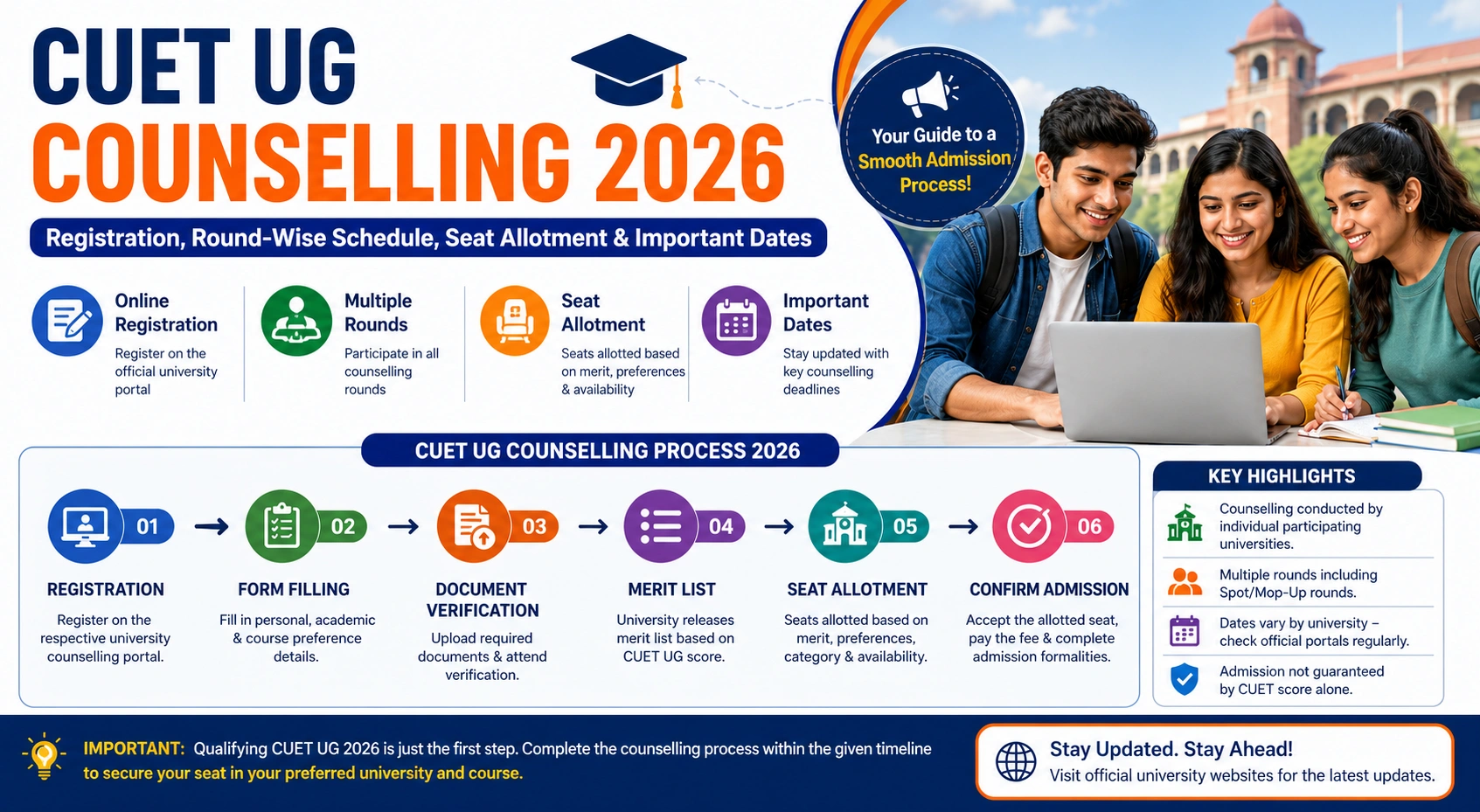
CUET UG Counselling 2026 Important Dates
The CUET UG Counselling 2026 process is conducted separately by participating universities after the declaration of the CUET UG result.
Each university releases its own counselling notification, registration schedule, choice filling timeline, seat allotment dates, and reporting deadlines on its official admission portal.
As of now, the official CUET UG Counselling Schedule 2026 has not been announced. The table below includes the key counselling events.
The exact dates will be updated once they are officially released by the respective universities.
Note: The schedule below is expected based on previous admission cycles. Candidates should verify the latest updates on the official websites of the universities where they are applying.
| Counselling Event | Expected Timeline* | Status |
|---|---|---|
| CUET UG Counselling Registration Begins | To Be Announced | Official dates awaited |
| Last Date for Registration | To Be Announced | Official dates awaited |
| Choice Filling & Preference Submission | To Be Announced | Official dates awaited |
| Choice Locking Deadline | To Be Announced | Official dates awaited |
| Round 1 Seat Allotment | To Be Announced | Official dates awaited |
| Acceptance of Allotted Seat | To Be Announced | Official dates awaited |
| Document Verification | To Be Announced | Official dates awaited |
| Fee Payment Deadline | To Be Announced | Official dates awaited |
| Round 2 Seat Allotment | To Be Announced | Official dates awaited |
| Additional Rounds (If Required) | To Be Announced | Official dates awaited |
| Spot/Final Round (If Conducted) | To Be Announced | Subject to university notification |
*Expected based on previous admission cycles. Candidates should verify updates on the official website of the respective university.
Registration Dates
The first step in CUET UG Counselling Registration 2026 is to complete the online registration on the admission portal of the university where you wish to apply.
Since there is no centralized counselling for all universities, every participating institution publishes its own registration schedule and admission guidelines.
Students should regularly check the official admission portals because registration windows are usually available for a limited period.
During registration, candidates are generally required to:
- Create a student account on the university admission portal.
- Enter CUET UG application details.
- Fill in personal, academic, and category information.
- Upload the required documents, if applicable.
- Pay the counselling or application fee, if prescribed.
Expert Tip: Register as early as possible instead of waiting until the last day. This gives you enough time to correct any errors or resolve technical issues before the registration window closes.
Choice Filling Dates
After successful registration, eligible candidates can participate in CUET UG Choice Filling 2026.
During this stage, students select their preferred universities, colleges, and undergraduate programmes based on their CUET score, eligibility, and career goals.
The choice filling window remains open only for a specified period, after which candidates may be allowed to lock or confirm their preferences before the deadline.
While filling your preferences:
- Research colleges and courses carefully.
- Verify the eligibility criteria for each programme.
- Arrange choices in your genuine order of preference.
- Review all entries before final submission.
- Lock your choices if the university requires it.
Submitting thoughtful preferences can improve your chances of receiving a suitable seat during the counselling process.
Seat Allotment Dates
The CUET UG Seat Allotment 2026 results are released in multiple rounds by individual universities.
Seat allocation is generally based on several factors, including:
- CUET UG score
- Programme-specific eligibility
- Candidate’s category (where applicable)
- Reservation policy
- Availability of seats
- Order of choices submitted by the candidate
After each round of seat allotment, candidates should immediately log in to the admission portal to check their allotment status and follow the instructions provided by the university.
If a seat is allotted, students should carefully review the next steps and complete them within the specified deadline to avoid cancellation of the allotted seat.
Reporting & Admission Dates
Candidates who receive a seat offer must complete the admission formalities within the timeline announced by the respective university. Missing the reporting deadline may result in the cancellation of the allotted seat.
The admission process generally includes:
- Accepting the allotted seat.
- Uploading or presenting the required documents.
- Completing document verification.
- Paying the admission fee within the prescribed deadline.
- Reporting online or physically, as instructed by the university.
Since every university follows its own admission schedule, students should regularly visit the official admission portal for the latest announcements and reporting instructions.
Important: The official CUET UG Counselling 2026 dates, including registration, choice filling, seat allotment, and reporting schedules, will be updated in this article as soon as they are announced by the participating universities. Always rely on official university notifications for the most accurate and up-to-date information.
CUET UG Counselling Registration 2026
CUET UG Counselling Registration 2026 is the first and most important step in the admission process for candidates seeking undergraduate admissions through CUET scores.
While the National Testing Agency (NTA) conducts the CUET UG examination, most participating universities manage their own counselling and admission process through their official counselling portals.
Candidates should register only on the official website of the university or counselling portal where they wish to seek admission. Before applying, carefully read the eligibility criteria, admission guidelines, and important instructions released by the respective university.
Important: The registration schedule and admission process may vary from one university to another. Candidates should regularly check the official websites for the latest notifications.
Who Can Register?
Candidates who meet the admission requirements of a participating university can apply for CUET UG Counselling Registration 2026. Although each institution may have its own eligibility conditions, the following candidates are generally eligible to register:
- Students who have appeared for CUET UG 2026.
- Candidates who have obtained a valid CUET UG score.
- Students who have passed or are eligible as per the Class 12 (or equivalent) qualification requirements of the respective university.
- Candidates fulfilling the subject combination and minimum marks criteria prescribed by the university.
- Reserved category candidates possessing valid category certificates, wherever applicable.
Before registering, students should verify:
- Eligibility for the selected course.
- Subject mapping requirements.
- Reservation rules.
- Age criteria (if specified).
- Additional admission requirements announced by the university.
Expert Tip: Do not assume that qualifying CUET UG guarantees admission to every university. Each institution may prescribe its own eligibility criteria, subject combinations, and admission rules.
Registration Process
The registration process is conducted online through the official admission portal of the respective university.
Although the interface may differ, the overall process remains similar across most participating institutions.
Follow these steps to complete CUET UG Counselling Registration 2026:
- Visit the official counselling or admission portal of the desired university.
- Register using your basic details such as name, email ID, mobile number, and CUET application information (if required).
- Log in using the credentials created during registration.
- Fill in your personal, academic, and communication details carefully.
- Enter your CUET UG score and other required examination details, if applicable.
- Upload the necessary documents in the prescribed format.
- Review all information before submitting the application.
- Pay the applicable counselling or registration fee through the available online payment methods.
- Submit the application form and download the confirmation page for future reference.
Practical Advice: Keep scanned copies of all required documents ready before starting the registration process. This helps avoid delays and reduces the chances of errors while uploading files.
Registration Fee
Most universities charge a counselling or registration fee to process admission applications. The fee amount, payment mode, and refund policy differ from one institution to another.
The registration fee generally depends on factors such as:
| Factor | Details |
|---|---|
| University | Every participating university decides its own registration fee. |
| Category | Fee may vary for General, OBC, EWS, SC, ST, or PwD candidates. |
| Course | Some professional or specialized courses may have different fee structures. |
| Payment Mode | Usually accepted through online payment methods such as UPI, debit card, credit card, or net banking. |
Important: Candidates should verify the latest registration fee from the official admission portal of the respective university before making any payment.
Note: Registration fees are often non-refundable once the application has been successfully submitted. Always read the official admission guidelines carefully.
Important Registration Guidelines
Following a few essential precautions can help ensure a smooth registration process and prevent unnecessary complications during admission.
Keep these guidelines in mind before submitting your application:
- Register only through the official counselling or admission portal of the university.
- Read the complete admission brochure before filling out the application form.
- Enter your personal and academic details exactly as they appear in your official documents.
- Use an active mobile number and email ID, as all admission-related updates are generally sent through these channels.
- Double-check your CUET application details before submission.
- Upload clear and readable scanned copies of all required documents in the prescribed format and file size.
- Pay the registration fee only through the official payment gateway.
- Save the payment receipt and registration confirmation for future reference.
- Avoid waiting until the last day to register, as heavy website traffic may lead to technical issues.
- Regularly monitor the university’s official website for notices, corrections, or additional admission instructions.
Official Guidance: If any registration details or counselling dates have not yet been announced, they are expected based on previous admission cycles.
Candidates should verify all updates on the official website of the respective university before taking any action.
Documents Required for CUET UG Counselling
Before starting the counselling process, candidates should keep all required documents ready in the prescribed format.
Having the correct documents helps avoid delays during registration, document verification, and admission.
Incomplete or incorrect uploads may result in the rejection of your application by the concerned university.
The Documents Required for CUET UG Counselling may vary slightly across participating universities.
However, most institutions ask for a common set of documents during registration and admission.
Candidates should always verify the latest requirements on the official counselling portal or the respective university’s website.
Mandatory Documents
The following checklist includes the documents that are commonly required during CUET UG Counselling 2026.
| Document | Purpose |
|---|---|
| CUET UG 2026 Scorecard | Used to verify your entrance examination score and eligibility for admission. |
| Class 10 Marksheet & Certificate | Required as proof of date of birth and academic record. |
| Class 12 Marksheet & Passing Certificate | Confirms eligibility for undergraduate admission. If the final marksheet is unavailable, follow the university’s official instructions. |
| Aadhaar Card or Valid Government ID | Used for identity verification during counselling and admission. |
| Category Certificate (SC/ST/OBC-NCL/EWS) | Required only for candidates claiming reservation benefits. The certificate should be valid and issued by the competent authority. |
| PwD Certificate | Mandatory for candidates applying under the Persons with Disabilities (PwD) category. |
| Recent Passport-size Photographs | May be required for registration forms, document verification, or admission records. |
| Migration Certificate (If Applicable) | Required by some universities for students moving from another education board or university. |
Document Checklist
Before beginning the registration process, make sure you have:
- CUET UG 2026 Scorecard
- Class 10 Marksheet and Certificate
- Class 12 Marksheet and Passing Certificate
- Aadhaar Card or other valid photo ID
- Category Certificate (if applicable)
- PwD Certificate (if applicable)
- Recent passport-size photographs
- Migration Certificate (if applicable)
Expert Tip: Save scanned copies of all documents in both PDF and JPEG formats. Keep file sizes within the limits specified on the official counselling portal to avoid upload errors.
Important: The exact list of Documents Required for CUET UG Counselling may differ from one university to another.
Candidates should always check the official admission guidelines of the university where they are applying.
Tips Before Uploading Documents
Uploading documents correctly is just as important as having them ready.
A small mistake, such as an unclear scan or incorrect file format, can delay verification or require resubmission.
Follow these practical tips to ensure a smooth upload process.
Follow the Official File Specifications
Always check the official counselling portal for the required file format, size, and dimensions before uploading your documents.
Uploading files that do not meet the specified requirements may result in rejection.
Use Clear and Readable Scans
Scan your documents in high resolution so that all text, signatures, and seals are clearly visible. Avoid blurred images, shadows, or cropped pages.
Upload Valid and Updated Certificates
If you are claiming reservation benefits, ensure that your category or PwD certificate is valid and issued by the appropriate government authority.
Expired or incorrect certificates may not be accepted.
Match Personal Details
Verify that your name, date of birth, parent’s name, and other personal details are consistent across all uploaded documents.
If there are differences due to spelling or legal changes, follow the official instructions provided by the concerned university.
Keep Original Documents Ready
Uploading scanned copies does not replace the need for original documents.
Universities may ask candidates to present the originals during physical reporting or document verification.
Save Backup Copies
Store digital copies of all uploaded documents in cloud storage, email, or another secure location.
This makes it easier to access them if you need to upload them again during later admission rounds.
Expert Recommendation: Complete document uploads well before the registration deadline instead of waiting until the last day.
Heavy traffic on the counselling portal may lead to slow uploads or temporary technical issues.
Official Guidance: Document requirements and upload specifications are expected based on previous admission cycles.
Candidates should verify the latest instructions and document checklist on the official counselling portal and the websites of the respective participating universities before submitting their application.
CUET UG Choice Filling 2026
CUET UG Choice Filling 2026 is one of the most important stages of the admission process.
During this step, candidates select and prioritize the colleges and courses they wish to join based on their CUET UG score, eligibility, and career goals.
The order in which you arrange your preferences can directly influence the seat allotted to you.
A well-planned choice filling strategy improves your chances of getting admission to a preferred college without missing better opportunities.
Before submitting your choices, always review the eligibility criteria, previous years’ cut-offs (where available), and the official admission guidelines of the participating universities.
Expert Tip: Never select colleges based only on popularity. Always match your preferences with your score, course interest, eligibility, and future career plans.
What is Choice Filling?
Choice filling is the process where eligible candidates log in to the counselling portal of the respective university and arrange their preferred courses and colleges in order of priority.
After completing the registration process, candidates are generally required to:
- Log in to the counselling portal.
- View eligible courses and colleges.
- Select preferred programmes.
- Arrange them from highest to lowest preference.
- Review all selections carefully.
- Save and submit the choices before the deadline.
The seat allotment process uses these preferences along with factors such as merit, category, reservation policy, seat availability, and university admission rules.
Note: Every participating university may have its own counselling portal and admission procedure.
Candidates should always follow the latest instructions published on the respective university’s official website.
| Step | What You Need to Do |
|---|---|
| Register | Complete the counselling registration process. |
| Check Eligibility | Verify that you meet the course-specific eligibility criteria. |
| Select Courses | Choose the courses you wish to apply for. |
| Arrange Preferences | Place your most preferred options at the top. |
| Review | Double-check all selections before submission. |
| Submit & Lock | Save and lock your choices before the deadline. |
How to Fill College Preferences
Selecting the right college preferences requires planning rather than guesswork.
Your list should reflect both your aspirations and realistic admission possibilities.
Follow these practical steps while filling your preferences:
1. Research participating universities.
o Visit the official websites.
o Check available programmes.
o Compare placement opportunities, faculty, campus facilities, and accreditation.
2. Verify course eligibility.
o Ensure you satisfy the subject and minimum qualification requirements before selecting a programme.
3. Compare previous admission trends.
o Previous years’ cut-offs can provide a useful reference, but they should not be treated as guaranteed indicators because admission trends may change each year.
4. Prioritize based on genuine interest.
o Choose courses that align with your career goals rather than selecting only high-demand colleges.
5. Include sufficient options.
o Adding more eligible preferences generally provides greater flexibility during seat allotment.
6. Review before final submission.
o Check spelling, course names, college names, reservation category, and preference order carefully.
Expert Recommendation: Prepare your complete preference list on paper or in a spreadsheet before entering it into the counselling portal. This helps reduce errors during online submission.
Choice Locking Process
After completing your preference list, you may be required to lock your choices before the counselling deadline, depending on the rules of the respective university.
Choice locking confirms that your submitted preferences are final for that counselling round.
A typical choice locking process includes:
- Review all selected colleges and courses.
- Verify the preference order carefully.
- Click the Lock Choices option if available.
- Confirm the submission.
- Download or print the confirmation page for future reference.
Some universities automatically lock saved choices after the deadline, while others require candidates to lock them manually.
Always follow the official instructions issued by the concerned university.
Important: Once choices are locked or the deadline has passed, modifications may not be permitted for that counselling round.
Common Mistakes to Avoid
Even students with good CUET scores sometimes lose admission opportunities because of avoidable mistakes during choice filling.
Avoid the following errors:
- Waiting until the last day to submit preferences.
- Ignoring course-specific eligibility requirements.
- Selecting colleges without proper research.
- Arranging preferences randomly.
- Entering incorrect personal or category details.
Forgetting to review the final preference list.
- Missing the choice locking deadline if applicable.
- Depending on unofficial social media rumours instead of official notifications.
Spending a little extra time reviewing your choices can prevent costly mistakes later in the admission process.
Choosing Dream Colleges First
Always place your most preferred colleges and courses at the top of your preference list.
Many students mistakenly believe they should avoid listing highly competitive colleges if they are unsure about admission. In most counselling systems, your higher preferences are considered first, and if you are not eligible for a particular option, the system moves to your next eligible preference.
Good practice:
- List your dream colleges first.
- Prioritize courses you genuinely want to study.
- Don’t let fear prevent you from aiming high.
This approach ensures you do not miss an opportunity simply because you placed your preferred college too low.
Understanding Safe Choices
A balanced preference list should also include safe choices.
Safe choices are colleges or courses where, based on previous admission trends, your CUET score may offer a stronger chance of receiving a seat.
While past cut-offs can provide guidance, they should not be considered a guarantee, as admission depends on factors such as applicant numbers, seat availability, reservation policies, and university rules.
A balanced list generally includes:
- A few ambitious choices.
- Several realistic choices.
- Some safer options.
This strategy reduces the risk of remaining without an allotment while still allowing you to compete for your preferred institutions.
Backup College Strategy
A backup strategy is an essential part of successful CUET UG Choice Filling 2026.
If your first few preferences are highly competitive, include additional colleges and courses that match your interests and eligibility.
This increases your chances of receiving a seat during the counselling process.
Before finalizing your backup options:
- Research the college’s academic reputation.
- Check programme recognition and accreditation.
- Review available facilities and student support.
- Understand placement opportunities, where applicable.
- Confirm that you meet the eligibility criteria.
Expert Advice: Keep a written list of your dream, realistic, and backup colleges before logging into the counselling portal.
A balanced preference strategy can help you make informed decisions while improving your chances of securing admission during CUET UG Counselling 2026.
CUET UG Counselling Schedule 2026 (Round-Wise)
The CUET UG Counselling Schedule 2026 is expected to follow a multi-round admission process, allowing eligible candidates to secure seats in participating universities based on their CUET UG scores and the preferences submitted during choice filling.
Each university may release its own counselling schedule, so students should regularly check the respective university’s official admission portal.
Note: As of now, the official counselling schedule for 2026 has not been announced.
The information below is expected based on previous admission cycles.
Candidates should verify the latest updates on the official websites of the participating universities.
| Counselling Stage | Expected Status* |
|---|---|
| Registration Begins | To be announced |
| Choice Filling & Preference Locking | To be announced |
| Round 1 Seat Allotment | To be announced |
| Round 1 Admission & Document Verification | To be announced |
| Round 2 Seat Allotment | To be announced |
| Round 2 Admission & Reporting | To be announced |
| Round 3 Seat Allotment (If Conducted) | To be announced |
| Spot Round / Mop-Up Round (If Required) | To be announced |
Disclaimer: Dates are expected based on previous admission cycles. Candidates should verify updates on the official website of the respective university.
Counselling Flow at a Glance
CUET UG Result
↓
Registration
↓
Choice Filling & Preference Locking
↓
Round 1 Seat Allotment
↓
Seat Acceptance & Document Verification
↓
Round 2 Seat Allotment
↓
Round 3 (If Required)
↓
Spot Round (If Vacant Seats Remain)
Round 1
Round 1 is the first and most significant phase of the counselling process. Candidates who complete registration and submit their college and course preferences before the deadline are considered for seat allotment in this round.
The allotment is generally based on:
- CUET UG score
- Category or reservation rules (where applicable)
- Availability of seats
- Order of college and course preferences
After the Round 1 result is published, shortlisted candidates should:
- Check their allotted college and course.
- Accept the allotted seat within the prescribed deadline.
- Upload or verify the required documents.
- Complete any fee payment, if applicable.
- Report to the allotted institution as instructed.
Expert Tip: Arrange your preferences carefully during choice filling. Placing your most preferred colleges and courses at the top improves your chances of securing your desired option if your score meets the cut-off.
Round 2
Round 2 is conducted after the completion of admissions from the first round.
Seats that remain vacant due to non-acceptance, cancellations, or withdrawals are offered to eligible candidates in this phase.
Students who may participate in Round 2 include:
- Candidates who did not receive a seat in Round 1.
- Candidates seeking an upgraded allotment, subject to the university’s admission policy.
- Eligible students who complete any additional requirements announced by the university.
After Round 2 seat allotment, candidates should:
- Download the allotment letter.
- Verify the allotted college and course.
- Complete document verification.
- Confirm admission within the specified timeline.
Missing the reporting deadline may result in the cancellation of the allotted seat.
Round 3
If seats remain vacant after the first two rounds, universities may conduct a Round 3 counselling process.
This round generally provides another opportunity for:
- Candidates who have not yet secured admission.
- Students who become eligible due to seat withdrawals.
- Applicants considered under the university’s counselling rules.
The exact eligibility and participation criteria may vary from one university to another.
Therefore, candidates should carefully read the official admission notifications before applying for Round 3.
Remember: Not every participating university conducts a third counselling round. It depends on seat availability and institutional requirements.
Spot Round (If Conducted)
Some universities may organize a Spot Round or Mop-Up Round if seats remain vacant after all regular counselling rounds.
This round is intended to fill the remaining vacant seats and may have different eligibility conditions depending on the university.
Before participating in a Spot Round, candidates should:
- Check whether their preferred university has announced a Spot Round.
- Read the official eligibility criteria and admission guidelines.
- Keep all required documents ready.
- Be prepared to complete admission formalities within a short timeframe.
Since Spot Round admissions usually follow a strict schedule, students should monitor the official admission portal regularly to avoid missing important announcements.
Expert Recommendation: Always rely on the official counselling portal of your chosen university for the latest CUET UG Counselling Schedule 2026, seat allotment updates, reporting deadlines, and admission notifications.
Counselling timelines can vary across participating universities, and official notices should be treated as the final authority.
CUET UG Seat Allotment 2026
CUET UG Seat Allotment 2026 is the process through which participating universities allocate seats to eligible candidates based on their CUET UG score, category, reservation rules, course preferences, seat availability, and each university’s admission policy.
Unlike the entrance examination, the seat allotment process is generally conducted by individual universities or their respective counselling portals rather than by the National Testing Agency (NTA).
Candidates who complete the counselling registration and CUET UG Choice Filling 2026 within the prescribed deadline become eligible for seat allotment.
Once the allotment result is announced, candidates must check their status on the respective university’s counselling portal and complete the required admission formalities within the given timeline.
Note: The exact seat allotment process may vary across universities. Candidates should always refer to the official admission portal of the university they have applied to for the latest guidelines.
How Seat Allotment Works
The CUET UG Seat Allotment 2026 process follows a structured procedure to ensure fair and transparent admissions.
Although each participating university may have slight variations, the overall process remains similar.
Step-by-Step Seat Allotment Process
1. Counselling Registration
o Register on the official counselling portal of the participating university.
o Complete the application within the specified deadline.
2. Choice Filling
o Select your preferred universities and courses.
o Arrange them in the order of your preference.
3. Choice Locking (If Applicable)
o Some universities require candidates to lock their choices before the deadline.
o Review all preferences carefully before submission.
4. Merit Preparation
o Universities prepare merit lists based on:
CUET UG score
Eligibility criteria
Reservation policy
Seat availability
Candidate’s preferences
5. Seat Allotment Result
o Seats are allotted according to merit and preference order.
o Candidates can log in to the counselling portal to view their allotment status.
6. Seat Acceptance
o Candidates who receive a seat must accept it within the specified period.
o Failure to respond may result in cancellation of the allotted seat.
Factors Affecting Seat Allotment
Factor Impact on Seat Allotment
CUET UG Score Higher scores generally improve admission chances.
Course Preferences The order of choices plays a key role.
Reservation Category Reservation rules are applied as per university policies.
Seat Availability Admission depends on the number of available seats.
Eligibility Criteria Candidates must meet the course-specific requirements.
Expert Tip: List your most preferred course and university first. The system generally considers your highest available preference for which you qualify.
Seat Acceptance Process
Receiving a seat allotment is only one part of the admission process. To confirm your admission, you must complete the seat acceptance process within the deadline announced by the university.
A typical seat acceptance process includes:
- Log in to the university’s counselling portal.
- Check your allotted course and college.
- Accept the allotted seat.
- Pay the admission or seat acceptance fee, if applicable.
- Upload or verify the required documents.
- Wait for document verification by the university.
- Report to the allotted institute if physical reporting is required.
Before Accepting Your Seat, Verify:
- Course name
- College or university name
- Category details
- Fee information
- Reporting schedule
- Document verification requirements
Missing any deadline may lead to the cancellation of the allotted seat. Always monitor the official counselling portal and your registered email or mobile number for updates.
Official Guidance: Follow only the instructions issued by the respective university. Admission timelines and procedures can differ between institutions.
Freeze, Float & Upgrade Options
Many universities offer options that allow candidates to manage their allotted seat during multiple counselling rounds.
The availability of these options depends on the university’s admission policy.
| Option | Meaning | Best For |
|---|---|---|
| Freeze | Accept the allotted seat and do not participate in further rounds. | Candidates satisfied with their allotted course and college. |
| Float | Accept the current seat but remain eligible for a higher preferred option in future rounds. | Candidates hoping for a better college or course. |
| Upgrade | Request consideration for a higher preference if seats become available in later rounds. | Candidates willing to improve their allotment without losing eligibility. |
Which Option Should You Choose?
Choose Freeze if:
- You have received your preferred college.
- You are satisfied with the allotted course.
- You do not want to participate in additional counselling rounds.
Choose Float or Upgrade if:
- A higher-ranked preference is still available.
- You are comfortable waiting for the next round.
- You understand the university’s rules regarding seat movement.
Important: Not every university uses the same terminology or provides all three options. Check the official counselling guidelines before making a decision.
What to Do If No Seat Is Allotted?
Not receiving a seat in the first counselling round does not necessarily mean your admission journey has ended. Many candidates secure admission in later rounds due to seat withdrawals, upgraded allotments, or newly available vacancies.
If no seat is allotted, consider the following steps:
- Stay calm and wait for the next counselling round.
- Check whether you are eligible for subsequent rounds.
- Review your submitted preferences to ensure they align with your eligibility and score.
- Monitor the official counselling portal regularly for fresh notifications.
- Keep all admission documents ready for future rounds.
- Follow the schedule for additional counselling rounds or spot admissions, if announced.
Quick Checklist
- Check your allotment status after every round.
- Read official notices carefully.
- Do not miss reporting or registration deadlines.
- Keep copies of all uploaded documents.
- Verify updates only through the official university website.
Expected Information: If multiple counselling rounds are conducted, vacant seats may become available after candidates withdraw or fail to report.
The availability of such rounds depends on the respective university’s admission policy. Candidates should verify updates on the official website.
With careful planning, timely action, and regular monitoring of official announcements, many students improve their chances of securing admission during subsequent rounds of CUET UG Seat Allotment 2026.
Participating Universities in CUET 2026
Participating Universities in CUET 2026 include a wide range of Central Universities, State Universities, Deemed-to-be Universities, and Private Universities that accept CUET UG scores for admission to undergraduate programmes.
While the National Testing Agency (NTA) conducts the CUET UG examination, each participating university manages its own admission and counselling process through its official admission portal.
The list of participating institutions may be updated every admission cycle.
Therefore, candidates should always verify the latest information on the official CUET website and the respective university’s admission portal before applying.
The table below provides an overview of the different categories of universities participating in CUET UG admissions.
| University Category | Admission Through CUET UG | Examples |
|---|---|---|
| Central Universities | Yes | Delhi University (DU), Banaras Hindu University (BHU), Jawaharlal Nehru University (JNU), Aligarh Muslim University (AMU), University of Hyderabad, Jamia Millia Islamia |
| State Universities | Yes (Selected Universities) | Allahabad University and other participating state universities (subject to official notification) |
| Deemed-to-be Universities | Yes (Selected Universities) | Universities that have officially adopted CUET UG for admissions |
| Private Universities | Yes (Selected Universities) | Private universities accepting CUET UG scores as per their admission policy |
Expert Tip: Not every university offering undergraduate courses participates in CUET UG. Always check whether your preferred institution accepts CUET UG scores before filling your application or counselling preferences.
Central Universities
Central Universities are among the most sought-after institutions for undergraduate admissions through CUET UG Counselling 2026.
These universities are established by the Government of India and generally follow a transparent admission process based on CUET UG scores and university-specific eligibility criteria.
Some of the prominent Central Universities expected to participate include:
- University of Delhi (DU)
- Banaras Hindu University (BHU)
- Jawaharlal Nehru University (JNU)
- Aligarh Muslim University (AMU)
- Jamia Millia Islamia (JMI)
- University of Hyderabad
- Central University of Rajasthan
- Central University of Punjab
- Central University of Haryana
- Central University of Karnataka
- Central University of Kerala
- Central University of Tamil Nadu
- Central University of Odisha
- Mahatma Gandhi Central University
- Dr. Harisingh Gour Vishwavidyalaya
- Guru Ghasidas Vishwavidyalaya
Most Central Universities conduct admissions through their own counselling portals.
For example, Delhi University uses the Common Seat Allocation System (CSAS) for undergraduate admissions after the declaration of CUET UG results.
Note: The final list of Central Universities participating in CUET UG 2026 will be confirmed through official notifications. Candidates should verify updates on the respective university websites.
State Universities
Several State Universities also accept CUET UG scores for admission to selected undergraduate programmes.
However, participation varies from one state and university to another, and some institutions may continue to conduct admissions through their own entrance tests or merit-based processes.
Examples of State Universities that have accepted CUET UG scores in previous admission cycles include:
- Allahabad University
- Dr. B. R. Ambedkar University, Delhi (subject to admission policy)
- Other participating State Universities notified during the admission cycle
Before applying, students should carefully check:
- Whether the university accepts CUET UG scores.
- The courses offered through CUET UG.
- Minimum eligibility requirements.
- Reservation policy.
- Admission schedule and counselling process.
Expert Recommendation: If you plan to apply to multiple State Universities, prepare a separate list of their admission portals and important dates to avoid missing deadlines.
Deemed Universities
Deemed-to-be Universities are autonomous institutions recognized by the University Grants Commission (UGC).
Some of these universities use CUET UG scores for admission to selected undergraduate programmes, while others may conduct their own entrance examinations.
Before choosing a Deemed University, candidates should review:
- Available undergraduate courses.
- CUET UG score acceptance policy.
- Programme-specific eligibility criteria.
- Admission procedure and counselling schedule.
- Fee structure and scholarship opportunities.
Because admission policies may change every year, students should rely only on information published on the official university website.
Expected Information: The list of Deemed Universities participating in CUET 2026 is expected to be similar to previous admission cycles.
Candidates should verify the latest updates on the official admission portal before submitting applications.
Private Universities
Many Private Universities have also started accepting CUET UG scores as part of their admission process.
Some institutions use CUET scores as the primary admission criterion, while others may consider them along with board examination marks, interviews, or additional selection processes.
Before applying to a Private University, check the following:
- Whether CUET UG scores are accepted.
- Eligibility requirements for your chosen course.
- Admission deadlines.
- Scholarship and financial aid options.
- Placement records and campus facilities.
- Accreditation and recognition status.
Private universities may release their admission schedules independently, so candidates should regularly visit the official websites of the universities they wish to join.
Quick Checklist Before Applying to Any Participating University
- Confirm that the university accepts CUET UG 2026 scores.
- Verify course-specific eligibility criteria.
- Check the official counselling or admission portal.
- Note all important registration and reporting dates.
- Keep required documents ready before the admission process begins.
By selecting universities carefully and following official admission notifications, candidates can make informed decisions during CUET UG Counselling 2026 and improve their chances of securing admission to their preferred undergraduate programme.
CUET UG Counselling 2026 Eligibility Criteria
To participate in CUET UG Counselling 2026, candidates must meet the eligibility requirements prescribed by the university they are applying to. While the CUET UG examination is conducted by the National Testing Agency (NTA), the counselling and admission process is managed separately by individual participating universities.
The basic eligibility generally depends on your educational qualifications, CUET UG score, subject combination, category, and the specific admission rules of the university.
Since eligibility criteria may vary across institutions, candidates should always verify the latest admission guidelines on the official website of their preferred university.
Expert Tip: Qualifying the CUET UG examination does not guarantee admission.
You must also satisfy the eligibility criteria and admission requirements of the university and course you are applying for.
Academic Eligibility
The academic eligibility for CUET UG Counselling 2026 is based on your Class 12 qualification and the admission requirements of the chosen university and course.
Most universities generally expect candidates to meet the following conditions:
- Must have passed or appeared in the Class 12 (10+2) or equivalent examination from a recognized board.
- Must have appeared for the relevant subjects in CUET UG 2026 as required for the selected course.
- Should meet the minimum qualifying marks or percentage prescribed by the respective university.
- Must fulfill any subject-specific eligibility criteria, such as having studied Physics, Chemistry, and Mathematics for engineering-related courses or Biology for life science programs.
- Candidates awaiting their Class 12 results may be eligible to apply if permitted by the university. However, admission will be confirmed only after successful verification of qualifying examination results.
The exact academic requirements differ from one university to another. For example, admission criteria for B.Com, B.Sc., BA, or B.Tech. programs may not be the same across institutions.
| Eligibility Factor | General Requirement |
|---|---|
| Qualifying Examination | Class 12 (10+2) or equivalent |
| Recognized Board | Required |
| CUET UG Score | Required for applicable courses |
| Subject Combination | Must match course requirements |
| Minimum Marks | As prescribed by the respective university |
Note: Admission criteria are expected to follow previous admission cycles unless officially revised.
Candidates should verify the latest eligibility requirements on the respective university’s admission portal.
Category-wise Eligibility
Candidates belonging to reserved categories can apply under their respective reservation quota, provided they satisfy both the academic eligibility and the reservation rules of the university.
Common reservation categories include:
- Scheduled Caste (SC)
- Scheduled Tribe (ST)
- Other Backward Classes – Non-Creamy Layer (OBC-NCL)
- Economically Weaker Section (EWS)
- Persons with Disabilities (PwD)
- Other reservation categories, if applicable under university or government norms
To claim reservation benefits, candidates must produce valid certificates issued by the competent authority in the prescribed format.
Some universities may also provide:
- Relaxation in minimum qualifying marks.
- Reservation in seat allocation.
- Additional support for PwD candidates during admission.
Important: Reservation policies are governed by the admission rules of individual universities and applicable Government of India regulations.
Candidates should ensure that all certificates are valid and up to date before counselling.
University-Specific Requirements
Each participating university has the authority to define its own admission criteria for undergraduate programs.
Therefore, meeting the basic CUET eligibility alone may not be sufficient.
Before registering for counselling, candidates should carefully review the admission brochure of their preferred university and check the following:
- Required CUET UG subject combinations for the chosen course.
- Minimum qualifying marks in Class 12.
- Course-specific eligibility requirements.
- Reservation policy and accepted certificates.
- Age restrictions, if applicable.
- Additional admission conditions notified by the university.
For example:
- A university offering B.Sc. Physics may require candidates to have studied Physics and Mathematics in both Class 12 and CUET UG.
- A B.Com (Hons.) program may specify eligibility based on subjects such as Accountancy, Mathematics, or Business Studies, depending on its admission policy.
- Certain language or humanities courses may require candidates to appear for a specific language paper in CUET UG.
Because eligibility rules differ across institutions, candidates should always rely on official sources such as the university admission portal or prospectus instead of unofficial information circulating on social media.
Expert Recommendation: Before completing your counselling registration, prepare a shortlist of universities and carefully compare their eligibility criteria.
This simple step can help you avoid applying for courses where you do not meet the admission requirements and improve your chances of securing admission to a suitable program.
Common Mistakes Students Make During CUET Counselling
Even students with excellent CUET scores can miss out on their preferred college because of avoidable mistakes during the counselling process. CUET UG Counselling 2026 involves multiple steps, and a small error at any stage can affect your admission.
The best way to avoid problems is to follow official notifications, keep all required documents ready, and complete every step well before the deadline.
Below are some of the most common mistakes students make and practical ways to avoid them.
| Common Mistake | Possible Impact | How to Avoid It |
|---|---|---|
| Missing important deadlines | Registration or admission may be cancelled | Track official dates and set reminders |
| Uploading incorrect documents | Verification may fail | Check file format, size, and document details before uploading |
| Incorrect preference order | Allotment of an undesired college or course | Arrange choices based on genuine preference and eligibility |
| Ignoring college eligibility | Application may be rejected | Read the admission criteria of each university carefully |
| Not locking choices | Preferences may remain incomplete or unconfirmed | Lock choices before the deadline if the portal requires it |
| Waiting until the last day | Website traffic or technical issues may delay submission | Complete every step several days before the deadline |
Missing Deadlines
One of the biggest reasons students miss admission opportunities is failing to complete counselling activities on time. Registration, choice filling, document submission, and seat acceptance each have separate deadlines.
Missing even one deadline can result in losing your chance to participate in that counselling round.
Expert Tips:
- Check the official counselling portal regularly.
- Save all important dates in your phone calendar.
- Enable reminders one or two days before each deadline.
- Do not rely only on social media updates; always verify information from the official website.
Expert Recommendation: If official dates for CUET UG Counselling 2026 are yet to be announced, follow updates from the official counselling authorities.
Expected timelines may be based on previous admission cycles but should always be verified once notifications are released.
Wrong Document Upload
Uploading incorrect or unclear documents is another common mistake.
Blurred scans, expired certificates, incorrect file formats, or mismatched information can delay document verification.
Before uploading any file, make sure it is readable and matches the details entered in your application.
Use this quick checklist:
- Upload clear scanned copies.
- Check the required file size and format.
- Ensure your name, date of birth, and other details match your records.
- Keep both digital and printed copies for future use.
Students should also keep all Documents Required for CUET UG Counselling ready before registration begins to avoid last-minute confusion.
Incorrect Preference Order
The order in which you arrange colleges and courses during CUET UG Choice Filling 2026 plays an important role in seat allotment.
A common mistake is placing a less preferred college above a more preferred one simply because of assumptions about cut-offs or advice from others.
A better approach is to prepare your preference list after considering:
- Your career goals
- Course interest
- Previous admission trends (where available)
- College reputation
- Location and affordability
- Eligibility requirements
Remember, once preferences are submitted or locked (depending on the counselling portal), changing them may not always be possible.
Ignoring College Eligibility
Not every university accepting CUET scores has the same admission requirements.
Each institution may have its own eligibility criteria, subject combinations, minimum marks, reservation rules, or additional conditions.
Before selecting a college, carefully review:
- Required Class 12 subjects
- Minimum qualifying marks
- Category-specific requirements
- Course-specific eligibility
- University admission guidelines
Always refer to the official admission brochure of the respective university instead of relying on unofficial sources.
Not Locking Choices
Some counselling portals require candidates to lock their preferences before the deadline.
If this step is applicable and is missed, your submitted choices may not be considered for seat allotment.
Before logging out, verify that:
- Your preferences are arranged correctly.
- All changes have been saved.
- Choices have been locked if the portal requires it.
- You have downloaded or printed the confirmation page.
Reading the official counselling instructions carefully helps you understand whether manual choice locking is required.
Waiting Until the Last Day
Many students postpone registration or document uploads until the final day.
This increases the risk of facing slow website performance, heavy server traffic, payment failures, or internet connectivity issues.
Completing the process early gives you enough time to correct mistakes if any issue arises.
Good Practice:
- Register as soon as the counselling window opens.
- Upload documents after checking them carefully.
- Review your application before final submission.
- Keep screenshots and acknowledgement receipts for your records.
Expert Advice: Finish every counselling activity at least 2–3 days before the official deadline.
This simple habit can help you avoid unnecessary stress and reduce the chances of missing important admission opportunities.
Expert Tips to Secure Your Preferred College
Securing admission to your preferred college through CUET UG Counselling 2026 requires more than a good exam score.
A well-planned counselling strategy can significantly improve your chances of getting the course and university you want.
Before submitting your choices, take time to research colleges, understand previous admission trends, keep realistic backup options, and rely only on official updates.
The following expert recommendations are based on common counselling practices followed by participating universities in previous admission cycles.
Candidates should always verify the latest information on the respective university’s official website before making any decision.
Research Colleges Before Choice Filling
Before filling your preferences, learn about each college rather than selecting names based only on popularity.
Every university and college may differ in terms of academic environment, faculty, placement opportunities, campus facilities, and course availability.
When researching colleges, consider the following factors:
- Course curriculum and available specializations
- Accreditation and university recognition
- Faculty and teaching quality
- Placement records (where applicable)
- Internship and research opportunities
- Campus infrastructure and student facilities
- Hostel and accommodation availability
- Location, travel, and living expenses
- Alumni achievements
- Student clubs and extracurricular activities
A simple comparison table can help you shortlist colleges.
| Comparison Factor | College A | College B | College C |
|---|---|---|---|
| Preferred Course Available | ✔ | ✔ | ✘ |
| NAAC Accreditation | ✔ | ✔ | ✔ |
| Hostel Facility | ✔ | ✘ | ✔ |
| Placement Support | High | Moderate | Moderate |
| Distance from Home | Near | Moderate | Far |
Expert Tip: Do not choose a college solely because of its reputation. Instead, prioritize the college that offers your preferred course, aligns with your career goals, and provides a supportive learning environment.
Check Previous Year Cut-offs
Previous year’s cut-offs are one of the most useful references during CUET UG Choice Filling 2026.
They help you understand the approximate score range required for admission to different colleges and courses.
However, remember that cut-offs can change every year depending on factors such as:
- Number of applicants
- Seat availability
- Difficulty level of the examination
- Reservation policies
- Candidate preferences
Therefore, previous cut-offs should be used as a reference—not as a guaranteed prediction.
A practical approach is to divide your choices into three categories:
| Category | Purpose |
|---|---|
| Dream Colleges | Colleges where admission may require a higher score than yours. |
| Target Colleges | Colleges where your score is close to the previous year’s cut-off. |
| Safe Colleges | Colleges where your score is comfortably above the previous year’s cut-off. |
Expert Tip: Whenever available, refer to cut-off information published by the official admission portal or the respective university rather than relying on unofficial sources.
Keep Backup Options Ready
Many students make the mistake of selecting only a few highly competitive colleges.
If seats are unavailable, they may miss other good opportunities.
A better strategy is to prepare a balanced preference list that includes multiple colleges and courses matching your interests.
Your backup options should:
- Offer the same or a related course
- Be recognized by the appropriate education authorities
- Match your academic profile
- Fit your budget and preferred location
- Support your long-term career plans
Having backup choices does not reduce your chances of getting your dream college.
Instead, it ensures that you remain eligible for admission if your first preferences are unavailable.
Expert Tip: Review your entire preference list before final submission to confirm that every selected college is one you would genuinely consider joining.
Stay Updated with Official Notifications
Admission schedules, counselling rounds, and seat allotment announcements may change depending on decisions made by the concerned universities.
For this reason, always rely on official sources for the latest information related to CUET UG Counselling 2026.
Regularly check:
- Official websites of participating universities
- Official counselling or admission portals
- University admission notifications
- Official press releases and notices
- Verified social media accounts of universities (if used for announcements)
Avoid depending on unverified social media posts, forwarded messages, or unofficial websites for important admission updates.
Expert Recommendation: If official dates or notifications have not yet been released, treat any published schedule as expected information based on previous admission cycles.
Always verify the latest updates on the official website before completing registration, CUET UG Counselling Registration 2026, choice filling, document submission, or admission formalities.
Staying informed helps you avoid missing important deadlines and ensures you complete every step of the counselling process on time.
Final Thoughts
CUET UG Counselling 2026 is the final step that transforms your entrance exam score into a confirmed college admission.
A well-planned approach can help you avoid common mistakes and improve your chances of securing your preferred course and university.
To stay on track, complete each stage of the counselling process within the prescribed timeline:
- Register on the official counselling portal of the participating university.
- Fill and lock your college and course preferences carefully.
- Check the seat allotment results for every counselling round.
- Upload and verify the required documents as instructed.
- Pay the admission fee and report to the allotted institute before the deadline.
Always remember that CUET UG Counselling is conducted separately by participating universities, and each institution may have its own registration process, eligibility requirements, counselling schedule, and admission deadlines.
Candidates should regularly visit the official websites of their preferred universities instead of relying solely on social media updates or unofficial sources.
If any dates or counselling schedules are not officially announced, treat them as expected timelines based on previous admission cycles.
Candidates should verify the latest information through the respective university’s official admission portal before taking any action.
Expert Recommendations
- Keep digital and printed copies of all required documents ready before registration begins.
- Research colleges, previous years’ cut-offs, and course eligibility before filling your preferences.
- Do not wait until the last day to complete registration or document uploads, as heavy website traffic may cause delays.
- Check your registered email address and mobile number regularly for counselling updates and admission notifications.
- Save copies of your application form, fee payment receipt, and acknowledgement slips for future reference.
By following official instructions and completing every stage—from registration and CUET UG Choice Filling 2026 to CUET UG Seat Allotment 2026, document verification, and final admission—you can navigate the counselling process with greater confidence.
Stay informed, meet every deadline, and rely on official university notifications to maximize your chances of securing admission to your desired institution.
Frequently Asked Questions (FAQs)
1. When will CUET UG Counselling 2026 start?
CUET UG Counselling 2026 is expected to begin shortly after the declaration of CUET UG results. Unlike the examination, counselling is conducted separately by participating universities. Candidates should regularly visit the official websites of their preferred universities to check registration dates, merit lists, and admission schedules.
2. How many rounds are there in CUET UG Counselling 2026?
The number of counselling rounds varies from one university to another. Most universities conduct multiple rounds, including Round 1, Round 2, Round 3, and spot or mop-up rounds if seats remain vacant. Candidates should participate in every eligible round to improve their chances of securing admission.
3. What is the CUET UG cut-off for admission in 2026?
The CUET UG cut-off depends on several factors, including the number of applicants, seat availability, course demand, reservation category, and candidate scores. Popular courses and top universities generally have higher cut-offs, while less competitive programs may have comparatively lower cut-offs.
4. What documents are required for CUET UG Counselling 2026?
Candidates typically need their CUET UG scorecard, Class 10 and 12 mark sheets, passing certificates, category certificate (if applicable), domicile certificate (if required), passport-size photographs, valid photo ID proof, and any university-specific documents. It is advisable to keep both original documents and photocopies ready during admission.
5. How many universities can students apply to through CUET UG 2026?
Students can apply to multiple participating universities through CUET UG, provided they meet the eligibility criteria of each institution and course. There is no common counselling process for all universities, so candidates must separately register for counselling on the official portals of the universities where they wish to seek admission.