

CLAT 2027 Registration Overview
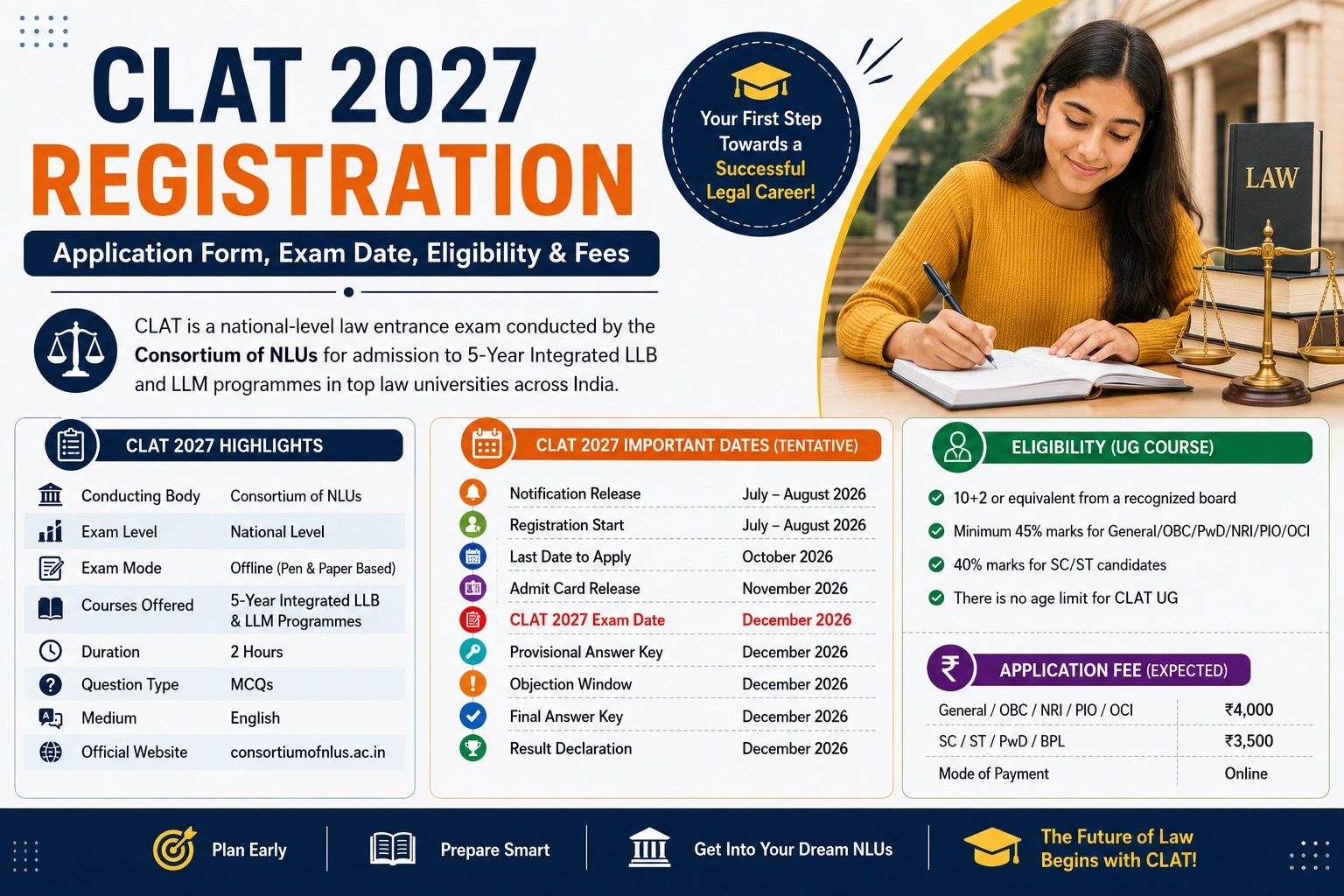
CLAT 2027 Registration is the process through which eligible candidates can apply for the Common Law Admission Test (CLAT) 2027.
CLAT is a national-level law entrance examination conducted by the Consortium of National Law Universities (NLUs) for admission to undergraduate (UG) and postgraduate (PG) law programmes offered by participating NLUs and other accepting institutions across India.
The CLAT 2027 application form is expected to be released online through the official Consortium website.
Candidates must complete the registration process, fill in personal and academic details, upload required documents, and pay the prescribed application fee before the deadline.
As of now, the Consortium of NLUs has not officially announced the CLAT 2027 registration schedule.
The dates mentioned below are expected based on previous admission cycles. Candidates should verify all updates on the official website:
https://consortiumofnlus.ac.in
CLAT 2027 Highlights
| Particulars | Details |
|---|---|
| Exam Name | Common Law Admission Test (CLAT) 2027 |
| Conducting Body | Consortium of National Law Universities (NLUs) |
| Exam Level | National Level |
| Exam Mode | Offline (Pen and Paper Based) |
| Courses Offered | 5-Year Integrated LLB Programmes and LLM Programmes |
| Participating Institutions | National Law Universities (NLUs) and other accepting law colleges |
| Application Mode | Online |
| Official Website | consortiumofnlus.ac.in |
| Exam Duration | 2 Hours |
| Question Type | Multiple Choice Questions (MCQs) |
| Medium of Exam | English |
Quick Fact: CLAT scores are accepted by most National Law Universities in India and are also considered by several private law institutions and public sector organizations for recruitment purposes.
Key Dates at a Glance
The official CLAT 2027 exam date, registration dates, and notification schedule have not been released yet. The timeline below is based on previous years’ trends and should be treated as tentative.
| Event | Expected Timeline* |
|---|---|
| Release of CLAT 2027 Notification | July–August 2026 |
| Start of CLAT 2027 Registration | July–August 2026 |
| Last Date to Submit Application Form | October 2026 |
| CLAT 2027 Application Correction Window | Expected after registration closes |
| Admit Card Release | November 2026 |
| CLAT 2027 Exam Date | December 2026 |
| Provisional Answer Key | December 2026 |
| Objection Submission Window | December 2026 |
| Final Answer Key | December 2026 |
| Result Declaration | December 2026 |
*Expected based on previous admission cycles. Candidates should verify updates on the official Consortium website.
Important Note
- The CLAT 2027 registration last date will be announced only through the official notification.
- Candidates should avoid waiting until the final days to complete registration.
- Keep essential documents such as photograph, signature, identity proof, and academic records ready before the application process begins.
- Regularly check the Consortium of NLUs website for official announcements and schedule updates.
CLAT 2027 Important Dates
The Consortium of National Law Universities (NLUs) has not yet released the official CLAT 2027 schedule at the time of writing.
Based on previous admission cycles, candidates can expect the registration and examination process to follow a similar timeline.
Important: All dates mentioned as “Expected” should be verified on the official website of the Consortium of NLUs once the notification is released.
| Event | Tentative Status |
|---|---|
| Registration Start Date | Expected in July–August 2026 |
| CLAT 2027 Registration Last Date | Expected in October 2026 |
| Admit Card Release Date | Expected in November 2026 |
| CLAT 2027 Exam Date | Expected in December 2026 |
| Result Declaration | Expected within a few weeks after the exam |
| Counselling Registration | Expected after result announcement |
Source: Consortium of National Law Universities (Official Notification to be released)
Registration Start Date
The CLAT 2027 Registration process is expected to begin in July or August 2026, based on recent admission cycles.
Once the registration window opens, candidates can complete the CLAT 2027 application form through the official Consortium website. Students are advised not to wait until the last few days, as heavy website traffic can sometimes cause technical issues.
Before starting the application, keep the following documents ready:
- Passport-size photograph
- Signature image
- Class 10 mark sheet
- Class 12 details (if applicable)
- Valid email ID
- Mobile number
- Category certificate (if applicable)
Expert Tip: Use an active email address and mobile number because all important updates, including admit card and counselling information, are usually communicated through registered contact details.
Application Deadline
The CLAT 2027 registration last date is expected to fall in October 2026, though the exact deadline will be confirmed through the official notification.
Candidates should submit the application form well before the closing date to avoid:
- Payment failures
- Server-related delays
- Incorrect form submissions
- Last-minute document upload issues
After submitting the form, download and save:
- Application confirmation page
- Fee payment receipt
- Registration details
These documents may be useful during later stages of the admission process.
Expected Information: Based on previous admission cycles. Candidates should verify updates on the official website.
Admit Card Release Date
The CLAT admit card is expected to be released approximately two to three weeks before the examination.
The admit card serves as the official entry pass for the examination and generally contains:
- Candidate’s name
- Roll number
- Exam date
- Exam timing
- Test centre details
Important exam-day instructions
Candidates should carefully verify all information mentioned on the admit card after downloading it.
If any discrepancy is found, it should be reported to the Consortium immediately through the official support channels.
Important: Entry to the examination centre is usually not permitted without a valid admit card and approved photo identification.
CLAT 2027 Exam Date
The CLAT 2027 exam date has not been officially announced yet.
Based on the pattern followed in recent years, the examination is expected to be conducted in December 2026 in offline mode (pen-and-paper based test).
The Common Law Admission Test (CLAT) is conducted for admission to:
- Undergraduate (UG) law programmes
- Postgraduate (PG) law programmes
- Participating National Law Universities (NLUs)
Candidates preparing for the examination should regularly monitor official announcements rather than relying solely on unofficial sources.
Official Status: Awaiting notification from the Consortium of National Law Universities.
Result and Counselling Schedule
The CLAT 2027 result is expected to be declared a few weeks after the examination. The exact timeline will be announced by the Consortium of NLUs.
After the result declaration, the counselling process generally begins. Qualified candidates are invited to participate based on their rank and category.
The counselling process typically includes:
- Counselling registration
- Seat allotment rounds
- Document verification
- Seat acceptance fee payment
- Admission confirmation
Candidates should keep all academic and category-related documents ready in advance to avoid delays during verification.
Expected Information: The counselling schedule will be published after the result announcement. Candidates should refer to the official Consortium notification for the latest updates.
Reference: Consortium of National Law Universities (https://consortiumofnlus.ac.in/)
What is CLAT 2027?
CLAT 2027 (Common Law Admission Test) is a national-level law entrance examination conducted by the Consortium of National Law Universities (NLUs) for admission to undergraduate and postgraduate law programs offered by participating NLUs across India.
For students seeking admission to integrated law courses such as BA LLB, BBA LLB, BCom LLB, BSc LLB, and BSW LLB, CLAT is one of the most important entrance exams in the country.
Many government institutions, private law colleges, and public sector organizations also consider CLAT scores for admissions and recruitment.
The CLAT 2027 Registration process is expected to begin through the official Consortium website.
Candidates should regularly check the official portal for the latest updates regarding the CLAT 2027 application form, exam schedule, eligibility requirements, and admission notifications.
Official Website: https://consortiumofnlus.ac.in
Purpose of the CLAT Examination
The primary purpose of CLAT is to provide a common and transparent admission process for law aspirants across India.
CLAT helps evaluate a candidate’s:
- Reading and comprehension skills
- Logical reasoning ability
- Legal aptitude and awareness
- Critical thinking skills
- Quantitative techniques
- General awareness and current affairs knowledge
Instead of conducting separate entrance examinations, participating NLUs use CLAT scores to select candidates for admission.
This creates a standardized admission process and reduces the burden of appearing for multiple law entrance tests.
Why CLAT is Important
- Gateway to India’s top National Law Universities.
- Accepted by several private law institutions.
- Used by some Public Sector Undertakings (PSUs) for legal recruitment.
- Provides opportunities for quality legal education and career growth.
Courses Offered Through CLAT
CLAT scores are used for admission to both undergraduate and postgraduate law programs offered by participating NLUs.
Undergraduate (UG) Law Programs
Candidates who have completed or are appearing for Class 12 can apply for integrated five-year law courses through CLAT UG.
Some commonly offered programs include:
| UG Law Program | Description |
|---|---|
| BA LLB (Hons.) | Law combined with Arts and Humanities subjects |
| BBA LLB (Hons.) | Law integrated with Business Administration |
| BCom LLB (Hons.) | Law combined with Commerce and Accounting |
| BSc LLB (Hons.) | Law integrated with Science subjects |
| BSW LLB (Hons.) | Law combined with Social Work studies |
UG Law Program Description
- BA LLB (Hons.) Law combined with Arts and Humanities subjects
- BBA LLB (Hons.) Law integrated with Business Administration
- BCom LLB (Hons.) Law combined with Commerce and Accounting
- BSc LLB (Hons.) Law integrated with Science subjects
- BSW LLB (Hons.) Law combined with Social Work studies
These integrated programs allow students to earn both a bachelor’s degree and a law degree within five years.
Expert Tip: Students interested in litigation, corporate law, judiciary preparation, legal research, policy-making, or civil services often choose CLAT as their entry route into legal education.
Postgraduate (PG) Law Programs
Candidates holding an LLB degree can appear for CLAT PG to seek admission into Master of Laws (LLM) programs.
LLM programs help law graduates specialize in areas such as:
- Constitutional Law
- Corporate Law
- Criminal Law
- Intellectual Property Rights (IPR)
- International Law
- Human Rights Law
- Environmental Law
Many students pursue an LLM to build careers in legal academia, research, litigation, corporate legal practice, policy analysis, or higher judicial services.
Participating National Law Universities (NLUs)
The Consortium of NLUs includes several prestigious law universities across India that accept CLAT scores for admission.
Some of the leading participating NLUs are:
- National Law School of India University (NLSIU), Bengaluru
- NALSAR University of Law, Hyderabad
- The West Bengal National University of Juridical Sciences (WBNUJS), Kolkata
- National Law University (NLU), Jodhpur
- Gujarat National Law University (GNLU), Gandhinagar
- National Law University, Delhi (does not participate in CLAT and conducts AILET separately)
- Dr. Ram Manohar Lohiya National Law University (RMLNLU), Lucknow
- Hidayatullah National Law University (HNLU), Raipur
- National University of Advanced Legal Studies (NUALS), Kochi
- National Law University Odisha (NLUO), Cuttack
- National Law University and Judicial Academy (NLUJAA), Assam
Important Note: The list of participating institutions may change from year to year. Candidates should verify the latest participating NLUs through the official Consortium notification before applying.
| Admission Authority | Official Source |
|---|---|
| Consortium of National Law Universities | https://consortiumofnlus.ac.in |
| Participating NLUs List | Official CLAT Admission Notification |
| Course Availability | Respective NLU Admission Brochure |
CLAT 2027 Eligibility Criteria
Before filling out the CLAT 2027 Registration form, candidates should carefully check the eligibility requirements prescribed by the Consortium of National Law Universities (NLUs).
Meeting the eligibility criteria is essential for appearing in the examination and participating in the admission process.
The eligibility conditions mainly cover:
- Educational qualification
- Minimum qualifying marks
- Age requirements
- Eligibility for UG and PG programmes
Candidates should always verify the latest requirements in the official CLAT 2027 Information Brochure when released.
Eligibility for CLAT UG 2027
Candidates seeking admission to the 5-year Integrated Undergraduate Law Programme (BA LLB, BBA LLB, BCom LLB, BSc LLB, etc.) through CLAT 2027 must satisfy the following conditions:
| Eligibility Requirement | Details |
|---|---|
| Qualifying Examination | Class 12 or equivalent examination from a recognized board |
| Minimum Marks (General/OBC/PWD/NRI/PIO/OCI) | 45% aggregate marks or equivalent grade |
| Minimum Marks (SC/ST) | 40% aggregate marks or equivalent grade |
| Appearing Candidates | Students appearing in Class 12 examination in the admission year may also apply |
Expert Tip: Students should keep their Class 10 and Class 12 academic records ready while filling the CLAT 2027 application form to avoid errors in academic details.
Eligibility for CLAT PG 2027
Candidates applying for admission to the Master of Laws (LL.M.) programme through CLAT PG 2027 must meet the following eligibility requirements:
| Eligibility Requirement | Details |
|---|---|
| Qualifying Degree | LL.B. degree or an equivalent law degree from a recognized university |
| Minimum Marks (General/OBC/PWD/NRI/PIO/OCI) | 50% aggregate marks or equivalent grade |
| Minimum Marks (SC/ST) | 45% aggregate marks or equivalent grade |
| Appearing Candidates | Final-year LL.B. students may also apply |
Candidates who are completing their final year of LL.B. can register and appear for CLAT PG 2027.
Admission will remain subject to fulfilling the required qualification before the prescribed deadline.
Minimum Educational Qualification
The minimum educational qualification depends on the programme selected by the candidate.
Important points to remember:
- The qualifying examination must be from a recognized board or university.
- Candidates appearing for their final qualifying examination are generally eligible to apply.
- Admission may be cancelled if a candidate fails to produce the required educational documents during verification.
- Marks obtained in the qualifying examination must satisfy the minimum percentage criteria prescribed for the respective category.
Common Mistake to Avoid: Entering incorrect marks or academic details during registration can lead to issues during document verification. Always cross-check information before submitting the application form.
Age Limit Criteria
As per recent CLAT admission policies, there is no upper age limit for candidates appearing in the CLAT examination.
Quick Answer
Is there any age limit for CLAT 2027?
No. Candidates are not restricted by an upper age limit for either CLAT UG or CLAT PG, provided they meet the required educational qualifications.
Key points:
- No upper age restriction for CLAT UG.
- No upper age restriction for CLAT PG.
- Eligibility is determined primarily by educational qualification and qualifying marks.
- Candidates from any age group can apply if they satisfy the prescribed criteria.
Important: Eligibility rules are based on previous CLAT admission cycles and official notifications.
Candidates should verify the final CLAT 2027 eligibility criteria through the official CLAT Information Brochure once released by the Consortium of NLUs.
CLAT 2027 Application Form
The CLAT 2027 application form is expected to be released online through the official website of the Consortium of National Law Universities (NLUs).
Candidates must complete the registration process, fill in their personal and academic details, upload the required documents, and pay the application fee before the deadline.
Since the official notification for CLAT 2027 Registration may not have been released yet, the application process mentioned below is based on previous admission cycles.
Candidates should verify all updates on the official website once the notification is published.
A typical CLAT application process includes:
- Online registration using a valid email ID and mobile number.
- Filling personal, academic, and communication details.
- Uploading scanned documents.
- Reviewing the entered information.
- Paying the applicable registration fee.
- Submitting and downloading the confirmation page.
Documents Required for Registration
Before starting the application process, candidates should keep all necessary documents ready.
This helps avoid errors and delays while filling the form.
Documents commonly required for CLAT registration include:
| Document | Purpose |
|---|---|
| Recent passport-size photograph | Identity verification |
| Candidate’s signature | Authentication |
| Class 10 mark sheet/certificate | Date of birth verification |
| Class 12 mark sheet (if available) | Academic details |
| Category certificate (SC/ST/OBC/EWS, if applicable) | Reservation benefits |
| PwD certificate (if applicable) | Special category eligibility |
| Domicile certificate (if applicable) | State-specific reservations |
| Valid email ID | Registration and communication |
| Mobile number | OTP verification and updates |
Expert Tip: Use documents exactly as they appear in official records. Differences in spelling, initials, or date of birth may create issues during counselling and admission.
Information Required While Filling the Form
Candidates should enter all details carefully because incorrect information can lead to application rejection or difficulties during document verification.
The following information is generally required in the application form:
Personal Details
- Full name
- Date of birth
- Gender
- Nationality
- Category
- Parent/guardian details
Contact Details
- Mobile number
- Email address
- Correspondence address
- Permanent address
Academic Information
- Class 10 board and passing year
- Class 10 marks or percentage
- Class 12 board and passing year
- Class 12 marks (if available)
Reservation Details (If Applicable)
- Category information
- PwD status
- Domicile details
- Other reservation claims supported by valid certificates
Exam Preferences
- Preferred National Law Universities (NLUs), if applicable
- Reservation preferences based on eligibility
Checklist Before Submission
✓ Verify spelling of your name.
✓ Check date of birth carefully.
✓ Ensure your email ID and mobile number are active.
✓ Match academic details with official mark sheets.
✓ Review uploaded documents before final submission.
Photograph and Signature Specifications
Candidates must upload clear and readable images of their photograph and signature. Blurred, cropped, or unclear images may lead to application issues.
The exact specifications for CLAT 2027 Registration will be announced in the official notification.
However, candidates should generally follow these guidelines based on previous years:
| Upload Type | Recommended Guidelines |
|---|---|
| Photograph | Recent passport-size color photograph with clear face visibility |
| Background | Plain and light-colored background preferred |
| Signature | Candidate’s own signature in dark ink on white paper |
| Image Quality | Clear, readable, and not blurred |
| File Format | As specified in the official notification |
| File Size | As specified in the official notification |
Photograph Tips
- Face should be clearly visible.
- Avoid sunglasses or heavy filters.
- Use a recent photograph.
- Ensure proper lighting.
Signature Tips
- Sign consistently as used in official documents.
- Avoid using capital letters as a typed name.
- Do not upload initials unless they are part of your official signature.
- Ensure the signature is fully visible within the image frame.
Important: File size limits and image dimensions may vary for the CLAT 2027 application form.
Candidates should check the official instructions released by the Consortium of NLUs before uploading documents.
How to Apply for CLAT 2027
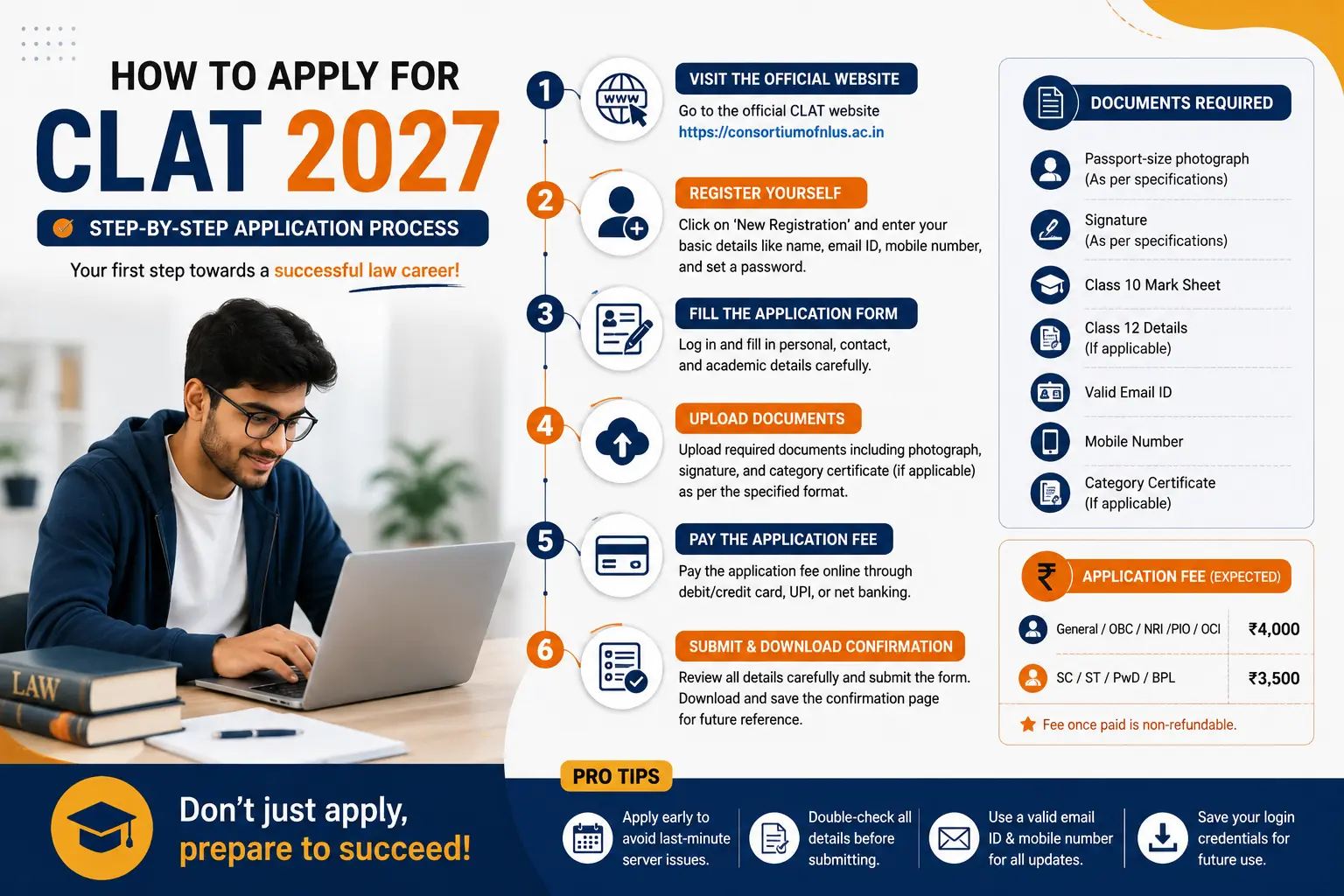
The CLAT 2027 Registration process is expected to be conducted online through the official website of the Consortium of National Law Universities (NLUs).
Candidates should complete each step carefully to avoid application rejection due to incorrect information or missing documents.
Step 1: Visit the Official Website
Begin the application process by visiting the official CLAT portal managed by the Consortium of NLUs.
What to do:
- Open the official CLAT website.
- Click on the registration or application link for CLAT 2027.
- Read the instructions and eligibility requirements carefully before proceeding.
Expert Tip: Always use the official website for registration. Avoid third-party websites that may provide outdated or incorrect information.
Note: The official notification and application link for CLAT 2027 may be released later. Candidates should verify all updates on the official website.
Step 2: Complete New Registration
First-time applicants must create a new account to access the CLAT 2027 application form.
Details generally required during registration:
- Candidate’s full name
- Mobile number
- Email address
- Date of birth
- Password creation
After successful registration, a unique login ID may be generated and sent to the registered email address or mobile number.
Important: Use an active email ID and mobile number because all future communication regarding the examination is usually sent through these channels.
Step 3: Fill Personal and Academic Details
After logging in, candidates need to complete the application form with accurate information.
Personal Details
- Candidate’s name
- Gender
- Category
- Nationality
- Address details
- Parent or guardian information
Academic Details
- Class 10 information
- Class 12 information (for UG applicants)
- Qualifying examination details
- Board or institution name
- Marks obtained or expected marks (if applicable)
Before submitting, check:
✓ Spelling of name matches official documents
✓ Date of birth is correct
✓ Category details are accurate
✓ Educational information is entered carefully
Even minor mistakes can create issues during counselling or document verification.
Step 4: Upload Documents
Candidates must upload scanned copies of required documents in the prescribed format and size specified in the official notification.
The following documents are commonly required:
| Document | Purpose |
|---|---|
| Passport-size photograph | Candidate identification |
| Signature | Verification |
| Category certificate (if applicable) | Reservation benefits |
| PwD certificate (if applicable) | Special category claims |
| Relevant supporting documents | As specified by the Consortium |
Document Upload Tips
- Use clear and readable scans.
- Ensure documents are not blurred or cropped.
- Follow the prescribed file size and format.
- Keep digital copies ready before starting the application.
- A poor-quality upload may lead to delays during verification.
Step 5: Pay the Application Fee
Once all details are entered and documents are uploaded, candidates must pay the applicable CLAT 2027 registration fees through the online payment gateway.
Common payment options may include:
- Debit Card
- Credit Card
- Net Banking
- UPI
- Other online payment methods supported by the portal
Important: The exact CLAT 2027 registration fees will be confirmed in the official notification. Candidates should verify the latest fee details on the official website before making payment.
After successful payment, save the transaction receipt for future reference.
Step 6: Submit and Download Confirmation Page
Before final submission, review every section of the application form carefully.
Final Checklist
- Personal details are correct
- Academic information is accurate
- Documents are uploaded successfully
- Application fee payment is completed
- Contact details are active and accessible
After verification:
- Click the final submit button.
- Wait for the confirmation message.
- Download the confirmation page.
- Save a PDF copy and take a printout for future use.
Keeping a copy of the submitted application and payment receipt can be helpful during the admission and counselling process.
CLAT 2027 Registration Fees
The CLAT 2027 registration fees are paid online while submitting the application form.
The fee amount is decided by the Consortium of National Law Universities (NLUs) and may vary based on the candidate’s category.
The official fee details for CLAT 2027 Registration have not been announced yet.
Candidates should regularly check the official CLAT website for the latest updates.
Expected based on previous admission cycles. Candidates should verify updates on the official website.
Fee Structure by Category
The table below shows the fee pattern generally followed in recent CLAT admission cycles.
| Category | Expected Registration Fee* |
|---|---|
| General / OBC / PWD / NRI / PIO / OCI | ₹4,000 |
| SC / ST / BPL Category Candidates | ₹3,500 |
*Expected based on previous admission cycles. Official CLAT 2027 registration fees may change.
Additional Cost for Official CLAT Materials
Candidates may also have the option to purchase official preparation materials issued by the Consortium.
Item Expected Fee*
Official CLAT Preparation Material Approximately ₹500
*Optional purchase. Check the official notification for the exact amount and availability.
Expert Tip: Keep a digital copy of the payment receipt after successful fee payment. It may be useful during application verification or future correspondence.
Available Payment Methods
The CLAT application portal usually supports multiple online payment options to make the registration process convenient for students across India.
Candidates can generally pay the application fee through:
- Debit Card
- Credit Card
- Net Banking
- UPI (Unified Payments Interface)
- Digital Wallets (if enabled on the portal)
Steps to Pay the CLAT Registration Fee
- Complete the CLAT 2027 application form.
- Upload all required documents.
- Review the entered details carefully.
- Proceed to the payment page.
- Select a preferred payment method.
- Complete the transaction.
- Download and save the payment confirmation receipt.
Important: The application is usually considered complete only after successful fee payment.
If the transaction fails, verify whether the amount was deducted and check the application status before making another payment.
Refund and Correction Policy
Candidates should assume that the CLAT registration fee is non-refundable unless the Consortium issues a specific notification stating otherwise.
Based on previous CLAT guidelines:
- Registration fees paid successfully are generally not refunded.
- Requests for fee refunds due to incorrect form submission are usually not accepted.
- Fees are normally not transferable to another candidate or future examination cycle.
- Candidates should carefully review all details before final submission.
Can You Edit the CLAT Application Form After Submission?
The Consortium may provide an application correction window for certain fields.
However:
- Not all details can be edited.
- Some information, such as category or uploaded documents, may have restrictions.
- Correction facility, if provided, is available only for a limited period.
Expert Recommendation: Before making the final payment, verify the following:
Candidate’s name matches official documents.
- Date of birth is correct.
- Mobile number and email ID are active.
- Category details are accurate.
- Uploaded photograph and signature meet specifications.
Reference: Candidates should follow the latest instructions published by the Consortium of National Law Universities (Consortium of NLUs), as the official CLAT fee, payment options, correction facility, and refund rules for CLAT 2027 may be updated before the registration process begins.
CLAT 2027 Exam Pattern
The CLAT 2027 Exam Pattern helps candidates understand the structure of the examination, the number of questions, marking scheme, and subject-wise distribution.
Knowing the pattern in advance allows students to prepare strategically and manage their time effectively during the exam.
Note: The Consortium of National Law Universities (NLUs) will release the official CLAT 2027 exam pattern in the admission notification. The information below is based on the latest available CLAT pattern and should be verified through the official website when the notification is released.
Exam Mode and Duration
CLAT (Common Law Admission Test) is conducted as a national-level entrance examination for admission to undergraduate law programs offered by participating National Law Universities (NLUs).
| Particulars | Details* |
|---|---|
| Exam Mode | Offline (Pen-and-Paper Based Test) |
| Question Type | Multiple Choice Questions (MCQs) |
| Duration | 2 Hours |
| Medium | English |
| Total Questions | 120 |
| Maximum Marks | 120 |
*Expected based on recent admission cycles. Candidates should verify updates on the official CLAT website.
Preparation Tip: Since candidates get only 120 minutes to answer 120 questions, speed and accuracy are equally important. Regular mock tests can help improve time management.
Section-wise Weightage
The CLAT UG examination assesses reading comprehension, analytical ability, legal aptitude, logical thinking, numerical skills, and awareness of current events.
The expected section-wise distribution is as follows:
| Section | Approximate Number of Questions |
|---|---|
| English Language | 22–26 |
| Current Affairs & General Knowledge | 28–32 |
| Legal Reasoning | 28–32 |
| Logical Reasoning | 22–26 |
| Quantitative Techniques | 10–14 |
| Total | 120 Questions |
The exact number of questions may vary. Candidates should refer to the official notification for confirmation.
English Language
This section evaluates a candidate’s ability to read, understand, and analyze written passages.
Topics commonly tested include:
- Reading comprehension
- Vocabulary in context
- Inference-based questions
- Main idea identification
- Author’s viewpoint
- Grammar through passages
What examiners look for:
- Understanding of written English
- Ability to interpret information
- Critical reading skills
Expert Tip: Read newspapers, editorials, and quality magazines regularly to improve comprehension speed and vocabulary.
Current Affairs & General Knowledge
This section tests awareness of recent events and important developments in India and around the world.
Questions are generally based on passages related to:
- National news
- International events
- Government schemes
- Important judgments
- Science and technology
- Sports
- Awards and honors
- Economy and business
Recommended Sources:
- The Hindu
- Indian Express
- PIB (Press Information Bureau)
- Official Government Portals
Expert Tip: Focus on understanding the background and significance of major events rather than memorizing isolated facts.
Legal Reasoning
Legal Reasoning is one of the most important sections of CLAT.
Candidates are presented with passages related to legal principles, public policy, rights, duties, and legal issues.
Questions assess the ability to apply logical reasoning to legal situations.
This section does not require prior knowledge of law, although familiarity with legal concepts can be helpful.
Key skills tested:
- Analytical thinking
- Application of legal principles
- Interpretation of scenarios
- Problem-solving ability
Common Misconception: Students often believe they need extensive legal knowledge.
In reality, most questions can be solved using the information provided in the passage.
Logical Reasoning
The Logical Reasoning section measures critical thinking and analytical ability.
Candidates may encounter questions involving:
- Arguments and conclusions
- Assumptions
- Logical relationships
- Cause and effect
- Inferences
- Statement-based reasoning
The focus is on evaluating information and reaching logical conclusions rather than memorizing facts.
Expert Tip: Practice passage-based reasoning questions regularly, as they form a significant portion of the section.
Quantitative Techniques
This section tests basic mathematical and data interpretation skills.
Questions are generally based on:
- Tables
- Charts
- Graphs
- Ratios and proportions
- Percentages
- Averages
- Basic arithmetic calculations
The mathematics level is usually based on concepts studied up to Class 10.
Preparation Advice:
- Strengthen fundamental arithmetic concepts.
- Practice interpreting numerical data quickly.
- Avoid spending excessive time on lengthy calculations.
Marking Scheme
The expected CLAT 2027 marking scheme is as follows:
| Response Type | Marks Awarded |
|---|---|
| Correct Answer | +1 Mark |
| Incorrect Answer | -0.25 Mark |
| Unattempted Question | 0 Mark |
If a candidate answers:
- 80 questions correctly
- 20 questions incorrectly
- 20 questions unattempted
Score calculation:
- Correct Answers = 80 × 1 = 80
- Incorrect Answers = 20 × 0.25 = 5 marks deducted
Final Score = 80 − 5 = 75 Marks
Important Strategy:
- Avoid random guessing because negative marking can reduce your score.
- Attempt questions where you can eliminate one or more incorrect options.
- Balance accuracy with speed to maximize your overall score.
Official Reference: Consortium of National Law Universities (NLUs) — https://consortiumofnlus.ac.in/ (Candidates should verify the latest exam pattern and marking scheme once the official CLAT 2027 notification is released.)
CLAT 2027 Syllabus Overview
The CLAT (Common Law Admission Test) syllabus is designed to evaluate a candidate’s reading ability, reasoning skills, legal aptitude, awareness of current events, and basic mathematical skills.
The UG CLAT question paper consists of comprehension-based passages followed by multiple-choice questions.
The Consortium of National Law Universities (NLUs) publishes the official syllabus and exam pattern.
While the exact details for CLAT 2027 Registration and the examination are expected to follow previous trends, candidates should verify the latest updates on the official website: https://consortiumofnlus.ac.in.
The CLAT UG syllabus is divided into five major sections:
| Section | Key Skills Tested |
|---|---|
| English Language | Reading comprehension, vocabulary, grammar, inference |
| Current Affairs & GK | Awareness of national and international events |
| Legal Reasoning | Legal principles, application of laws, analytical thinking |
| Logical Reasoning | Critical thinking, arguments, conclusions, assumptions |
| Quantitative Techniques | Basic mathematics and data interpretation |
English Language Syllabus
The English Language section tests a candidate’s ability to read, understand, and analyze passages. Questions are usually based on contemporary or historically significant topics.
Key topics include:
- Reading Comprehension
- Vocabulary in Context
- Word Meanings and Usage
- Grammar Fundamentals
- Sentence Correction
- Inference-Based Questions
- Main Idea Identification
- Author’s Viewpoint and Tone
- Summarization Skills
What students should practice:
- Reading newspapers and editorials regularly
- Understanding the central idea of passages
- Identifying assumptions and conclusions
- Learning commonly used vocabulary through context
Example Skill Tested:
If a passage discusses climate change, a question may ask:
“Which statement best reflects the author’s opinion?”
To answer correctly, students must understand the passage rather than rely on general knowledge.
Expert Tip: Read quality newspapers such as The Hindu or Indian Express daily to improve comprehension speed and vocabulary.
Current Affairs & GK Syllabus
This section evaluates awareness of important events and developments in India and around the world. Most questions are linked to current affairs passages.
Major areas include:
- National News
- International Affairs
- Government Schemes
- Indian Polity
- Constitution of India
- Legal Developments
- Economy and Business
- Science and Technology
- Environment and Climate Issues
- Awards and Honors
- Sports Events
- Important Days and Reports
Focus Areas for CLAT Preparation:
- Significant Supreme Court judgments
- Major legislation and policy changes
- International organizations such as:
o United Nations (UN)
o World Bank
o International Monetary Fund (IMF)
o World Health Organization (WHO)
Important government initiatives
| Topic | What to Study |
|---|---|
| Polity | Constitution, Parliament, Fundamental Rights |
| Economy | Budget highlights, economic developments |
| International Affairs | Global events and agreements |
| Legal Updates | Landmark judgments and new laws |
| Environment | Climate conferences and sustainability issues |
Expert Tip: Revise monthly current affairs notes instead of depending only on last-minute preparation.
Legal Reasoning Syllabus
Legal Reasoning is one of the most important sections in CLAT.
It does not require prior legal knowledge. Instead, it tests a candidate’s ability to understand legal principles and apply them logically.
Topics generally include:
- Legal Principles
- Rights and Duties
- Constitutional Concepts
- Contract Basics
- Criminal Law Basics
- Tort Law Concepts
- Legal Maxims (Basic Understanding)
- Contemporary Legal Issues
- Legal Awareness
Questions are usually based on passages that describe a legal situation or principle.
Example:
A passage may explain a legal principle related to negligence and then ask candidates to apply that principle to a new situation.
Skills tested include:
- Analytical Thinking
- Application of Rules
- Logical Interpretation
- Decision-Making
- Understanding Legal Language
Common Mistake: Memorizing legal provisions. CLAT primarily evaluates reasoning ability, not law school-level legal knowledge.
Expert Tip: Read legal news summaries and landmark case discussions to become familiar with legal terminology.
Logical Reasoning Syllabus
The Logical Reasoning section measures critical thinking and the ability to evaluate arguments and information.
Questions are passage-based and require careful analysis.
Important topics include:
- Critical Reasoning
- Arguments and Conclusions
- Assumptions
- Inferences
- Cause and Effect
- Analogies
- Logical Sequences
- Statement-Based Reasoning
- Strengthening and Weakening Arguments
- Identifying Contradictions
Candidates may be asked to:
- Identify the author’s conclusion
- Find hidden assumptions
- Evaluate the strength of an argument
- Determine whether a statement logically follows
Example Skill Tested:
If a passage argues that online education improves accessibility, students may be asked to identify evidence that supports or weakens that claim.
| Topic | What to Study |
|---|---|
| Polity | Constitution, Parliament, Fundamental Rights |
| Economy | Budget highlights, economic developments |
| International Affairs | Global events and agreements |
| Legal Updates | Landmark judgments and new laws |
| Environment | Climate conferences and sustainability issues |
Expert Tip: Solve reasoning questions daily and focus on understanding why an answer is correct or incorrect.
Quantitative Techniques Syllabus
The Quantitative Techniques section tests basic mathematical concepts through data-based passages, charts, graphs, and tables.
The difficulty level is generally based on elementary mathematics taught up to Class 10.
Key topics include:
- Percentages
- Ratios and Proportions
- Averages
- Profit and Loss
- Simple Interest
- Compound Interest
- Time and Work
- Time, Speed and Distance
- Mensuration
- Number System
- Data Interpretation
Candidates should be comfortable analyzing:
- Tables
- Bar Graphs
- Pie Charts
- Line Graphs
- Numerical Data Sets
Sample Areas of Calculation:
- Finding percentage increase or decrease
- Comparing values from charts
- Calculating averages
- Interpreting survey data
| Logical Skill | Purpose |
|---|---|
| Inference | Draw conclusions from information |
| Assumption | Identify unstated ideas |
| Argument Analysis | Evaluate reasoning quality |
| Cause and Effect | Understand relationships |
| Critical Thinking | Assess evidence objectively |
Expert Tip: Accuracy matters more than advanced mathematics. Strong fundamentals and regular practice can help candidates score well in this section.
Top NLUs Accepting CLAT 2027 Scores
The Common Law Admission Test (CLAT) is accepted by most National Law Universities (NLUs) in India for admission to undergraduate (UG) and postgraduate (PG) law programs.
Candidates completing CLAT 2027 Registration should carefully review the participating NLUs before filling their preferences during counselling.
As of recent admission cycles, 27 National Law Universities participate in the CLAT admission process.
However, candidates should verify the latest participating institute list on the official Consortium of NLUs website (consortiumofnlus.ac.in) because admission policies may change.
Leading National Law Universities in India
Some NLUs consistently attract high CLAT rankers due to their academic reputation, faculty, placement opportunities, moot court culture, and alumni network.
| Topic | Common Application |
|---|---|
| Percentages | Growth rates and comparisons |
| Ratio & Proportion | Distribution problems |
| Averages | Data analysis |
| Profit & Loss | Commercial calculations |
| Data Interpretation | Graph and table-based questions |
Important: NLU Delhi does not accept CLAT scores. It conducts the All India Law Entrance Test (AILET) separately.
Top-Tier NLUs Often Preferred by High Rank Holders
Many candidates consider the following institutions among the most sought-after choices:
- NLSIU Bengaluru
- NALSAR Hyderabad
- WBNUJS Kolkata
- GNLU Gandhinagar
- NLU Jodhpur
These universities are known for:
- Strong academic curriculum
- National and international moot court exposure
- Competitive internships
- Active research centers
- Better placement opportunities
- Large alumni networks in law firms, judiciary, corporate sector, and public policy
Emerging NLUs Worth Considering
Apart from the traditional top NLUs, several newer NLUs have shown significant growth in recent years:
- MNLU Mumbai
- MNLU Nagpur
- MNLU Aurangabad
- NLU Odisha
- DSNLU Visakhapatnam
- NLU Assam
- NLU Tripura
Students should evaluate these universities based on current faculty strength, infrastructure, internship opportunities, and placement records rather than relying solely on historical rankings.
Factors to Consider While Choosing an NLU
A high CLAT rank gives candidates multiple options, but selecting the right NLU requires more than checking rankings alone.
- Academic Reputation
Review the university’s:
- Faculty qualifications
- Research output
- Academic collaborations
- Specialized law courses
- A strong academic environment can improve legal knowledge and career prospects.
2. Placement Opportunities
Check the latest placement reports whenever available.
Key factors include:
- Average and highest salary packages
- Number of recruiters
- Law firm placements
- Corporate placements
- Litigation and judicial preparation support
3. Internship Exposure
Practical experience is essential in legal education.
Look for NLUs that provide access to:
- Law firms
- Senior advocates
- Courts and tribunals
- Corporate legal departments
- Government organizations
4. Location Advantage
The city where an NLU is located can influence internship and networking opportunities.
For example:
- Bengaluru offers strong corporate law exposure.
- Delhi provides access to courts, law firms, ministries, and policy organizations.
- Mumbai offers opportunities in corporate and financial law.
5. Alumni Network
A strong alumni network can help students secure:
- Internships
- Mentorship
- Career guidance
- Placement opportunities
Many top NLUs have alumni working in leading law firms, multinational companies, judiciary, academia, and civil services.
6. Campus Infrastructure
Before finalizing preferences, review:
- Library facilities
- Digital learning resources
- Hostels
- Moot court halls
- Research centers
- Student support services
A well-equipped campus contributes significantly to the overall learning experience.
7. Fee Structure and Financial Support
NLU fees vary considerably across institutions.
Candidates should compare:
- Tuition fees
- Hostel charges
- Other academic expenses
- Scholarships
- Fee waivers
- Education loan support
Always refer to the respective university’s official website for the latest fee details.
Quick Checklist Before Filling NLU Preferences
- Academic reputation
- Placement record
- Internship opportunities
- Faculty quality
- Campus facilities
- Alumni network
- Location advantage
- Fee affordability
- Scholarship availability
- Personal career goals
Choosing an NLU should be a balance between your CLAT rank, career aspirations, budget, and learning preferences.
A university that aligns with your long-term goals may be a better choice than simply selecting an institution based on popularity alone.
Common Mistakes to Avoid During CLAT 2027 Registration
Even a small mistake during CLAT 2027 Registration can create problems later in the admission process. Incorrect details, invalid documents, missed deadlines, or unsuccessful fee payments may lead to application rejection or unnecessary delays.
Before submitting the CLAT 2027 application form, carefully review every detail and follow the instructions provided on the official Consortium of National Law Universities (NLUs) website.
Incorrect Personal Information
One of the most common mistakes is entering incorrect personal details in the application form.
The information submitted during registration is used for admit cards, result processing, counselling, and admission verification.
Pay special attention to:
- Candidate’s name
- Date of birth
- Gender
- Category details
- Mobile number
- Email address
- Parent or guardian information
Example: If your name in the CLAT application form does not match the name printed on your Class 10 certificate, you may face verification issues during admission.
Expert Tip: Keep your Class 10 marksheet, identity proof, and other academic documents nearby while filling out the form. This helps reduce typing errors.
| National Law University | Location | Popular Programs |
|---|---|---|
| National Law School of India University (NLSIU) | Bengaluru | BA LLB (Hons), LLM |
| NALSAR University of Law | Hyderabad | BA LLB (Hons), LLM |
| The West Bengal National University of Juridical Sciences (WBNUJS) | Kolkata | BA LLB (Hons), LLM |
| National Law University (NLU) Delhi* | New Delhi | Separate Admission Test (AILET) |
| Gujarat National Law University (GNLU) | Gandhinagar | BA LLB (Hons), BCom LLB (Hons) |
| National Law University, Jodhpur (NLUJ) | Jodhpur | BA LLB (Hons), BBA LLB (Hons) |
| Hidayatullah National Law University (HNLU) | Raipur | BA LLB (Hons) |
| Rajiv Gandhi National University of Law (RGNUL) | Patiala | BA LLB (Hons) |
| National University of Advanced Legal Studies (NUALS) | Kochi | BA LLB (Hons) |
| Maharashtra National Law University (MNLU) | Mumbai | BA LLB (Hons), LLM |
Uploading Invalid Documents
Many applications face issues because candidates upload documents that do not meet the prescribed specifications.
Common document-related mistakes include:
- Blurry photographs
- Unclear signatures
- Incorrect file format
- Exceeding file size limits
- Uploading old or damaged images
- Uploading the wrong document
Before uploading any file:
- Read the document guidelines carefully.
- Use clear and recent images.
- Check the required format and size.
- Preview the uploaded files before final submission.
Expert Recommendation: Scan documents using a reliable scanner or a document-scanning mobile application instead of taking casual photographs.
Since document requirements for CLAT 2027 application form uploads may vary, candidates should always verify the latest specifications on the official CLAT website before submission.
Missing the Application Deadline
Waiting until the last few days to register is a risky approach. Heavy website traffic, payment failures, internet issues, or technical errors can prevent successful submission.
Candidates should regularly monitor announcements regarding:
- CLAT 2027 application form release
- CLAT 2027 registration last date
- Correction windows (if announced)
- Admit card schedule
Important: The official CLAT 2027 registration last date will be announced by the Consortium of NLUs.
Candidates should rely only on official notifications and avoid depending on unofficial sources.
Best Practice
- Register early.
- Upload documents in advance.
- Complete fee payment well before the deadline.
- Save confirmation receipts and application details.
This reduces stress and provides enough time to correct any errors if needed.
Incomplete Fee Payment
Some candidates assume that submitting the form is enough.
However, an application is generally considered complete only after successful payment of the prescribed CLAT 2027 registration fees and generation of a payment confirmation.
Common payment-related mistakes include:
- Closing the browser before payment completion
- Ignoring payment failure messages
- Not checking transaction status
- Failing to download the payment receipt
- Assuming money deduction automatically means successful registration
After making the payment:
- Verify the payment status on the application dashboard.
- Download the payment receipt.
- Save the application confirmation page.
- Check for confirmation through email or SMS, if provided.
Quick Reminder: If the payment status remains pending or unsuccessful, contact the official CLAT helpdesk immediately through the support channels listed on the official website.
A successfully submitted application, along with confirmed fee payment, helps ensure a smooth registration process and prevents last-minute complications before the CLAT 2027 exam date.
Final Thoughts
CLAT 2027 Registration is the first and most important step for students aiming to secure admission to top National Law Universities (NLUs) and other participating law institutions in India.
Missing a registration deadline, uploading incorrect documents, or providing inaccurate details can create unnecessary problems later in the admission process.
Students should regularly check the official Consortium of National Law Universities website for updates related to the CLAT 2027 application form, exam schedule, eligibility requirements, and other important announcements. Official notifications should always be treated as the final authority.
If you are planning to appear for CLAT 2027, start preparing your documents, academic records, and examination strategy well before the registration window opens.
Early preparation helps reduce last-minute errors and gives you more time to focus on exam preparation.
Key Takeaways for CLAT 2027 Aspirants
- CLAT 2027 Registration will be conducted online through the official Consortium of NLUs website.
- Candidates should carefully read the official information brochure before filling out the application form.
- Verify eligibility requirements before submitting the form to avoid disqualification at later stages.
- Keep scanned copies of required documents ready in the prescribed format and size.
- Complete the registration process well before the CLAT 2027 registration last date to avoid technical issues.
- Pay the applicable CLAT 2027 registration fees through authorized online payment methods.
- Regularly monitor official announcements regarding the CLAT 2027 exam date, admit card, and examination guidelines.
- Preserve the application confirmation page and payment receipt for future reference.
- Use only information published by the Consortium of National Law Universities for decision-making.
- Any dates, eligibility updates, or procedural changes should be verified through official sources before taking action.
References
The following official sources should be consulted for the most accurate and updated information regarding CLAT 2027 Registration, eligibility, examination schedules, application procedures, and admission policies.
Official CLAT 2027 Notification
Purpose: Provides official announcements related to CLAT 2027.
What candidates can find:
- Registration opening and closing dates
- Examination schedule
- Eligibility conditions
- Reservation policies
- Important instructions for applicants
- Official updates and corrigenda
Official Source:
https://consortiumofnlus.ac.in
Candidates should rely on the official notification for the latest information. Any dates mentioned elsewhere should be cross-checked with the official notice.
Consortium of National Law Universities
The Consortium of National Law Universities (Consortium of NLUs) is the official body responsible for conducting the Common Law Admission Test (CLAT).
Official Website:
https://consortiumofnlus.ac.in
Key Services Available:
- CLAT registration portal
- Candidate login dashboard
- Official announcements
- Admit card downloads
- Result updates
- Counselling and admission information
- Frequently Asked Questions (FAQs)
Students are advised to create and manage their application only through the official portal to ensure data security and authenticity.
CLAT Information Brochure 2027
The CLAT Information Brochure serves as the primary reference document for applicants.
| Verify Detail | Why It Matters |
|---|---|
| Name spelling | Must match official records |
| Date of Birth | Used for eligibility verification |
| Category details | Affects reservation benefits |
| Email ID | Used for official communication |
| Mobile number | Required for updates and OTP verification |
The brochure generally contains:
Access Method:
The brochure is usually made available through the official CLAT portal once released by the Consortium of NLUs.
If the CLAT Information Brochure 2027 has not yet been published, candidates should refer to the latest available official brochure and monitor the Consortium website for updates.
Future details are expected based on previous admission cycles and must be verified through official notifications.
Frequently Asked Questions (FAQs)
1. Can I register for CLAT 2027 now?
CLAT 2027 registration is expected to begin on 3 August 2026 through the official website of the Consortium of National Law Universities. Candidates should check the official portal regularly for the latest registration schedule, application link, and important announcements.
2. Who is eligible for CLAT 2027 exam?
For CLAT UG 2027, candidates must have passed or be appearing in Class 12 (10+2) from a recognized board. For CLAT PG 2027, candidates must have completed or be appearing in an LL.B. degree program. Applicants should refer to the official CLAT 2027 notification for detailed eligibility requirements.
3. Is CLAT 2027 online or offline?
CLAT is generally conducted in offline mode (pen-and-paper based test). However, candidates should verify the examination mode mentioned in the official CLAT 2027 notification, as the Consortium of NLUs has the authority to make changes if required.
4. What is the CLAT syllabus?
The CLAT UG syllabus covers five main areas: English Language, Current Affairs and General Knowledge, Legal Reasoning, Logical Reasoning, and Quantitative Techniques. The official CLAT information brochure provides the latest syllabus, exam pattern, and section-wise details.
5. How many seats are there in CLAT 2027?
CLAT scores are accepted by participating National Law Universities (NLUs) across India for admission to undergraduate and postgraduate law programs. The total number of seats may vary each year based on participating institutions and seat matrix updates. Candidates should refer to the official CLAT counselling and admission notifications for the latest seat availability.