Why Students Without Maths Feel Confused About Their Future
Many students experience confusion after completing Class 12 without Maths because they are surrounded by conflicting opinions from family, friends, teachers, and social media.
One of the biggest reasons for this confusion is the widespread belief that Mathematics is essential for most career paths. Students often hear statements such as:
- “You won’t get a good job without Maths.”
- “Only Science students have the best career opportunities.”
- “High-paying careers require strong mathematical skills.”
Hearing such opinions repeatedly can create unnecessary stress and self-doubt.
Another reason for confusion is the large number of career choices available today.
Students may find it difficult to decide between traditional degree programs, professional courses, skill-based careers, government job preparation, or emerging digital professions.
The fear of making the wrong decision also contributes to uncertainty.
Many students worry about choosing a course that may not offer good career prospects in the future.
However, the real issue is not the lack of opportunities—it is the lack of proper guidance.
Once students understand their strengths, interests, and career goals, choosing the right path becomes much easier.
The good news is that there are plenty of career options after 12th without Maths that can lead to rewarding careers across various industries.
With the right information and planning, students can confidently choose a path that aligns with their abilities and aspirations.
Can You Build a Successful Career Options After 12th WITHOUT Maths?
Absolutely.
Success is not determined by a single subject studied in school. In today’s competitive world, employers and organizations value practical skills, communication abilities, creativity, leadership, adaptability, and industry knowledge.
Many successful professionals, entrepreneurs, content creators, lawyers, managers, journalists, and business leaders have built impressive careers without relying heavily on advanced Mathematics.
What truly matters is choosing a field that matches your interests and consistently developing the skills required for that profession.
Modern industries offer countless opportunities for students who prefer business, communication, creativity, management, social sciences, law, media, and digital careers.
These fields continue to grow and create employment opportunities across India and globally.
Instead of focusing on what you have not studied, it is more productive to focus on what you can learn and achieve moving forward.
Common Myths vs Reality
Students often make career decisions based on myths rather than facts. Let’s separate reality from misconception.
Myth 1: You Cannot Get a Good Job Without Maths
Reality: Many well-paying careers do not require advanced mathematical knowledge.
Fields such as law, journalism, digital marketing, public relations, hotel management, psychology, and content creation focus more on communication, analytical thinking, and practical expertise.
Myth 2: Only Science Students Have Better Career Opportunities
Reality: Every stream offers excellent career prospects.
Commerce, Arts, and professional courses have produced successful business leaders, civil servants, lawyers, entrepreneurs, and media professionals.
Career growth depends more on skills and dedication than on the stream chosen in school.
Myth 3: High Salaries Are Impossible Without Maths
Reality: High income is closely linked to expertise, experience, and market demand.
Careers in management, law, digital marketing, consulting, aviation, and entrepreneurship can offer attractive salaries without requiring advanced Mathematics.
Myth 4: Career Options Are Very Limited Without Maths
Reality: The number of career options after 12th without Maths has increased significantly over the last decade.
Students can choose from degree courses, professional certifications, diploma programs, government career paths, and digital skill-based opportunities.
Myth 5: Success Depends on Academic Subjects Alone
Reality: Employers today look for practical skills, communication, teamwork, leadership, creativity, and problem-solving abilities.
These qualities often play a bigger role in career growth than academic subjects.
Skills That Matter More Than Maths
While Mathematics can be useful in certain professions, many industries prioritize other skills that have become increasingly valuable in the modern workplace.
Communication Skills
Strong communication helps professionals express ideas clearly, build relationships, work in teams, and interact effectively with clients and customers.
Digital Skills
As businesses continue to move online, skills such as digital marketing, content creation, social media management, and basic technology knowledge are becoming highly valuable.
Critical Thinking
Employers prefer individuals who can analyze situations, make informed decisions, and solve problems effectively.
Creativity
Creative thinking is essential in fields such as marketing, media, design, advertising, content creation, branding, and entrepreneurship.
Leadership and Management
The ability to lead teams, manage projects, and make strategic decisions is highly valued across industries.
Adaptability
Technology and business trends change rapidly. Professionals who can learn new skills and adapt to changing environments often enjoy better career growth.
Emotional Intelligence
Understanding people, managing emotions, and building positive relationships can significantly improve professional success, especially in management, teaching, counseling, sales, and customer-facing roles.
The future belongs to individuals who continuously learn, upgrade their skills, and stay relevant in their chosen field.
Therefore, students should focus less on the absence of Maths and more on developing the skills that modern employers truly value.
The truth is simple: there are numerous career options after 12th without Maths, and with the right mindset, skills, and guidance, students can build a successful and rewarding future.
Best Career Options After 12th Without Maths
Many students believe that choosing a successful career becomes difficult if they do not study Maths after Class 12.
However, this is one of the biggest misconceptions among students and parents.
In today’s rapidly changing job market, employers are looking for practical skills, communication abilities, creativity, leadership qualities, and problem-solving capabilities rather than focusing solely on a student’s academic subjects.
The good news is that there are numerous career options after 12th without Maths that offer excellent growth opportunities, attractive salaries, and long-term career stability.
Whether you belong to the Commerce stream, Arts stream, or simply want to pursue a professional or skill-based course, there are plenty of paths available to build a successful future.
The key is to choose a career that aligns with your interests, strengths, and long-term goals rather than selecting a course based on societal pressure or popular trends.
Let’s explore some of the best options available in 2026.
Commerce Career Options
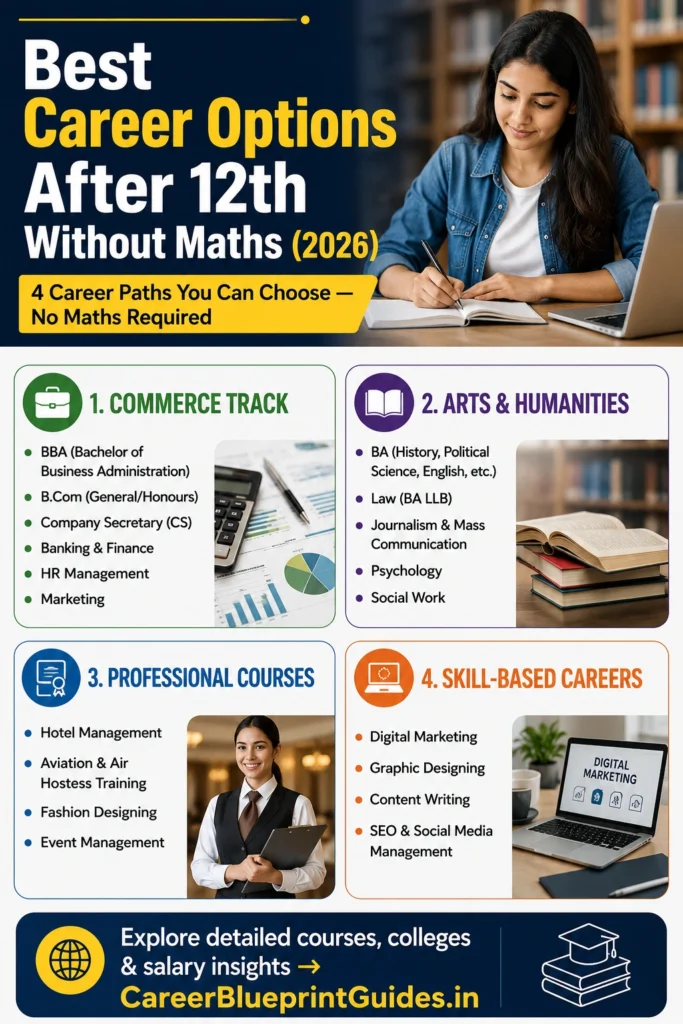
Commerce is one of the most popular streams for students who want to build careers in business, management, finance, and entrepreneurship without studying advanced Mathematics.
Many courses in Commerce focus more on business understanding, accounting principles, communication, and management skills.
Some of the most promising Commerce career options include:
- Bachelor of Business Administration (BBA)
- Bachelor of Commerce (B.Com)
- Company Secretary (CS)
- Banking and Financial Services
- Human Resource Management
- Marketing and Sales Management
- Entrepreneurship
A BBA degree is particularly suitable for students interested in management and leadership roles.
It provides a strong foundation in business operations, marketing, human resources, and organizational management. Students can later pursue an MBA to enhance their career prospects and earning potential.
Similarly, B.Com remains a reliable choice for students interested in accounting, taxation, finance, and banking sectors.
With additional certifications and industry-relevant skills, Commerce graduates can secure rewarding opportunities in both private and public sectors.
Commerce careers are ideal for students who enjoy business concepts, decision-making, communication, and working in corporate environments.
Arts and Humanities Career Options
Arts and Humanities offer some of the most diverse and flexible career opportunities available today.
Contrary to common misconceptions, Arts is not a limited stream. In fact, it opens doors to careers in law, media, education, psychology, public administration, and many other growing industries.
Popular Arts and Humanities career options include:
- Bachelor of Arts (BA)
- Law (LLB)
- Journalism and Mass Communication
- Psychology
- Social Work
- Public Relations
- Content Writing and Publishing
- Teaching and Education
Law has become one of the most respected and rewarding professions for students who possess strong analytical and communication skills.
Likewise, Journalism and Mass Communication provide exciting opportunities in digital media, broadcasting, content creation, and corporate communications.
Psychology is another rapidly growing field as awareness about mental health and emotional well-being continues to increase.
Qualified psychologists and counselors are in demand across schools, hospitals, corporate organizations, and wellness centers.
Arts and Humanities careers are especially suitable for students who enjoy reading, writing, communication, critical thinking, and understanding human behavior.
Professional Courses
Professional courses focus on practical training and industry-specific knowledge.
These courses are designed to prepare students for employment by developing real-world skills and hands-on experience.
Some of the best professional courses after 12th without Maths include:
- Hotel Management
- Aviation and Cabin Crew Training
- Fashion Designing
- Interior Designing
- Event Management
- Travel and Tourism Management
- Culinary Arts
Hotel Management remains a strong career option due to the continuous growth of the hospitality and tourism sectors.
Students gain expertise in customer service, operations management, and hospitality administration.
The aviation industry also offers attractive career opportunities through cabin crew and ground staff training programs.
These roles often provide excellent exposure, career growth, and travel opportunities.
Fashion Designing and Interior Designing are ideal for creative students who enjoy innovation, aesthetics, and design.
As consumer preferences continue to evolve, skilled designers remain in demand across various industries.
Professional courses are best suited for students who prefer practical learning and want to enter the workforce with specialized skills.
Skill-Based Career Options
The modern job market increasingly values skills over degrees.
This trend has created exciting opportunities for students who want to build successful careers through practical learning and continuous skill development.
Some of the most in-demand skill-based career options include:
- Digital Marketing
- Graphic Designing
- Content Writing
- Video Editing
- Social Media Management
- Web Designing
- Freelancing
- Search Engine Optimization (SEO)
Digital Marketing is one of the fastest-growing industries worldwide.
Businesses of all sizes require professionals who can manage social media campaigns, improve online visibility, generate leads, and drive sales through digital platforms.
Graphic Designing and Video Editing have also become highly sought-after skills due to the growing demand for visual content across websites, social media, and online advertising.
Content Writing is another excellent option for students who possess strong writing and communication skills.
Skilled writers can work with businesses, media companies, educational platforms, and digital agencies.
One of the biggest advantages of skill-based careers is flexibility.
Students can learn these skills through online courses, internships, and practical projects while pursuing higher education.
Many professionals also choose freelancing, allowing them to work remotely and earn income from clients worldwide.
As technology continues to reshape industries, skill-based careers are expected to offer some of the strongest growth opportunities in the coming years.
For students exploring career options after 12th without Maths, developing practical skills can be one of the smartest investments for long-term success.
High Salary Career Options After 12th Without Maths
Many students believe that earning a high salary is only possible if they study Maths after Class 12.
However, that is no longer true in 2026. Today, companies value skills, communication, creativity, leadership, and problem-solving abilities as much as technical knowledge.
The good news is that there are several high-paying career options available for students who want to avoid Maths.
Whether you come from Commerce, Arts, or any other stream, you can build a successful career by choosing the right path and developing relevant skills.
Let’s explore some of the best high salary career options after 12th without Maths that offer excellent growth, stability, and future opportunities.
Digital Marketing
Digital Marketing has become one of the fastest-growing career fields in the world.
As businesses continue to move online, the demand for digital marketers is increasing every year.
This field focuses on promoting products and services through digital platforms such as Google, YouTube, Instagram, Facebook, and websites.
The best part is that advanced Maths is not required to build a successful career in this industry.
Some popular specializations include:
- Search Engine Optimization (SEO)
- Social Media Marketing
- Content Marketing
- Email Marketing
- Google Ads and Meta Ads
- Affiliate Marketing
One of the biggest advantages of Digital Marketing is that students can start learning while pursuing graduation.
Many professionals begin freelancing, managing social media accounts, or creating content within a few months of learning the required skills.
Career Growth Potential:
- Beginner: Digital Marketing Executive
- Mid-Level: SEO Specialist or Marketing Manager
- Advanced: Digital Marketing Consultant or Agency Owner
Expected Salary:
- Freshers: ₹20,000–₹40,000 per month
- Experienced Professionals: ₹60,000–₹1.5 lakh per month or more
- Freelancers and agency owners can earn significantly higher based on clients and projects.
For students looking for flexible and future-ready career options after 12th without maths, Digital Marketing is one of the strongest choices.
Management
Management is an excellent career path for students who are interested in business, leadership, decision-making, and entrepreneurship.
Contrary to popular belief, many management courses can be pursued without studying advanced Mathematics.
The most common route is:
BBA (Bachelor of Business Administration) → MBA (Master of Business Administration)
Management professionals play a crucial role in planning, organizing, and managing business operations.
They work in various sectors including finance, marketing, human resources, retail, healthcare, and technology.
Popular career roles include:
- Business Manager
- Marketing Manager
- Human Resource Manager
- Operations Executive
- Business Development Manager
The demand for skilled managers continues to rise as companies expand and require professionals who can lead teams and drive business growth.
Why Choose Management?
- Strong career growth opportunities
- Leadership positions in organizations
- Opportunity to start your own business
- High earning potential over time
Expected Salary:
- After BBA: ₹25,000–₹50,000 per month
- After MBA: ₹60,000–₹2 lakh per month depending on the organization and experience
Students who enjoy working with people, solving business challenges, and leading projects can consider Management among the best career options after 12th without maths.
Law
Law is one of the most respected and rewarding professions in India. It offers excellent career stability, professional recognition, and strong income potential.
Students can pursue integrated law programs after Class 12, such as:
- BA LLB
- BBA LLB
- B.Com LLB
These programs allow students to begin their legal education directly after school.
A legal career is not limited to courtroom practice. Modern law graduates work in corporate firms, government departments, legal consultancies, multinational companies, and policy-making organizations.
Popular career opportunities include:
- Advocate
- Corporate Lawyer
- Legal Advisor
- Public Prosecutor
- Legal Consultant
Law is particularly suitable for students who have strong communication skills, analytical thinking abilities, and an interest in understanding rules, regulations, and justice systems.
Benefits of Choosing Law:
- High professional respect
- Diverse career opportunities
- Long-term job security
- Excellent growth in corporate sectors
Expected Salary:
- Freshers: ₹25,000–₹50,000 per month
- Experienced Lawyers: ₹80,000–₹2 lakh per month or more
- Senior legal professionals can earn substantially higher incomes
Among the high salary career options after 12th without maths, Law remains one of the most stable and prestigious choices.
Aviation and Hospitality
The Aviation and Hospitality industries offer exciting career opportunities for students who enjoy interacting with people, travelling, and working in dynamic environments.
These industries focus heavily on customer service, communication skills, professionalism, and personality development rather than advanced mathematical knowledge.
Popular courses include:
- Hotel Management
- Aviation Management
- Cabin Crew Training
- Travel and Tourism Management
Career opportunities include:
- Cabin Crew
- Flight Steward
- Ground Staff Executive
- Hotel Manager
- Front Office Executive
- Guest Relations Manager
- Travel Consultant
The aviation sector continues to expand due to increasing domestic and international travel, while the hospitality industry benefits from the growth of tourism, hotels, and luxury services.
Why Choose Aviation and Hospitality?
- Attractive work environment
- Opportunities to travel
- Fast career progression
- International job prospects
Expected Salary:
- Freshers: ₹20,000–₹45,000 per month
- Experienced Professionals: ₹60,000–₹1.5 lakh per month
- International roles often offer significantly higher packages
For students seeking exciting and people-oriented career options after 12th without maths, Aviation and Hospitality can provide both financial growth and a rewarding professional experience.
Final Thoughts
A high-paying career is not determined by whether you studied Maths in school. In today’s skill-driven economy, success depends more on your interests, abilities, dedication, and willingness to learn.
Digital Marketing, Management, Law, and Aviation & Hospitality are all strong examples of career options after 12th without maths that offer excellent salary potential and long-term growth. Instead of focusing on what subjects you are avoiding, focus on choosing a career path that aligns with your strengths and future goals.
The right career decision today can create opportunities that benefit you for years to come.
Job-Oriented Courses After 12th Without Maths
Many students want to start earning as early as possible after completing Class 12. If you are not comfortable with Mathematics, there is no need to worry.
Several job-oriented courses focus more on practical skills, industry knowledge, and real-world applications rather than complex calculations.
The biggest advantage of these courses is that they can help you develop employable skills and improve your chances of finding work in growing industries.
Whether you want a traditional job, a creative profession, or the freedom to work independently, there are plenty of career options after 12th without maths that can help you build a successful future.
Let’s explore some of the best choices available in 2026.
Short-Term Courses
Short-term courses are ideal for students who want to learn a specific skill and enter the workforce quickly.
Most of these programs can be completed within a few months, making them a practical option for those who do not want to spend several years pursuing a degree before starting their career.
Some popular short-term courses include:
- Digital Marketing
- Graphic Designing
- Video Editing
- Content Writing
- Photography
- Social Media Management
- Basic Computer Applications
These courses focus on practical learning and industry-relevant skills. For example, a student who learns digital marketing can work with businesses to manage social media accounts, run advertising campaigns, or improve website visibility on search engines.
Similarly, graphic design and video editing skills are in demand among businesses, content creators, and media companies.
One of the biggest benefits of short-term courses is flexibility. Students can continue their higher education while simultaneously learning valuable skills that improve employability and earning potential.
For students looking for career options after 12th without maths that can lead to quick job opportunities, short-term skill programs are definitely worth considering.
Diploma Courses
Diploma programs offer a more structured learning experience than short-term courses.
They usually combine theoretical knowledge with practical training, helping students gain industry-specific expertise.
Some popular diploma courses include:
- Diploma in Hotel Management
- Diploma in Fashion Designing
- Diploma in Interior Designing
- Diploma in Animation and Multimedia
- Diploma in Event Management
- Diploma in Travel and Tourism
These programs are particularly useful for students who want job-oriented training without committing to a traditional three-year degree course.
For example, a diploma in hotel management can open opportunities in hotels, resorts, restaurants, and the hospitality sector.
Similarly, a diploma in animation can help students enter the growing fields of digital media, gaming, and content production.
Many diploma holders also choose to pursue higher education later while gaining valuable industry experience at the same time.
When evaluating career options after 12th without maths, diploma courses can be an excellent choice because they strike a balance between skill development, affordability, and employability.
Online Skills and Freelancing
The rise of the digital economy has created entirely new career paths that were almost unheard of a decade ago.
Today, students can learn valuable online skills and earn income from anywhere with a laptop and internet connection.
Some of the most in-demand online skills include:
- Digital Marketing
- Search Engine Optimization (SEO)
- Content Writing
- Graphic Designing
- Video Editing
- Website Design
- Social Media Management
- Virtual Assistance
Once these skills are developed, students can work as freelancers on platforms such as Upwork, Fiverr, Freelancer, and LinkedIn.
Freelancing offers several advantages:
- Flexible working hours
- Opportunity to work with global clients
- Low startup costs
- Ability to build multiple income sources
- Potential to work from home
For example, a skilled content writer can work with blogs, businesses, and digital agencies.
A graphic designer can create logos, social media creatives, and marketing materials for clients worldwide.
What makes this path attractive is that success depends more on skills and consistency than on academic qualifications.
As a result, many students are exploring online careers as a modern alternative to traditional jobs.
Among the fastest-growing career options after 12th without maths, online skills and freelancing stand out because they provide flexibility, independence, and significant long-term earning potential.
By choosing the right skill, continuously improving your expertise, and building a strong portfolio, you can create a rewarding career that grows with experience and market demand.
How to Choose the Right Career After 12th
Choosing a career after Class 12 can feel overwhelming, especially if you have decided not to continue with Mathematics.
Many students worry that their options are limited, but the reality is quite different.
Today, there are numerous career options after 12th without maths that can lead to stable jobs, professional growth, and good earning potential.
The key is not to focus on what subject you are avoiding but on what skills, interests, and goals you want to pursue.
A well-planned career decision can save years of confusion and help you move confidently toward a successful future.
Let’s understand the most practical ways to choose the right career path.
Based on Your Interests
Your interests play a major role in determining long-term career satisfaction.
When you choose a field that genuinely excites you, learning becomes easier, and you are more likely to stay motivated throughout your career journey.
Ask yourself a few simple questions:
- Do you enjoy writing, speaking, or communicating with people?
- Are you interested in business, management, or entrepreneurship?
- Do you like creative activities such as designing, photography, or content creation?
- Are you passionate about helping people, teaching, or counseling?
For example:
- Students who enjoy creativity may explore Graphic Designing, Fashion Designing, Animation, or Content Creation.
- Students interested in business can consider BBA, B.Com, Digital Marketing, or Entrepreneurship.
- Those who enjoy helping others may find Psychology, Teaching, Social Work, or Counseling rewarding.
- Students with strong communication skills can explore Journalism, Public Relations, Law, or Media-related careers.
Many students make the mistake of choosing a course simply because their friends are choosing it.
However, what works for someone else may not be the right fit for you. Understanding your interests is one of the most important steps when evaluating career options after 12th without maths.
Based on Career Goals
Your career goals should also influence your decision.
Different careers offer different opportunities, work environments, and growth paths. Before selecting a course, think about where you see yourself in the future.
Consider questions such as:
- Do you want a high-paying corporate career?
- Are you interested in government jobs?
- Do you want to start your own business someday?
- Would you prefer a flexible work-from-home career?
Here are some examples:
For High-Paying Careers
Management, Law, Digital Marketing, and Aviation-related fields offer strong growth opportunities and attractive salary packages with experience.
For Government Job Aspirants
Courses such as BA, B.Com, or other graduation programs can provide a solid foundation while preparing for exams like UPSC, SSC, Banking, or State Government Services.
For Business-Oriented Students
BBA, B.Com, and Entrepreneurship-related programs can help develop the skills needed to run a business or manage teams effectively.
For Flexible Career Paths
Digital Marketing, Content Writing, Graphic Designing, Video Editing, and Freelancing allow students to work independently and even build online income streams.
When your educational path aligns with your long-term goals, decision-making becomes much easier and more meaningful.
Based on Salary and Future Scope
While salary should not be the only factor in your decision, it is important to understand the future demand and earning potential of different careers.
Before choosing any course, research:
- Current industry demand
- Future growth prospects
- Required skills
- Average salary range
- Advancement opportunities
Some of the fastest-growing fields in 2026 include:
Digital Marketing
As businesses continue to move online, professionals skilled in SEO, social media marketing, content marketing, and paid advertising remain in high demand.
Management and Business
Graduates with management skills continue to find opportunities across startups, multinational companies, and corporate organizations.
Law
Legal professionals are needed in both private and government sectors, making law a respected and stable career option.
Media and Content Creation
The growth of digital platforms has created opportunities in journalism, content writing, video production, and social media management.
Hospitality and Aviation
These industries continue to offer exciting career opportunities for students who enjoy customer interaction, travel, and dynamic work environments.
A smart career choice balances three important factors:
- Your interests
- Your career goals
- Future job demand and earning potential
When all three align, you are far more likely to build a successful and fulfilling career.
Remember, the best career options after 12th without maths are not necessarily the most popular ones.
The right career is the one that matches your strengths, aspirations, and long-term vision for success.
Common Mistakes Students Should Avoid
Choosing a career after Class 12 is one of the most important decisions in a student’s life.
However, many students make avoidable mistakes that lead to confusion, wasted time, and dissatisfaction later.
While exploring different career options after 12th without maths, it is important to make informed decisions based on your interests, strengths, and future goals.
Understanding these common mistakes can help you choose a career path with greater confidence and clarity
Following Friends Blindly
One of the biggest mistakes students make after 12th is choosing a course simply because their friends are choosing it.
While it may feel comfortable to stay with familiar people, career decisions should never be based on someone else’s choices.
Every student has different interests, abilities, learning styles, and career aspirations.
A course that is perfect for your friend may not be suitable for you. For example, a student interested in business may enjoy BBA or entrepreneurship, while another student may be better suited for journalism, psychology, or law.
Instead of following the crowd, take time to evaluate what genuinely interests you. Research different fields, understand their future scope, and identify careers that align with your strengths.
The best career options after 12th without maths are those that match your personal goals rather than social influence.
Before making any decision, ask yourself:
- What subjects do I enjoy studying?
- What kind of work environment do I prefer?
- What are my long-term career goals?
A career chosen with self-awareness is more likely to bring success and satisfaction than one chosen out of peer pressure.
Ignoring Skill Development
Another common mistake is focusing only on obtaining a degree while ignoring practical skills.
In today’s competitive job market, employers value skills as much as academic qualifications.
Many students complete graduation but struggle to find good opportunities because they have not developed industry-relevant skills.
Whether you choose commerce, arts, management, media, or any other field, building practical skills can significantly improve your career prospects.
Some valuable skills that students can start learning alongside their studies include:
- Communication and presentation skills
- Digital marketing
- Content writing
- Graphic designing
- Video editing
- Basic computer and software skills
- Problem-solving and critical thinking
The job market in 2026 is increasingly skill-driven. Students who continuously learn and adapt often gain a competitive advantage over those who rely solely on their academic degrees.
When exploring career options after 12th without maths, remember that developing practical skills can increase employability, create freelancing opportunities, and even open doors to entrepreneurship.
Choosing a Course Without Research
Many students select a course without properly understanding its curriculum, career opportunities, earning potential, or future demand.
This often leads to disappointment when they realize the course does not align with their interests or career expectations.
Before enrolling in any program, spend time researching important factors such as:
- Course subjects and syllabus
- Duration of the program
- Career opportunities after completion
- Industry demand and future growth
- Required skills and qualifications
- Salary expectations
For example, a student interested in communication may find opportunities in journalism, public relations, content creation, or digital marketing.
Similarly, students interested in business can explore BBA, B.Com, management studies, or entrepreneurship-related fields.
Making decisions based on proper research helps reduce uncertainty and prevents costly mistakes later.
It also allows students to identify the most suitable career options after 12th without maths according to their interests and future aspirations.
A few hours of research today can save years of confusion in the future. Therefore, always compare multiple options, seek guidance from reliable sources, and make an informed decision before choosing any course.
Career Roadmap for Students After 12th
Choosing a career after Class 12 can feel overwhelming, especially for students who have not studied Maths or do not want to pursue a maths-related field.
With so many courses, colleges, and career paths available, it is natural to feel confused about what to do next.
The good news is that there are numerous career options after 12th without maths that offer excellent growth, good salaries, and long-term stability.
The key is not to choose a course randomly but to follow a structured roadmap that helps you make informed decisions.
A well-planned career roadmap can save years of confusion, prevent costly mistakes, and help you move confidently toward your future goals.
Instead of following trends or copying others, focus on understanding yourself, exploring opportunities, and developing relevant skills.
By following the right strategy, you can identify a career path that matches your interests, strengths, and future aspirations.
Step-by-Step Career Planning Strategy
A successful career does not happen by chance. It is the result of careful planning and smart decisions.
Here is a practical step-by-step strategy that can help students choose the right path after 12th.
Step 1 – Understand Your Interests and Strengths
The first step in career planning is self-discovery. Before selecting any course or career, ask yourself what subjects, activities, or skills genuinely interest you.
For example:
- If you enjoy communication and public speaking, fields like Journalism, Law, or Public Relations may suit you.
- If you are creative, careers in Graphic Designing, Fashion Designing, or Content Creation could be ideal.
- If you are interested in business and management, BBA or Entrepreneurship may be worth exploring.
Choosing a career aligned with your interests increases motivation, improves performance, and leads to greater job satisfaction in the future.
Step 2 – Explore Available Career Options
Once you understand your interests, start researching the various career opportunities available.
Some popular career options after 12th without maths include:
- BBA (Bachelor of Business Administration)
- B.Com
- Law (LLB)
- Journalism and Mass Communication
- Psychology
- Hotel Management
- Fashion Designing
- Digital Marketing
- Graphic Designing
- Event Management
Learn about course duration, eligibility, career scope, and future growth prospects before making a decision.
Step 3 – Set Clear Career Goals
Having a clear goal helps you choose the right educational path.
Ask yourself:
- Do you want a high-paying corporate job?
- Are you interested in government services?
- Do you want to start your own business?
- Are you looking for a creative career?
Your answers will help narrow down the most suitable options and prevent unnecessary confusion later.
Step 4 – Evaluate Future Demand and Growth
Not every course offers the same career opportunities. Before selecting a field, research industry trends and future job demand.
In 2026, some of the fastest-growing sectors include:
- Digital Marketing
- E-commerce
- Content Creation
- Hospitality and Tourism
- Legal Services
- Business Management
- Media and Communication
Choosing a field with strong future demand can improve job prospects and long-term career growth.
Step 5 – Develop Practical Skills Alongside Your Studies
In today’s competitive job market, employers value skills as much as degrees.
Students should focus on developing practical skills such as:
- Communication Skills
- Digital Literacy
- Public Speaking
- Leadership Skills
- Content Writing
- Social Media Management
- Graphic Designing
- Basic Business Skills
These skills can significantly improve employability and help students stand out from the competition.
Step 6 – Gain Real-World Experience
Practical exposure is essential for understanding how a profession works.
Students can gain experience through:
- Internships
- Freelancing Projects
- Volunteering Opportunities
- Online Certifications
- Part-Time Work
Real-world experience not only builds confidence but also strengthens your resume before entering the job market.
Step 7 – Review and Adjust Your Plan Regularly
Career planning is not a one-time activity. As industries evolve and personal interests change, students should regularly review their goals and progress.
Stay updated with industry trends, learn new skills, and remain open to opportunities that align with your long-term vision.
Final Thought
The best career decisions are based on clarity, research, and self-awareness. Instead of rushing into a course because friends or relatives recommend it, take the time to understand your strengths and future goals.
Remember, there are many rewarding career options after 12th without maths.
With the right roadmap, skill development, and consistent effort, you can build a successful and fulfilling career regardless of the subjects you studied in school.
Conclusion
Choosing a career after Class 12 is one of the most important decisions in a student’s life.
While many students worry that not having Maths may limit their opportunities, the reality is very different.
Today, there are numerous career options after 12th without maths that offer excellent career growth, good earning potential, and long-term stability.
Whether you are interested in business, law, media, psychology, hospitality, design, or digital careers, there is a path that can match your interests and strengths.
The key is to focus on your skills, career goals, and future industry demand rather than comparing yourself with others.
Before making a decision, take time to understand your interests, research different courses, and explore the career opportunities available in each field.
Developing practical skills alongside your education can further improve your chances of success and help you stay competitive in the evolving job market.
Remember, a successful career is not determined by whether you studied Maths or not.
It is determined by your willingness to learn, adapt, and consistently work towards your goals.
Choose a path that aligns with your passion, invest in skill development, and keep learning throughout your journey.
With the right planning and dedication, you can build a rewarding future and achieve your professional aspirations with confidence.