How to Choose the Best Career Options After 10th or 12th
Choosing a career after 10th or 12th can feel overwhelming, especially when everyone around you seems to have an opinion.
Parents may suggest one path, friends may choose another, and social media often creates the impression that only a few careers lead to success. This confusion is completely normal.
The good news is that there is no single “perfect” career for everyone.
The best career options are those that match your interests, strengths, future goals, and the opportunities available in the job market.
Instead of following the crowd, students should take time to understand themselves and explore different possibilities before making an important career decision.
The following factors can help you make a smarter and more confident choice.
Know Your Interests and Strengths
One of the biggest mistakes students make is choosing a career simply because their friends are doing it or because it is currently popular.
While trends may change, your interests and natural abilities often remain consistent and can play a major role in long-term career satisfaction.
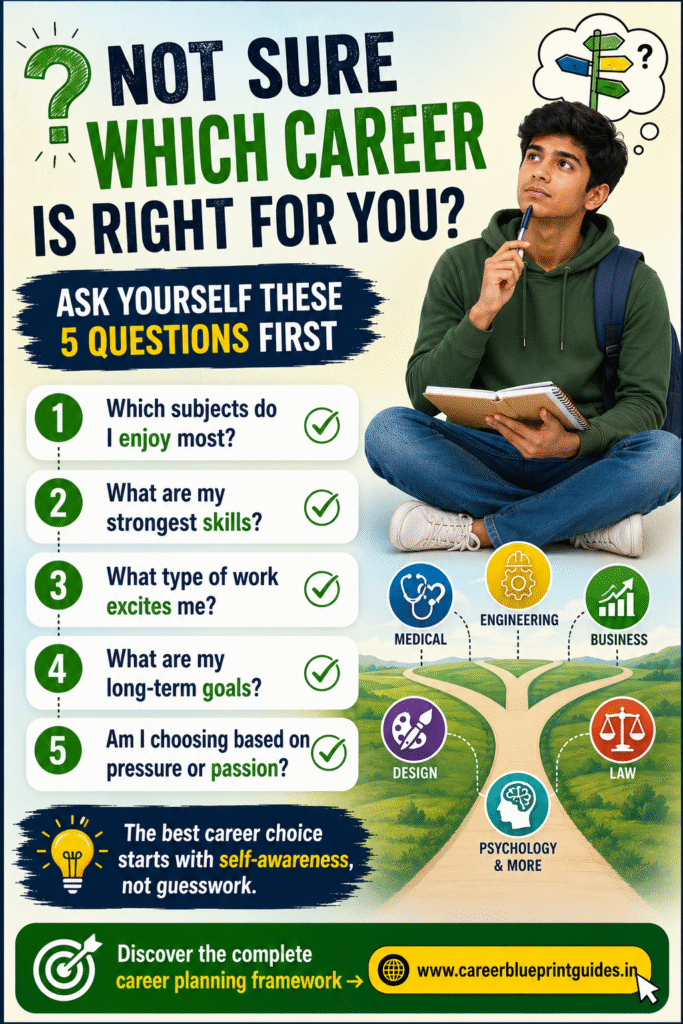
Ask yourself a few simple questions:
- Which subjects do I enjoy studying?
- What activities keep me engaged for long periods?
- Do I enjoy working with people, technology, numbers, creativity, or practical tasks?
- What kind of work environment would suit me best?
For example, if you enjoy solving technical problems and working with computers, careers related to information technology, software development, or cybersecurity may be suitable.
If you enjoy helping people and have a caring nature, healthcare-related careers such as nursing, physiotherapy, or medical laboratory technology could be a better fit.
Similarly, students who enjoy creativity may find opportunities in graphic design, digital marketing, content creation, animation, or video editing.
Those who prefer practical, hands-on work can explore diploma courses, ITI trades, or technical professions.
Understanding your strengths is equally important. A student may not score the highest marks in every subject but may possess excellent communication skills, leadership qualities, creativity, or technical aptitude.
These strengths can become valuable assets in many careers.
Before selecting a course or career path, spend some time evaluating what genuinely interests you.
A career aligned with your strengths often leads to better performance, greater confidence, and higher chances of success.
Focus on Skills, Not Just Marks
Many students believe that average marks automatically limit their career opportunities. In reality, employers today are increasingly looking for practical skills, problem-solving abilities, communication skills, and industry knowledge rather than academic scores alone.
Marks can help you gain admission to certain courses, but skills often determine how successful you become in your career.
Across industries, organizations are hiring candidates who can contribute effectively from day one.
For example:
- A skilled graphic designer can earn well even without top academic grades.
- A talented digital marketer can build a successful career through practical experience.
- An experienced video editor can work with clients across the world.
- A trained electrician or technician can enjoy stable income and strong job demand.
This is why students should start developing relevant skills alongside their education. Online courses, internships, certifications, workshops, and practical projects can significantly improve employability.
Some valuable skills for today’s job market include:
- Communication skills
- Computer literacy
- Digital marketing
- Graphic design
- Data analysis
- Problem-solving
- Time management
- Artificial Intelligence (AI) tools
- Coding and programming
- Content creation
The most successful professionals are often lifelong learners. Instead of worrying only about marks, focus on acquiring skills that employers actually need.
Choose Careers with Good Demand and Income Potential
When evaluating the best career options, it is important to consider market demand.
A career may sound attractive, but if job opportunities are limited, finding employment can become difficult after completing the course.
Students should research industries that are expected to grow in the coming years.
Careers linked to growing sectors generally offer better job security, more opportunities, and stronger salary growth.
Some high-demand sectors in 2026 and beyond include:
Healthcare and Medical Services
Healthcare remains one of the most stable industries worldwide. Professionals such as nurses, medical laboratory technicians, radiology technicians, physiotherapists, and healthcare assistants continue to be in demand.
These careers offer:
- Strong job security
- Consistent demand
- Opportunities in both government and private sectors
- Good long-term growth
Information Technology and Digital Careers
Technology continues to create new opportunities every year. Students interested in computers can explore careers such as:
- Software Development
- Web Development
- Cybersecurity
- Data Analytics
- Artificial Intelligence Support Roles
- Cloud Computing
Many of these careers offer attractive salary packages and opportunities to work remotely.
Digital Marketing and Content Creation
As businesses increasingly move online, demand for digital marketing professionals continues to grow. Skills such as SEO, social media marketing, content writing, video editing, and advertising management are highly valuable.
Students can often start freelancing and earning even while studying.
Skilled Technical Trades
Technical professions are often overlooked but can provide excellent income and stability. Examples include:
- Electrician
- Fitter
- HVAC Technician
- Machine Operator
- Industrial Technician
- Automotive Technician
Many industries actively recruit skilled workers, making these careers practical options for average students seeking early employment.
When comparing career options, consider not only the starting salary but also future demand and growth potential.
A career with moderate starting income but strong long-term opportunities may be a better choice than a career with limited future prospects.
Think About Long-Term Growth
While early income is important, students should avoid making decisions based only on short-term earnings.
A career should also offer opportunities for learning, promotions, specialization, and salary growth over time.
Many successful professionals started with modest salaries but gradually increased their earnings through experience, certifications, and skill development.
For example:
- A digital marketing executive can become a marketing manager or consultant.
- A software developer can progress to senior developer, team lead, or architect roles.
- A nurse can specialize in different medical fields and move into leadership positions.
- A technician can eventually start an independent business or consultancy.
When evaluating a career, ask yourself:
- Will this field still be relevant after 10 years?
- Are there opportunities for advancement?
- Can I continue learning and growing in this profession?
- Does this career offer financial stability in the future?
It is also wise to consider the impact of technology and automation. Careers that require creativity, problem-solving, technical expertise, human interaction, and specialized skills are generally more resilient to automation.
The best career options are not necessarily those that provide the highest salary immediately.
They are the careers that offer a combination of job security, continuous learning, growth opportunities, and long-term earning potential.
Choosing a career after 10th or 12th is an important decision, but it does not have to be stressful.
By understanding your interests, developing valuable skills, researching market demand, and focusing on long-term growth, you can make a choice that supports both your personal satisfaction and financial future.
A well-informed decision today can open the door to a successful and rewarding career tomorrow.
Best Career Options After 10th for Average Students
Many students feel uncertain after completing Class 10. Some may not have scored exceptionally high marks, while others may simply be confused about which path to choose. The good news is that success is not reserved only for toppers.
Today, there are several career paths that focus more on practical skills, hands-on learning, and industry demand than academic percentages.
When exploring the best career options after 10th, students should focus on courses that offer employable skills, reasonable education costs, and strong future growth.
Choosing the right path early can help build a stable career and even create opportunities for earning at a younger age.
Polytechnic Diploma Courses
Polytechnic diploma courses are among the most popular options for students who want technical education without spending several years in traditional academic programs.
These courses typically last three years and provide practical knowledge that industries actively seek.
Popular diploma branches include:
- Mechanical Engineering
- Civil Engineering
- Electrical Engineering
- Computer Engineering
- Electronics Engineering
One of the biggest advantages of a polytechnic diploma is that students can enter the workforce earlier than many degree holders.
After completing the diploma, students can either start working or continue their studies through lateral entry into engineering degree programs.
Industries such as manufacturing, construction, infrastructure, and technology regularly hire diploma holders.
This makes polytechnic education one of the best career options for average students who enjoy technical subjects and practical learning.
ITI Courses
Industrial Training Institute (ITI) courses are specifically designed to prepare students for skilled jobs in various industries.
These courses are job-oriented, affordable, and generally shorter in duration than traditional degree programs.
Popular ITI trades include:
- Electrician
- Fitter
- Welder
- Mechanic
- Diesel Mechanic
- COPA (Computer Operator and Programming Assistant)
- Refrigeration and Air Conditioning Technician
The demand for skilled technicians continues to grow across India. Electricians, mechanics, and machine operators are required in factories, construction projects, service centers, and government departments.
For students who prefer practical work over classroom-based learning, ITI courses can provide a direct route to employment and financial independence.
With experience and additional certifications, many ITI graduates also start their own businesses and earn significantly higher incomes.
Paramedical Courses
Healthcare is one of the fastest-growing sectors and continues to offer stable employment opportunities.
Students who are interested in the medical field but do not wish to pursue MBBS can consider paramedical courses after Class 10.
Some popular options include:
- Medical Laboratory Technician
- X-Ray Technician
- Emergency Medical Technician
- Operation Theatre Assistant
- Dialysis Technician
These courses focus on practical healthcare skills and prepare students to work alongside doctors and medical professionals.
Hospitals, diagnostic centers, clinics, and healthcare organizations frequently hire trained paramedical staff.
The healthcare industry is expected to expand further in the coming years, making paramedical education one of the safest and most reliable career choices for students seeking job security and long-term growth.
Digital Skills Courses (Graphic Design, Video Editing, Web Design)
The digital economy has created opportunities that did not exist a decade ago. Students can now learn valuable skills online and start earning much earlier than in traditional career paths.
Some of the most in-demand digital skills include:
Graphic Design
Graphic designers create visual content for businesses, websites, advertisements, and social media platforms.
Companies of all sizes need creative professionals who can design logos, banners, posters, and marketing materials.
Students can learn graphic design through short-term courses and build a portfolio to attract clients or employers.
Video Editing
With the growth of YouTube, Instagram, online education, and digital marketing, video editors are in high demand.
Skilled editors can work with content creators, agencies, businesses, and media companies.
Many students begin freelancing while still pursuing their education, allowing them to gain experience and income simultaneously.
Web Design
Every business today wants an online presence. Web designers help create attractive and user-friendly websites for companies, professionals, and entrepreneurs.
Learning web design can open opportunities in freelancing, remote work, startups, and digital agencies.
It is a skill-based career where talent and portfolio often matter more than academic scores.
Digital skills are particularly attractive because they offer flexibility, low startup costs, and the possibility of earning from home.
For students looking for early income opportunities, these fields can be excellent choices.
Think About Long-Term Growth
While choosing a course after 10th, it is important not to focus only on immediate job opportunities.
A career should also provide room for learning, advancement, and higher earnings in the future.
Before making a decision, ask yourself:
- Will this field be relevant five to ten years from now?
- Can I upgrade my skills in this industry?
- Are there opportunities for promotions and higher salaries?
- Does this career match my interests and strengths?
A student who chooses a career with strong long-term potential often enjoys greater job satisfaction and financial stability.
Whether you select a diploma course, ITI trade, healthcare program, or digital skill, continuous learning will play a major role in your success.
The reality is that average students can build extraordinary careers when they choose the right path and consistently improve their skills.
Instead of comparing yourself with others, focus on developing practical abilities, gaining experience, and preparing for future opportunities.
That approach will always deliver better results than relying solely on marks.
Best Career Options After 12th for Average Students
Many students believe that only toppers can build successful careers after Class 12. In reality, employers today value practical skills, communication abilities, problem-solving, and work experience just as much as academic marks.
If you consider yourself an average student, there are still plenty of career paths that offer stable employment, good growth opportunities, and the potential to earn a respectable income.
The key is to choose a field that matches your interests and strengths rather than blindly following trends.
Below are some of the best career options after 12th that can provide both job security and long-term career growth.
Nursing and Allied Healthcare Courses
The healthcare industry continues to grow rapidly in India and across the world.
Hospitals, diagnostic centers, clinics, and healthcare organizations constantly need trained professionals, making healthcare one of the most reliable career sectors.
Students who are interested in helping others and working in a service-oriented profession can consider courses such as Nursing, Medical Laboratory Technology (MLT), Radiology, Operation Theatre Technology, Physiotherapy, and other allied healthcare programs.
One of the biggest advantages of healthcare careers is the steady demand for qualified professionals. Unlike some industries that fluctuate with market conditions, healthcare services remain essential regardless of economic situations.
Popular Healthcare Courses After 12th:
- B.Sc Nursing
- General Nursing and Midwifery (GNM)
- Medical Laboratory Technology (MLT)
- Radiology and Imaging Technology
- Physiotherapy
- Operation Theatre Technology
Why Choose This Career?
- High job demand
- Stable and secure career path
- Opportunities in India and abroad
- Strong long-term growth prospects
For students seeking safe and dependable career opportunities, healthcare remains one of the best career options available after 12th.
BCA and Computer-Based Careers
Technology has transformed almost every industry, creating a huge demand for skilled IT professionals.
The good news is that you do not need to be an engineering student to enter the technology sector.
A Bachelor of Computer Applications (BCA) is an excellent choice for students who are interested in computers, software, and digital technologies.
This course focuses on programming, databases, networking, web development, and software applications.
The IT industry offers multiple career opportunities, allowing students to specialize in different areas based on their interests.
Even average students can perform well in this field if they focus on developing practical skills alongside their academic studies.
Career Opportunities After BCA:
- Software Developer
- Web Developer
- Technical Support Specialist
- Data Analyst
- Cybersecurity Executive
- System Administrator
Students can further enhance their career prospects by learning in-demand skills such as Python, AI tools, cloud computing, digital analytics, and website development.
Why Choose This Career?
- Growing demand in the technology sector
- Multiple specialization options
- Opportunity for remote work
- Good salary growth with experience
As businesses continue to digitize their operations, computer-based careers remain among the best career options for students looking for future-ready professions.
B.Com with Accounting and Finance Skills
Commerce students often underestimate the value of a B.Com degree.
However, when combined with practical accounting and finance skills, it can open doors to numerous career opportunities.
Every business, whether small or large, requires professionals who can manage accounts, taxation, payroll, budgeting, and financial reporting. This creates a consistent demand for skilled accounting and finance professionals.
Students pursuing B.Com can strengthen their employability by learning industry-relevant tools and certifications.
Useful Skills to Learn Alongside B.Com:
- Tally Prime
- GST Filing
- Income Tax Basics
- MS Excel
- Financial Accounting
- Payroll Management
Career Opportunities:
- Accountant
- Tax Assistant
- Finance Executive
- Accounts Officer
- Banking Professional
- Audit Assistant
The finance sector offers both private-sector and government-sector opportunities, making it suitable for students who prefer stability and structured career growth.
Why Choose This Career?
- Strong demand across industries
- Multiple job opportunities
- Suitable for government and private jobs
- Good career progression over time
For commerce students seeking practical and stable career paths, accounting and finance remain some of the best career options after 12th.
Digital Marketing and Content Creation
The digital economy has created entirely new career opportunities that did not exist a decade ago.
Businesses today rely heavily on online marketing to reach customers, making digital marketing one of the fastest-growing career fields.
Unlike many traditional careers, digital marketing focuses more on skills and results than academic marks.
This makes it particularly attractive for average students who are willing to learn and gain practical experience.
Digital marketing covers various specializations, allowing students to choose areas that match their interests.
Popular Digital Marketing Skills:
- Search Engine Optimization (SEO)
- Social Media Marketing
- Content Writing
- Google Ads
- Email Marketing
- Video Marketing
- Affiliate Marketing
Similarly, content creation has become a viable career option through platforms such as YouTube, Instagram, blogs, and podcasts.
Career Opportunities:
- Digital Marketing Executive
- SEO Specialist
- Social Media Manager
- Content Writer
- Video Creator
- Freelance Marketer
Why Choose This Career?
- Low entry barrier
- High demand across industries
- Opportunity for freelancing
- Potential for early income generation
For students who enjoy creativity, technology, and communication, digital marketing is undoubtedly one of the best career options in 2026 and beyond.
Hotel Management and Tourism
India’s tourism and hospitality industry continues to expand due to increasing domestic and international travel.
As a result, trained hospitality professionals are in demand across hotels, resorts, airlines, cruise lines, and travel companies.
Hotel Management is an excellent option for students who possess good communication skills, enjoy interacting with people, and are comfortable working in dynamic environments.
The industry offers a wide range of roles beyond hotel operations, including event management, tourism services, customer relations, and travel planning.
Popular Courses:
- Bachelor of Hotel Management (BHM)
- Diploma in Hotel Management
- Travel and Tourism Management
- Hospitality Management
Career Opportunities:
- Hotel Manager
- Front Office Executive
- Guest Relations Executive
- Event Coordinator
- Travel Consultant
- Tourism Officer
Why Choose This Career?
- Diverse career opportunities
- Opportunities to work globally
- Strong industry growth
- Development of communication and management skills
Students who enjoy people-oriented careers and wish to work in a professional service environment may find hospitality and tourism among the best career options after 12th.
Conclusion
Being an average student does not limit your future success.
The modern job market rewards practical skills, adaptability, and continuous learning far more than academic scores alone. Whether you choose healthcare, technology, finance, digital marketing, or hospitality, success depends on developing expertise and staying committed to your goals.
The best career options are not necessarily the most popular ones—they are the careers that align with your interests, strengths, and long-term aspirations.
Before making a decision, research each field carefully, understand its growth potential, and focus on building relevant skills that can help you succeed in the years ahead.
Best Career Options for Early Income
One of the biggest concerns for students after 10th or 12th is how quickly they can start earning.
Not everyone wants to spend four to six years studying before seeing any financial returns.
The good news is that several modern career paths allow students to develop practical skills and start generating income much earlier than traditional professions.
When exploring the best career options, it is important to focus on skills that are in demand, affordable to learn, and offer both freelancing and job opportunities.
Fields such as digital marketing, graphic designing, video editing, and social media management have created thousands of opportunities for students who are willing to learn and apply their skills consistently.
Let’s look at some of the most promising career options for early income in 2026.
Digital Marketing
Digital marketing has become one of the fastest-growing career fields in India and worldwide.
Every business today needs an online presence, whether it is a local shop, a coaching institute, an e-commerce store, or a multinational company.
This growing demand has created excellent opportunities for students who want to earn early.
Unlike many traditional careers, digital marketing does not require expensive degrees.
Students can start learning skills such as Search Engine Optimization (SEO), Social Media Marketing, Google Ads, Content Marketing, and Email Marketing through online courses and practical projects.
One of the biggest advantages of digital marketing is its flexibility.
Students can work as freelancers, join agencies, work remotely, or even start their own online business.
Many beginners start earning through internships or small freelance projects while continuing their studies.
Why Digital Marketing is a Good Option:
- High demand across industries
- Low investment for learning
- Freelancing and remote work opportunities
- Continuous career growth
- Suitable for students from all streams
For students looking for the best career options with early earning potential, digital marketing is undoubtedly one of the strongest choices.
Graphic Designing
If you enjoy creativity, visual design, and working with images, graphic designing can be an excellent career option.
Every brand requires logos, social media posts, advertisements, brochures, presentations, and website graphics. As a result, skilled graphic designers are always in demand.
Students can learn graphic design using tools such as Canva, Adobe Photoshop, Adobe Illustrator, and Figma.
Initially, they can create social media creatives for small businesses and gradually move towards higher-paying projects.
Graphic designing offers multiple income opportunities. You can work as a freelancer, join a design agency, collaborate with digital marketing companies, or even build your own design business.
Benefits of Graphic Designing:
- Creative and enjoyable work
- Flexible working hours
- Freelancing opportunities
- Growing demand in digital businesses
- Possibility of earning while studying
For average students who may not be interested in highly technical careers, graphic designing provides a practical and rewarding path toward financial independence.
Video Editing
The popularity of YouTube, Instagram Reels, online courses, podcasts, and digital advertising has significantly increased the demand for video editors.
Today, content creators, businesses, educators, and influencers constantly need professionals who can edit videos professionally.
Video editing is a skill-based profession where your portfolio matters more than your academic marks.
Students can learn editing software such as Adobe Premiere Pro, DaVinci Resolve, Filmora, or CapCut and start working on small projects.
Many beginners begin by editing videos for local businesses, YouTubers, or social media creators.
As their skills improve, they can charge higher fees and work on larger projects.
Why Video Editing Has Strong Income Potential:
- Massive demand in the creator economy
- Growing number of businesses using video content
- Opportunity to work remotely
- No specific degree required
- High earning potential with experience
For students searching for the best career options that combine creativity with strong earning opportunities, video editing deserves serious consideration.
Social Media Management
Businesses today understand the importance of social media platforms such as Instagram, Facebook, LinkedIn, YouTube, and Pinterest.
However, many business owners do not have the time or expertise to manage their accounts effectively.
This has created a growing demand for social media managers.
A social media manager is responsible for planning content, scheduling posts, engaging with followers, tracking performance, and helping brands grow online.
Students who enjoy social media and communication can turn this interest into a professional skill.
Learning social media management does not require a large investment. By understanding content creation, audience engagement, and basic analytics, students can start offering services to local businesses and entrepreneurs.
Advantages of Social Media Management:
- Beginner-friendly career path
- High demand among small businesses
- Opportunity to work from home
- Can be combined with digital marketing skills
- Potential for recurring monthly income
This career is particularly suitable for students who enjoy online platforms and want to build a stable source of income at an early stage.
Freelancing Opportunities for Students
Freelancing is not a separate skill but a way of earning by offering your skills directly to clients.
Today, students can work as freelancers in various fields such as content writing, graphic designing, video editing, web development, digital marketing, social media management, and virtual assistance.
The biggest advantage of freelancing is flexibility. Students can choose their working hours, projects, and clients according to their schedules.
It also allows them to gain practical experience while studying.
Initially, income may be small, but as skills, experience, and client trust increase, freelancing can become a highly rewarding career option.
Many successful professionals started their journey as student freelancers and later built agencies or full-time businesses.
Popular Freelancing Skills for Students:
- Content Writing
- Graphic Designing
- Video Editing
- Social Media Management
- Digital Marketing
- Website Development
- Data Entry and Virtual Assistance
Students should focus on building a portfolio, gaining practical experience, and continuously improving their skills.
Over time, freelancing can become a strong source of income and valuable professional experience.
Conclusion
For students who want to start earning as early as possible, skill-based careers offer tremendous opportunities.
Digital marketing, graphic designing, video editing, social media management, and freelancing are among the best career options because they require relatively low investment, have growing demand, and allow students to earn while continuing their education.
The key is not to focus only on earning quickly but also on developing valuable skills that can provide long-term career growth.
With dedication, continuous learning, and practical experience, even average students can build successful and financially rewarding careers in these modern industries.
Best Government Career Options for Average Students
Many students believe that government jobs are only for toppers, but that is not true. Every year, thousands of students with average academic records secure government jobs through proper preparation and consistency.
If you are looking for best career options that offer job security, stable income, retirement benefits, and respect in society, government careers can be an excellent choice.
One of the biggest advantages of government jobs is that selection is usually based on entrance examinations and performance during the recruitment process rather than your school marks.
This means that even if you were an average student in 10th or 12th, you still have the opportunity to build a successful and financially secure future.
Let’s explore some of the most popular government career options for students after 10th and 12th.
SSC Jobs
The Staff Selection Commission (SSC) conducts various examinations to recruit candidates for central government departments and ministries.
SSC jobs are among the most preferred government career options because they offer stability, good salaries, and opportunities for promotion.
Students who complete their 12th standard can apply for exams such as SSC CHSL (Combined Higher Secondary Level), while graduates can appear for SSC CGL (Combined Graduate Level).
Some popular SSC job roles include:
- Lower Division Clerk (LDC)
- Data Entry Operator (DEO)
- Postal Assistant
- Tax Assistant
- Income Tax Inspector
- Central Government Office Assistant
The starting salary generally ranges from ₹25,000 to ₹50,000 per month, depending on the post and location.
Along with salary, employees receive various benefits such as house rent allowance, medical facilities, paid leave, and pension-related benefits.
For average students who are willing to prepare consistently, SSC examinations can be one of the best career options in the government sector.
Railway Jobs
Indian Railways is one of the largest employers in the world and regularly recruits candidates for technical and non-technical positions.
Railway jobs are highly sought after because of their job security, steady income, and attractive employee benefits.
Students can apply for different railway recruitment exams after 10th, ITI, 12th, or graduation, depending on the position.
Popular railway career options include:
- Railway Clerk
- Ticket Collector (TC)
- Station Master
- Goods Guard
- Assistant Loco Pilot (ALP)
- Technician
- Junior Engineer
Railway employees receive several benefits, including travel concessions, medical facilities, housing allowances, and career advancement opportunities.
For students who want a secure government career without pursuing highly competitive professional degrees, railway jobs remain one of the most practical and reliable choices.
Banking Jobs
The banking sector offers some of the most attractive government and public-sector career opportunities for students.
Public Sector Banks recruit candidates through examinations conducted by IBPS, SBI, and other banking organizations.
Banking jobs are suitable for students who have good communication skills, basic numerical ability, and an interest in finance and customer service.
Popular banking positions include:
- Clerk
- Probationary Officer (PO)
- Customer Service Associate
- Specialist Officer
- Relationship Manager
A bank clerk can earn around ₹30,000 to ₹40,000 per month initially, while officers often receive higher salary packages along with additional allowances and benefits.
Apart from financial stability, banking careers provide opportunities for promotions, transfers across India, and long-term career growth.
For students seeking professional office-based work, banking can be one of the best career options available.
Defence and Police Services
Students who are physically fit, disciplined, and passionate about serving the nation can consider careers in defence and police services.
These professions not only provide stable income but also offer a sense of pride and responsibility.
After 10th, 12th, or graduation, candidates can apply for various recruitment opportunities in defence and police departments.
Popular options include:
Indian Army
The Indian Army recruits soldiers, technical staff, clerks, and officers through various entry schemes.
Candidates receive professional training, attractive salaries, medical facilities, housing benefits, and pension-related advantages.
Indian Navy
The Navy offers technical and non-technical roles for students interested in serving at sea and working with advanced technologies.
Indian Air Force
Students with science backgrounds can explore technical and aviation-related opportunities, while other streams also have administrative and support roles available.
Police Services
State Police Departments and Central Armed Police Forces (CAPFs) regularly recruit candidates for positions such as:
- Constable
- Head Constable
- Sub-Inspector (SI)
- Assistant Sub-Inspector (ASI)
Police and defence careers provide respectable salaries, career growth opportunities, government benefits, and the chance to contribute directly to national security and public safety.
For students who value discipline, adventure, and service to the country, defence and police careers can be among the most rewarding government career paths.
Government careers continue to be among the best career options for average students because they focus more on preparation, determination, and performance in competitive examinations than on school marks alone.
With the right strategy and dedication, even students who were not academic toppers can build a secure, respected, and financially stable future through government employment.
Career Mistakes Students Should Avoid
Choosing a career after 10th or 12th is one of the most important decisions in a student’s life.
However, many students make decisions based on incomplete information, peer pressure, or short-term thinking.
These mistakes can lead to dissatisfaction, wasted time, and limited career growth later on.
The good news is that most career mistakes are avoidable if you take the time to understand your interests, strengths, and future opportunities. While searching for the best career options, it is equally important to know what mistakes you should avoid.
A well-informed decision today can help you build a stable and rewarding future.
Following Friends Without Research
One of the most common mistakes students make is choosing a course simply because their friends are choosing it. After 10th or 12th, many students feel uncertain about their future and prefer to stay with their friend group.
While this may seem comfortable, it is not always the right career decision.
Every student has different interests, abilities, learning styles, and career goals.
A course that works well for your friend may not be suitable for you. For example, your friend may enjoy programming and choose BCA, while your strengths may lie in design, healthcare, business, or government services.
Before selecting any course, take time to understand:
- Your interests and hobbies
- Subjects you enjoy studying
- Skills you naturally possess
- Career opportunities available after the course
Remember, careers are built on personal strengths, not friendships. Research thoroughly before making a decision and choose a path that matches your own goals.
Choosing a Course Only for Salary
Many students search for the highest-paying careers and assume that a high salary automatically means a successful career.
While earning potential is important, salary should never be the only factor when choosing a career.
A course may offer attractive salary packages, but if you have no interest in the field, it can become difficult to stay motivated and perform well.
Over time, this may affect both your career growth and job satisfaction.
Instead of focusing only on salary, consider:
- Your interest in the field
- Long-term career growth
- Job stability
- Work-life balance
- Future demand for the profession
The best career options are not always the ones with the highest starting salary.
Often, careers that match your skills and interests provide better growth and higher earnings in the long run.
Ignoring Skill Development
In today’s competitive job market, degrees alone are often not enough.
Employers increasingly look for practical skills that can help candidates contribute from day one. Unfortunately, many students focus only on obtaining a qualification and ignore skill development.
Whether you choose commerce, science, arts, technology, healthcare, or any other field, developing relevant skills can significantly improve your career prospects.
Some valuable skills include:
- Communication skills
- Computer literacy
- Digital marketing
- Graphic designing
- Data analysis
- Problem-solving ability
- Teamwork and leadership
Students who continuously learn and upgrade their skills often have an advantage over others with similar educational qualifications.
Building skills alongside your studies can help you secure internships, freelance projects, and better job opportunities.
Not Checking Future Job Demand
Another major mistake is choosing a course without understanding the future demand for the profession.
Some careers may be popular today but offer limited opportunities in the future due to technological changes, automation, or shifting industry requirements.
Before finalizing any course, research:
- Industry growth trends
- Job availability
- Emerging technologies
- Required future skills
- Employment rates in the field
Fields such as healthcare, digital marketing, cybersecurity, data analytics, renewable energy, artificial intelligence support roles, and skilled trades are expected to continue growing in the coming years.
A smart career choice balances personal interest with market demand. Students who evaluate future opportunities carefully are more likely to build stable careers with consistent income and growth.
By avoiding these common mistakes, students can make better career decisions and confidently move toward the best career options that align with their strengths, interests, and long-term goals.
A little research today can save years of confusion and help create a stronger foundation for future success.
Quick Career Roadmap for Confused Students
If you are confused after 10th or 12th, you are not alone. Every year, thousands of students struggle to decide which stream, course, or career path is right for them.
The good news is that you do not need to have all the answers immediately. Instead of following what your friends are doing or choosing a course simply because it is popular, focus on understanding your interests and strengths.
One of the biggest mistakes students make is searching for the “perfect” career. In reality, the best career options are usually those that match your skills, interests, and long-term goals.
When you choose a field that you genuinely enjoy, learning becomes easier and career growth becomes more natural.
To make your decision easier, here is a simple career roadmap based on different interests and personality types.
If You Like Technology
Students who enjoy computers, gadgets, software, mobile apps, or solving technical problems can explore careers in the technology sector.
This field continues to grow rapidly and offers excellent opportunities for both employment and freelancing.
After 10th, students can consider Polytechnic Diploma courses in Computer Engineering, Information Technology, or Electronics. After 12th, courses such as BCA, B.Sc. Computer Science, and various IT certifications can open the door to rewarding careers.
Some popular technology careers include:
- Software Developer
- Web Developer
- App Developer
- Data Analyst
- Cyber Security Professional
- Cloud Computing Specialist
- AI and Automation Support Specialist
One advantage of technology careers is that students can start learning practical skills online while studying.
Many professionals begin freelancing or earning through internships even before completing their degree.
If you enjoy learning new technologies and solving problems, this can be one of the best career options with strong future demand and good income potential.
If You Like Healthcare
Healthcare is one of the most stable and respected sectors in India and around the world.
If you enjoy helping people and are interested in medical or health-related work, this field offers numerous career opportunities beyond becoming a doctor.
Students after 10th can explore paramedical certificate and diploma courses, while students after 12th can choose Nursing, Medical Laboratory Technology, Radiology, Physiotherapy, or other Allied Health Science programs.
Popular healthcare careers include:
- Staff Nurse
- Medical Lab Technician
- Radiology Technician
- Operation Theatre Technician
- Physiotherapy Assistant
- Emergency Medical Technician
- Healthcare Administrator
The healthcare sector is known for consistent demand because medical services are always needed regardless of economic conditions.
This makes it one of the best career options for students seeking job security and long-term stability.
Additionally, many healthcare careers offer opportunities to work in hospitals, clinics, diagnostic centers, research institutions, and even abroad.
If You Like Business and Finance
Students who enjoy numbers, money management, business concepts, or entrepreneurship may find success in business and finance-related careers.
After 12th, popular educational pathways include B.Com, BBA, Accounting Courses, Banking Courses, Financial Management Programs, and professional certifications such as Tally and GST.
Career opportunities in this field include:
- Accountant
- Financial Analyst
- Tax Consultant
- Banking Professional
- Investment Advisor
- Business Development Executive
- Entrepreneur
Business and finance professionals play an important role in helping organizations manage their operations, budgets, and growth strategies.
As businesses continue to expand, the demand for skilled finance professionals remains strong.
Students who develop practical skills in accounting software, taxation, financial analysis, and business communication often gain a significant advantage in the job market.
For students who enjoy planning, managing resources, and understanding how businesses work, this can be one of the best career options with excellent growth opportunities.
If You Like Creative Work
Not every student enjoys technical or finance-related subjects. Some students are naturally creative and enjoy designing, writing, storytelling, photography, video production, or social media content.
The rise of the digital economy has created many new opportunities for creative professionals.
Today, companies actively hire skilled individuals who can create engaging content and help brands build an online presence.
Popular creative career options include:
- Graphic Designer
- Video Editor
- Content Writer
- UI/UX Designer
- Social Media Manager
- Animator
- Digital Marketing Specialist
One of the biggest advantages of creative careers is the possibility of earning early.
Students can start building a portfolio, taking freelance projects, and developing practical experience while still studying.
Many successful freelancers and content creators began their journey with basic skills and gradually built their expertise over time.
If you enjoy expressing ideas, creating visual content, or working on innovative projects, creative industries can offer both flexibility and strong income potential.
If You Want Government Jobs
Government jobs remain a preferred choice for many students because of their stability, benefits, and long-term career security.
They are especially suitable for students who value a structured work environment and predictable career progression.
Students can begin preparing for government examinations after completing their education requirements.
Different positions require different qualifications, but there are opportunities available after both 10th and 12th, as well as after graduation.
Popular government career paths include:
- SSC Jobs
- Railway Jobs
- Banking Jobs
- Defence Services
- Police Services
- State Government Jobs
- Postal Department Jobs
Success in government examinations requires dedication, discipline, and consistent preparation. Students should focus on improving their general knowledge, reasoning ability, mathematics, and communication skills.
Although competition can be high, government careers continue to be among the best career options for students seeking long-term stability, pension-related benefits where applicable, and career growth through promotions.
By starting preparation early and following a structured study plan, students can significantly improve their chances of success.
Choosing a career does not have to be stressful. The key is to identify what genuinely interests you and then build the skills required in that field.
Whether you choose technology, healthcare, business, creative industries, or government services, consistent learning and practical experience will play a much bigger role in your success than marks alone.
A well-informed decision today can help you build a rewarding and financially secure future tomorrow.
Which Are the Best Career Options for Average Students?
Many students believe that only toppers can build successful careers. In reality, employers and businesses often value practical skills, communication abilities, consistency, and problem-solving more than school marks.
If you consider yourself an average student, there are still many excellent career paths that can provide stability, growth, and a good income.
Some of the best career options for average students include:
- Polytechnic Diploma Courses
- ITI Trades (Electrician, Fitter, COPA, Welder, etc.)
- Nursing and Allied Healthcare Courses
- BCA (Bachelor of Computer Applications)
- Digital Marketing
- Graphic Designing
- Video Editing
- Hotel Management
- Tourism and Travel Management
- Banking and Finance Courses
- Government Job Preparation
The right career depends on your interests, strengths, and long-term goals. For example, if you enjoy working with technology, BCA or digital marketing may be suitable.
If you prefer practical hands-on work, ITI or Polytechnic courses can offer excellent opportunities.
Instead of comparing yourself with others, focus on developing skills that are in demand. In today’s job market, a skilled student often has better opportunities than a student with high marks but limited practical knowledge.
What Should I Do After 10th If I Am Confused?
Feeling confused after Class 10 is completely normal. At this stage, students are expected to make decisions that can influence their future education and career path.
However, there is no need to rush into a decision simply because friends or relatives are choosing a particular stream.
Start by understanding your interests and strengths. Ask yourself:
- Which subjects do I enjoy studying?
- Do I prefer practical work or theoretical learning?
- Am I interested in technology, healthcare, business, government jobs, or creative fields?
After identifying your interests, explore different educational options such as:
- Science Stream
- Commerce Stream
- Arts/Humanities Stream
- Polytechnic Diploma Courses
- ITI Courses
- Skill-Based Training Programs
It is also a good idea to talk with teachers, career counselors, or professionals working in fields that interest you.
Researching future job opportunities and industry demand can help you make a more informed decision.
Remember that Class 10 is not the final destination. Many successful professionals changed their direction later in life.
The important thing is to choose a path that aligns with your abilities and gives you opportunities to grow.
Which Career Provides Early Income After 12th?
Many students want to become financially independent as soon as possible after completing their education. Fortunately, several career options can help students start earning within a relatively short period.
Some careers known for providing early income opportunities include:
Digital Marketing
Digital marketing is one of the fastest-growing industries today. Students can learn skills such as SEO, social media marketing, content creation, and paid advertising through short-term courses.
Many beginners start freelancing or working with small businesses while continuing their studies.
Graphic Designing
Creative students can learn graphic design using tools like Canva, Adobe Photoshop, and Illustrator.
Businesses constantly need designs for social media, websites, advertisements, and branding materials.
Video Editing
With the growth of YouTube, Instagram, and online education, video editors are in high demand.
Skilled editors can earn through freelancing, content creators, media companies, and digital agencies.
Web Designing and Development
Businesses of all sizes need websites. Students who learn website creation and basic coding can start working on projects relatively quickly and build a strong income source over time.
Healthcare Support Roles
Courses such as Medical Lab Technology, Radiology, and Operation Theatre Technology often provide job opportunities soon after course completion, making them attractive choices for students seeking stable income.
While these careers can provide early earnings, success depends on skill development, practical experience, and continuous learning.
Can Average Students Get High-Paying Jobs?
Yes, average students can absolutely get high-paying jobs. In fact, many successful professionals, entrepreneurs, and industry leaders were not necessarily top performers in school.
What often separates successful individuals from others is their willingness to learn, adapt, and improve their skills over time.
Modern employers increasingly focus on:
- Technical skills
- Communication abilities
- Problem-solving skills
- Teamwork
- Adaptability
- Professional attitude
For example, a student who learns digital marketing, coding, data analysis, graphic design, or sales skills may earn significantly more than someone who relies only on academic qualifications.
High-paying careers are available in various sectors, including:
- Information Technology
- Healthcare
- Digital Marketing
- Banking and Finance
- Data Analytics
- Cybersecurity
- Artificial Intelligence Support Roles
- Skilled Technical Trades
The key is to focus on becoming valuable in your chosen field. Consistent learning, certifications, internships, practical projects, and real-world experience can significantly improve your earning potential.
Rather than worrying about being an average student, concentrate on building expertise and gaining practical skills.
Over time, these efforts can open the door to excellent career opportunities and higher income levels.
Conclusion
If you are feeling confused after 10th or 12th, remember that your marks do not define your future.
Many successful professionals, entrepreneurs, and skilled workers were once average students who simply chose the right path and stayed consistent with their efforts.
In today’s world, employers and industries value practical skills, problem-solving abilities, and a willingness to learn just as much as academic performance.
When exploring the best career options, focus on careers that match your interests, strengths, and long-term goals rather than following trends or copying what others are doing. A career chosen with proper research and self-awareness is far more likely to bring satisfaction and success.
It is also important to start developing useful skills as early as possible.
Whether you choose technology, healthcare, commerce, creative fields, or government job preparation, skill development can significantly improve your career opportunities and earning potential.
The good news is that there is no single “perfect” career for everyone.
The best career option is the one that aligns with your abilities, interests, and future aspirations.
Take time to explore your choices, learn new skills, and move forward with confidence.
A well-informed decision today can help you build a secure and rewarding future in the years ahead.