
Why More Science Students Are Choosing Alternative Careers in 2026
For many years, Engineering and Medical courses were considered the most preferred career paths for Science students in India.
However, the career landscape has changed significantly over the last decade.
Today, students have access to a wide range of career opportunities that offer excellent growth, competitive salaries, global exposure, and job satisfaction.
With the rapid advancement of technology, changing industry requirements, and the emergence of new professions, students are no longer limited to traditional career choices.
Fields such as Artificial Intelligence, Data Science, Cybersecurity, Biotechnology, Digital Design, Psychology, and Environmental Science are creating exciting opportunities for Science students.
As a result, many students and parents are now exploring career options after 12th Science that align with personal interests, skills, and future industry demand rather than simply following conventional paths.
The Shift Beyond Traditional Engineering and Medical Careers
The belief that Science students must choose either Engineering or Medical careers is gradually fading.
While these professions continue to offer excellent opportunities, they are no longer the only routes to a successful future.
Several factors have contributed to this shift:
- Increased awareness of alternative career options.
- Growth of technology-driven industries.
- Rising demand for specialized skills rather than traditional degrees.
- Greater focus on passion, aptitude, and career satisfaction.
- Availability of diverse educational programs and certifications.
Today’s students have access to extensive career information through the internet, career counselors, webinars, and educational platforms.
This enables them to make informed decisions based on their interests and strengths.
For example, a student who enjoys technology may find Cybersecurity or Data Analytics more exciting than traditional Engineering.
Similarly, a Biology student interested in research may prefer Biotechnology or Forensic Science instead of pursuing a medical degree.
Parents are also becoming more open to alternative career paths as they recognize that success depends on skills, dedication, and adaptability rather than a specific degree alone.
The modern job market rewards expertise and innovation.
Therefore, students who choose careers that match their abilities often perform better and experience greater long-term career growth.
Skills and Industries Driving Future Job Growth
The future job market is being shaped by technological innovation, digital transformation, sustainability initiatives, and changing consumer needs.
As industries evolve, employers are increasingly looking for candidates with practical skills, analytical thinking, creativity, and adaptability.
Some of the fastest-growing industries creating new career opportunities for Science students include:
- Artificial Intelligence (AI) and Machine Learning
- Data Science and Analytics
- Cybersecurity
- Biotechnology and Life Sciences
- Renewable Energy and Environmental Science
- Digital Media and Animation
- Aviation and Aerospace
- Healthcare Technology
- Agri-Tech and Sustainable Agriculture
- Psychology and Mental Wellness Services
Along with technical knowledge, students are expected to develop essential workplace skills such as:
- Problem-solving abilities
- Critical thinking
- Communication skills
- Digital literacy
- Creativity and innovation
- Teamwork and collaboration
- Adaptability to changing technologies
According to industry trends, many future jobs will combine technology with domain-specific expertise.
For instance, Biotechnology professionals increasingly use Artificial Intelligence in research, while Environmental Scientists leverage data analytics to address climate-related challenges.
This changing employment landscape has expanded the number of career options after 12th Science available to students.
Instead of focusing only on traditional professions, students can now choose careers that offer strong future demand, attractive salary potential, and opportunities to make a meaningful impact in their chosen fields.
By understanding emerging industries and developing relevant skills, Science students can position themselves for success in the rapidly evolving job market of 2026 and beyond.
How to Choose the Right Career After 12th Science
Choosing a career after Class 12 is one of the most important decisions a student will make.
While many Science students automatically think about Engineering or Medical careers, today’s job market offers a much wider range of opportunities.
Fields such as Artificial Intelligence, Data Science, Psychology, Biotechnology, Aviation, and Digital Design are creating exciting career paths for students with different interests and strengths.
Before selecting a course or profession, it is important to look beyond trends, peer pressure, and popular opinions.
The right career choice should align with your interests, skills, long-term goals, and the opportunities available in the industry.
Taking the time to evaluate these factors can help you make a more informed decision and avoid costly career changes later.
Know Your Interests and Strengths
The first step in choosing the right career is understanding yourself. Every student has unique abilities, preferences, and talents.
A career that suits one student may not be the right fit for another.
Ask yourself a few important questions:
- Which subjects do you enjoy studying the most?
- Do you prefer practical work, research, creativity, or problem-solving?
- Are you interested in technology, healthcare, business, design, or social sciences?
- Do you enjoy working with people, data, machines, or ideas?
For example, a student who enjoys mathematics and analytical thinking may find Data Science or Artificial Intelligence exciting.
Someone interested in biology and research might prefer Biotechnology or Environmental Science.
Students with strong communication and interpersonal skills may explore Psychology, Hospitality Management, or Aviation.
Identifying your strengths early can help narrow down your options and make career planning more effective.
Career assessment tests, aptitude tests, and guidance from experienced career counselors can also provide valuable insights into suitable career paths.
Check Future Scope, Salary and Job Demand
A career should not only match your interests but also offer long-term growth opportunities.
As industries evolve, some professions are growing rapidly while others are becoming less relevant due to automation and changing market demands.
Before choosing a course, research factors such as:
- Future industry growth
- Employment opportunities
- Demand for skilled professionals
- Average salary packages
- Opportunities for higher education and specialization
Emerging sectors such as Artificial Intelligence, Cybersecurity, Data Analytics, Biotechnology, Renewable Energy, and Digital Media are expected to generate significant employment opportunities in the coming years.
These industries are driven by technological advancements and are likely to remain in demand for the foreseeable future.
While salary should not be the only factor in your decision, understanding earning potential can help you set realistic expectations.
A career with strong growth prospects often offers better opportunities for skill development, promotions, and long-term financial stability.
Consider Course Duration and Costs
Another important factor to evaluate is the time and financial investment required for a particular career path.
Different courses vary significantly in terms of duration, fees, training requirements, and additional certifications.
For example:
- BCA, B.Sc., and many undergraduate programs typically take 3 years to complete.
- Professional courses such as Commercial Pilot Training may require substantial financial investment.
- Some careers may require postgraduate studies or specialized certifications to achieve better career prospects.
Students and parents should carefully assess the overall cost of education, including tuition fees, accommodation expenses, training costs, and certification requirements.
It is also worth exploring scholarships, educational loans, and government-supported programs that can reduce the financial burden.
A well-planned decision balances personal interests, future career opportunities, and financial considerations.
By evaluating these factors before selecting a course, students can move forward with greater confidence and build a successful career that aligns with both their aspirations and market demand.
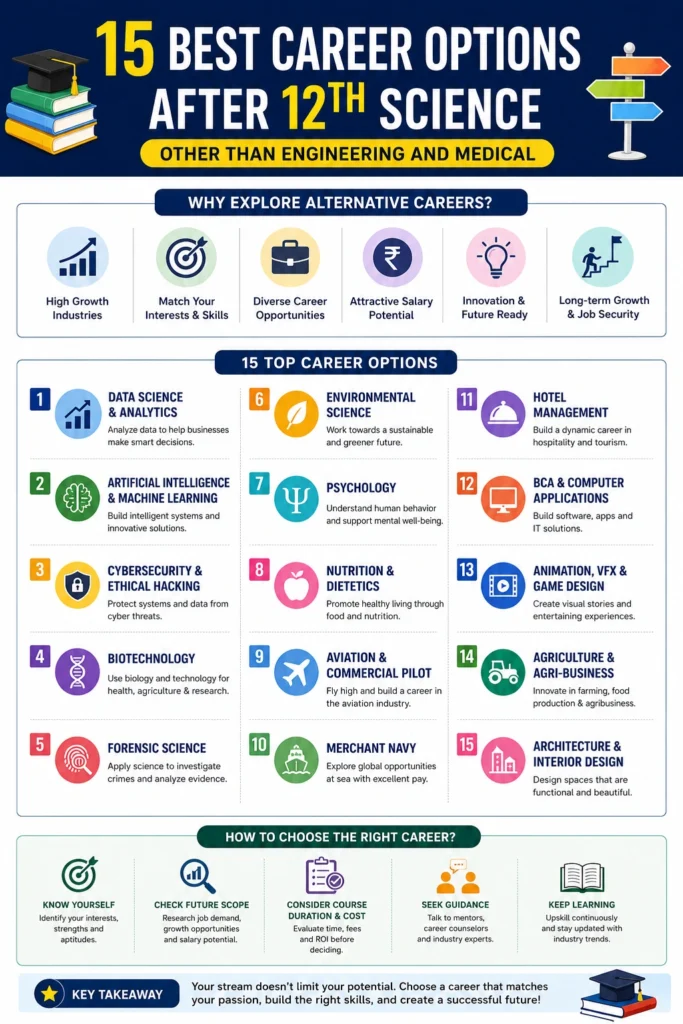
15 Best Career Options After 12th Science Other Than Engineering and Medical
Many students believe that Science stream offers only two major career paths—Engineering or Medical.
However, the reality is very different. With rapid technological advancements, changing industry demands, and the emergence of new career fields, students today have access to a wide range of rewarding opportunities.
If you are looking for career options after 12th Science that match your interests, skills, and future goals, there are several high-growth fields worth exploring.
From technology and research to design, psychology, and aviation, these careers offer excellent scope, competitive salaries, and long-term growth potential.
1. Data Science and Analytics
Data Science has become one of the fastest-growing career fields in the world.
Organizations across industries rely on data to make business decisions, improve customer experiences, and identify future opportunities.
Strong analytical thinking, mathematics, statistics, and problem-solving skills are valuable in this field.
Popular job roles include Data Analyst, Business Analyst, Data Scientist, and Data Engineer.
As businesses continue to generate massive amounts of data, the demand for skilled professionals is expected to remain strong in the coming years.
2. Artificial Intelligence and Machine Learning
Artificial Intelligence (AI) is transforming industries ranging from healthcare and education to finance and transportation.
AI and Machine Learning professionals develop systems that can learn from data, automate tasks, and improve decision-making processes.
Knowledge of programming languages, algorithms, and data analysis is often required.
This field offers exciting career opportunities such as AI Engineer, Machine Learning Specialist, AI Researcher, and Automation Expert.
It is considered one of the most future-ready career options after 12th Science.
3. Cybersecurity and Ethical Hacking
As businesses become increasingly digital, protecting sensitive information has become a top priority.
Cybersecurity professionals help organizations defend their systems against cyber threats, hacking attempts, and data breaches.
Students can pursue specialized courses in Cybersecurity, Information Security, or Ethical Hacking.
Certifications such as CEH (Certified Ethical Hacker) can further enhance career prospects.
Career opportunities include Cybersecurity Analyst, Security Consultant, Penetration Tester, and Ethical Hacker.
The growing importance of digital security makes this field highly promising for the future.
4. Biotechnology
Biotechnology combines biological sciences with technology to develop innovative products and solutions.
This field plays a crucial role in healthcare, agriculture, pharmaceuticals, and environmental conservation.
Students can pursue B.Sc. Biotechnology, integrated biotechnology programs, or related life science courses.
A strong interest in biology and scientific research can be beneficial.
Career options include Biotechnologist, Research Associate, Laboratory Scientist, and Quality Control Specialist.
Biotechnology continues to expand as scientific innovations create new opportunities across multiple sectors.
5. Forensic Science
Forensic Science involves the application of scientific methods to investigate crimes and analyze evidence.
Professionals in this field work closely with law enforcement agencies and legal institutions.
Students can pursue B.Sc. Forensic Science and later specialize in areas such as forensic biology, toxicology, or digital forensics.
Career opportunities include Forensic Scientist, Crime Scene Investigator, Forensic Analyst, and Laboratory Expert.
This field offers a unique blend of science, investigation, and public service.
6. Environmental Science
Environmental Science focuses on understanding environmental challenges and developing sustainable solutions.
With growing concerns about climate change and resource management, environmental professionals are becoming increasingly important.
Students can pursue undergraduate degrees in Environmental Science, Sustainability Studies, or Environmental Management.
Potential careers include Environmental Consultant, Sustainability Specialist, Environmental Researcher, and Conservation Officer.
This field is ideal for students interested in protecting natural resources and promoting sustainable development.
7. Psychology
Psychology is a rapidly growing field that focuses on understanding human behavior, emotions, and mental processes.
Increased awareness of mental health has created new opportunities for psychology professionals.
Students can pursue a Bachelor’s degree in Psychology and later specialize in clinical, counseling, educational, or industrial psychology.
Career options include Psychologist, Counselor, Human Resource Specialist, Behavioral Analyst, and Career Counselor.
This field offers opportunities to make a meaningful impact on individuals and communities.
8. Nutrition and Dietetics
Health and wellness have become major priorities worldwide, increasing the demand for qualified nutrition professionals.
Nutrition and Dietetics focuses on food science, healthy eating habits, and disease prevention through proper nutrition.
Students can pursue B.Sc. Nutrition and Dietetics or related health science programs.
Career opportunities include Dietitian, Nutrition Consultant, Wellness Coach, and Clinical Nutritionist.
Professionals in this field can work in hospitals, fitness centers, research institutions, and private practice.
9. Aviation and Commercial Pilot
For students who dream of working in the aviation industry, becoming a commercial pilot can be an exciting career choice.
Aviation offers opportunities that combine technical knowledge, responsibility, and travel.
To become a pilot, students typically need to complete flying training from a recognized aviation academy and obtain the required licenses.
Apart from commercial pilots, career options in aviation include Flight Operations Officer, Aviation Management Professional, and Air Traffic Control-related roles.
The aviation sector continues to grow with increasing air travel demand.
10. Merchant Navy
The Merchant Navy is a lucrative career option for students who enjoy adventure and travel.
Merchant Navy professionals work on commercial ships involved in transporting goods and passengers across the world.
Students can pursue specialized maritime courses and training programs after completing their 12th Science education.
Career opportunities include Deck Officer, Marine Engineer, Navigation Officer, and Ship Operations Specialist.
The profession offers attractive salaries and opportunities to work internationally.
11. Hotel Management
The hospitality industry offers diverse career opportunities for students interested in customer service, travel, event management, and business operations.
Students can pursue Bachelor of Hotel Management (BHM) or related hospitality courses.
The curriculum typically covers hotel operations, food and beverage management, tourism, and hospitality services.
Career options include Hotel Manager, Event Manager, Hospitality Consultant, and Tourism Professional.
The sector continues to grow as domestic and international tourism expands.
12. BCA and Computer Applications
Bachelor of Computer Applications (BCA) is an excellent option for students interested in technology but not necessarily in traditional engineering programs.
The course focuses on software development, programming, database management, and computer applications.
After completing BCA, students can pursue careers in software development, web development, application support, and IT services.
Common job roles include Software Developer, Web Developer, System Analyst, and IT Consultant. The increasing reliance on technology makes this a strong career option for science students.
13. Animation, VFX and Game Design
The digital entertainment industry has created significant opportunities in animation, visual effects (VFX), and game design.
This field combines creativity with technology to produce engaging digital experiences.
Students can pursue degree, diploma, or certification programs in animation, multimedia, VFX, and game development.
Career opportunities include Animator, VFX Artist, Game Designer, Motion Graphics Designer, and Multimedia Specialist.
The growth of digital content and gaming has increased demand for skilled professionals in this sector.
14. Agriculture and Agri-Business
Modern agriculture has evolved far beyond traditional farming.
Technology, research, food processing, and agribusiness management have opened new career opportunities for science students.
Students can pursue B.Sc. Agriculture, Agribusiness Management, Food Technology, or related programs.
Career options include Agricultural Officer, Agribusiness Manager, Food Processing Specialist, and Agricultural Researcher.
With increasing focus on food security and sustainable farming, this field offers strong long-term prospects.
15. Architecture and Interior Design
Architecture and Interior Design are ideal career choices for students who enjoy creativity, planning, and problem-solving.
These professions involve designing functional, aesthetically appealing, and sustainable spaces.
Students interested in architecture can pursue B.Arch programs, while those inclined toward interior spaces can explore Interior Design courses.
Career opportunities include Architect, Interior Designer, Urban Planner, and Design Consultant.
As urban development and infrastructure projects continue to grow, skilled professionals remain in demand across residential, commercial, and public sectors.
Best Career Options for PCM Students Other Than Engineering
Many students choose the Physics, Chemistry, and Mathematics (PCM) stream in Class 11 with the assumption that engineering is the only logical career path.
However, today’s job market offers a wide range of exciting opportunities for PCM students beyond traditional engineering courses.
With the rise of technology, digital transformation, data-driven industries, and creative professions, students can now build successful careers based on their interests, skills, and long-term goals rather than following a conventional path.
1. Data Science and Analytics
Data Science is one of the fastest-growing career fields globally.
Businesses, governments, and organizations rely on data to make important decisions, creating strong demand for skilled professionals who can analyze and interpret information.
Popular Courses:
- B.Sc. Data Science
- B.Sc. Statistics
- BCA with Data Analytics
- Data Science Certification Programs
Career Roles:
- Data Analyst
- Business Analyst
- Data Scientist
- Research Analyst
2. Artificial Intelligence and Machine Learning
Artificial Intelligence (AI) is transforming industries such as healthcare, finance, education, and manufacturing.
Students with a strong mathematical background can explore AI and Machine Learning as future-ready career options.
Career Roles:
- AI Specialist
- Machine Learning Engineer
- AI Research Assistant
- Automation Consultant
3. Cybersecurity and Ethical Hacking
As cyber threats continue to increase, organizations require professionals who can protect digital systems and sensitive information.
Cybersecurity offers excellent career growth, competitive salaries, and global opportunities.
Career Roles:
- Cybersecurity Analyst
- Ethical Hacker
- Security Consultant
- Information Security Specialist
4. Architecture and Interior Design
Students who enjoy creativity, design, and problem-solving can consider Architecture as an alternative to engineering.
Architects design residential, commercial, and public spaces while combining functionality with aesthetics.
Popular Course:
- Bachelor of Architecture (B.Arch)
Career Roles:
- Architect
- Urban Planner
- Interior Designer
- Landscape Designer
5. Commercial Pilot and Aviation Careers
The aviation industry continues to create opportunities for skilled professionals.
PCM students are eligible for pilot training programs and various aviation-related careers.
Career Roles:
- Commercial Pilot
- Flight Operations Officer
- Aviation Manager
- Air Traffic Professional
6. Merchant Navy
For students interested in travel, adventure, and high earning potential, the Merchant Navy can be a rewarding career path.
It offers opportunities to work on cargo ships, oil tankers, and international vessels.
Career Roles:
- Deck Officer
- Marine Officer
- Navigation Officer
- Ship Operations Executive
7. Animation, VFX and Game Design
The entertainment and gaming industries are expanding rapidly.
Students with technical and creative abilities can build successful careers in animation, visual effects, gaming, and digital media.
Career Roles:
- Animator
- VFX Artist
- Game Designer
- Multimedia Specialist
Why PCM Students Should Explore Multiple Career Paths
Choosing PCM does not mean that engineering is the only option available.
Modern industries value skills, creativity, analytical thinking, and adaptability.
Before selecting a career, students should evaluate their interests, strengths, future industry demand, and long-term career goals.
With proper planning and guidance, PCM students can pursue rewarding careers in technology, design, aviation, analytics, cybersecurity, and several other emerging fields that offer excellent growth prospects in 2026 and beyond.
Best Career Options for PCB Students Other Than Medical
Not every Biology student dreams of becoming a doctor. While MBBS remains a popular choice, many students discover that their interests lie elsewhere.
The good news is that the Science stream offers a wide range of rewarding careers beyond medicine.
With the rise of new industries, research fields, and technology-driven sectors, PCB students now have more opportunities than ever before.
If you are a PCB student looking for career options after 12th Science other than medical, consider exploring fields that match your interests, skills, and long-term career goals.
Biotechnology
Biotechnology combines Biology with technology to develop products and solutions in healthcare, agriculture, pharmaceuticals, and environmental science.
Students interested in research, innovation, and scientific problem-solving may find this field highly rewarding.
Career Opportunities
- Biotechnologist
- Research Associate
- Clinical Research Professional
- Pharmaceutical Scientist
- Quality Control Analyst
Future Scope
The biotechnology industry is expanding rapidly due to advancements in healthcare, genetics, and vaccine development.
Skilled professionals are in demand across both private companies and research institutions.
Forensic Science
Forensic Science involves applying scientific methods to investigate crimes and analyze evidence.
It is an excellent career option for students who enjoy Biology, Chemistry, and analytical thinking.
Career Opportunities
- Forensic Scientist
- Crime Scene Investigator
- Forensic Toxicologist
- DNA Analyst
- Laboratory Specialist
Future Scope
With increasing reliance on scientific evidence in criminal investigations, the demand for qualified forensic professionals continues to grow.
Environmental Science
Environmental Science focuses on understanding environmental challenges and developing sustainable solutions.
This field is ideal for students who are passionate about nature, conservation, and sustainability.
Career Opportunities
- Environmental Consultant
- Environmental Researcher
- Sustainability Officer
- Wildlife Conservation Specialist
- Environmental Analyst
Future Scope
As governments and organizations focus on climate change and environmental protection, career opportunities in this sector are expected to increase significantly.
Psychology
Psychology is the scientific study of human behavior, emotions, and mental processes.
It has become one of the most sought-after career options among students interested in understanding people and helping others.
Career Opportunities
- Clinical Psychologist
- Counseling Psychologist
- School Counselor
- Human Resource Specialist
- Behavioral Therapist
Future Scope
Growing awareness of mental health has created strong demand for trained psychology professionals across healthcare, education, and corporate sectors.
Nutrition and Dietetics
Nutrition and Dietetics focuses on promoting health through proper nutrition and dietary planning.
This field is suitable for students who want to work in healthcare and wellness without pursuing a medical degree.
Career Opportunities
- Nutritionist
- Dietitian
- Wellness Consultant
- Sports Nutrition Expert
- Clinical Nutrition Specialist
Future Scope
The increasing focus on preventive healthcare and fitness has made nutrition professionals highly valuable in hospitals, wellness centers, and sports organizations.
Agriculture and Agri-Business
Modern agriculture is far more advanced than traditional farming. It now includes technology, research, food production, agribusiness management, and sustainable farming practices.
Career Opportunities
- Agricultural Officer
- Agribusiness Manager
- Food Processing Specialist
- Agricultural Research Scientist
- Farm Management Consultant
Future Scope
India’s agriculture sector continues to evolve with government support, technological innovation, and growing demand for food security solutions.
Microbiology
Microbiology focuses on studying microorganisms such as bacteria, viruses, fungi, and other microscopic life forms.
It is a popular choice among students who enjoy laboratory work and scientific research.
Career Opportunities
- Microbiologist
- Laboratory Research Assistant
- Quality Assurance Analyst
- Pharmaceutical Researcher
- Food Safety Specialist
Future Scope
Microbiology plays a critical role in healthcare, pharmaceuticals, food industries, and biotechnology, offering diverse career opportunities.
Genetics and Genomics
Genetics is an emerging field that studies genes, heredity, and genetic variations.
Advances in genetic research are transforming healthcare, disease prevention, and personalized medicine.
Career Opportunities
- Genetic Counselor
- Genomics Researcher
- Clinical Genetics Professional
- Biotechnology Specialist
- Research Scientist
Future Scope
As genetic testing and precision medicine continue to develop, professionals in this field are expected to enjoy excellent career prospects.
Why PCB Students Should Explore Alternative Careers
Many students believe that Biology automatically means becoming a doctor.
However, today’s job market offers numerous high-potential career paths that do not require pursuing MBBS.
Fields such as biotechnology, psychology, forensic science, environmental science, and nutrition provide excellent growth opportunities, meaningful work, and competitive salaries.
The most important factor is choosing a career that aligns with your interests, strengths, and future aspirations.
By exploring different options and understanding industry trends, PCB students can build successful and fulfilling careers beyond the traditional medical route.
Key Takeaway
PCB students have access to a wide range of career options after 12th Science besides medical studies.
Whether your interest lies in research, healthcare, environmental protection, mental health, nutrition, or agriculture, there are several promising pathways available.
Take time to explore your options, evaluate your strengths, and choose a career that supports both your passion and long-term goals.
Highest-Paying Career Options After 12th Science in 2026
One of the most common questions students and parents ask is, “Which career offers the highest salary after 12th Science?”
While salary should never be the only factor in choosing a career, understanding earning potential can help students make informed decisions.
In 2026, the job market is being shaped by technology, data, automation, healthcare innovation, sustainability, and digital transformation.
As a result, several careers outside traditional Engineering and Medical fields now offer excellent salary packages and long-term growth opportunities.
Top High-Paying Career Fields for Science Students
Data Science and Analytics
Organizations across industries rely on data to make business decisions.
Data Scientists and Analysts are among the most sought-after professionals today.
Students can enter this field through courses in Data Science, Statistics, Mathematics, Computer Applications, or specialized certification programs.
Average Starting Salary: ₹5–10 LPA
Experienced Professionals: ₹15–30+ LPA
Artificial Intelligence and Machine Learning
Artificial Intelligence (AI) continues to transform industries such as healthcare, finance, education, manufacturing, and e-commerce.
Students interested in technology, problem-solving, and innovation can build rewarding careers in this domain.
Average Starting Salary: ₹6–12 LPA
Experienced Professionals: ₹20–40+ LPA
Cybersecurity and Ethical Hacking
With increasing cyber threats and data breaches, companies are investing heavily in cybersecurity professionals.
This field offers strong career growth, global opportunities, and attractive salaries.
Average Starting Salary: ₹4–8 LPA
Experienced Professionals: ₹12–25+ LPA
Commercial Pilot
For students passionate about aviation, becoming a Commercial Pilot can be one of the highest-paying career options after 12th Science.
Although training costs can be significant, the long-term earning potential is substantial.
Average Starting Salary: ₹12–25 LPA
Experienced Pilots: ₹40+ LPA
Merchant Navy
The Merchant Navy offers excellent salaries, international exposure, and opportunities to travel across the world.
Professionals working on ships often receive additional benefits such as accommodation and allowances.
Average Starting Salary: ₹6–12 LPA
Senior Officers: ₹20–50+ LPA
Biotechnology and Life Sciences
The biotechnology sector is expanding rapidly due to advancements in healthcare, pharmaceuticals, genetics, and research.
Students with a strong interest in science and innovation can find rewarding opportunities in this field.
Average Starting Salary: ₹4–8 LPA
Experienced Professionals: ₹10–20+ LPA
A Quick Reality Check About Salaries
While salary is important, career success depends on several factors, including skills, continuous learning, industry demand, work experience, and personal interest.
A student who enjoys a particular field and consistently develops relevant skills is more likely to achieve long-term success than someone who chooses a career based solely on salary.
The best approach is to balance your interests, strengths, future job demand, and earning potential before making a career decision.
This will help you build a career that is not only financially rewarding but also professionally satisfying.
Career Comparison Table (Course Duration, Eligibility and Salary)
Choosing the right career after 12th Science is not just about interest—it is also important to understand the course duration, eligibility requirements, and earning potential of different career paths.
| Career Option | Typical Course Duration | Eligibility | Average Starting Salary* |
|---|---|---|---|
| Data Science & Analytics | 3–4 Years | PCM preferred, basic mathematics skills | ₹4–8 LPA |
| Artificial Intelligence & Machine Learning | 3–4 Years | PCM preferred | ₹5–10 LPA |
| Cybersecurity & Ethical Hacking | 3–4 Years | Science stream, computer interest | ₹4–9 LPA |
| Biotechnology | 3–4 Years | PCB or PCM | ₹3–7 LPA |
| Forensic Science | 3 Years | PCB or PCM | ₹3–6 LPA |
| Environmental Science | 3 Years | Science stream | ₹3–6 LPA |
| Psychology | 3 Years | Any Science student | ₹3–6 LPA |
| Nutrition & Dietetics | 3–4 Years | PCB preferred | ₹3–7 LPA |
| Commercial Pilot Training | 18–24 Months | PCM with required medical fitness | ₹8–20 LPA |
| Merchant Navy | 1–4 Years | PCM preferred | ₹6–12 LPA |
| Hotel Management | 3–4 Years | Any Science student | ₹3–6 LPA |
| BCA (Computer Applications) | 3 Years | Science stream (varies by college) | ₹3–8 LPA |
| Animation, VFX & Game Design | 1–4 Years | Any Science student | ₹3–8 LPA |
| Agriculture & Agri-Business | 4 Years | PCB or PCM | ₹4–7 LPA |
| Architecture & Interior Design | 5 Years (Architecture) | PCM with qualifying entrance requirements | ₹4–8 LPA |
Key Takeaways from the Comparison
- Technology-driven careers such as Data Science, Artificial Intelligence, and Cybersecurity offer some of the strongest growth opportunities in 2026 and beyond.
- Students from the PCB stream are not limited to Medical careers and can explore fields such as Biotechnology, Forensic Science, Psychology, Nutrition, and Agriculture.
- Commercial Pilot and Merchant Navy careers can offer high earning potential but often require specialized training and additional eligibility criteria.
- Creative students may find rewarding opportunities in Animation, VFX, Game Design, Architecture, and Interior Design.
- Salary figures can vary depending on skills, location, qualifications, and industry demand.
A Quick Note for Students
While salary is an important factor, it should not be the only basis for choosing a career.
The best career option after 12th Science is one that aligns with your interests, strengths, personality, and long-term goals.
A well-chosen career path can provide both professional satisfaction and financial growth over time.
Note: Salary ranges are approximate and may vary based on employer, city, experience level, and market conditions.
Conclusion
Choosing the right career after 12th Science is one of the most important decisions in a student’s academic journey.
While Engineering and Medical careers continue to be popular choices, they are no longer the only paths to success.
Today, students have access to a wide range of opportunities across technology, data science, cybersecurity, biotechnology, psychology, aviation, design, agriculture, and many other fast-growing industries.
The best career option is not necessarily the one with the highest salary or the most popularity. Instead, it is the one that matches your interests, strengths, skills, and long-term goals.
Taking the time to understand different career paths can help you make a more informed decision and avoid confusion later.
As industries continue to evolve, employers are increasingly looking for skilled professionals who can adapt, learn, and solve real-world problems.
This means that students who choose emerging and future-focused careers can build rewarding and successful professional lives even without pursuing Engineering or Medical studies.
If you are exploring career options after 12th Science, focus on your interests, research the available opportunities, understand the required qualifications, and seek guidance whenever needed.
A well-planned career decision today can create a strong foundation for your future success.
Remember, your stream does not limit your potential. The right career is the one that aligns with your passion, abilities, and aspirations.