
Your Class 10 Result Is Not Your Final Destination
The day your Class 10 result is announced can feel like a turning point in life.
Some students feel excited, while others feel worried about their marks and future.
Questions like “Which stream should I choose?”, “What career is right for me?“, or “What to do after Class 10 result?” are common at this stage.
The good news is that your Class 10 result is only the beginning of your academic journey, not the final chapter.
The decisions you make after the result are often more important than the marks themselves.
Many successful professionals, entrepreneurs, government officers, and creators did not necessarily score the highest marks in school.
What helped them succeed was choosing the right path, developing valuable skills, and staying consistent in their efforts.
Instead of comparing yourself with friends or worrying about what others think, focus on understanding your strengths, interests, and future goals.
The choices available after Class 10 today are far more diverse than they were a decade ago.
Whether you choose Science, Commerce, Arts, a Diploma course, ITI, or a skill-based program, every path can lead to a successful career when chosen wisely.
The key is to make informed decisions rather than emotional ones.
Once you understand your options clearly, the confusion about what to do after Class 10 result starts to disappear, and you can move forward with confidence.
What Your Marks Really Mean
One of the biggest misconceptions among students is that their marks decide their entire future.
While marks are important, they are not the only factor that determines success.
Your Class 10 score is simply a measure of how well you performed in a particular examination.
It does not measure your creativity, communication skills, leadership qualities, problem-solving ability, or determination.
These qualities often play a much bigger role in career growth and long-term success.
For example, a student who scores high in Mathematics may naturally feel comfortable choosing Science or Commerce with Maths.
Similarly, a student who enjoys writing, history, psychology, or social sciences may find greater success in Arts or Humanities.
The purpose of your marks is to help you understand your academic strengths, not to limit your future possibilities.
Rather than focusing only on the percentage, look deeper into your subject-wise performance. Ask yourself:
- Which subjects did I enjoy studying the most?
- Which subjects felt easier to understand?
- Where did I perform well consistently?
- What kind of work interests me the most?
The answers to these questions can provide better career direction than marks alone.
Remember, marks can open certain doors, but your skills, attitude, and continuous learning determine how far you go in life.
The 3 Decisions You Need to Make Now
After receiving your result, there are three important decisions that deserve your attention.
Taking time to think about these carefully can help you avoid confusion and make better career choices.
1. Choose the Right Educational Path
The first decision is selecting your next step after Class 10.
Most students continue with Class 11 and choose a stream such as Science, Commerce, or Arts.
However, this is not the only option.
Depending on your interests and career goals, you may also consider:
- Polytechnic Diploma courses
- ITI programs
- Vocational training courses
- Skill-based certifications
Understanding all available options before making a decision can help you choose a path that matches your strengths and aspirations.
2. Understand Your Interests and Strengths
Many students choose a stream based on marks, family pressure, or what their friends are doing. This often leads to frustration later.
Before making any decision, spend some time identifying your interests.
Think about the subjects you enjoy, the activities you naturally excel at, and the careers that attract you.
When your studies align with your interests, learning becomes easier and more enjoyable.
Choosing a path that suits your personality and abilities can significantly improve your chances of long-term success.
3. Start Thinking About Skills, Not Just Degrees
The modern job market values skills as much as educational qualifications.
Employers increasingly look for candidates who can communicate effectively, solve problems, adapt to technology, and work with others.
No matter which stream or course you choose, start developing useful skills alongside your studies. Examples include:
- Communication skills
- Computer and digital literacy
- Coding and technology skills
- Graphic design
- Content creation
- Public speaking
- Financial literacy
Building these skills early can give you a strong advantage in college admissions, internships, and future career opportunities.
At this stage, you do not need to have your entire life planned out. You simply need clarity about your next step.
By choosing the right path, understanding your strengths, and focusing on skill development, you can move forward confidently after your Class 10 result and create a strong foundation for your future.
What Are Your Options After Class 10?
Once your Class 10 results are announced, one of the most common questions students ask is: what to do after class 10 result?
The good news is that there is no single path that suits everyone. Today, students have multiple educational and career-focused options available based on their interests, strengths, and future goals.
Some students prefer continuing their academic journey through Class 11 and 12, while others choose practical and skill-oriented routes such as Diploma, ITI, or professional skill-based courses.
The right choice depends on your learning style, career aspirations, and long-term plans.
Before making a decision, take time to understand each option carefully instead of following friends or societal pressure.
Class 11 (Science, Commerce & Arts)
For most students, moving to Class 11 is the traditional and widely chosen path after Class 10.
This option allows you to continue your school education while preparing for higher studies and professional careers.
The three main streams available are Science, Commerce, and Arts (Humanities).
Science Stream
The Science stream is suitable for students who enjoy subjects such as Mathematics, Physics, Chemistry, and Biology.
It opens doors to careers in engineering, medicine, research, technology, and many other technical fields.
Students who choose Science generally have strong analytical and problem-solving abilities.
It is often considered one of the most flexible streams because it allows students to explore a wide range of career options after Class 12.
Commerce Stream
Commerce is ideal for students interested in business, finance, economics, accounting, and management.
This stream provides a solid foundation for careers such as Chartered Accountant (CA), Company Secretary (CS), banking professional, financial analyst, entrepreneur, and business manager.
Students who enjoy understanding how businesses operate and how money is managed often find Commerce an excellent choice.
Arts/Humanities Stream
Arts or Humanities is a diverse stream that focuses on subjects such as History, Political Science, Geography, Psychology, Sociology, and Economics.
This stream offers opportunities in fields like law, civil services, journalism, teaching, design, psychology, and social work.
Contrary to old misconceptions, Arts has become one of the fastest-growing streams with numerous modern career opportunities.
If you enjoy creativity, communication, social issues, or understanding human behavior, Arts may be a suitable option for you.
Diploma Courses
Diploma courses are an excellent alternative for students who prefer practical learning over traditional classroom education.
These programs typically focus on industry-relevant skills and technical knowledge.
Most diploma courses can be pursued immediately after Class 10 and usually last between two and three years.
Some popular diploma options include:
- Polytechnic Engineering
- Computer Engineering
- Mechanical Engineering
- Civil Engineering
- Electrical Engineering
- Graphic Design
- Animation and Multimedia
- Hotel Management
- Fashion Designing
One of the biggest advantages of diploma courses is that they provide hands-on training and can help students enter the workforce earlier.
In many cases, diploma holders can also pursue higher education later through lateral entry into degree programs.
Students who enjoy practical work and want job-oriented education often consider diploma courses a strong option after Class 10.
ITI Courses
Industrial Training Institutes (ITI) offer vocational training programs designed to develop technical and practical skills for specific trades.
ITI courses generally range from six months to two years, depending on the trade selected.
These programs focus heavily on practical training rather than theoretical studies.
Popular ITI trades include:
- Electrician
- Fitter
- Welder
- Mechanic
- Plumber
- Computer Operator
- Refrigeration Technician
- Electronics Technician
ITI can be a suitable option for students who want to become job-ready quickly and develop specialized technical skills.
Many ITI graduates find opportunities in government departments, railways, manufacturing industries, public sector companies, and private organizations.
For students who enjoy hands-on work and technical tasks, ITI provides a direct pathway toward employment and career growth.
Skill-Based Courses
In today’s digital economy, skills are becoming just as important as academic qualifications.
Many students are now choosing skill-based courses alongside their studies to improve their career prospects.
These courses are generally short-term, practical, and focused on real-world applications.
Some popular skill-based courses after Class 10 include:
- Digital Marketing
- Graphic Designing
- Video Editing
- Content Creation
- Web Development
- Coding and Programming
- Photography
- UI/UX Design
- Social Media Management
- Mobile App Development
The biggest advantage of skill-based learning is flexibility. Students can learn these skills online or offline while continuing their regular education.
Many of these skills can also lead to freelance opportunities, internships, part-time work, or even entrepreneurship at a young age.
As industries continue to evolve, practical skills can provide a valuable advantage regardless of the academic path you choose.
Final Thoughts
If you are wondering what to do after class 10 result, remember that there is no universally “best” option.
The best choice is the one that aligns with your interests, abilities, learning style, and future goals.
Whether you choose Class 11, a Diploma course, ITI training, or skill-based learning, focus on building knowledge, developing practical skills, and making informed decisions.
The path you choose today is just the beginning of your career journey, and with the right effort and guidance, every path can lead to success.
Science, Commerce or Arts – How to Choose the Right Stream?
One of the biggest questions students face after receiving their Class 10 results is which stream they should choose.
If you are wondering what to do after class 10 result, selecting the right stream is one of the most important decisions you will make.
Many students choose a stream based on marks, friends, or family pressure.
However, the best approach is to consider your interests, strengths, learning style, and future career goals.
The good news is that there is no “best” stream. Science, Commerce, and Arts all offer excellent career opportunities.
The right choice depends on what suits you best.
Let’s understand each stream in a simple way.
Who Should Choose Science?
Science is a popular stream for students who enjoy understanding how things work and have an interest in subjects such as Physics, Chemistry, Mathematics, or Biology.
You may consider Science if:
- You enjoy solving logical and numerical problems.
- Mathematics or Science are among your strongest subjects.
- You are curious about technology, medicine, research, or engineering.
- You are comfortable with regular study and practical learning.
- You want access to a wide range of future career options.
Popular career paths after Science include:
- Engineering
- Medicine (MBBS, BDS, Nursing, Pharmacy)
- Computer Science and Artificial Intelligence
- Data Science
- Architecture
- Defence Services
- Research and Scientific Careers
Science can be a good choice for students who enjoy analytical thinking and are willing to invest time in building a strong academic foundation.
Who Should Choose Commerce?
Commerce is ideal for students interested in business, finance, economics, and management. It is a practical stream that opens doors to both professional careers and entrepreneurship.
You may consider Commerce if:
- You enjoy working with numbers and financial concepts.
- You are interested in business and how companies operate.
- You like subjects related to economics and money management.
- You want to explore careers in finance, banking, or accounting.
- You dream of starting your own business in the future.
Popular career paths after Commerce include:
- Chartered Accountant (CA)
- Company Secretary (CS)
- Banking and Finance
- Business Management
- Investment and Financial Planning
- Digital Marketing
- Entrepreneurship
Commerce offers excellent opportunities for students who want to build careers in the corporate and business world.
Who Should Choose Arts?
Arts or Humanities is a great option for students who are interested in society, creativity, communication, and human behavior. Contrary to common myths, Arts provides a wide range of career opportunities in today’s world.
You may consider Arts if:
- You enjoy subjects such as History, Geography, Political Science, or Psychology.
- You have strong communication and creative skills.
- You are interested in understanding people and society.
- You enjoy reading, writing, and critical thinking.
- You want flexibility in your future career choices.
Popular career paths after Arts include:
- Civil Services (UPSC)
- Law
- Journalism and Media
- Psychology
- Teaching
- Graphic Designing
- Content Creation and Digital Media
- Social Work and Public Administration
Arts can be an excellent choice for students who are creative, expressive, and interested in making an impact on society.
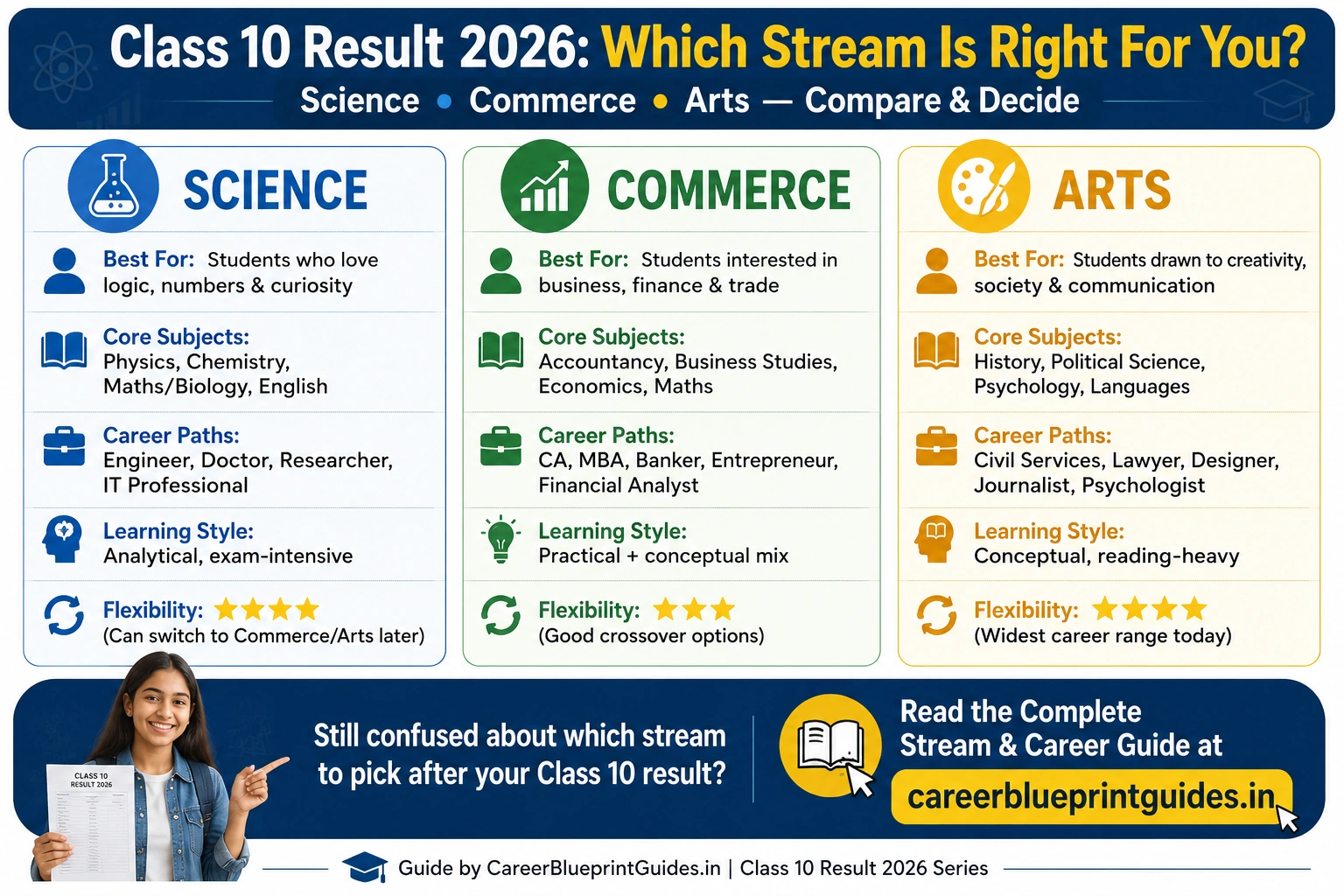
Quick Comparison Table
| Factor | Science | Commerce | Arts |
|---|---|---|---|
| Main Subjects | Physics, Chemistry, Maths/Biology | Accountancy, Economics, Business Studies | History, Geography, Political Science, Psychology |
| Best For | Technical and Medical Careers | Business and Finance Careers | Creative, Social and Government Careers |
| Learning Style | Analytical and Practical | Numerical and Business-Oriented | Conceptual and Creative |
| Popular Careers | Engineer, Doctor, Data Scientist | CA, Banker, Business Manager | Lawyer, Journalist, Psychologist |
| Difficulty Level | Generally Higher | Moderate | Flexible |
| Career Flexibility | Very High | High | High |
Before making your final decision, spend time understanding your interests and long-term goals.
If you are still confused about what to do after class 10 result, remember that success depends more on your dedication and skills than on the stream itself.
Choose a path that matches your strengths and gives you confidence about your future.
Best Career Options After Each Stream
One of the most common questions students ask after receiving their board results is: what to do after class 10 result and which stream will offer the best career opportunities in the future.
The good news is that every stream—Science, Commerce, and Arts—offers excellent career paths.
Success does not depend on choosing the “most popular” stream. It depends on selecting a stream that matches your interests, strengths, and long-term goals.
Before making a decision, it is important to understand the career opportunities available after each stream so that you can choose with confidence rather than confusion.
Careers After Science
Science is often considered the most flexible stream because it provides access to a wide range of careers in technology, healthcare, research, and engineering.
Students who choose Science generally study Physics, Chemistry, Mathematics (PCM) or Biology (PCB). Depending on the subjects selected, different career paths become available.
Popular Careers for PCM Students
- Software Engineer
- Mechanical Engineer
- Civil Engineer
- Data Scientist
- Artificial Intelligence Specialist
- Architect
- Commercial Pilot
- Defence Officer through NDA
The growing demand for technology and innovation has created excellent opportunities for students interested in mathematics, problem-solving, and technical subjects.
Popular Careers for PCB Students
- Doctor (MBBS)
- Dentist (BDS)
- Pharmacist
- Physiotherapist
- Nurse
- Biotechnology Professional
- Medical Laboratory Specialist
- Nutritionist
Healthcare remains one of the most stable and respected sectors.
Students who enjoy biology and helping others may find these careers rewarding both personally and professionally.
Science can be a great choice if you enjoy analytical thinking, scientific concepts, and practical problem-solving.
Careers After Commerce
Commerce is an excellent option for students interested in business, finance, economics, and entrepreneurship.
Many students believe Commerce is only for becoming a Chartered Accountant, but the reality is that this stream offers a wide variety of career opportunities in today’s business-driven world.
Popular Career Options in Commerce
- Chartered Accountant (CA)
- Company Secretary (CS)
- Investment Banker
- Financial Analyst
- Accountant
- Business Consultant
- Marketing Professional
- Entrepreneur
- Banking Officer
- Business Manager
With the rapid growth of startups, digital businesses, and financial services, Commerce students have numerous opportunities to build successful careers.
Students who enjoy working with numbers, business strategies, and financial planning often perform well in this stream.
Careers After Arts
Arts or Humanities has evolved significantly over the last decade. Today, it offers diverse career opportunities in government services, law, media, psychology, education, and creative industries.
Many successful professionals, civil servants, lawyers, and content creators have built their careers through the Arts stream.
Popular Career Options in Arts
- Civil Services Officer (UPSC)
- Lawyer
- Psychologist
- Journalist
- Teacher
- Graphic Designer
- Content Writer
- Social Worker
- Public Relations Specialist
- Fashion Designer
Arts is a suitable option for students who enjoy creativity, communication, social sciences, history, politics, or understanding human behavior.
The stream also provides excellent preparation for competitive examinations and public service careers.
Government Job Opportunities
One important fact that many students do not realize while deciding what to do after class 10 result is that government job opportunities are available to students from all three streams.
Whether you choose Science, Commerce, or Arts, you can prepare for government examinations after completing your higher education.
Popular Government Career Options
- Civil Services (IAS, IPS, IFS)
- Banking Jobs (IBPS, SBI, RBI)
- SSC Examinations
- Railway Recruitment
- Defence Services
- State Government Services
- Public Sector Undertakings (PSUs)
- Teaching and Education Services
Government jobs continue to attract students because of job security, career growth, and various employee benefits.
However, success in government examinations depends more on preparation, discipline, and consistency than on the stream chosen after Class 10.
Final Takeaway
If you are wondering what to do after class 10 result, remember that no stream is inherently better than another.
Science, Commerce, and Arts all offer rewarding career opportunities.
Instead of choosing a stream based on social pressure or popular opinion, focus on your interests, strengths, and future aspirations.
A well-informed decision today can help you build a successful and satisfying career tomorrow.
How to Choose the Right Path Based on Your Interest and Marks
One of the biggest questions students face after receiving their board results is what to do after class 10 result.
While marks are important, they are only one part of the decision-making process.
Choosing the right path requires a combination of self-awareness, academic performance, and future career goals.
Many students make the mistake of selecting a stream simply because their friends are choosing it or because society considers it prestigious.
However, the right choice is the one that matches your strengths, interests, and long-term aspirations.
Before making a decision, take some time to evaluate:
- Which subjects you enjoy studying the most
- Which subjects you consistently perform well in
- What kind of career interests you
- Whether you prefer theoretical learning or practical skill-based learning
The following guidance can help you make a more informed decision based on your marks and personal interests.
If You Scored Above 80%
Scoring above 80% gives you access to a wide range of academic opportunities.
Most schools and colleges offer greater flexibility in stream selection to students with strong academic performance.
However, having high marks does not automatically mean you should choose Science. Instead, use your result as an opportunity to explore the stream that genuinely aligns with your interests.
For example:
- If you enjoy Mathematics, problem-solving, and technology, Science may be a suitable option.
- If you are interested in business, finance, or entrepreneurship, Commerce could be the right choice.
- If you enjoy subjects such as History, Psychology, Political Science, or Languages, Arts and Humanities can open many rewarding career paths.
Students with high scores should focus on future career goals rather than social expectations.
A student scoring 90% can be equally successful in Commerce or Arts as in Science if the chosen path matches their strengths and ambitions.
The key is to use your strong academic foundation to build a career in a field that genuinely excites you.
If You Scored Between 60–80%
A score between 60% and 80% is considered a good result and provides access to many excellent opportunities.
At this stage, understanding your abilities becomes more important than comparing yourself with others.
Students in this range should ask themselves:
- Which subjects do I understand best?
- Which subjects do I enjoy studying?
- What kind of work would I like to do in the future?
For many students, Commerce and Arts provide excellent career opportunities while allowing them to develop additional skills alongside their studies.
Science can also be a good option if your fundamentals in Mathematics and Science are strong.
This is also an ideal stage to start developing practical skills such as:
- Communication skills
- Computer proficiency
- Digital marketing
- Graphic design
- Coding
- Content creation
Combining academics with skill development can significantly improve future career prospects.
Remember, success is not determined by marks alone but by how effectively you use your abilities and opportunities.
If You Scored Below 60%
If your result is below 60%, there is no reason to lose confidence. Many successful professionals, entrepreneurs, artists, and skilled workers did not achieve top scores in school.
Instead of focusing on the percentage, focus on understanding what can be improved moving forward.
Ask yourself:
- Which subjects were challenging for me?
- What learning methods work best for me?
- Do I prefer practical learning over theoretical studies?
Students in this category may consider several options, including:
- Arts and Humanities
- Commerce without Mathematics
- Diploma courses
- ITI courses
- Vocational and skill-based programs
These pathways can lead to successful and rewarding careers when approached with dedication and consistency.
The most important thing is to avoid making decisions based on pressure from relatives, friends, or societal expectations.
Your future depends more on your willingness to learn and improve than on a single exam result.
Interest vs Marks – Which Matters More?
When deciding what to do after class 10 result, students often wonder whether they should prioritize marks or personal interest.
The reality is that both factors matter, but interest should play a bigger role in your final decision.
Marks indicate your current academic performance, while interest determines your motivation and willingness to work hard over the long term.
For example:
- A student with average marks but a genuine passion for business may perform exceptionally well in Commerce.
- A student who loves Biology may succeed in healthcare-related careers even if they are not a school topper.
- A creative student interested in design, media, or psychology may find greater success through Arts and Humanities.
When students choose a stream that matches their interests, they are generally more engaged, motivated, and willing to develop expertise in that field.
A simple formula to follow is:
Interest + Strengths + Future Opportunities = Better Career Decisions
Instead of asking which stream is considered the best, ask which stream is best for you.
That single mindset shift can help you make a confident and informed decision about your future.
Your Class 10 result is an important milestone, but it is not the final chapter of your journey.
The choices you make today, combined with consistent effort and skill development, will have a much greater impact on your long-term success.
Common Mistakes Students Make After Class 10 Results
After receiving their Class 10 results, many students feel excited, confused, nervous, or pressured.
This is completely normal because the next academic decision can influence future career opportunities.
However, while deciding what to do after class 10 result, students often make mistakes that lead to confusion, stress, and sometimes regret later.
The good news is that these mistakes can be avoided with proper awareness and planning.
Understanding the common errors made by students can help you make a more informed and confident decision about your future.
Following Friends
One of the most common mistakes students make after Class 10 is choosing a stream simply because their friends are choosing it.
Many students feel comfortable staying with their friend group and assume that following the same path is the safest option.
However, every student has different interests, strengths, learning styles, and career goals.
A stream that suits your friend may not necessarily be the right choice for you.
For example, your friend may enjoy Mathematics and want to become an engineer, while you may have a strong interest in business, psychology, design, or law.
Choosing a stream based solely on friendship can result in poor academic performance and loss of interest in studies.
Instead of following others, ask yourself:
- Which subjects do I genuinely enjoy?
- What are my strengths?
- What kind of career excites me?
Remember, friends may change streams, colleges, and careers in the future, but your career journey is unique to you.
Taking Science for Status
For many years, Science has been viewed as the “best” stream by society. As a result, some students choose Science not because they are interested in it, but because they believe it carries more prestige.
This mindset can create unnecessary pressure. Science requires a strong foundation in subjects like Mathematics, Physics, Chemistry, and Biology, along with consistent effort and genuine interest.
Choosing Science only for status can lead to:
- Increased academic stress
- Difficulty understanding concepts
- Lower confidence levels
- Lack of motivation to study
The reality is that every stream offers excellent career opportunities. Commerce can lead to careers in finance, accounting, banking, and entrepreneurship.
Arts can open doors to law, civil services, psychology, media, design, and many other growing fields.
When deciding what to do after class 10 result, focus on your interests and abilities rather than social perceptions. Success comes from choosing the right path, not the most popular one.
Ignoring Skills and Diploma Options
Many students believe that their only options after Class 10 are Science, Commerce, or Arts. While these are popular pathways, they are not the only choices available today.
The job market is changing rapidly, and employers increasingly value practical skills alongside academic qualifications.
This is why diploma programs, vocational training, and skill-based courses have become valuable alternatives.
Some popular options include:
- Polytechnic Diploma Courses
- ITI Programs
- Graphic Designing
- Digital Marketing
- Web Development
- Animation and Multimedia
- Hotel Management
- Fashion Designing
These programs often provide practical exposure and can help students develop industry-relevant skills at an early stage.
Ignoring such opportunities can limit your awareness of potential career paths.
Before making a final decision, explore all available options and choose the one that aligns with your goals and learning preferences.
Delaying Admission Decisions
Another common mistake is postponing important decisions for too long. While it is important not to rush, excessive delay can create unnecessary problems.
Many students spend weeks or months feeling confused and fail to take timely action. As a result, they may miss:
- Admission deadlines
- Preferred schools or colleges
- Scholarship opportunities
- Popular diploma or vocational course seats
The best approach is to start researching your options soon after receiving your results.
Gather information, discuss possibilities with parents and teachers, compare different streams, and create a shortlist of choices.
Making an informed decision within a reasonable timeframe will help you move forward confidently and avoid last-minute stress.
Interest vs Marks – Which Matters More?
This is one of the most important questions students ask after receiving their results.
Many students assume that marks alone should decide their stream. While academic performance is certainly an important factor, it should not be the only factor.
Marks show how you performed in a particular exam, but they do not always reflect your true interests, strengths, creativity, communication skills, leadership abilities, or future potential.
For example:
- A student scoring 90% may genuinely enjoy business and entrepreneurship, making Commerce a better choice than Science.
- A student with average marks may have exceptional creative skills and excel in design, media, or psychology through the Arts stream.
- A student interested in technical work may find a diploma course more suitable than traditional schooling.
The ideal approach is to balance both interest and marks.
Ask yourself:
- Which subjects do I enjoy learning?
- Which subjects am I naturally good at?
- What kind of career do I see myself pursuing in the future?
- What are my strengths beyond academics?
When deciding what to do after class 10 result, remember that marks can guide your decision, but your interests should help shape your future direction.
Students who choose a path aligned with both their abilities and passions are often more motivated, successful, and satisfied in the long run.
A Quick Guide for Parents
The period after Class 10 results can be stressful not only for students but also for parents.
Many parents worry about their child’s future, career opportunities, and stream selection.
While these concerns are natural, it is important to remember that Class 10 is only the beginning of a student’s academic journey.
If you are wondering what to do after class 10 result, your role as a parent is not to make decisions for your child but to guide them toward making informed choices.
The support and encouragement provided during this stage can have a lasting impact on your child’s confidence and future success.
Instead of focusing only on marks, try to understand your child’s interests, strengths, learning style, and career aspirations.
Every student is different, and there is no single stream or career path that is perfect for everyone. The best decision is one that aligns with the student’s abilities and long-term goals.
By creating a positive and supportive environment at home, parents can help students make career decisions with confidence rather than fear.
How Parents Can Support Without Pressure
One of the biggest mistakes parents make after Class 10 results is putting unnecessary pressure on their children.
Sometimes this pressure comes in the form of comparisons, expectations, or forcing a particular stream because it is considered more prestigious.
However, career success is not determined by choosing Science, Commerce, or Arts.
Success depends on a student’s interest, dedication, skills, and willingness to learn.
Here are some practical ways parents can support their child without creating pressure:
Listen Before Giving Advice
Allow your child to express their thoughts, concerns, and aspirations. Understanding their perspective can help you guide them more effectively.
Avoid Comparing Them with Others
Every student has unique strengths. Comparing your child with relatives, neighbors, or classmates can reduce confidence and create unnecessary stress.
Focus on Interests and Strengths
Pay attention to the subjects and activities your child genuinely enjoys.
A student who enjoys business concepts may thrive in Commerce, while someone interested in creativity and social sciences may perform better in Arts.
Encourage Exploration
Help your child research different streams, courses, and career options. Exposure to accurate information often reduces confusion and builds clarity.
Support Skill Development
In today’s world, skills such as communication, digital literacy, problem-solving, and critical thinking are valuable across all careers. Encourage your child to learn and develop these skills alongside academics.
Most importantly, reassure your child that one result does not define their future. Students perform better when they feel supported rather than judged.
When Career Counselling Can Help
Despite discussions and research, some students remain confused about the best path forward.
This is where professional career counselling can be useful.
Career counselling helps students understand their strengths, interests, personality traits, and potential career options through structured guidance and assessment tools.
Parents may consider career counselling when:
- The student is unable to decide between two or more streams.
- There is a significant difference between the student’s interests and parental expectations.
- The student feels overwhelmed by career choices.
- Parents want expert guidance before making an important academic decision.
- The student is unsure about future career goals.
A qualified career counsellor can provide objective advice and help students evaluate different opportunities based on their aptitude and interests rather than assumptions or social pressure.
Career counselling does not make decisions on behalf of students.
Instead, it provides clarity, helping both students and parents understand the options available and the paths that may suit them best.
As students move forward after Class 10, the combination of parental support, self-awareness, and proper guidance can make the decision-making process much smoother and more confident.
Your Next 30-Day Action Plan After Results
Getting your Class 10 result can bring a mix of emotions—excitement, relief, confusion, or even stress.
Many students immediately start wondering what to do after class 10 result and whether they are making the right choice for their future.
The good news is that you do not need to decide everything in a single day.
Instead of rushing into a stream or course because of pressure from friends, relatives, or social media, follow a simple 30-day action plan.
This approach will help you understand your options, make informed decisions, and move forward with confidence.
Week 1 – Explore Options
The first week after receiving your result should focus on exploration rather than decision-making.
Before choosing a stream or course, take time to understand all the opportunities available after Class 10.
Start by learning about the three major streams—Science, Commerce, and Arts.
At the same time, explore alternative pathways such as Polytechnic Diploma courses, ITI programs, and skill-based vocational courses.
Each option offers different career opportunities, and understanding them will help you make a better choice.
During this week, ask yourself a few important questions:
- Which subjects do I enjoy studying the most?
- Which subjects do I score well in consistently?
- What kind of career interests me?
- Do I prefer practical learning or academic studies?
Avoid comparing your marks or choices with your friends. Every student has different strengths, interests, and goals.
The purpose of this week is simply to gather information and gain clarity.
Pro Tip: Create a notebook or digital document where you can write down the pros and cons of each option. This will make the decision-making process much easier in the coming weeks.
Week 2 – Shortlist Your Path
After exploring different options, it is time to narrow your choices.
By the second week, you should have a basic understanding of which streams or courses match your interests and strengths.
Instead of keeping too many options open, try to shortlist two or three paths that genuinely appeal to you.
For example:
- If you enjoy Mathematics and Science, you may consider the Science stream.
- If you are interested in business, finance, or entrepreneurship, Commerce could be a suitable option.
- If you enjoy subjects like History, Psychology, Political Science, or creative fields, Arts may be the right choice.
- If you prefer practical skills and early job opportunities, Diploma or ITI courses could be worth exploring.
When deciding what to do after class 10 result, remember that interest and aptitude should carry more weight than social pressure or popular opinions.
Talk to your parents, teachers, seniors, or career counsellors during this stage.
Their guidance can provide valuable insights and help you avoid common mistakes.
Week 3 – Research Schools & Courses
Once you have shortlisted your preferred path, the next step is researching educational institutions and course options.
Many students focus only on the stream and forget that the quality of the school, college, or institute also plays an important role in their learning experience.
While researching, consider the following factors:
- Academic performance and reputation
- Availability of your preferred stream or course
- Experienced faculty members
- Infrastructure and facilities
- Distance from your home
- Fee structure and affordability
- Extra-curricular and skill development opportunities
If you are considering Diploma or ITI courses, check whether the institute is recognized by the appropriate government authority.
You should also gather information about admission procedures, important dates, required documents, and eligibility criteria.
Keeping these details ready in advance will prevent last-minute stress.
This week is all about collecting reliable information so that your final decision is based on facts rather than assumptions.
Week 4 – Take Action
The final week is the time to turn your research into action.
After evaluating your interests, strengths, career goals, and available opportunities, make your decision confidently.
Remember that no stream or course guarantees success on its own. Your dedication and continuous learning will always play a bigger role than the path you choose.
During this week:
- Complete admission applications.
- Submit required documents.
- Pay admission fees before deadlines.
- Organize study materials and resources.
- Learn basic concepts related to your chosen stream or course.
If you still feel uncertain, do not panic. Many successful professionals have changed their career direction multiple times during their educational journey.
The important thing is to take a thoughtful first step rather than remaining stuck in confusion.
Final Thought
If you are wondering what to do after class 10 result, the best approach is to follow a structured plan instead of making impulsive decisions.
Use these 30 days to understand yourself, explore opportunities, seek guidance, and choose a path that aligns with your interests and future goals.
Your Class 10 result is not the final chapter of your journey—it is simply the beginning of a new and exciting phase of learning, growth, and career development.
Conclusion
Choosing what to do after Class 10 result 2026 can feel overwhelming at first, but it is important to remember that your result is only the beginning of your academic and career journey.
A single score cannot define your future, your abilities, or your potential for success.
The most important step is to make informed decisions based on your interests, strengths, learning style, and long-term goals.
Whether you choose Science, Commerce, Arts, a Diploma course, ITI, or a skill-based program, every path can lead to rewarding career opportunities when approached with dedication and the right guidance.
If you are still wondering what to do after class 10 result, avoid making decisions based on pressure from friends, relatives, or social expectations. Instead, take time to understand your options, explore different career paths, and select a direction that genuinely matches your interests and abilities.
Students should focus not only on academics but also on developing practical skills such as communication, digital literacy, problem-solving, and critical thinking.
In today’s competitive world, skills and continuous learning often play a bigger role in long-term success than marks alone.
For parents, this is the time to support, encourage, and guide rather than compare or pressure.
A student’s confidence grows when they feel understood and trusted during important career decisions.
Remember, there is no universally “best” stream or course after Class 10.
The best option is the one that aligns with your goals and helps you build a future that you enjoy and feel confident about.
Take your time, research carefully, seek guidance when needed, and move forward with confidence.
Your Class 10 result is one milestone in a much larger journey, and the choices you make today can open the door to many exciting opportunities tomorrow.