

Why Class 11 Is the Best Time to Start JEE Main 2027 Preparation
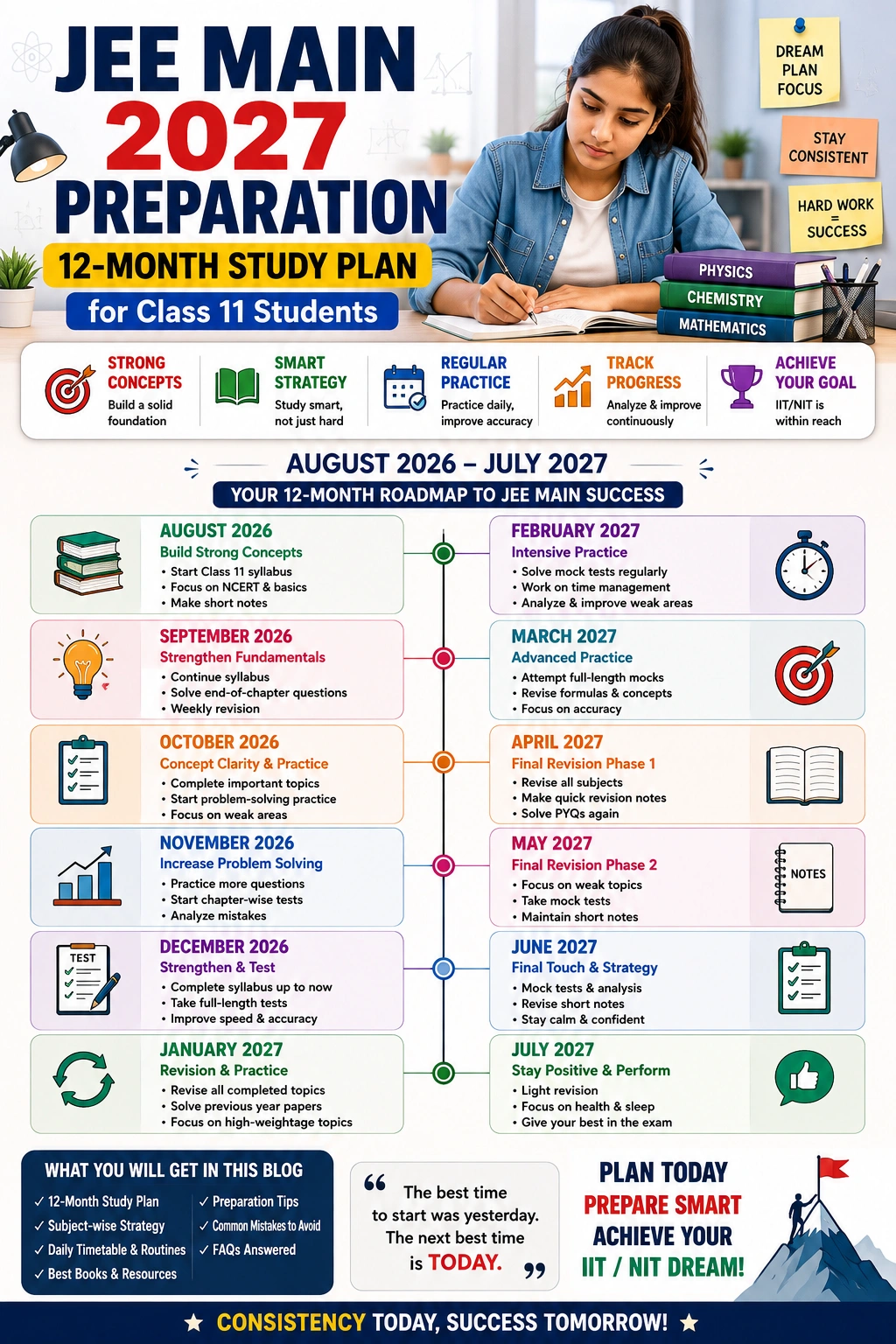
Starting JEE Main 2027 Preparation in Class 11 gives students enough time to build strong fundamentals, practice questions regularly, and revise concepts without excessive pressure.
Since many important JEE topics are introduced in Class 11, beginning early helps students understand concepts gradually and avoid last-minute stress.
A well-planned start also allows students to balance school studies and entrance exam preparation more effectively. Instead of rushing through the syllabus, they can focus on concept clarity, problem-solving skills, and consistent improvement.
Benefits of Starting Early
Students who start preparing in Class 11 often gain a significant advantage because they have more time to learn, practice, and revise.
Key Benefits:
- Strong understanding of Physics, Chemistry, and Mathematics fundamentals.
- More time to solve practice questions and previous year papers.
- Better revision opportunities before the actual exam.
- Reduced pressure during Class 12.
- Improved accuracy and problem-solving speed.
- Easier identification of weak subjects and topics.
| Benefit | Advantage |
|---|---|
| Early Start | More preparation time |
| Regular Practice | Better accuracy |
| Multiple Revisions | Strong retention |
| Lower Stress | Better focus and consistency |
A simple but consistent study routine in Class 11 is often more effective than intense preparation started at the last moment.
Common Mistakes Students Make
Many students begin their preparation with enthusiasm but make mistakes that slow their progress.
Common Mistakes to Avoid:
- Ignoring NCERT and school fundamentals.
- Using too many books and study materials.
- Focusing only on theory and not enough practice.
- Skipping regular revision.
- Avoiding difficult chapters.
- Comparing progress with friends.
- Studying without a proper timetable.
One of the biggest mistakes is trying to complete too many resources at the same time. For most students, a limited number of quality resources combined with consistent practice works far better than collecting multiple books and notes.
Another common issue is neglecting revision. Without regular revision, even well-understood concepts can be forgotten over time. A weekly review schedule can help students retain important formulas, concepts, and problem-solving techniques.
Expert Tip: Focus on consistency rather than study hours. Even 2–3 hours of focused daily self-study can produce excellent results when maintained throughout Class 11.
JEE Main 2027 Exam Overview
Before starting your JEE Main 2027 Preparation, it is important to understand how the exam is structured and what level of competition you can expect.
A clear understanding of the exam pattern helps students plan their studies more effectively and avoid wasting time on unnecessary topics.
JEE Main is conducted by the National Testing Agency (NTA) and serves as the gateway to prestigious engineering institutions such as NITs, IIITs, and other centrally funded technical institutes.
It is also the qualifying examination for students who wish to appear for JEE Advanced, which is required for admission to the Indian Institutes of Technology (IITs).
Students who begin their preparation in Class 11 have a significant advantage because they get enough time to build concepts, practice questions, and improve problem-solving skills gradually.
Exam Pattern and Subjects
The JEE Main examination evaluates a student’s understanding of concepts from Physics, Chemistry, and Mathematics based primarily on the Class 11 and Class 12 syllabus.
The exact pattern for JEE Main 2027 will be announced by NTA through the official website.
Until then, students can refer to the existing pattern as a reliable guide. Candidates should always verify the latest updates from official sources.
| Subject | Main Focus Areas |
|---|---|
| Physics | Mechanics, Electricity, Magnetism, Modern Physics, Optics |
| Chemistry | Physical Chemistry, Organic Chemistry, Inorganic Chemistry |
| Mathematics | Algebra, Calculus, Coordinate Geometry, Trigonometry, Statistics |
| Component | Details |
|---|---|
| Mode of Exam | Computer-Based Test (CBT) |
| Subjects | Physics, Chemistry, Mathematics |
| Question Type | Multiple Choice Questions (MCQs) and Numerical Value Questions |
| Duration | As notified by NTA |
| Language Options | Multiple Indian languages including English and Hindi |
Language Options Multiple Indian languages including English and Hindi.
Students often assume that JEE Main is only about memorizing formulas. In reality, the exam focuses heavily on concept application and problem-solving ability.
For example:
- Physics questions often test conceptual understanding.
- Chemistry requires both theory and application.
- Mathematics rewards speed, accuracy, and logical thinking.
Quick Preparation Insight
A strong JEE Main 2027 Study Plan should balance all three subjects. Focusing too much on one subject while neglecting others can reduce your overall score significantly.
Expected Competition Level
JEE Main is one of India’s most competitive entrance examinations.
Every year, a large number of students from different educational boards and coaching backgrounds appear for the exam.
Competition is especially intense because many students aim for:
- National Institutes of Technology (NITs)
- Indian Institutes of Information Technology (IIITs)
- Government Engineering Colleges
- Eligibility for JEE Advanced
- Other reputed engineering institutions
What Makes the Competition Tough?
1. Large Candidate Pool
- Students from across India participate.
- Many aspirants begin preparation years in advance.
2. Limited Top-Ranked Seats
- High-demand branches such as Computer Science have limited seats.
- Cut-offs are usually higher for popular institutions.
3. Strong Academic Competition
- Many candidates have strong foundations in Mathematics and Science.
- Consistent practice plays a major role in rank improvement.
The Good News for Class 11 Students
Starting early can significantly improve your chances.
Students who begin JEE Main 2027 Preparation for Class 11 Students often benefit because they can:
- Learn concepts without rushing.
- Revise multiple times.
- Practice more questions.
- Build strong fundamentals before entering Class 12.
Expert Recommendation
Instead of comparing yourself with lakhs of aspirants, focus on:
- Daily consistency
- Concept clarity
- Regular revision
- Weekly self-assessment
A student who studies consistently for two years generally performs better than someone who relies only on last-minute preparation.
JEE Main vs JEE Advanced
Many students confuse JEE Main and JEE Advanced. Although both examinations are related, they serve different purposes.
Direct Answer
JEE Main is the entrance examination for NITs, IIITs, and several engineering colleges, while JEE Advanced is the examination required for admission into IITs.
| Feature | JEE Main | JEE Advanced |
|---|---|---|
| Conducting Authority | National Testing Agency (NTA) | One of the IITs under guidance of the Joint Admission Board |
| Purpose | Admission to NITs, IIITs, and qualifying for JEE Advanced | Admission to IITs |
| Difficulty Level | Moderate to High | High to Very High |
| Eligibility | Open to eligible candidates | Only top JEE Main qualifiers can appear |
| Focus | Strong concepts and application | Deep analytical and problem-solving skills |
| Competition | Very High | Extremely High |
The best approach is to first build a strong foundation for JEE Main.
A student who develops:
- Clear concepts
- Strong calculation skills
- Good accuracy
- Regular practice habits
will naturally be in a better position to prepare for JEE Advanced later.
Common Misconception
Many students believe they must immediately start preparing for the toughest level of questions.
In reality, successful aspirants usually follow a step-by-step approach:
- Master NCERT fundamentals.
- Build conceptual understanding.
- Practice JEE Main-level questions.
- Gradually move toward advanced problem-solving.
This method creates a stronger foundation and reduces unnecessary stress during the early stages of preparation.
12-Month Study Plan for JEE Main 2027
August – October 2026 (Build Strong Concepts)
The first three months of your JEE Main 2027 Preparation journey should focus on building strong fundamentals. Many students make the mistake of rushing into difficult problems before understanding the concepts.
This often leads to confusion later.
Your goal during this phase is simple: understand the theory, master NCERT concepts, and develop a daily study routine.
Focus on completing the core Class 11 chapters being taught in school. If a concept is unclear, solve basic examples before moving to advanced questions.
Suggested Focus Areas
| Subject | Topics to Focus On |
|---|---|
| Physics | Units & Dimensions, Motion in One Dimension, Motion in Two Dimensions, Laws of Motion |
| Chemistry | Mole Concept, Atomic Structure, Chemical Bonding, Periodic Table |
| Mathematics | Sets, Relations, Functions, Trigonometry, Basic Algebra |
Mathematics Sets, Relations, Functions, Trigonometry, Basic Algebra
Study Priorities
- Attend school or coaching classes regularly.
- Read NCERT before solving advanced questions.
- Create short notes for formulas and key concepts.
- Solve basic and moderate-level questions daily.
- Maintain a separate notebook for doubts.
Weekly Target
- Physics: 4–5 hours
- Chemistry: 4–5 hours
- Mathematics: 5–6 hours
- Revision: 2–3 hours
A good rule is to spend at least 60% of your time learning concepts and 40% solving questions.
Expert Tip: If you cannot explain a topic in your own words, you probably have not understood it well enough. Try teaching the concept to a friend or writing a short summary after every chapter.
By the end of October 2026, you should have a clear understanding of the major Class 11 fundamentals and a consistent study routine.
November 2026 – January 2027 (Strengthen Problem Solving)
Once the basics are in place, the next step in your JEE Main 2027 Study Plan is improving problem-solving skills.
Many students understand concepts but struggle to apply them in numerical questions. This phase is designed to bridge that gap.
Start solving chapter-wise practice sets and previous years’ JEE Main questions related to completed topics. Do not focus only on getting answers right.
Focus on understanding the logic behind every solution.
| Subject | Topics to Focus On |
|---|---|
| Physics | Work, Power & Energy, Rotational Motion, Gravitation |
| Chemistry | Thermodynamics, Equilibrium, Redox Reactions |
| Mathematics | Quadratic Equations, Sequences & Series, Coordinate Geometry |
Problem-Solving Strategy
- Solve questions topic-wise before attempting mixed practice.
- Maintain an error notebook.
- Mark questions that take excessive time.
- Learn multiple approaches when possible.
- Revise mistakes every week.
| Subject | Questions Per Day |
|---|---|
| Physics | 15–20 |
| Chemistry | 15–20 |
| Mathematics | 20–25 |
Quality matters more than quantity. Solving 20 questions carefully is often more useful than rushing through 100 questions.
Start Using PYQs
PYQs (Previous Year Questions) help you understand:
- Question patterns
- Difficulty levels
- Frequently tested concepts
- Time-management requirements
Even if you cannot solve every PYQ, analyzing the solutions will improve your understanding significantly.
Expert Tip: Whenever you get a question wrong, identify the reason:
- Concept mistake
- Calculation mistake
- Reading mistake
- Time pressure
This simple habit can dramatically improve your accuracy over time.
February – April 2027 (Practice & Revision)
At this stage, your preparation should shift from learning new concepts to strengthening what you already know.
Students often forget topics studied months earlier. Regular revision prevents this problem and improves retention.
The objective of this phase is to consolidate your Class 11 learning and increase question-solving speed.
Revision Framework
Use a three-step revision method:
- Revise notes.
- Solve selected questions.
- Review mistakes.
This method is far more effective than repeatedly reading textbooks.
| Month | Focus |
|---|---|
| February | Physics Revision |
| March | Chemistry Revision |
| April | Mathematics Revision + Mixed Practice |
Develop Speed and Accuracy
To improve performance:
- Use timers while solving questions.
- Avoid spending too much time on a single problem.
- Learn approximation techniques where appropriate.
- Review difficult questions repeatedly.
Short Notes Strategy
Prepare one-page revision sheets containing:
- Important formulas
- Frequently used concepts
- Common mistakes
- Key shortcuts
These notes become extremely useful during later revision cycles.
Self-Assessment Checklist
By the end of April, ask yourself:
- Can I solve questions without referring to notes?
- Do I remember important formulas?
- Can I complete practice sets within time limits?
- Have I revised all completed chapters at least twice?
If the answer is yes, your JEE Main 2027 Preparation Strategy is moving in the right direction.
Expert Tip: Revision is not about rereading everything. It is about identifying weak areas and fixing them before they become major problems.
May – July 2027 (Mock Tests & Class 12 Readiness)
The final phase of this 12-month JEE Main 2027 Roadmap focuses on evaluating your progress and preparing for the transition into Class 12.
Many students enter Class 12 with unfinished Class 11 concepts. This creates unnecessary pressure later. Before starting new topics, ensure your Class 11 foundation is stable.
Begin Full-Length Mock Tests
Start taking mock tests regularly.
Initially:
- One mock test every two weeks
Later:
- One mock test every week
The purpose is not just scoring marks. It is understanding your strengths and weaknesses.
After Every Mock Test
Analyze:
- Accuracy percentage
- Time spent per section
- Weak topics
- Silly mistakes
- Unattempted questions
Test analysis is often more valuable than the test itself.
| Area | What to Check |
|---|---|
| Physics | Concept clarity |
| Chemistry | Memory-based errors |
| Mathematics | Speed and calculations |
| Overall | Time management |
Before moving fully into Class 12:
- Revise all major formulas.
- Complete pending chapters.
- Finish important practice questions.
- Update revision notes.
This will make advanced Class 12 topics easier to understand.
Summer Study Goals
During May–July:
- Complete backlog removal.
- Continue mixed-topic practice.
- Improve test-taking strategy.
- Strengthen weak subjects.
- Build a sustainable study routine for Class 12.
- What Success Looks Like by July 2027
By the end of this phase, a Class 11 student should ideally:
- Understand all major Class 11 concepts.
- Maintain organized notes.
- Solve moderate-level JEE Main questions confidently.
- Have experience with mock tests.
- Enter Class 12 with a strong academic foundation.
Expert Tip: The biggest advantage in JEE Main 2027 Preparation for Class 11 Students is consistency. A student who studies regularly for 12 months usually performs better than someone who studies intensely for a few weeks and then loses momentum.
Subject-Wise Preparation Strategy
A strong JEE Main 2027 Preparation Strategy requires a balanced approach across Physics, Chemistry, and Mathematics.
Many students spend too much time on their favorite subject and ignore weaker areas. This often creates a score gap during the exam.
The best approach is to build concepts first, practice questions regularly, and revise important topics throughout the year.
Since Class 11 introduces many new concepts, consistency matters more than study hours.
A simple rule is:
- Understand the concept.
- Solve basic questions.
- Move to application-based problems.
- Revise regularly.
- Track mistakes and improve.
The goal is not to complete the syllabus quickly but to develop problem-solving skills that will help throughout your JEE journey.
Physics Strategy
Physics is often considered one of the most challenging subjects in JEE Main because it tests both conceptual understanding and numerical problem-solving ability.
Many students make the mistake of memorizing formulas without understanding the logic behind them. In JEE Main, concepts are more important than rote learning.
Focus on Concept Clarity First
Before solving advanced problems, make sure you understand:
- Definitions
- Fundamental laws
- Derivations
- Real-life applications
For example, before solving Motion in a Straight Line questions, understand concepts such as velocity, acceleration, and displacement clearly.
| Topic | Priority Level |
|---|---|
| Units and Measurements | High |
| Motion in One Dimension | High |
| Motion in Two Dimensions | High |
| Laws of Motion | Very High |
| Work, Power and Energy | Very High |
| Rotational Motion | Very High |
| Gravitation | High |
| Mechanical Properties of Matter | Medium |
| Thermodynamics | Very High |
| Oscillations and Waves | High |
Recommended Physics Study Method
Follow this sequence:
- Read theory from NCERT.
- Study classroom or coaching notes.
- Make short notes.
- Solve solved examples.
- Practice topic-wise questions.
- Revise formulas weekly.
Physics Practice Rule
Try solving questions in three levels:
- Level 1: Basic Concept Questions
- Level 2: Numerical Problems
- Level 3: Mixed Application Questions
This gradually improves confidence and accuracy.
Expert Tip
Maintain a separate Physics formula notebook. Revise it every Sunday. Small weekly revisions prevent last-minute pressure before exams.
Chemistry Strategy
Chemistry is usually the highest-scoring subject in JEE Main when prepared systematically. It contains a mix of conceptual understanding, factual knowledge, and numerical calculations.
Many students treat Chemistry as a single subject. In reality, it should be approached as three different sections:
- Physical Chemistry
- Organic Chemistry
- Inorganic Chemistry
Each section requires a different preparation method.
Physical Chemistry Strategy
Physical Chemistry involves formulas, calculations, and numerical problem-solving.
Focus on:
- Mole Concept
- Atomic Structure
- Chemical Equilibrium
- Thermodynamics
Best approach:
- Understand theory.
- Memorize formulas.
- Solve numerical questions daily.
- Practice calculations without shortcuts initially.
Organic Chemistry Strategy
Organic Chemistry is built on concepts rather than memorization.
Key topics include:
- Basic Organic Chemistry
- Hydrocarbons
- Chemical Bonding Concepts
To strengthen Organic Chemistry:
- Understand reaction mechanisms.
- Learn electron movement.
- Create reaction summary notes.
- Revise regularly.
Students who understand “why” a reaction occurs generally perform better than those who only memorize reactions.
Inorganic Chemistry Strategy
Inorganic Chemistry requires careful reading and revision.
NCERT is extremely important for this section.
Recommended approach:
- Read NCERT line by line.
- Highlight important points.
- Create revision sheets.
- Revise frequently.
Chemistry Revision Formula
A practical revision cycle:
- Day 1: Learn concept
- Day 3: Quick revision
- Day 7: Practice questions
- Day 30: Full revision
This helps improve long-term retention.
Expert Tip
Keep separate notebooks for Organic, Physical, and Inorganic Chemistry. Mixing notes often creates confusion during revision.
Mathematics Strategy
Mathematics is a scoring subject for students who practice consistently. Unlike Chemistry, Mathematics cannot be mastered through reading alone.
The only way to improve is by solving problems regularly.
Many students understand concepts but struggle in exams because they do not practice enough questions under time limits.
| Topic | Priority Level |
|---|---|
| Sets and Relations | High |
| Functions | High |
| Trigonometry | Very High |
| Complex Numbers | High |
| Permutation and Combination | Very High |
| Binomial Theorem | High |
| Sequence and Series | Very High |
| Straight Lines | High |
| Conic Sections | High |
| Limits and Basic Calculus | Very High |
Mathematics Preparation Method
For every chapter:
- Learn formulas and concepts.
- Solve solved examples.
- Practice basic questions.
- Attempt moderate-level problems.
- Solve mixed-topic questions.
Do not move to a new chapter until you have solved enough questions from the current one.
Improve Speed and Accuracy
JEE Main is a time-bound exam. Speed matters.
To improve speed:
Solve questions using a timer.
- Learn multiple approaches to the same problem.
- Analyze mistakes after every practice session.
- Focus on accuracy before speed.
Create a Formula Revision Sheet
Maintain a one-page summary for each chapter.
Include:
- Key formulas
- Important identities
- Common mistakes
- Short tricks (only after understanding concepts)
These sheets become valuable during revision.
Expert Tip
Spend at least 30–45 minutes daily solving Mathematics questions, even on busy school days. Regular practice is more effective than solving hundreds of questions only on weekends.
Subject-Wise Study Time Allocation
The exact study time depends on your strengths and weaknesses. However, a balanced distribution for most Class 11 students is:
| Subject | Recommended Share of Study Time |
|---|---|
| Physics | 35% |
| Chemistry | 30% |
| Mathematics | 35% |
If one subject is significantly weaker, temporarily increase its share until your understanding improves.
A successful JEE Main 2027 Study Plan is not about studying one subject excessively.
Consistent progress in all three subjects creates a strong foundation for higher scores and long-term success in JEE Main 2027.
Best Books for JEE Main 2027 Preparation
Choosing the right study material is one of the most important parts of JEE Main 2027 Preparation. Many students make the mistake of collecting too many books and end up completing none of them properly.
A better approach is to start with NCERT textbooks, build strong concepts, and then use a limited number of trusted reference books for practice. Quality matters more than quantity.
The books listed below are widely used by successful JEE aspirants and are recommended by many teachers and coaching institutes.
However, students should focus on mastering a few good books rather than constantly switching resources.
Physics Books
Physics in JEE Main tests both conceptual understanding and problem-solving ability. Students should first understand the theory and then practice numerical questions regularly.
| Purpose | Book |
|---|---|
| School Concepts | NCERT Physics Class 11 |
| Concept Building | Concepts of Physics by H.C. Verma |
| Practice Questions | DC Pandey Series |
| Advanced Problem Solving | Problems in General Physics by I.E. Irodov (Selective Use) |
Suggested Study Order
- Read the NCERT chapter.
- Understand the concepts from H.C. Verma.
- Solve examples and exercises.
- Practice additional questions from DC Pandey.
- Maintain a formula notebook for revision.
Expert Tip
Many students jump directly to difficult numerical problems. Instead, focus on understanding concepts such as motion, laws of motion, work and energy, and rotational mechanics before attempting advanced questions.
Chemistry Books
Chemistry often becomes a scoring subject when studied consistently. Since the subject is divided into Physical, Organic, and Inorganic Chemistry, students should use different strategies for each section.
| Section | Recommended Books |
|---|---|
| Basic Concepts | NCERT Chemistry Class 11 |
| Physical Chemistry | O.P. Tandon |
| Organic Chemistry | Morrison & Boyd (Reference) |
| Organic Fundamentals | M.S. Chauhan |
| Inorganic Chemistry | NCERT Chemistry |
| Question Practice | Previous Year Questions |
How to Study Chemistry Effectively
For Physical Chemistry
- Focus on formulas and numerical practice.
- Solve questions regularly.
- Revise calculations frequently.
For Organic Chemistry
- Understand reaction mechanisms.
- Learn concepts instead of memorizing reactions blindly.
- Create short notes for important reactions.
For Inorganic Chemistry
- Read NCERT multiple times.
- Highlight important facts and exceptions.
- Revise regularly to improve retention.
Expert Tip
For JEE Main, NCERT plays a very important role in Chemistry, especially in Inorganic Chemistry. Many direct and concept-based questions are linked to NCERT content.
Mathematics Books
Mathematics requires continuous practice. Unlike theory-based subjects, improvement in Mathematics comes through solving a large number of quality problems.
| Purpose | Book |
|---|---|
| Basic Concepts | NCERT Mathematics Class 11 |
| Concept Learning | R.D. Sharma (Objective Sections) |
| JEE Main Practice | Cengage Mathematics Series |
| Problem Solving | Arihant Skills in Mathematics Series |
Important Areas to Focus On
Students starting their JEE Main 2027 Study Plan in Class 11 should pay special attention to:
- Sets and Functions
- Trigonometry
- Quadratic Equations
- Sequence and Series
- Coordinate Geometry
- Permutations and Combinations
- Probability
- Limits and Basic Calculus Foundations
Mathematics Study Strategy
- Practice every day, even if only for one hour.
- Maintain a notebook of mistakes.
- Revise formulas weekly.
- Solve previous year questions regularly.
- Focus on accuracy before speed.
Expert Tip
If a question takes too much time, do not immediately check the solution. Spend a few extra minutes trying different approaches. This habit improves analytical thinking and problem-solving skills.
Is NCERT Enough?
Short Answer: NCERT is essential, but for most students, NCERT alone is not sufficient for complete JEE Main preparation.
NCERT should be considered the foundation of your JEE Main 2027 Preparation Strategy.
It helps students build conceptual clarity and covers the school syllabus effectively.
However, JEE Main also tests application-based problem-solving skills that often require additional practice.
What NCERT Is Best For
- Building basic concepts
- Understanding theory
- Learning formulas and definitions
- Strengthening Inorganic Chemistry
- School examinations
Where Additional Books Help
- Advanced numerical practice
- Multiple question formats
- Speed and accuracy improvement
- Higher-level problem-solving
- Competitive exam exposure
| Stage | Resource |
|---|---|
| Step 1 | Complete NCERT thoroughly |
| Step 2 | Solve NCERT exercises |
| Step 3 | Move to one trusted reference book |
| Step 4 | Practice Previous Year Questions (PYQs) |
| Step 5 | Take regular mock tests |
Practical Recommendation
A student who studies NCERT seriously, solves previous year questions, and consistently practices from one good reference book will usually perform better than a student who collects many books but completes none.
For most Class 11 students following a JEE Main 2027 Roadmap, the ideal combination is:
- NCERT for theory and fundamentals
- H.C. Verma for Physics
- O.P. Tandon / NCERT for Chemistry
- Cengage or Arihant for Mathematics
- Previous Year Questions for exam-oriented practice
The goal is not to finish the maximum number of books.
The goal is to master the concepts, solve questions regularly, and revise consistently throughout your JEE Main 2027 Preparation journey.
Daily Study Timetable for Class 11 Students
A well-planned timetable can make JEE Main 2027 Preparation more effective and less stressful.
The goal is not to study for the maximum number of hours but to study consistently every day.
Your timetable should balance school, self-study, revision, practice questions, and rest.
The ideal schedule depends on whether you are attending regular school, coaching classes, or preparing independently.
Below are realistic study plans that Class 11 students can follow and customize according to their daily routine.
School Students
Most Class 11 students spend 6–8 hours in school. In this situation, the focus should be on daily revision and concept reinforcement rather than long study sessions.
Recommended Study Hours: 3–4 focused hours on weekdays and 6–8 hours on weekends.
| Time | Activity |
|---|---|
| 5:30 AM – 6:30 AM | Revision of previous day’s topics |
| 6:30 AM – 7:30 AM | School preparation |
| 8:00 AM – 3:00 PM | School |
| 4:00 PM – 5:00 PM | Rest and refresh |
| 5:00 PM – 6:30 PM | Physics or Mathematics practice |
| 6:30 PM – 7:00 PM | Break |
| 7:00 PM – 8:00 PM | Chemistry study |
| 8:00 PM – 9:00 PM | Dinner and relaxation |
| 9:00 PM – 10:00 PM | Revision and short notes |
| 10:00 PM | Sleep |
Weekly Strategy for School Students
- Complete school homework on time.
- Revise classroom concepts within 24 hours.
- Solve at least 15–20 quality questions daily.
- Reserve weekends for difficult chapters and additional practice.
- Keep one day every week for revision of completed topics.
Expert Tip: Many students postpone revision until exams. Revising the same day helps improve retention and reduces pressure before tests.
Coaching Students
Students enrolled in coaching institutes often receive structured guidance, assignments, and regular tests.
The challenge is not finding study material but managing it effectively.
Recommended Study Hours: 4–6 hours of self-study apart from coaching.
| Time | Activity |
|---|---|
| 5:30 AM – 6:30 AM | Revision of coaching notes |
| 6:30 AM – 7:30 AM | Daily routine |
| 8:00 AM – 2:00 PM | School |
| 3:00 PM – 7:00 PM | Coaching Classes |
| 7:00 PM – 8:00 PM | Dinner and rest |
| 8:00 PM – 9:30 PM | Coaching homework and assignments |
| 9:30 PM – 10:30 PM | Practice questions and error correction |
| 10:30 PM | Sleep |
What Coaching Students Should Focus On
- Revise coaching notes within 24 hours.
- Complete assignments before collecting new ones.
- Maintain an error notebook.
- Analyze mistakes from weekly tests.
- Avoid collecting multiple study resources.
A Common Mistake
Many students attend coaching regularly but fail to revise concepts. Learning happens during revision and practice, not only during classroom lectures.
Recommended Subject Rotation
- Monday & Thursday: Physics
- Tuesday & Friday: Mathematics
- Wednesday & Saturday: Chemistry
- Sunday: Weekly revision and test analysis
This approach keeps all three subjects active throughout the week.
Self-Study Students
Many successful candidates clear engineering entrance exams through disciplined self-study.
A strong JEE Main 2027 Self Study Plan requires consistency, quality resources, and regular practice.
Students preparing without coaching should follow the official JEE Main 2027 Syllabus, NCERT textbooks, standard reference books, and previous years’ questions.
Recommended Study Hours: 5–7 focused hours daily in addition to school.
| Time | Activity |
|---|---|
| 5:30 AM – 7:00 AM | Mathematics practice |
| 7:00 AM – 8:00 AM | Daily routine |
| 8:00 AM – 2:00 PM | School |
| 3:00 PM – 4:30 PM | Physics concepts and numericals |
| 4:30 PM – 5:00 PM | Break |
| 5:00 PM – 6:30 PM | Chemistry study |
| 6:30 PM – 7:00 PM | Break |
| 7:00 PM – 8:00 PM | Previous topics revision |
| 8:00 PM – 9:00 PM | Dinner |
| 9:00 PM – 10:00 PM | Practice questions and short notes |
Self-Study Success Checklist
- Follow one study plan consistently.
- Complete NCERT before advanced books.
- Make concise notes for quick revision.
- Track weak chapters every week.
- Solve questions daily.
- Revise regularly instead of only before tests.
Suggested Weekly Distribution
| Subject | Weekly Focus |
|---|---|
| Mathematics | 35% |
| Physics | 35% |
| Chemistry | 30% |
This distribution works well for most Class 11 students because Mathematics and Physics generally require more problem-solving time.
Expert Recommendation
For JEE Main 2027 Preparation for Class 11 Students, consistency matters more than long study sessions.
Studying 4–5 focused hours every day for a year is usually more effective than studying 10–12 hours occasionally.
Build a routine you can follow for months, not just a few weeks.
Top 7 Mistakes to Avoid During JEE Main Preparation
Many students start their JEE Main 2027 Preparation with enthusiasm but lose momentum because of avoidable mistakes.
Success in JEE Main is not only about studying hard; it is also about following the right strategy consistently.
Understanding these common mistakes early can help Class 11 students stay on track and make better use of their study time.
Ignoring NCERT
One of the biggest mistakes students make is jumping directly to advanced reference books without building a strong foundation through NCERT textbooks.
NCERT forms the base of many concepts tested in JEE Main, especially in Chemistry.
Students who skip NCERT often struggle with fundamental concepts and make unnecessary errors in problem-solving.
What to do instead:
- Complete NCERT chapters before moving to reference books.
- Read theory carefully, especially in Chemistry.
- Solve all NCERT examples and exercises.
- Revise important formulas and definitions regularly.
Expert Tip: Think of NCERT as the foundation of a building. Strong foundations make advanced learning much easier.
Too Many Books
Many students believe that collecting more books will improve their preparation. In reality, using too many resources often creates confusion and reduces productivity.
Instead of mastering one book, students keep switching between multiple sources.
This leads to incomplete preparation and weak conceptual understanding.
| Wrong Approach | Better Approach |
|---|---|
| Studying from 5–6 books for one subject | Following 1–2 trusted books consistently |
| Constantly changing resources | Sticking to a planned study material |
| Collecting books without completing them | Completing selected books thoroughly |
A limited number of quality resources is usually more effective than a large collection of unfinished books.
No Revision
Many students focus only on learning new topics and forget to revise older chapters.
As a result, concepts that seemed clear a month ago become difficult to recall during tests.
Revision is essential because the JEE Main syllabus is extensive. Without revision, retention decreases over time.
Simple Revision Strategy:
- Revise the same topic within 24 hours of studying it.
- Revise again after one week.
- Revise once more after one month.
- Maintain a formula and short-notes notebook.
Signs You Need More Revision:
- Forgetting formulas frequently.
- Making repeated mistakes in similar questions.
- Taking too long to solve familiar problems.
Regular revision strengthens memory and improves confidence during exams.
No Mock Tests
Many aspirants delay mock tests because they feel they are not fully prepared. This is a costly mistake.
Mock tests help students understand exam pressure, improve time management, and identify weak areas before the actual exam.
Benefits of Mock Tests:
- Improve speed and accuracy.
- Build exam temperament.
- Highlight weak chapters.
- Help develop question-selection skills.
Recommended Practice for Class 11 Students:
- Start with chapter-wise tests.
- Gradually move to subject-wise tests.
- Analyze mistakes after every test.
- Focus on improvement rather than scores.
A mock test is not just an assessment tool—it is a learning tool.
Poor Time Management
Many students spend excessive time on their favorite subject while neglecting others. Some also spend hours studying without a clear plan.
Poor time management often results in syllabus backlogs and unnecessary stress.
Common Time Management Problems:
- Spending too much time on difficult questions.
- Studying without a daily schedule.
- Ignoring breaks and burnout.
- Leaving revision for the last minute.
Better Time Management Practices:
- Create a realistic weekly study plan.
- Allocate time to all three subjects.
- Set small daily goals.
- Track completed tasks.
Remember, consistency beats occasional long study sessions.
Weak Notes
Many students rely entirely on textbooks and coaching material without creating personal notes.
During revision, they are forced to revisit entire chapters, which consumes valuable time.
Good notes act as a quick revision tool and help organize important information.
What Should Good JEE Notes Include?
- Important formulas
- Key concepts
- Short tricks and methods
- Frequently made mistakes
- Important reactions and exceptions
| Weak Notes | Effective Notes |
|---|---|
| Long paragraphs copied from books | Short points and keywords |
| No organization | Clear headings and sections |
| Difficult to revise quickly | Easy to scan before tests |
Short and well-structured notes become extremely useful during revision periods.
Comparing Yourself with Others
Comparison is one of the most damaging habits among JEE aspirants. Every student learns at a different pace and has different strengths and weaknesses.
Constantly comparing marks, study hours, or progress with friends can reduce confidence and increase anxiety.
Instead of comparing yourself with others, compare your current performance with your past performance.
Focus on Personal Growth:
- Track your own improvement.
- Celebrate small achievements.
- Learn from toppers without copying their routine blindly.
- Concentrate on daily progress.
A student who improves steadily over time often performs better than someone who studies inconsistently but compares constantly.
Quick Self-Check Checklist
Before ending each week, ask yourself:
- Did I complete my planned study targets?
- Did I revise what I learned this week?
- Did I take at least one test?
- Did I avoid unnecessary study resources?
- Did I maintain short notes?
- Did I manage my time effectively?
- Did I focus on my own progress instead of comparing myself with others?
Avoiding these seven mistakes can make your JEE Main 2027 Preparation Strategy more effective, improve consistency, and help you build strong habits throughout Class 11.
Final Thoughts
Consistency > Study Hours
One of the biggest misconceptions among JEE aspirants is that studying for 10–12 hours every day guarantees success. In reality, consistent study habits matter far more than long study sessions.
A student who studies with focus for 4–6 hours daily throughout the year is often better prepared than someone who studies irregularly for longer hours.
JEE Main is not a test of how many hours you sit at your desk; it is a test of how well you understand concepts and apply them under exam conditions.
For effective JEE Main 2027 Preparation, focus on:
- Following your study schedule regularly
- Completing daily learning targets
- Practicing questions consistently
- Revising previously learned topics
- Avoiding long breaks in preparation
A simple rule to remember is:
Small daily efforts, repeated consistently, create strong results over time.
Even on busy school days, try to maintain some connection with your preparation. Solving a few problems or revising formulas is better than skipping studies completely.
Revision is Key
Learning a chapter once is not enough for JEE Main. Students often understand a topic during class but forget important concepts after a few weeks if they do not revise regularly.
Revision helps:
- Strengthen memory retention
- Improve problem-solving speed
- Reduce mistakes in exams
- Build confidence before mock tests
A practical revision strategy is:
| Revision Stage | When to Revise |
|---|---|
| First Revision | Within 24–48 hours of learning |
| Second Revision | After 1 week |
| Third Revision | After 1 month |
| Final Revision | Before mock tests and exams |
While revising:
- Review formulas and key concepts
- Solve previously marked questions
- Update short notes
- Revisit weak areas
Many successful candidates follow a simple principle:
Study new topics daily, but never stop revising old ones.
Consistent revision often makes the difference between remembering a concept and forgetting it during the exam.
Focus on Fundamentals
Strong fundamentals are the foundation of successful JEE Main 2027 Preparation for Class 11 Students.
Many students rush toward advanced problems without fully understanding basic concepts. This approach usually creates confusion and weakens overall performance.
Before attempting difficult questions, make sure you can:
- Explain the concept in simple words
- Solve basic examples confidently
- Understand why a formula works
- Apply the concept in different situations
For example:
- In Physics, understand the underlying laws before solving numericals.
- In Chemistry, learn concepts before memorizing reactions.
- In Mathematics, understand the logic behind formulas rather than memorizing them blindly.
A strong foundation in Class 11 topics such as:
- Motion and Mechanics
- Chemical Bonding
- Mole Concept
- Quadratic Equations
- Trigonometry
- Sequences and Series
will make Class 12 topics much easier to understand later.
Remember:
Advanced problem-solving becomes easier when the fundamentals are strong.
Stay Healthy and Motivated
Academic success and personal well-being go hand in hand. Continuous study without proper rest can lead to fatigue, stress, and reduced concentration.
To maintain long-term performance:
- Sleep for 7–8 hours daily
- Eat balanced and nutritious meals
- Stay physically active
- Take short breaks during study sessions
- Limit unnecessary screen time
- Maintain a positive study environment
Motivation naturally rises and falls during a long preparation journey. Instead of relying on motivation alone, build disciplined study habits that keep you moving forward even on difficult days.
When you feel discouraged:
- Review your progress.
- Focus on small achievable goals.
- Talk to parents, teachers, or mentors.
- Avoid comparing yourself with other students.
- Celebrate small improvements and milestones.
Most importantly, remember that JEE preparation is a marathon, not a sprint.
Success in JEE Main 2027 comes from consistent effort, regular revision, strong fundamentals, and a healthy mindset. Stay patient, trust the process, and keep improving one day at a time.
Frequently Asked Questions (FAQs)
1: How to Prepare for JEE Main 2027 from Class 11?
Start JEE Main 2027 preparation in Class 11 by building strong concepts in Physics, Chemistry, and Mathematics, following NCERT, and practicing questions consistently throughout the year.
2: How Many Hours Should I Study in Class 11 for JEE Main 2027?
Most Class 11 students should aim for 3–5 hours of focused self-study daily, along with regular revision and problem-solving practice.
3: Can I Crack JEE Main 2027 Through Self-Study?
Yes, you can crack JEE Main 2027 through self-study if you follow a structured study plan, use quality resources, and practice mock tests regularly.
4: What Is a Good Study Plan for JEE Main 2027?
A good JEE Main 2027 study plan includes concept building, daily practice, weekly revision, and regular mock tests spread over 12 months.
5: What Are the Best Books for JEE Main 2027 Preparation?
NCERT books, H.C. Verma for Physics, O.P. Tandon for Chemistry, and R.D. Sharma for Mathematics are among the most recommended books for JEE Main 2027 preparation.