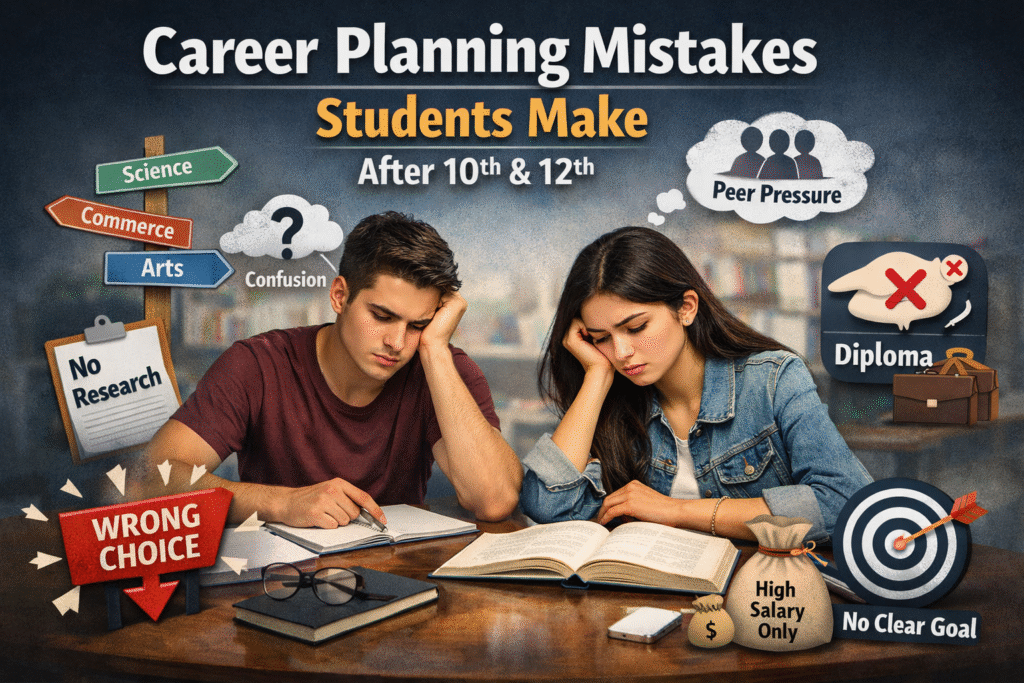
Why Career Planning Matters After 10th & 12th
The decisions students make after Class 10th and Class 12th often play a significant role in shaping their academic journey, career opportunities, and future lifestyle.
While no single decision determines an entire career, the stream, course, or educational path chosen at this stage can influence the skills students develop, the opportunities they can access, and the direction they take in the coming years.
Many students make these decisions without proper research or self-assessment.
As a result, they may later realize that their chosen path does not align with their interests, strengths, or long-term goals.
This is why understanding common Career Planning Mistakes After 10th & 12th is essential before making any major educational decision.
Effective career planning is not about predicting the future perfectly.
It is about making informed choices based on available information, personal interests, abilities, and emerging opportunities.
When students take time to evaluate their options carefully, they are better prepared to build a career that is both fulfilling and sustainable.
The Importance of Early Career Decisions
The choices made after 10th and 12th standard often serve as the foundation for future educational and professional opportunities.
While career paths can change over time, the stream selected after Class 10th and the course chosen after Class 12th can influence the range of options available later.
For example, a student who chooses the Science stream may have access to engineering, medical, research, and technology-related fields.
Similarly, students opting for Commerce can explore careers in finance, accounting, management, economics, and entrepreneurship.
Arts and Humanities students can pursue opportunities in law, design, journalism, psychology, civil services, education, and many other growing sectors.
Making these decisions without proper understanding can lead to unnecessary challenges.
Students may find themselves studying subjects they do not enjoy or pursuing courses that do not match their career aspirations. This can affect motivation, academic performance, and confidence.
Early career decisions also influence skill development. Students who identify their interests and goals early can focus on acquiring relevant knowledge, certifications, internships, and practical experience.
Over time, these efforts can provide a significant advantage in college admissions, job opportunities, and career growth.
The objective is not to choose a perfect career path immediately but to make thoughtful decisions that keep future opportunities open rather than limiting them.
Changing Career Trends in India
The career landscape in India is evolving rapidly. A decade ago, many students primarily focused on traditional professions such as engineering, medicine, government jobs, teaching, and accounting.
While these careers continue to offer excellent opportunities, today’s job market includes many new and emerging fields that did not exist at the same scale in the past.
Advancements in technology, artificial intelligence, digital transformation, and globalization have created demand for professionals in areas such as:
- Data Science and Analytics
- Artificial Intelligence and Machine Learning
- Cybersecurity
- Digital Marketing
- Content Creation and Media
- UI/UX Design
- Cloud Computing
- Financial Technology (FinTech)
- E-commerce and Online Business
- Environmental and Sustainability Careers
Employers are increasingly looking for candidates who possess practical skills, adaptability, critical thinking, and problem-solving abilities.
Academic qualifications remain important, but skills and real-world experience are becoming equally valuable.
As industries continue to evolve, students must understand that career planning is no longer limited to choosing a stream or degree.
It also involves staying informed about industry trends, learning new skills, and preparing for future job market requirements.
One of the common Career Planning Mistakes After 10th & 12th is relying on outdated career information while ignoring emerging opportunities.
Students who stay updated with changing trends can make more informed decisions and position themselves for future success.
Why Students Often Feel Confused
Career confusion is a common experience among students after 10th and 12th. With countless courses, colleges, entrance exams, and career options available today, it is natural to feel uncertain about the right path.
One major reason for this confusion is a lack of awareness. Many students know only a limited number of career options because they are rarely exposed to the full range of opportunities available in today’s world.
As a result, they may choose careers based on incomplete information.
Peer pressure also plays a significant role. Students often compare themselves with friends or follow the choices made by their classmates without considering their own interests and abilities.
Just because a particular stream or course is suitable for one student does not mean it will be the right fit for everyone.
Family expectations can create additional pressure. Parents naturally want the best for their children, but sometimes students feel compelled to pursue certain careers even when their interests lie elsewhere.
This mismatch can lead to dissatisfaction and reduced motivation over time.
Another challenge is information overload. The internet provides access to unlimited educational and career-related content.
While this can be helpful, it can also overwhelm students with conflicting advice, making decision-making even more difficult.
The key to overcoming confusion is a structured approach. Students should focus on understanding their interests, strengths, values, and long-term goals while researching career options thoroughly.
Seeking guidance from teachers, mentors, career counselors, and industry professionals can also provide valuable clarity.
Career planning does not require having every answer immediately. It requires gathering the right information, evaluating options carefully, and making informed decisions based on personal goals rather than external pressure.
By doing so, students can avoid many of the common mistakes that affect career growth later in life.
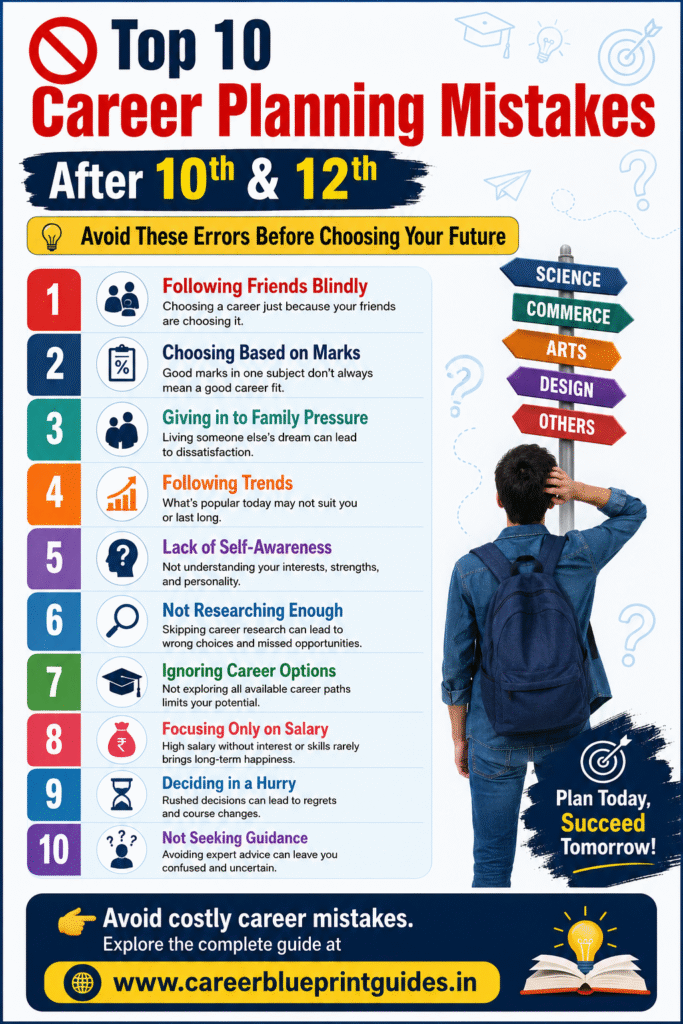
Top Career Planning Mistakes After 10th & 12th
Choosing a stream after Class 10 or selecting a course after Class 12 can significantly influence a student’s academic and professional journey.
However, many students make decisions based on incomplete information, external pressure, or temporary trends.
Understanding these common mistakes can help students make more informed choices and build a stronger foundation for their future.
Choosing a Career Based on Friends’ Decisions
One of the most common career planning mistakes after 10th and 12th is blindly following friends.
Many students choose a stream, course, or college simply because their classmates are making the same choice.
While studying with friends may seem comfortable, career decisions should be based on individual interests, strengths, and long-term goals.
Every student has different abilities, learning preferences, and aspirations. What works well for one person may not necessarily be the right path for another.
Before making any decision, students should evaluate their own interests and future objectives rather than relying on peer influence.
Selecting a Stream Without Understanding Future Opportunities
Many students choose Science, Commerce, or Arts based on common assumptions rather than factual information. This often leads to confusion and regret later.
Some students believe that Science is the only stream with good career prospects, while others underestimate the opportunities available in Commerce and Arts.
In reality, every stream offers a wide range of career options when aligned with a student’s interests and skills.
Before selecting a stream, students should research potential career paths, higher education opportunities, required skills, and future industry demand.
A well-informed decision can prevent unnecessary stress and course changes later.
Ignoring Personal Interests and Strengths
A successful career is often built on a combination of interest, aptitude, and consistent effort. Unfortunately, many students ignore their natural strengths when making academic choices.
For example, a student who enjoys designing, writing, or communication may struggle if pushed into a highly technical field solely because it is considered prestigious.
Similarly, a student with strong analytical abilities may thrive in fields related to finance, engineering, or data analysis.
Self-assessment is an important step in career planning. Students should identify subjects they enjoy, activities they excel at, and skills they naturally possess before making major academic decisions.
Making Decisions Based Only on Marks
Marks are important, but they should not be the sole factor in choosing a career path.
Many students assume that high marks automatically mean they should pursue Science, while lower marks limit their options. This mindset can be misleading because academic scores do not always reflect a person’s talents, interests, creativity, communication skills, or practical abilities.
A career decision should consider multiple factors, including personal interests, strengths, future opportunities, and industry trends.
Focusing only on marks may result in choosing a field that does not align with a student’s long-term goals.
Following Family Pressure Without Research
Parents and family members often want the best for their children, but sometimes career recommendations are based on outdated information or personal preferences rather than current market realities.
Students may feel pressured to pursue specific professions such as engineering, medicine, government jobs, or family businesses without fully understanding whether those fields match their interests and capabilities.
A balanced approach is essential. Students should respectfully discuss their goals with family members while also conducting independent research about career opportunities, educational requirements, and future growth prospects. Open communication can help bridge the gap between expectations and aspirations.
Not Exploring Different Career Options
Another major career planning mistake after 10th and 12th is limiting awareness to only a few traditional professions.
Many students are familiar with careers such as doctor, engineer, teacher, lawyer, or accountant, but may not know about emerging opportunities in fields like digital marketing, cybersecurity, data science, artificial intelligence, animation, content creation, UX design, environmental science, and many others.
The modern job market offers diverse career pathways across industries. Exploring different options allows students to discover opportunities that align better with their interests and future goals.
Choosing Courses Only Because They Are Popular
Popularity does not guarantee suitability.
Every year, certain courses become trending due to social media discussions, high salary reports, or public perception.
As a result, many students enroll in these programs without understanding the actual curriculum, required skills, or career outcomes.
A course that is highly popular today may not be the right fit for every student. Instead of following trends, students should evaluate whether a course aligns with their strengths, interests, and long-term career vision.
Making decisions based on popularity alone can lead to dissatisfaction and reduced motivation during higher education.
Ignoring Skill Development
Academic qualifications remain important, but employers increasingly value practical skills alongside degrees.
Many students focus entirely on examinations while neglecting skills such as communication, problem-solving, teamwork, leadership, digital literacy, and critical thinking.
This can create challenges when competing for internships, jobs, or higher education opportunities.
Students should actively participate in workshops, online courses, projects, internships, and extracurricular activities to develop industry-relevant skills. Continuous learning can significantly improve career readiness and future employability.
Not Researching College and Course Quality
Selecting the right college is just as important as selecting the right course.
Some students choose institutions based solely on advertisements, location, or peer recommendations without evaluating important factors such as accreditation, faculty expertise, curriculum quality, infrastructure, industry exposure, and placement records.
A well-researched decision can help students access better learning opportunities, professional networks, internships, and career support services.
Before taking admission, students should compare multiple colleges and verify information through official sources whenever possible.
Delaying Career Planning Until the Last Moment
Many students postpone career planning until admission deadlines are approaching. This often results in rushed decisions, limited options, and unnecessary stress.
Effective career planning requires time for self-assessment, research, entrance exam preparation, college selection, and financial planning.
Students who begin exploring their options early are generally better prepared to make confident and informed decisions.
Starting the planning process well in advance allows students to evaluate multiple pathways and choose the one that best supports their future aspirations.
Key Takeaway
Most career planning mistakes after 10th and 12th occur when decisions are made without adequate research, self-awareness, or long-term thinking.
By understanding personal strengths, exploring career options, developing relevant skills, and gathering accurate information, students can make choices that support both academic success and long-term career growth.
Career Planning Mistakes Specific to Class 10th Students
Class 10th is a major turning point in a student’s academic journey. One of the first important decisions students make is choosing a stream for Classes 11 and 12.
While this decision may seem overwhelming, many students make choices based on incomplete information, social pressure, or common misconceptions.
Understanding these mistakes can help students make more informed decisions and build a stronger foundation for their future careers.
Selecting Science Without Knowing the Curriculum
One of the most common career planning mistakes after 10th is choosing the Science stream simply because it is considered prestigious or because friends and relatives recommend it.
Many students assume that Science automatically offers better career opportunities, without fully understanding what the stream actually involves.
Science is an excellent choice for students who enjoy subjects such as Physics, Chemistry, Biology, and Mathematics. However, it also comes with a rigorous academic structure that requires strong analytical skills, problem-solving abilities, and consistent effort.
Understanding Academic Workload and Expectations
Before selecting Science, students should understand the level of commitment required.
The syllabus becomes significantly more detailed compared to Class 10th, and concepts often demand deeper understanding rather than memorization.
Students pursuing Science may need to:
- Spend more time on conceptual learning and practical applications.
- Prepare for competitive examinations such as JEE, NEET, CUET, and other entrance tests.
- Manage school studies along with additional coaching or self-study.
- Develop strong time-management and problem-solving skills.
Choosing Science without considering these factors can lead to academic stress, loss of confidence, and dissatisfaction.
Instead of selecting a stream based solely on its reputation, students should evaluate whether their interests, strengths, and long-term goals align with the curriculum.
Underestimating Commerce and Arts Streams
Another common mistake is assuming that Commerce and Arts offer fewer opportunities compared to Science.
This misconception causes many students to overlook streams that may actually match their interests and career aspirations more effectively.
In today’s rapidly evolving job market, success depends more on skills, expertise, and continuous learning than on the stream chosen in Class 11.
Opportunities Available Across All Streams
Both Commerce and Arts provide access to diverse and rewarding career paths.
Commerce Stream Opportunities:
- Chartered Accountant (CA)
- Company Secretary (CS)
- Cost and Management Accountant (CMA)
- Banking and Finance
- Investment Analysis
- Business Management
- Entrepreneurship
- Digital Marketing
- Financial Planning
Arts/Humanities Stream Opportunities:
- Civil Services
- Law
- Psychology
- Journalism and Mass Communication
- Design and Creative Fields
- International Relations
- Social Work
- Teaching and Education
- Public Administration
Many high-growth industries actively recruit professionals from Commerce and Arts backgrounds.
Therefore, students should focus on identifying their interests and strengths rather than ranking streams based on outdated perceptions.
Choosing a Stream Based on Social Status
In many families and communities, certain streams are viewed as more prestigious than others.
As a result, some students choose a particular stream not because they genuinely enjoy it, but because they believe it will earn greater social recognition.
This approach can create long-term challenges. A student who selects a stream primarily for social approval may struggle academically and lose motivation over time.
Breaking Common Stereotypes
Several stereotypes continue to influence stream selection decisions:
- “Science students are more intelligent.”
- “Commerce is only for students who cannot handle Science.”
- “Arts has limited career opportunities.”
- “Only doctors and engineers are successful.”
These beliefs do not reflect today’s career landscape.
Modern industries value diverse skills, creativity, communication abilities, business understanding, critical thinking, and technical expertise.
Successful professionals come from every educational background, including Science, Commerce, and Arts.
Students should remember that no stream is inherently superior to another. The best stream is the one that aligns with an individual’s interests, abilities, learning style, and future career goals.
Choosing a stream based on personal aptitude rather than social expectations increases the likelihood of academic success, career satisfaction, and long-term professional growth.
Key Takeaway for Class 10th Students
The stream you choose after Class 10th can influence your future academic and career options, but it should never be selected based on pressure, popularity, or misconceptions.
Take time to understand each stream, explore career opportunities, assess your strengths, and make a decision that supports your long-term goals.
A well-informed choice today can open the door to a more fulfilling and successful future.
Career Planning Mistakes Specific to Class 12th Students
Completing Class 12th is a major milestone, but it also brings one of the most important decisions of a student’s life—choosing the right career path.
At this stage, many students feel pressure from family, friends, society, and even social media. As a result, they often make decisions without proper planning or research.
While there are countless opportunities available today, a lack of awareness can lead students toward choices that may not align with their interests, skills, or long-term goals.
Understanding these common career planning mistakes can help students make informed decisions and build a stronger foundation for their future.
Choosing a Degree Without Career Research
One of the most common career planning mistakes after 12th is selecting a degree simply because it sounds popular, prestigious, or familiar.
Many students choose courses based on what their friends are doing, what relatives suggest, or what is currently trending, without understanding the actual career opportunities associated with the degree.
A degree is not just a qualification; it is often the first step toward a professional career.
Therefore, students should evaluate where a particular course can lead them in the future before making a final decision.
Looking Beyond Course Names
The name of a degree does not always reveal its career potential. For example, two courses may appear similar but can lead to completely different career paths, skill requirements, and job opportunities.
Before choosing any degree, students should research:
- The subjects included in the curriculum
- Potential career opportunities after graduation
- Required skills for success in the field
- Industry demand and future growth prospects
- Higher education and specialization options
For instance, a student interested in technology may discover opportunities not only in Computer Science but also in Data Science, Artificial Intelligence,
Cybersecurity, Cloud Computing, and Business Analytics. Without proper research, such options can easily be overlooked.
Taking time to understand the long-term value of a degree can prevent future dissatisfaction and help students make career decisions with greater confidence.
Ignoring Entrance Exams and Admission Deadlines
Another major mistake students make after Class 12th is focusing only on board examinations while ignoring entrance exams, application deadlines, and admission procedures.
Many reputed colleges and universities have separate entrance tests that significantly influence admissions.
Unfortunately, some students begin preparing for these exams too late or miss important deadlines altogether, limiting their available options.
Importance of Planning Ahead
Effective career planning requires students to stay informed about important admission-related activities well in advance.
Students should create a timeline that includes:
- Entrance examination dates
- Application submission deadlines
- Counseling schedules
- Document verification processes
- Scholarship application deadlines
- College admission rounds
Planning ahead offers several advantages. It reduces last-minute stress, provides sufficient preparation time, and increases the chances of securing admission to preferred institutions.
Whether students are aiming for engineering, medical, management, law, design, or other professional courses, keeping track of admission requirements can make a significant difference in their educational journey.
Focusing Only on Traditional Career Paths
For many years, careers such as Engineering, Medicine, Government Services, Chartered Accountancy, and Law have been considered the most popular choices among students.
While these professions continue to offer excellent opportunities, focusing exclusively on traditional career paths can limit a student’s perspective.
The modern job market has evolved rapidly due to technological advancements, digital transformation, and changing industry demands.
As a result, several new-age professions have emerged, offering exciting and rewarding career opportunities.
Exploring New-Age Professions
Students should explore a wide range of career options instead of restricting themselves to conventional choices. New-age careers often combine creativity, technology, innovation, and specialized skills.
Some growing career fields include:
- Artificial Intelligence and Machine Learning
- Data Science and Analytics
- Digital Marketing
- Cybersecurity
- UI/UX Design
- Content Creation
- Animation and Gaming
- Financial Technology (FinTech)
- Cloud Computing
- Renewable Energy
- Healthcare Technology
- E-commerce Management
Exploring these fields does not mean abandoning traditional careers. Rather, it allows students to understand the full spectrum of opportunities available and identify careers that align with their interests and strengths.
A successful career is not determined by how popular a profession is. It depends on how well a student’s abilities, interests, and long-term goals match the chosen path.
By remaining open to emerging opportunities and continuously learning about industry trends, students can make smarter career decisions and avoid some of the most common career planning mistakes after 12th.
Choosing a career after Class 12th should never be a rushed decision.
Careful research, timely planning, and an open mindset can help students avoid costly mistakes and move confidently toward a fulfilling and successful future.
How to Avoid Career Planning Mistakes After 10th & 12th
Making the right career decision after 10th or 12th does not require predicting the future perfectly. What matters most is having a clear understanding of yourself, exploring available opportunities, and making informed decisions based on facts rather than assumptions.
Many students make choices based on pressure, trends, or incomplete information, only to realize later that their selected path does not align with their goals.
Fortunately, most career planning mistakes after 10th & 12th can be avoided through proper research, self-awareness, and strategic planning.
The following steps can help students make smarter career decisions and build a strong foundation for future success.
Understand Your Interests and Aptitude
One of the biggest reasons students end up dissatisfied with their academic or career choices is that they never take the time to understand their own interests and strengths.
Before choosing a stream, course, or career path, ask yourself some important questions:
- Which subjects do I genuinely enjoy studying?
- What activities keep me engaged for long periods?
- What are my strongest skills and abilities?
- Do I prefer analytical, creative, technical, or people-oriented work?
A career that matches your interests and natural aptitude is often easier to pursue and more rewarding in the long run.
Practical Self-Analysis Methods
Students can gain better clarity about themselves through:
- Maintaining a journal of interests and achievements
- Reviewing subjects they consistently perform well in
- Taking aptitude and career assessment tests
- Seeking feedback from teachers, mentors, and parents
- Participating in extracurricular activities to discover hidden talents
Self-awareness is the first step toward avoiding career planning mistakes after 10th & 12th because it helps students make choices based on their unique strengths rather than external influences.
Research Career Opportunities Thoroughly
Many students select a stream or degree without fully understanding the career opportunities associated with it. As a result, they may discover years later that the field does not offer the work environment, growth opportunities, or job roles they expected.
Thorough research helps students gain a realistic picture of different careers before making important decisions.
Reliable Sources of Career Information
When researching careers, consider using trustworthy sources such as:
- Official university websites
- Government education portals
- Industry reports and employment statistics
- Career counseling platforms
- Professional networking websites
- Educational webinars and career fairs
Students should gather information about:
- Job roles and responsibilities
- Required qualifications
- Salary expectations
- Career growth potential
- Future demand in the industry
The more informed your decision is, the lower the chances of making a costly career mistake.
Learn About Future Industry Trends
The job market is changing rapidly due to technological advancements, automation, and evolving business needs. Careers that are in demand today may look very different in the coming years.
Instead of focusing only on current opportunities, students should also understand emerging trends and future career possibilities.
High-Growth Career Sectors to Watch
Some industries expected to continue growing include:
Technology and Artificial Intelligence
- AI and Machine Learning
- Data Analytics
- Cybersecurity
- Software Development
- Cloud Computing
Healthcare and Life Sciences
- Medical Technology
- Healthcare Management
- Biotechnology
- Public Health
Finance and Business
- Financial Analysis
- FinTech
- Investment Management
- Digital Banking
Creative and Digital Careers
- Digital Marketing
- Content Creation
- Graphic Design
- Animation
- User Experience (UX) Design
Understanding industry trends helps students prepare for future opportunities rather than relying solely on traditional career paths.
Speak with Professionals and Mentors
Students often make career decisions based on assumptions rather than real-world insights. Speaking with people who are already working in a particular field can provide valuable clarity.
Professionals can share practical information about:
- Daily work responsibilities
- Industry challenges
- Required skills
- Career progression
- Future opportunities
This firsthand knowledge can help students determine whether a particular career aligns with their interests and expectations.
Benefits of Career Guidance
Career guidance from experienced mentors can help students:
- Identify suitable career options
- Avoid common misconceptions
- Set realistic expectations
- Understand educational pathways
- Build confidence in decision-making
Whether it comes from teachers, career counselors, alumni, or industry experts, guidance from experienced individuals can significantly reduce the risk of making uninformed career choices.
Develop Relevant Skills Early
Academic qualifications remain important, but employers increasingly value practical skills alongside formal education.
Students who start developing relevant skills early often gain a competitive advantage during college admissions, internships, and job placements.
Ways to Build Career-Relevant Skills
Students can enhance their profiles by:
- Completing online certification courses
- Participating in workshops and training programs
- Taking internships and project-based learning opportunities
- Volunteering for community initiatives
- Learning communication and presentation skills
- Developing digital and technical competencies
Skill development not only improves employability but also helps students discover areas they genuinely enjoy working in.
Create a Long-Term Career Roadmap
One common mistake students make is focusing only on the next immediate step, such as selecting a stream after 10th or a degree after 12th.
Effective career planning requires looking beyond short-term decisions.
A long-term roadmap helps students connect their present choices with future goals.
Short-Term and Long-Term Career Planning
Short-Term Planning
- Selecting the right stream after 10th
- Choosing suitable subjects
- Preparing for entrance examinations
- Building foundational skills
- Exploring career options
Long-Term Planning
- Choosing a relevant degree or professional course
- Developing industry-specific expertise
- Gaining practical experience
- Building a professional network
- Preparing for future career advancement
Career plans do not need to be rigid. They can evolve as students gain new experiences and insights. However, having a roadmap provides direction and reduces confusion during important decision-making stages.
By understanding personal strengths, researching opportunities, staying informed about industry trends, seeking expert guidance, developing practical skills, and planning ahead, students can avoid many of the common career planning mistakes after 10th & 12th and make more confident decisions about their future.
Career Planning Checklist for Students
Making career decisions after 10th or 12th can feel overwhelming. With so many streams, courses, colleges, and career options available, students often struggle to identify the right path. A structured approach can help reduce confusion and prevent costly mistakes later.
Before making any major academic or career decision, it is important to evaluate your interests, strengths, future goals, and available opportunities.
The following career planning checklist can help students make informed choices and avoid common career planning mistakes after 10th and 12th.
Before Choosing a Stream After 10th
Selecting a stream after Class 10 is one of the first major career decisions a student makes. Whether you are considering Science, Commerce, or Arts, the choice should be based on careful evaluation rather than assumptions or external pressure.
Key Questions to Ask Yourself
1. Which subjects do I genuinely enjoy studying?
Your interest in a subject often determines how motivated you will remain during higher studies. Choosing a stream based on personal interest can improve both academic performance and long-term career satisfaction.
2. What are my academic strengths?
Take an honest look at the subjects where you consistently perform well. Strong performance often indicates aptitude and can provide valuable clues about suitable career directions.
3. What career fields interest me the most?
You do not need to have a complete career plan at this stage, but having a general idea can be helpful. For example, careers in engineering, medicine, finance, design, law, media, or public services may require different educational pathways.
4. Am I choosing a stream because of social pressure?
Many students select a stream simply because their friends are choosing it or because it is perceived as more prestigious. This is one of the most common career planning mistakes after 10th. Your decision should reflect your own goals and abilities.
5. Have I researched future opportunities in this stream?
Every stream offers diverse career options. Understanding the educational requirements, career scope, and future opportunities can help you make a more informed decision.
6. Have I discussed my options with knowledgeable mentors?
Teachers, career counselors, and experienced professionals can provide valuable insights that may help you understand the advantages and challenges of different streams.
7. Before Selecting a Course After 12th,
After completing Class 12, students often face an even wider range of choices. Selecting the right course is important because it influences future employment opportunities, skill development, and career growth.
Important Factors to Evaluate
1. Does the course align with my career goals?
Before enrolling in any degree or diploma program, understand how it connects to your desired career path. Avoid choosing a course solely because it is popular or trending.
2. What skills will I gain from this course?
Modern employers value practical skills as much as academic qualifications. Review the curriculum carefully and identify whether the course helps develop industry-relevant competencies.
3. What are the future career opportunities?
Research the industries and job roles associated with the course. Consider factors such as demand, salary potential, career progression, and future growth prospects.
4. Is the course recognized and respected in the industry?
Accreditation, university reputation, and industry recognition can influence future opportunities. Ensure that the course is offered by a credible institution.
5. What are the total costs involved?
Apart from tuition fees, consider expenses such as accommodation, books, transportation, examination fees, and other educational costs.
6. Are there opportunities for internships and practical exposure?
Internships, projects, workshops, and industry collaborations can significantly improve employability and help students gain real-world experience.
7. Have I explored alternative options?
Do not limit yourself to one course simply because it is familiar. Compare multiple options before making a final decision.
Before Taking Admission
Even after selecting a course and institution, students should complete a final verification process before confirming admission. This step can help prevent future regrets and ensure that the chosen path aligns with long-term goals.
Final Verification Checklist
- Verify college accreditation and approvals
Confirm that the institution is recognized by the appropriate educational authorities and regulatory bodies.
- Review the course curriculum carefully
Understand what subjects will be taught, the learning outcomes, and how the curriculum aligns with industry requirements.
- Check placement records and career support services
Explore previous placement statistics, internship opportunities, career guidance services, and industry partnerships.
- Evaluate faculty quality and learning resources
Experienced faculty members, laboratories, libraries, and digital learning resources contribute significantly to the quality of education.
- Compare multiple colleges before finalizing
Do not make a decision based on advertisements alone. Compare institutions based on academics, infrastructure, affordability, and student outcomes.
- Understand admission policies and fee structures
Read all terms and conditions carefully, including refund policies, scholarship opportunities, and payment schedules.
- Consider location and living arrangements
If you plan to study away from home, evaluate accommodation options, safety, transportation, and overall living expenses.
- Discuss the decision with trusted mentors and family members
A final discussion with parents, teachers, or career counselors can help identify any overlooked factors before admission is confirmed.
Final Thoughts
Successful career planning is not about choosing the most popular stream, course, or college.
It is about making informed decisions that align with your interests, strengths, and long-term aspirations. By following a structured checklist at every stage, students can avoid many common career planning mistakes after 10th and 12th and build a stronger foundation for future success.
Conclusion
Choosing a stream after 10th or selecting a course after 12th is an important milestone, but it does not have to be a stressful or rushed decision.
Many students make choices based on peer pressure, popular trends, incomplete information, or short-term thinking. These mistakes can lead to confusion, dissatisfaction, and the need to change direction later.
The good news is that most career planning mistakes can be avoided with proper research, self-awareness, and a clear understanding of future opportunities. Instead of focusing only on marks, societal expectations, or what others are doing, students should take the time to explore their interests, strengths, skills, and long-term goals.
A well-planned career path does not guarantee instant success, but it does increase the chances of making informed decisions that align with personal aspirations and market realities.
Make Informed Career Decisions
When evaluating your options after 10th or 12th, remember some of the most common mistakes students make:
- Choosing a stream or course simply because friends are selecting it.
- Following family or societal pressure without proper research.
- Making decisions based only on marks or popularity.
- Ignoring personal interests, aptitude, and strengths.
- Overlooking emerging career opportunities and industry trends.
- Neglecting skill development alongside academic education.
- Failing to research colleges, courses, and career outcomes.
- Waiting until the last moment to make important career decisions.
Avoiding these errors can help you build a stronger foundation for your future. Every student has unique abilities and ambitions, which means there is no single “best” career path for everyone. The right choice is the one that matches your interests, capabilities, and long-term objectives.
Focus on Growth, Skills, and Long-Term Success
Career planning should not be viewed as a one-time decision. The professional world is constantly evolving, and the most successful individuals are those who continue learning, adapting, and developing new skills throughout their lives.
Students should focus on building strong communication skills, problem-solving abilities, digital literacy, critical thinking, and practical knowledge alongside their academic qualifications. These skills are valuable across industries and can significantly improve career prospects in the future.
Parents also play an important role in this journey. Instead of comparing children with others or encouraging decisions based solely on prestige, parents can support their children by helping them explore different career options and make informed choices.
Whether you are a student who has just completed Class 10th or Class 12th, remember that a successful career is built through careful planning, continuous learning, and consistent effort.
By avoiding common career planning mistakes after 10th and 12th, you can move forward with greater confidence and create a path that supports both personal satisfaction and long-term professional success.