Why Career Confusion Is So Common After 10th and 12th
Career confusion does not happen because students are incapable or careless.
It happens because the system demands big decisions at a very early stage, without providing structured guidance.
Below are the most common and real reasons behind this confusion.
Too Many Choices, Too Little Guidance
Today’s students have more options than ever before—Science, Commerce, Arts, vocational courses, diploma programs, skill-based certifications, government exams, private careers, and even international pathways.
While options are good, unfiltered options create confusion.
Most schools focus only on completing the syllabus, not explaining where a subject actually leads.
Students know exam names, but not career outcomes.
Without a clear roadmap, they randomly select streams and later feel stuck.
Choices without guidance often turn into pressure instead of opportunity.
Marks, Pressure & Social Expectations
Marks still dominate career decisions in most Indian families.
High marks push students toward Science, average marks toward Commerce, and low marks toward Arts—often without considering interest or aptitude.
This creates immense pressure on students to “fit into a stream” rather than build a career.
Parents usually want security, society wants status, and relatives want comparison.
In this noise, the student’s own voice gets lost. Career confusion grows when decisions are driven by fear—“log kya kahenge”—instead of clarity.
Lack of Career Awareness at the Right Age
Most students are only aware of a few popular careers—Doctor, Engineer, CA, Government Job Only.
They rarely know about emerging fields, skill-based careers, hybrid roles, or multiple entry-exit options now allowed under NEP.
Career awareness should start before choosing subjects, not after failing or feeling stuck.
When students don’t know what exists, they choose blindly.
This gap between potential and awareness is the biggest cause of long-term career confusion after 10th and 12th.
Career Confusion in 2026 – What Students Must Understand
Career confusion in 2026 is very different from what students faced a decade ago.
Earlier, career paths were limited and predictable.
Today, opportunities are wider—but so is uncertainty. Students and parents must understand that the education system has already changed, but career thinking often hasn’t.
The biggest mistake students make is planning their future using old rules in a new system.
Marks alone are no longer the deciding factor, and degrees alone are no longer guarantees.
The National Education Policy (NEP 2020) has introduced flexibility, skill integration, and multiple pathways—but only those who understand this can use it effectively.
Career clarity in 2026 comes from awareness, planning, and adaptability, not blind competition.
Students must learn how education, skills, and real-world exposure connect together. Without this understanding, career confusion after 10th and 12th becomes even deeper.
Let’s break down what has actually changed—and why old career thinking no longer works.
How NEP 2020 Has Changed Career Planning
NEP 2020 has transformed career planning from a single-track system into a flexible journey.
Students are no longer forced into rigid subject combinations.
They can now choose flexible subjects, even mixing Science, Commerce, and Arts based on interest and career goals.
The focus has shifted toward skill-based learning, internships, vocational exposure, and practical understanding—starting as early as school level. Education is no longer only about textbooks and marks.
One of the biggest changes is multiple entry–exit options in higher education.
This means students can pause, switch, or upgrade their education without “wasting years.” In 2026, smart students plan careers that allow growth and correction—not one-time risky decisions.
Why Old Career Thinking No Longer Works
Earlier, a degree almost guaranteed a job. That equation is now broken. Degree ≠ Job is the new reality. Thousands of graduates today remain unemployed—not because they lack education, but because they lack Relevant Skills and planning.
In 2026, career stability comes from skills + strategy + adaptability.
Employers value what you can do, not just what Certificate you hold. Students who plan early—aligning education with skills, internships, and real exposure—build stronger careers.
Holding onto old career thinking only increases confusion. Updating your mindset is the first step toward clarity.
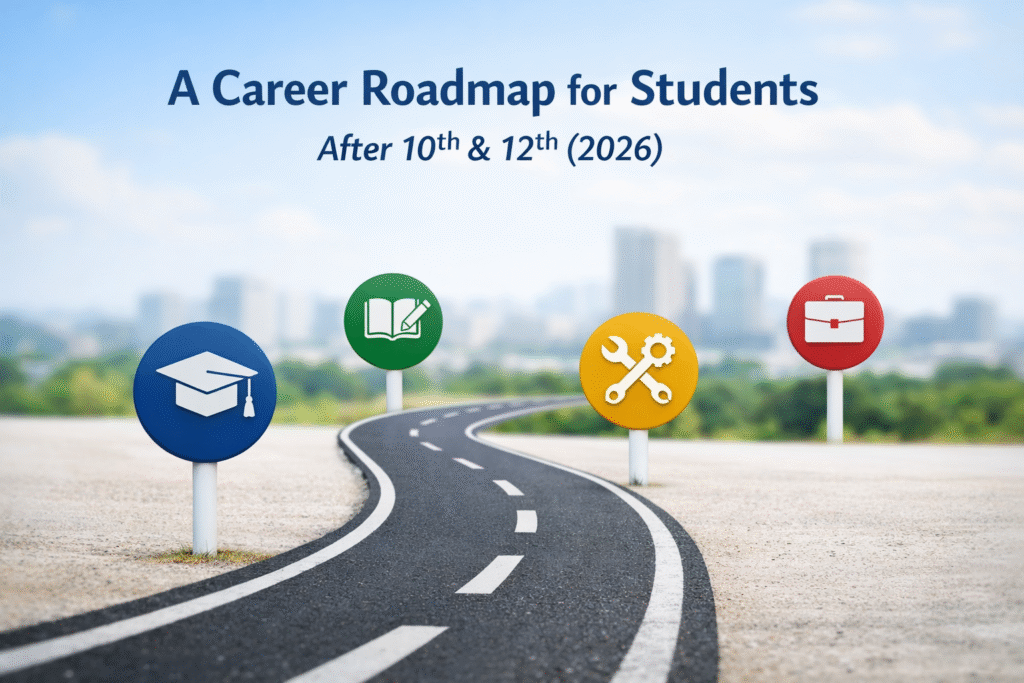
Career Roadmap After 10th – Making the Right Foundation
Class 10th is not the end of childhood—it is the starting point of career shaping. Yet, this is the stage where most career confusion quietly begins.
The decisions taken after 10th often decide what options remain open after 12th and beyond.
A strong career roadmap after 10th does not mean choosing the “best” stream. It means choosing the right foundation—one that matches a student’s interest, aptitude, and long-term direction.
When the foundation is wrong, students struggle later, even if they work hard.
In 2026, students have more flexibility than ever, but flexibility without clarity leads to confusion.
The key is understanding streams, skills, and future pathways together, not in isolation. Parents and students must stop treating Class 10th decisions as social choices and start treating them as strategic career planning steps.
Let’s understand how to do this correctly.
Stream Selection Based on Interest and Aptitude
Science, Commerce, and Arts are three different paths, not three levels of success.
There is no hierarchy—only suitability. A student who understands concepts, enjoys analysis, or loves experimentation may do well in Science.
One who enjoys numbers, business, or economics may flourish in Commerce. Creative thinkers, communicators, and analytical minds often excel in Arts and humanities.
Choosing a stream only because of marks, peer pressure, or fear of society creates long-term dissatisfaction.
Stream selection should be based on interest + aptitude + career awareness, not on comparison. The right stream makes learning easier and career planning clearer.
Skill-Based & Vocational Options After 10th
Not every successful career begins with a traditional degree.
Programs under NSQF, ITI, and MSME Technology Centres focus on practical skills, industry relevance, and employability.
These options are ideal for students who prefer hands-on learning, technical skills, or early earning opportunities.
With NEP 2020 supporting skill education, vocational paths are no longer “second choices”—they are smart choices when aligned with aptitude and long-term growth.
Common Mistakes Students Make After 10th
The most common mistake after 10th is blind stream selection—choosing Science, Commerce, or Arts without understanding where it leads. Another major error is ignoring future pathways.
Students often ask, “Which stream should I take?” instead of “What career options will this stream open after 12th?”
Without mapping the next steps, students feel stuck later. Career clarity after 10th comes from thinking two steps ahead, not one.
Career Roadmap After 12th – Courses, Exams & Career Direction
After Class 12th, career confusion often becomes more intense.
Unlike after 10th, students now face high-stakes decisions—college admissions, competitive exams, career commitments, and financial investment.
One wrong move at this stage can cost years, money, and confidence.
The biggest challenge after 12th is not lack of options, but lack of direction.
Students choose courses without understanding outcomes, prepare for exams without backup plans, or rush into jobs without thinking long term. In 2026, smart career planning after 12th means aligning education, exams, and employability into one clear roadmap.
Parents and students must shift their focus from “Which course is best?” to “Which path fits the student’s ability, interest, and future goals?” Let’s break this down step by step.
Higher Education Options After 12th
After 12th, students can choose from a wide range of UG courses and professional paths—Engineering, Medical, Law, Management, Science, Commerce, Arts, Design, Media, and many interdisciplinary programs introduced under NEP 2020.
Choosing a course should not be based on trends or peer choices.
Each UG course leads to different career ecosystems—some demand higher studies, some require skill layering, and some open direct job opportunities.
Understanding what comes after graduation is as important as selecting the graduation course itself. A clear education plan reduces career confusion later.
Competitive Exams & Government Career Paths
Many students after 12th aim for competitive exams such as Engineering (JEE), Medical (NEET), Defence services, and Civil Services. These paths offer prestige and stability, but they also demand long-term commitment, discipline, and backup planning.
Not clearing an exam does not mean failure—but preparing without a second plan creates stress.
Students should evaluate aptitude, preparation time, and alternative pathways before committing fully. Government careers reward patience and consistency, but only when approached with clarity, not pressure.
Job-Oriented Courses vs Long-Term Career Planning
Job-oriented courses make sense when students need early employment, financial support, or practical exposure.
Short-term courses, diplomas, and skill programs can provide immediate entry into the workforce.
However, when a career demands depth, leadership, or specialization, education matters more than speed.
The key is balance—choosing jobs when needed, and education when it builds long-term growth. Career success in 2026 comes from planned progression, not rushed decisions.
How to Overcome Career Confusion – A Practical Career Planning Framework
Career confusion does not disappear by motivation, random advice, or last-minute decisions.
It reduces only when students follow a structured career planning framework.
Most students fail not because they lack talent, but because they never follow a clear process.
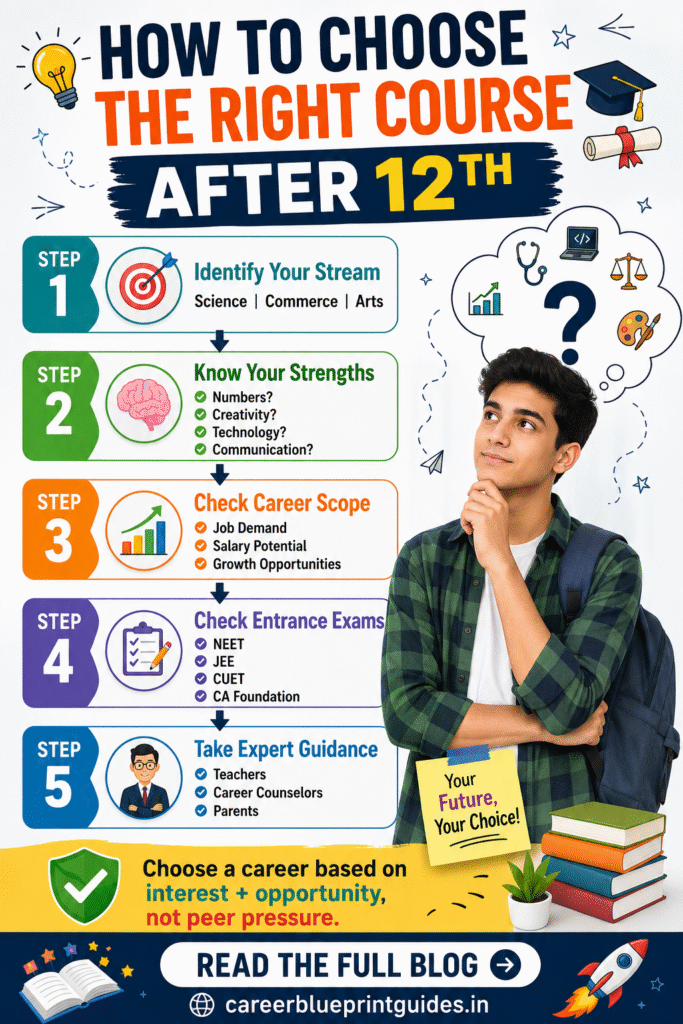
The most effective way to overcome career confusion after 10th or 12th is to answer three simple questions in the right order:
What suits me? How does it work? When should I act?
This framework focuses on clarity first, options second, and action last. It works for students from all backgrounds—academic, average, or skill-oriented—and helps parents participate constructively instead of emotionally.
Let’s break this framework into three practical steps.
Step 1 – Self-Assessment (Interest, Ability, Reality)
The first step is honest self-assessment. Students must understand what they enjoy (interest), what they can do well (ability), and what is realistically possible considering marks, finances, and time (reality).
Ignoring any one of these creates confusion later. Career clarity begins when students stop copying others and start understanding themselves.
Step 2 – Career Awareness & Future Scope
Once self-awareness is clear, the next step is career awareness.
Students should explore multiple careers linked to their strengths—not just popular options.
Understanding future scope, skill demand, education requirements, and growth potential helps avoid dead-end choices. Awareness turns confusion into informed decision-making.
Step 3 – Planning With Clear Short & Long-Term Goals
The final step is structured planning. Short-term goals focus on subjects, exams, skills, and internships. Long-term goals define where the student wants to be in 5–10 years.
When planning answers what to do now and why, career confusion naturally reduces. Clear timelines create confidence and direction.
Role of Parents in Reducing Career Confusion
Parents play a crucial role in either reducing or increasing career confusion.
Most parents want the best for their children, but good intentions can sometimes turn into pressure. The difference lies in guidance versus control.
Guidance means helping children explore options, understand consequences, and think long term.
Pressure means forcing decisions based on marks, social status, or fear of uncertainty. In 2026, careers are no longer one-dimensional, and children need support—not comparisons.
Parents can reduce career confusion by encouraging informed decision-making.
This includes discussing interests, strengths, realistic opportunities, and backup plans instead of focusing only on “safe” careers.
Asking the right questions is more powerful than giving ready-made answers.
Open discussion creates confidence. Exposure to real careers—through interactions, internships, career talks, or practical learning—helps students connect education with reality.
When parents participate as partners in planning rather than decision-makers, students feel secure and responsible.
A supportive environment at home does not guarantee Instant Success, but it significantly reduces regret, stress, and confusion. Career clarity grows best where understanding replaces pressure.
Why a Structured Career Roadmap Is Better Than Random Decisions
Most career confusion comes from random, one-time decisions—choosing a stream because of marks, a course because friends chose it, or a job because it was immediately available.
Careers, however, are not single events; they are long-term journeys that evolve over time.
A structured career roadmap treats career planning as a process, not a gamble. It connects self-understanding, education choices, skill development, and future opportunities into one clear direction.
Instead of reacting to situations, students act with awareness.
Documented guidance—whether in the form of a roadmap, framework, or career guide—helps students and parents see the bigger picture.
It answers what to do now, why it matters, and what comes next.
When students follow a roadmap, confusion reduces, anxiety lowers, and regret becomes rare. Clear planning builds confidence, even when paths change.
In today’s dynamic education system, structure is not restriction—it is freedom with direction.
Career confusion after 10th and 12th is not a weakness—it is a natural stage in a rapidly changing education and career landscape. Students do not need panic, comparison, or rushed decisions; they need time, clarity, and the right guidance.
With proper self-understanding, awareness of options, and structured planning, every student can move forward with confidence.
Careers are not built in one decision, but through thoughtful steps taken at the right time.
When planning replaces pressure, confusion turns into direction, and fear turns into focus. Parents and students who invest in clarity today save years of regret tomorrow.
Choose your career by Choice, not by Chance.